The Shift from Robotaxis to Commercial Delivery
While consumer-facing robotaxis from Waymo and Zoox frequently dominate automotive headlines, the most immediate and scalable commercial applications of autonomous driving technology are occurring in the delivery sector. Autonomous delivery vehicles (ADVs) bypass the complexities of human passenger interaction, allowing developers to focus purely on cargo security, route optimization, and predictable operational design domains (ODDs). This technology deep dive tracks the development, hardware specifications, and deployment strategies of the three most prominent ADV platforms currently reshaping logistics: the Nuro R3 for last-mile, the Gatik ISO box truck for middle-mile, and the Einride T-Pod for heavy-duty freight.
Nuro R3: The Last-Mile Specialist
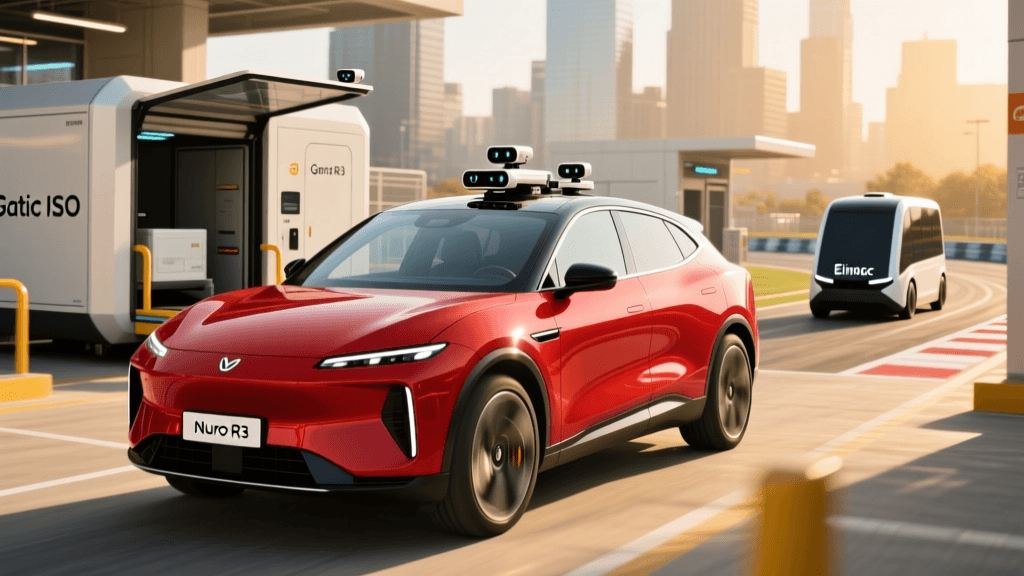
Nuro has positioned itself as the definitive leader in neighborhood and last-mile delivery. The Nuro R3, the company's third-generation production vehicle, is engineered specifically for local commerce, grocery delivery, and pharmacy fulfillment. Unlike retrofitted passenger vehicles, the R3 is a ground-up, purpose-built pod with no steering wheel or pedals, maximizing cargo space while minimizing the vehicle's physical footprint.
Technical Specifications and Hardware
- Payload Capacity: 190 kg (420 lbs) of cargo, roughly equivalent to 24 standard grocery bags.
- Dimensions: Compact footprint designed to navigate narrow suburban streets and fit into standard parking spaces.
- Sensor Suite: The R3 utilizes a proprietary fusion stack featuring 12 high-resolution cameras, 5 solid-state LiDAR units, and 4D imaging radar. This redundancy ensures reliable object detection in adverse weather conditions, a critical requirement for year-round grocery delivery.
- Compute Architecture: Powered by a customized, high-performance compute platform capable of processing over 1,000 TOPS (Tera Operations Per Second) for real-time path planning.
- Cost Target: Nuro aims to produce the R3 at scale for under $50,000 per unit, making it economically viable for widespread fleet deployment compared to $150,000+ robotaxi conversions.
Nuro's deployment strategy heavily relies on securing exemptions from the National Highway Traffic Safety Administration (NHTSA). Because the R3 lacks traditional human controls, it requires special permission to operate on public roads. The company has successfully navigated these NHTSA AV Safety Guidelines to launch commercial operations in select Texas and California markets.
Gatik: Dominating the Middle-Mile B2B Corridor
While Nuro focuses on the final few miles to the consumer's doorstep, Gatik targets the highly lucrative "middle-mile" B2B logistics market. Gatik's primary operational model involves moving goods from dark stores, micro-fulfillment centers, and distribution hubs to retail storefronts. By operating on fixed, repeatable routes, Gatik significantly reduces the edge-case complexity that plagues open-domain robotaxis.
Technical Specifications and Hardware
- Vehicle Platform: Class 3 to Class 6 light and medium-duty box trucks (e.g., Isuzu and Freightliner chassis).
- Payload Capacity: Up to 10,886 kg (24,000 lbs) depending on the chassis configuration.
- Sensor Suite: Gatik employs a robust, multi-modal sensor array including long-range automotive-grade LiDAR, high-dynamic-range cameras, and redundant radar systems. The LiDAR placement is optimized for highway speeds and merging, rather than low-speed neighborhood navigation.
- Compute Architecture: Utilizing Nvidia Drive Orin and proprietary compute boxes, Gatik's trucks process vast amounts of sensor data to handle high-speed lane changes and highway on-ramps safely.
- Teleoperation Ratio: Gatik boasts an industry-leading low teleoperation intervention rate, often going weeks on specific fixed routes without requiring remote human takeover.
Gatik's partnership with major retailers like Walmart and Loblaws has allowed them to accumulate millions of real-world commercial miles. Their focus on fixed routes allows for high-definition mapping and predictive AI modeling, making their middle-mile solution highly scalable across North America.
Einride T-Pod: Heavy-Duty Hub-to-Hub Freight
Swedish-based Einride takes a radically different approach by targeting heavy-duty, long-haul, and hub-to-hub freight. The Einride T-Pod and their newer Autonomous Electric Trucks (AET) are designed without a driver's cab. This cab-less design not only reduces the vehicle's weight and aerodynamic drag but also fundamentally shifts the cost structure of freight transport by eliminating the need for a human driver on board.
Technical Specifications and Hardware
- Vehicle Platform: Class 8 heavy-duty electric semi-trucks.
- Payload Capacity: Up to 15 metric tons (approx. 33,000 lbs) of standard freight pallets.
- Range and Battery: Modular battery configurations offering ranges between 120 to 180 miles per charge, optimized for hub-to-hub routes where charging infrastructure can be centralized.
- Remote Teleoperation: Einride relies heavily on its proprietary Remote Operations Center. A single remote operator can monitor and, when necessary, control multiple T-Pods simultaneously, intervening only during complex maneuvers or system faults.
Einride's deployment has expanded from closed facilities and private roads in Sweden to public road pilots in the United States, particularly in Texas and the Southeast. Their software platform, Einride Saga, acts as the central nervous system, orchestrating fleet routing, charging schedules, and freight matching.
Technology Comparison Matrix
To understand how these platforms fit into the broader supply chain, fleet operators must evaluate their distinct technical and operational parameters. The following table summarizes the core specifications of the Nuro R3, Gatik ISO, and Einride T-Pod.
| Feature | Nuro R3 (Last-Mile) | Gatik Box Truck (Middle-Mile) | Einride T-Pod (Heavy Freight) |
|---|---|---|---|
| Primary Use Case | Grocery, pharmacy, local retail | Distribution center to retail store | Port to warehouse, hub-to-hub |
| Payload Capacity | 420 lbs (190 kg) | Up to 24,000 lbs (10,886 kg) | Up to 33,000 lbs (15,000 kg) |
| Operating Speed | Up to 45 mph | Up to 70 mph (Highway capable) | Up to 65 mph |
| Human Cab/Controls | None (Pod design) | Retained (Safety driver present during scaling) | None (Cab-less design) |
| LiDAR Configuration | 5x Solid-state (360° low speed) | Long-range roof/bumper mount | Long-range + side blind-spot |
| Estimated Unit Cost | < $50,000 (at scale) | $150,000 - $200,000 (retrofit) | $250,000+ (Heavy EV chassis) |
Sensor and Compute Architecture Breakdown
The fundamental difference between passenger robotaxis and commercial ADVs lies in the sensor prioritization. Robotaxis must prioritize pedestrian detection, complex urban intersections, and passenger comfort (smooth braking). Autonomous delivery vehicles, particularly middle-mile and heavy freight platforms, prioritize long-range object detection, high-speed lane tracking, and cargo stability.
For vehicles like the Gatik box truck and Einride T-Pod, stopping distances at highway speeds require LiDAR sensors capable of detecting stationary obstacles at 250+ meters. This is why the industry has largely standardized around high-performance, long-range LiDAR paired with 4D imaging radar. 4D radar is particularly vital for freight, as it can penetrate heavy rain and fog—conditions that would typically blind camera-only systems and force a freight truck to pull over, disrupting supply chain timelines.
On the compute side, the shift toward centralized architectures using platforms like the Nvidia Drive Orin allows developers to run complex neural networks for perception and planning simultaneously. The Orin system-on-a-chip (SoC) delivers 254 TOPS, providing the necessary headroom to process 10+ high-resolution camera feeds and multiple LiDAR point clouds without latency.
Regulatory Tracker and FMVSS Exemptions
Deployment speed in the ADV sector is currently bottlenecked more by regulation than by technology. The Federal Motor Vehicle Safety Standards (FMVSS) were written with human drivers in mind, mandating steering wheels, mirrors, and brake pedals. Purpose-built pods like the Nuro R3 and Einride T-Pod inherently violate these standards.
To operate legally, companies must apply for FMVSS exemptions through the U.S. Department of Transportation and NHTSA. Nuro made history by securing the first-ever FMVSS exemption for a fully driverless delivery vehicle, allowing them to deploy the R2 and subsequently the R3. However, the exemption process is slow, highly scrutinized, and limits the number of vehicles a company can deploy annually. Fleet operators tracking this space must monitor NHTSA exemption dockets closely, as regulatory approval is the true leading indicator of a company's ability to scale its hardware.
Actionable Advice for Fleet Operators and Investors
For logistics managers, 3PL (third-party logistics) providers, and automotive investors looking to integrate or fund autonomous delivery tech, consider the following actionable metrics:
- Evaluate the Teleoperation Ratio: Do not just look at "driverless" miles. Ask vendors for their teleoperation intervention rate per 1,000 miles. A low intervention rate (e.g., less than 1 per 10,000 miles) indicates a mature software stack capable of true economic viability.
- Assess the ODD Rigidity: Middle-mile routes (Gatik) offer the fastest ROI because the ODD is fixed. If your fleet operates on highly variable, unmapped routes, current ADV tech will struggle. Stick to hub-to-hub or dark-store-to-store implementations first.
- Factor in Infrastructure Costs: The vehicle cost is only half the equation. Einride's electric T-Pods require massive depot charging infrastructure. Nuro's R3 requires secure, climate-controlled staging areas at grocery stores. Always model the total cost of ownership (TCO) including facility retrofitting.
- Monitor Hardware Degradation: Delivery vehicles operate 12-18 hours a day, 6 days a week. Sensor calibration drift and compute thermal throttling are real issues. Ensure the vendor provides a clear SLA on hardware maintenance, sensor cleaning systems, and edge-compute cooling.
The autonomous delivery sector is rapidly moving from proof-of-concept pilots to revenue-generating commercial deployments. By understanding the distinct hardware architectures and operational domains of Nuro, Gatik, and Einride, stakeholders can make informed decisions on where to allocate capital and how to future-proof their supply chains.