The Promise vs. The Reality of All-Weather Autonomous Driving
The autonomous vehicle industry has made remarkable strides over the last decade, transitioning from closed-track prototypes to commercial robotaxi services operating in complex urban environments. Companies like Waymo and Zoox have successfully deployed fully driverless fleets in cities like Phoenix, San Francisco, and Las Vegas. However, as the industry shifts from proof-of-concept to mass commercialization, a formidable barrier remains: the weather. While human drivers intuitively adjust their speed, wiper usage, and following distance in adverse conditions, autonomous vehicles (AVs) must rely on a delicate suite of sensors that are highly susceptible to environmental degradation. Understanding robotaxi weather limitations is critical for evaluating the future trends and true service reliability of the autonomous mobility sector.
According to data tracked by the National Highway Traffic Safety Administration (NHTSA), environmental factors play a significant role in the operational design domain (ODD) of automated driving systems. When weather conditions exceed a vehicle's ODD, the system must either safely pull over or rely on remote teleoperations, both of which severely impact fleet utilization rates and unit economics. As we look toward the future of smart mobility, overcoming these meteorological hurdles is the next great frontier for AV engineers.
How Specific Weather Conditions Degrade AV Sensors
To understand service reliability, we must first examine the physics of how weather interacts with the three primary sensor modalities: LiDAR, cameras, and radar. Each technology has distinct vulnerabilities that can compound during severe weather events.
LiDAR and the Scattering Effect
Light Detection and Ranging (LiDAR) is the cornerstone of most Level 4 robotaxi architectures, providing high-resolution, 3D point clouds of the vehicle's surroundings. However, LiDAR relies on near-infrared laser pulses. In heavy rain or dense fog, these laser pulses strike water droplets or ice crystals and scatter back to the receiver. This creates "noise" or false positives, making the software perceive a wall of obstacles where there is only empty air. In dense fog, a LiDAR system with a nominal range of 200 meters may see its effective range reduced to under 50 meters, forcing the robotaxi to reduce speed drastically or halt entirely.
Camera Saturation and Occlusion
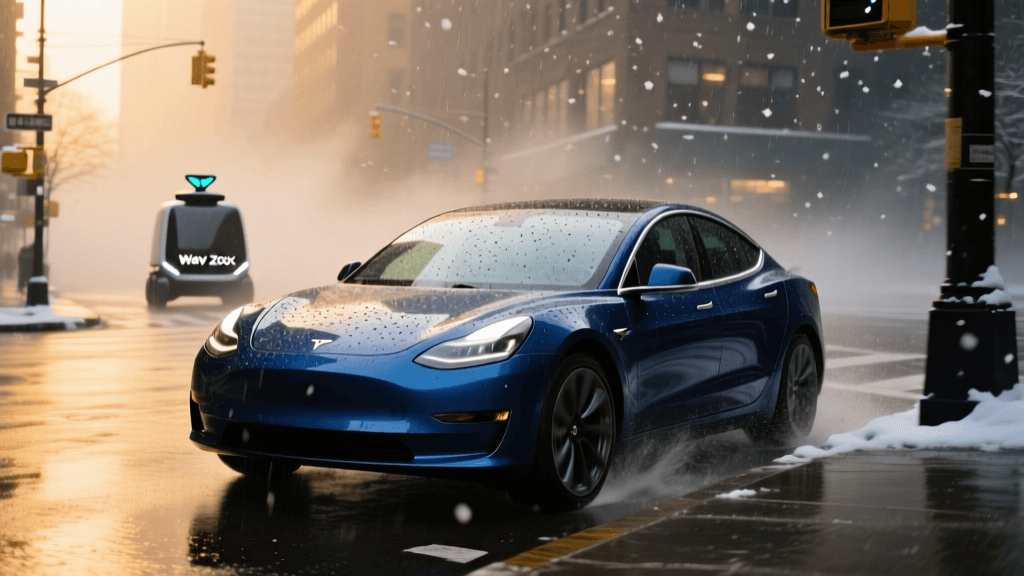
Cameras are essential for reading traffic lights, interpreting construction signs, and detecting lane markings. Yet, they are entirely dependent on ambient light and clear lenses. Heavy rain can physically occlude the lens, while "sun strike"—direct sunlight hitting the camera at a low angle—can completely saturate the image sensor, blinding the AI to pedestrians or stopped vehicles. Furthermore, snow and slush kicked up by preceding vehicles can coat camera housings in seconds, requiring sophisticated mechanical cleaning systems or hydrophobic coatings to maintain visibility.
Radar's Blind Spots
Radio Detection and Ranging (Radar) is traditionally the most weather-resilient sensor, as radio waves easily penetrate rain, fog, and snow. However, radar lacks the angular resolution of LiDAR and struggles with static object classification. In heavy snow, radar can experience "multipath" errors, where signals bounce off snowbanks and guardrails, creating ghost objects. Additionally, radar cannot read traffic lights or interpret the color of a construction barrel, meaning it cannot operate independently without camera or LiDAR fusion.
City-by-City Weather Reliability Profiles
Robotaxi reliability is not a universal metric; it is highly dependent on the local climate. Fleet operators must dynamically geofence areas based on real-time meteorological data.
- Phoenix, Arizona (Waymo): While Phoenix avoids snow, it faces extreme heat and monsoon season. Temperatures exceeding 110°F (43°C) require advanced liquid cooling for onboard compute racks to prevent thermal throttling. Furthermore, sudden "haboobs" (dust storms) can blind LiDAR and cameras similarly to heavy fog, forcing temporary service suspensions.
- San Francisco, California (Waymo, Cruise legacy): San Francisco presents a unique challenge with its famous marine layer fog and steep, winding hills. Wet leaves on steep inclines can cause wheel slip, confusing the vehicle's localization algorithms. The fog heavily degrades LiDAR range, requiring the AV to rely more heavily on high-definition mapping and radar.
- Detroit, Michigan (Testing Grounds): Snow and ice represent the ultimate test. Snow completely obscures lane markings, forcing the AV to rely on 3D localization rather than visual lane-keeping. Furthermore, road salt and brine can corrode exposed sensor housings and create a persistent, opaque film on camera lenses that automated sprayers struggle to remove.
Fleet Reliability Analysis: Sensor Suites and Strategies
Different manufacturers have adopted varying hardware philosophies to combat weather limitations. Below is a comparison of how leading platforms approach environmental resilience.
| Company / Platform | Primary Sensor Suite | Weather Geofencing Strategy | Known Limitations |
|---|---|---|---|
| Waymo (6th Gen) | Custom LiDAR, 29 Cameras, 6 Radars | Dynamic ODD adjustment; slows down in rain, halts in severe flooding. | High hardware cost; LiDAR still struggles in heavy marine fog. |
| Zoox (Purpose-Built) | Symmetrical LiDAR, Cameras, Radar | Redundant sensor pods on all 4 corners; aggressive automated cleaning. | Unique form factor limits high-speed highway driving in crosswinds. |
| Tesla (FSD v12) | Vision-Only (8 Cameras), No LiDAR | Relies on neural net inference; no strict geofencing but high variance. | Severe rain and sun glare cause phantom braking and vision occlusion. |
| Baidu Apollo (6th Gen) | LiDAR, Cameras, 4D Imaging Radar | Heavy V2X (Vehicle-to-Everything) infrastructure reliance in China. | Requires smart-city infrastructure updates to maintain reliability in snow. |
For a deeper look into how these sensor configurations impact real-world safety outcomes, the Waymo Safety Data portal provides extensive transparency on how their fleet handles edge cases, including adverse weather disengagements and collision avoidance metrics. Additionally, research from the Insurance Institute for Highway Safety (IIHS) highlights that while ADAS and AV systems are improving, their performance consistency drops noticeably when lane markings are obscured by water or snow.
The Economic Impact of Weather-Induced Downtime
From an industry outlook perspective, weather limitations are not just a safety issue; they are a massive bottleneck for profitability. The unit economics of a robotaxi rely on the vehicle being in revenue-generating motion for as many hours as possible. When a sudden downpour hits, and the fleet's confidence score drops below a safe threshold, vehicles are programmed to execute a Minimal Risk Condition (MRC) maneuver—usually pulling over to the side of the road.
This triggers a teleoperation event. A remote human operator must assess the situation via the vehicle's cameras and either guide the car through the hazard or authorize it to remain parked. Teleoperation costs can exceed $15 to $25 per intervention when factoring in labor, latency infrastructure, and lost revenue. If a fleet of 500 vehicles in San Francisco encounters a surprise fog bank, the resulting cascade of teleoperation requests can overwhelm remote assistance centers, leading to widespread service outages and frustrated consumers. Until AVs can confidently navigate moderate weather without human-in-the-loop validation, fleet utilization during winter months or rainy seasons will remain a significant drag on profit margins.
Future Trends: Overcoming the Weather Barrier
The industry is not standing still. Several emerging technologies are poised to drastically improve robotaxi weather reliability over the next three to five years.
4D Imaging Radar
Traditional radar provides range and velocity, but 4D imaging radar adds elevation and a dense point cloud similar to LiDAR. Companies like Arbe Robotics and Oculii are developing AI-enhanced radar that can "see" through heavy rain, fog, and snow with near-perfect clarity. While currently expensive (around $1,000 to $1,500 per module), economies of scale are expected to push costs below $300 by 2027, making it a standard redundancy for Level 4 fleets.
Advanced Sensor Cleaning and Hydrophobics
Mechanical wipers are insufficient for the dozens of sensors on a modern robotaxi. The future lies in ultrasonic vibration cleaning, high-pressure air jets, and nano-scale hydrophobic coatings that cause water to bead and roll off camera lenses instantly, maintaining optical clarity even in torrential rain.
V2X and Smart Infrastructure
Vehicle-to-Everything (V2X) communication allows the robotaxi to receive data from smart traffic lights and road sensors. If a fog bank obscures a pedestrian crossing, a smart intersection can broadcast the pedestrian's location directly to the AV's computer, bypassing the need for optical sensors entirely.
Actionable Advice for Robotaxi Riders and Fleet Managers
As the technology matures, both consumers and fleet operators must adapt to the current realities of weather-impacted autonomous driving.
For Riders:
- Check the App's Weather Alerts: Robotaxi apps (like Waymo One) will often display banners indicating reduced service areas or longer wait times during rain. Plan for a 15-to-20-minute buffer during adverse weather.
- Understand Geofencing Shifts: During heavy rain, AVs may avoid routes with known flooding risks or complex, unmarked construction zones. Be prepared for your drop-off location to be moved a block or two away to a safer, well-lit, and clearly mapped curb.
- Have a Backup Plan: In cities prone to sudden flash floods or heavy snow, always have a traditional rideshare app (Uber/Lyft) installed as a fallback, as robotaxi fleets may undergo total network pauses for safety.
For Fleet Managers:
- Invest in Predictive Meteorological AI: Integrate hyper-local weather APIs that predict micro-climate changes (like a sudden fog bank rolling over a specific bridge) 30 minutes in advance, allowing the fleet to pre-emptively reposition vehicles to clearer zones.
- Optimize Teleoperation Ratios: During winter months or monsoon seasons, increase the ratio of remote operators to active vehicles. A standard 1:15 ratio may need to shift to 1:5 during severe weather to prevent queue bottlenecks and ensure rapid MRC resolution.
- Schedule Aggressive Sensor Maintenance: Road salt and urban grime build up micro-scratches on sensor housings, which scatter light and worsen LiDAR performance. Implement weekly polishing and recalibration routines for fleets operating in harsh climates.
Ultimately, the transition to all-weather robotaxi reliability will not happen overnight. It requires a symphony of better hardware, smarter AI filtering, and adaptive city infrastructure. Until then, understanding these limitations is the key to setting realistic expectations for the future of autonomous transportation.