The Evolution of Autonomous Last-Mile Delivery
The last-mile delivery sector is undergoing a seismic shift, transitioning from human-driven vans to a diverse ecosystem of autonomous delivery vehicles (ADVs). As e-commerce and quick-commerce (q-commerce) demand faster, cheaper fulfillment, logistics companies and tech startups are deploying everything from sidewalk rovers to road-going pods. This technology deep dive tracks the current state of autonomous delivery development, analyzing the sensor suites, edge computing architectures, and deployment metrics that are defining the industry in 2024 and beyond.
Unlike robotaxis, which must navigate the high-speed unpredictability of urban traffic with human passengers inside, ADVs operate in highly constrained Operational Design Domains (ODDs). This distinction has allowed companies like Starship Technologies, Nuro, and Coco to bypass some of the steepest regulatory hurdles, focusing instead on unit economics, hardware durability, and edge AI efficiency.
Technology Deep Dive: Sensor Suites and Edge Computing
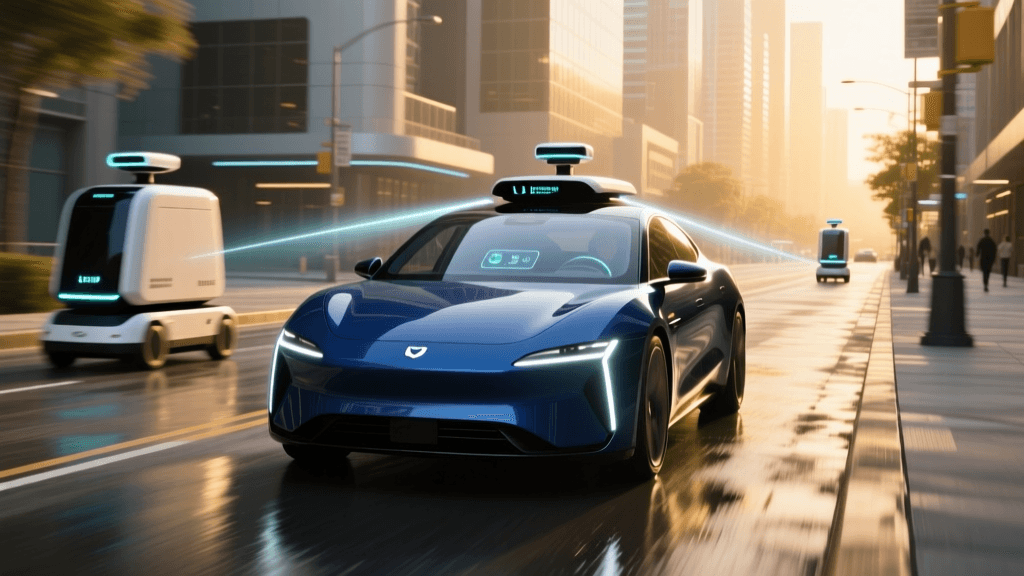
The hardware architecture of an autonomous delivery vehicle is dictated by its operating environment. Sidewalk rovers and road-going pods require vastly different sensor fusion strategies to maintain safety and redundancy.
Sidewalk Rovers: Vision-Dominant and Ultrasonic
Sidewalk delivery bots, such as those deployed by Starship Technologies and Coco, operate at pedestrian speeds (typically 3 to 6 mph). Because their kinetic energy is low, the safety requirements for long-range detection are relaxed. These vehicles rely heavily on vision-dominant sensor suites. A typical rover utilizes 6 to 12 high-dynamic-range (HDR) cameras providing a 360-degree field of view. To handle edge cases like glass storefronts or sudden drop-offs, these vision systems are supplemented by short-range ultrasonic sensors and solid-state LiDAR with a maximum range of 10 to 15 meters. This keeps the Bill of Materials (BOM) cost relatively low, often under $15,000 per unit.
Road-Going Pods: Automotive-Grade Redundancy
Vehicles designed for public roads, such as the Nuro R3, must meet automotive safety standards. These pods utilize a robust sensor fusion stack combining spinning or semi-solid-state LiDAR (from providers like Hesai or Luminar), 4D imaging radar, and high-resolution cameras. The inclusion of 4D radar is critical for delivery pods, as it allows the vehicle to detect static and dynamic obstacles in adverse weather conditions like heavy rain or fog, where LiDAR and cameras might degrade. The BOM cost for these road-legal pods remains high, often exceeding $100,000 per vehicle, though economies of scale are slowly driving this down.
Edge AI and Compute Platforms
Processing this massive influx of sensor data requires powerful edge computing. The industry standard has largely converged on NVIDIA's Jetson AGX Orin platform, which delivers up to 275 TOPS (Trillions of Operations Per Second) while maintaining a thermal design power (TDP) that can be passively or lightly actively cooled in a sealed, IP67-rated chassis. Modern ADVs are moving away from traditional 3D bounding box object detection toward Occupancy Networks and Bird's Eye View (BEV) transformer models. These neural networks map the environment in 3D voxels, allowing the rover to safely navigate around unmapped or unusual obstacles—like a spilled trash can or a uniquely shaped piece of furniture—without needing to explicitly classify the object first.
Deployment Tracker: Who is Operating Where?
The table below tracks the primary autonomous delivery platforms currently in commercial or advanced pilot deployment across North America and Europe.
| Company | Vehicle Class | Top Speed | Payload Capacity | Primary Sensor Suite | Active Deployment Zones |
|---|---|---|---|---|---|
| Starship Technologies | Sidewalk Rover | 4 mph | 20 lbs | Vision + Ultrasonic | US College Campuses, UK, Germany |
| Nuro | Road-going Pod (R3) | 45 mph | 420 lbs | LiDAR + Radar + Vision | California, Texas |
| Coco | Sidewalk Rover | 5 mph | 40 lbs | Vision + Short-range LiDAR | Los Angeles, Miami, Austin |
| Udelv | Road-going Transporter | 70 mph | 2,000 lbs | LiDAR + Vision + Radar | Various US Pilot Programs |
Teleoperation: The Hidden Backbone of Autonomous Delivery
A critical, often overlooked component of the ADV tech stack is the teleoperation infrastructure. No autonomous system operates with 100% autonomy in all edge cases. When a rover encounters a complex construction zone or an unresolvable path blockage, it halts and requests remote assistance. The industry metric for success here is the Remote Intervention Rate (RIR). Leading sidewalk fleets have pushed their RIR down to roughly one intervention per 5 to 10 miles. Advanced teleoperation setups now utilize augmented reality (AR) interfaces, allowing a single remote operator to 'draw' a safe path on their screen, which the rover's local planner then executes. The ultimate goal for fleet operators is to achieve a 1:50 ratio—one remote operator managing fifty active vehicles simultaneously—which is essential for achieving positive unit economics.
Regulatory Hurdles and the NHTSA Exemption Landscape
Regulatory frameworks for ADVs are highly fragmented. Sidewalk rovers are generally regulated at the municipal or county level, leading to a patchwork of local ordinances regarding right-of-way, speed limits, and accessibility for visually impaired pedestrians. Conversely, road-going pods fall under federal jurisdiction. According to the NHTSA Automated Vehicles Safety portal, vehicles lacking traditional manual controls (steering wheels, pedals) require special exemptions from Federal Motor Vehicle Safety Standards (FMVSS). Nuro famously secured the first-of-its-kind FMVSS exemption for its R2 vehicle, and subsequent iterations like the R3 are designed with advanced exterior airbags and breakaway components to protect pedestrians, setting a new benchmark for AV safety compliance.
Furthermore, the USDOT ITS Automated Vehicles research initiatives continue to explore how connected vehicle (V2X) infrastructure can integrate with delivery fleets to optimize routing and reduce traffic congestion in dense urban cores.
Unit Economics: Reaching Cost Parity
The fundamental promise of autonomous delivery is the reduction of last-mile fulfillment costs, which currently account for over 50% of total shipping expenses. A human delivery driver costs a fleet roughly $25 to $35 per hour in fully loaded labor costs. To reach parity, an autonomous pod must amortize its capital expenditure (CapEx), maintenance, software licensing, and teleoperation costs to below $20 per hour of operation. Sidewalk rovers have already achieved this in high-density, geofenced environments like university campuses, where the utilization rate is high and the ODD is tightly controlled. Road-going pods are still in the CapEx-heavy phase, requiring higher utilization rates and longer operational hours to justify the initial hardware investment.
Actionable Insights for Fleet Operators and Tech Developers
For logistics managers and fleet operators evaluating autonomous delivery partners, consider the following technical and operational benchmarks:
- API Latency and Webhooks: Ensure the ADV provider's API supports sub-200ms latency for real-time telemetry and webhook status updates. This is critical for integrating with your existing Warehouse Management System (WMS) and providing accurate customer ETAs.
- Geofencing Flexibility: Evaluate how quickly the provider can expand or modify the ODD geofence. Providers relying on HD mapping may take weeks to approve a new delivery zone, while those utilizing real-time SLAM (Simultaneous Localization and Mapping) can adapt to new neighborhoods in hours.
- Hardware Modularity: For hardware developers building the next generation of delivery pods, prioritize modular sensor housings. Sidewalk rovers endure high wear-and-tear, including kicks, mud, and vandalism. Sensor domes with quick-release mechanisms and integrated hydrophobic lens washers drastically reduce mean-time-to-repair (MTTR) in the field.
- Thermal Management: Edge compute units like the NVIDIA Orin generate significant heat. Designing chassis with passive heat sinks that double as structural elements, or utilizing liquid cooling loops that also manage battery temperatures, is essential for maintaining uptime during peak summer months.
As battery density improves and edge AI models become more computationally efficient, the deployment footprint of autonomous delivery vehicles will expand from controlled campuses to complex suburban and urban streetscapes, permanently altering the economics of the global supply chain.