The Reality of ADAS in Adverse Weather
Advanced Driver Assistance Systems (ADAS) have fundamentally changed the way we drive, offering a safety net that ranges from Automatic Emergency Braking (AEB) to sophisticated lane centering and adaptive cruise control. On a clear, sunny day with freshly painted lane lines, these systems feel almost magical. However, the moment the sky darkens and precipitation begins, the limitations of these technologies become starkly apparent. Understanding how ADAS features perform in rain, snow, and fog is not just a matter of convenience; it is a critical safety requirement for modern drivers.
Many drivers operate under the false assumption that their vehicle's computer vision and radar systems can 'see' through storms better than the human eye. In reality, the sensors that power your vehicle's safety suite are highly susceptible to environmental interference. According to the National Highway Traffic Safety Administration (NHTSA), ADAS features are designed to assist, not replace, the driver, and their operational limits are heavily tied to environmental conditions. When sensors are blinded by weather, the vehicle will either disengage the system abruptly or, worse, misinterpret the environment and make a dangerous maneuver.
In this expert guide, we will break down the physics of how weather impacts your vehicle's sensor suite, examine brand-specific quirks, and provide actionable best practices to maintain optimal ADAS performance during severe weather.
The Physics of ADAS Sensors in Bad Weather
To understand why your lane keep assist disengages in a snowstorm, you must first understand the hardware mounted on your vehicle. Modern EVs and hybrids rely on a fusion of four primary sensor types, each with unique vulnerabilities.
Optical Cameras (The Eyes)
Cameras are the backbone of traffic sign recognition, lane departure warning, and pedestrian detection. They rely on ambient or emitted light to process high-resolution images. Vulnerability: Water droplets on the lens act as magnifying glasses, distorting the image. Fog and snow reflect ambient light, causing 'bloom' or whiteout effects that blind the neural networks processing the video feed. If the camera cannot see the lane line, the lane centering system will shut off.
Millimeter-Wave Radar (The Distance Keeper)
Radar emits radio waves that bounce off solid objects to measure distance and relative speed, powering Adaptive Cruise Control (ACC) and AEB. Vulnerability: While radio waves can pass through rain and fog better than light, heavy precipitation can cause 'attenuation,' where the signal is weakened. More importantly, radar units are often hidden behind the front grille or brand emblem. A buildup of wet snow, ice, or road slush on this emblem will completely block the radar, disabling ACC and forward-collision warning instantly.
LiDAR (The 3D Mapper)
LiDAR uses pulsing lasers to create a precise 3D point-cloud map of the vehicle's surroundings, commonly used in advanced systems like GM's Super Cruise or Mercedes-Benz's Drive Pilot. Vulnerability: LiDAR is highly sensitive to particulate matter. Dense fog and heavy snowflakes scatter the laser pulses, creating 'noise' in the point cloud that the system may interpret as a solid obstacle, leading to phantom braking events.
Ultrasonic Sensors (The Close-Range Bumpers)
These sensors handle low-speed parking assist and blind-spot proximity alerts. Vulnerability: Ultrasonic waves are easily disrupted by heavy rain and ice buildup on the bumpers, often resulting in the incessant, false 'obstacle detected' beeping when parked in a freezing rainstorm.
Weather-by-Weather Breakdown & Expert Tips
Heavy Rain and Hydroplaning Risks
Rain introduces two major issues: optical distortion and reduced tire friction. Testing by the AAA Foundation for Traffic Safety has demonstrated that AEB and lane-keeping systems struggle significantly in simulated heavy rain, with test vehicles failing to stop in time for stationary targets due to camera blindness and extended braking distances on slick surfaces.
- Expert Tip: Apply a high-quality hydrophobic glass treatment (like Rain-X or Ceramic Pro Glass) to your windshield and side-view camera housings. This forces water to bead up and blow away at highway speeds, keeping the optical sensors clear.
- Expert Tip: Increase your ACC following distance to the maximum setting. Radar cannot predict the loss of traction; it only measures distance. Giving the system a larger buffer accounts for the increased stopping distance required on wet asphalt.
Snow, Ice, and Road Slush
Snow is the ultimate ADAS adversary. It obscures lane markings, buries road signs, and physically coats the sensors. Furthermore, semi-autonomous highway assist systems rely on clear lane lines to center the vehicle. In a snowstorm where the road is entirely white, the system will issue a 'Take Steering Immediately' warning and disengage.
- Expert Tip: Before driving, use a soft microfiber cloth and an isopropyl alcohol-based automotive glass cleaner to wipe down all camera lenses (front windshield, side mirrors, and rear backup camera). Never use a hard ice scraper near a camera housing, as scratching the lens will permanently ruin the sensor's calibration.
- Expert Tip: Keep the front grille and emblem completely clear of ice. If your vehicle is equipped with a heated radar emblem or heated windshield washer nozzles, ensure these features are activated in your climate control settings before hitting the road.
Dense Fog and Low Visibility
Fog consists of suspended water droplets that scatter light. This severely degrades camera performance and can cause LiDAR systems to register false positives. Research from the Insurance Institute for Highway Safety (IIHS) highlights that drivers often over-rely on automated systems in low-visibility conditions, leading to delayed reaction times when the system inevitably fails to track the vehicle ahead.
- Expert Tip: In dense fog, manually disable Adaptive Cruise Control and rely on standard cruise control or manual throttle input. ACC may suddenly detect a slow-moving vehicle in the fog and apply aggressive, unexpected braking, which could cause a rear-end collision from vehicles following you too closely.
ADAS Sensor Vulnerability Comparison Chart
| Sensor Type | Primary Weather Threat | Typical Failure Mode | Expert Mitigation Strategy |
|---|---|---|---|
| Optical Cameras | Fog, Snow, Heavy Rain | Lane departure warning disables; traffic sign recognition fails. | Apply hydrophobic coatings; use heated washer fluid. |
| Millimeter-Wave Radar | Freezing Rain, Slush, Ice | ACC and AEB shut down due to blocked front emblem. | Manually clear grille/emblem of ice; use de-icer spray. |
| LiDAR | Dense Fog, Heavy Snow | Phantom braking due to laser scatter off precipitation. | Reduce speed; be prepared to override aggressive braking. |
| Ultrasonic | Heavy Rain, Bumper Ice | False parking proximity alarms; blind-spot monitor errors. | Wipe bumper sensors clean; ignore false alarms in storms. |
Brand-Specific Quirks in Bad Weather
Different automakers utilize different sensor fusions, meaning their vehicles will fail in unique ways depending on the weather.
Subaru EyeSight
Subaru's EyeSight system relies heavily on stereo cameras mounted near the rearview mirror, rather than a combination of radar and cameras. Because it is purely optical, EyeSight is exceptionally sensitive to fog, heavy rain, and direct sun glare. If the windshield fogs up on the inside, or if snow accumulates on the outside of the glass directly in front of the cameras, the system will immediately disable and illuminate a warning light on the dash. Best Practice: Ensure your defroster is set to maximum and directed at the windshield to keep the interior glass perfectly clear.
Tesla Autopilot / FSD
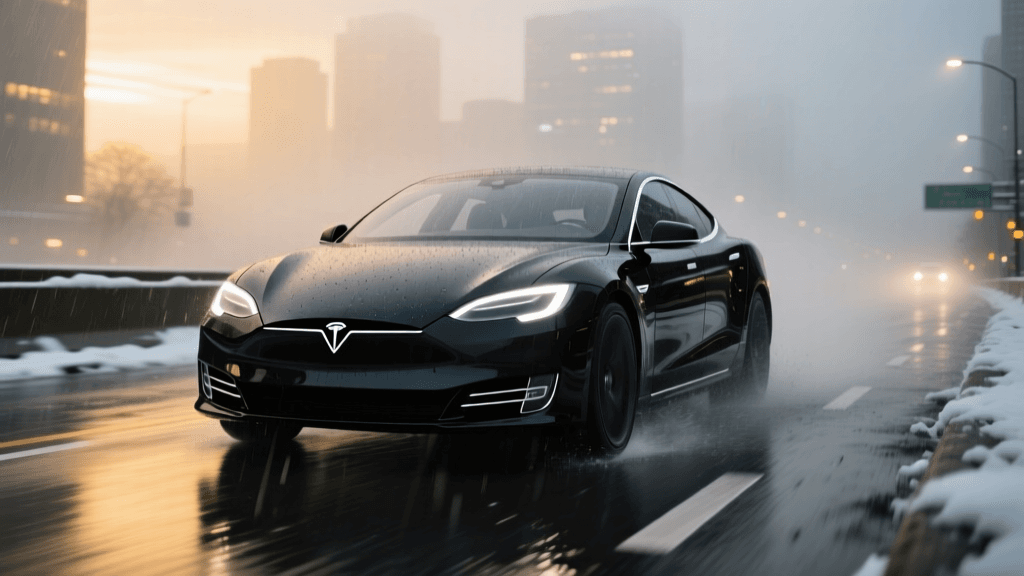
Tesla's 'Tesla Vision' relies entirely on a suite of high-resolution cameras, having removed radar and ultrasonic sensors from newer models. While their neural networks are highly advanced, they are still bound by the laws of physics. In heavy rain, water running down the side camera housings can cause the system to misinterpret lane boundaries or fail to detect adjacent vehicles. Best Practice: Keep the side repeater cameras meticulously clean and avoid using Autopilot in heavy, blowing snow where lane lines are completely obscured.
GM Super Cruise & Ford BlueCruise
These hands-free systems utilize a combination of LiDAR-mapped highway data, radar, and driver-monitoring cameras. While the LiDAR maps provide a baseline understanding of the road's geometry, the systems still require optical cameras to read lane lines and radar to track moving traffic. In heavy snow, the steering wheel light bar will turn red and prompt you to take over. Best Practice: These systems are best reserved for clear conditions. In winter storms, use standard ACC and lane keep assist, keeping your hands on the wheel to manage the micro-corrections required when traction is low.
Best Practices for Maintaining ADAS in Winter and Storms
To get the most out of your vehicle's safety suite year-round, adopt these expert maintenance habits:
- Upgrade Your Washer Fluid: Standard blue washer fluid will freeze on your windshield and camera lenses in sub-zero temperatures, blinding the car. Switch to a premium de-icing washer fluid rated for at least -30°F (-34°C) during the winter months.
- Invest in a Soft Snow Brush: Never use a metal scraper or a stiff-bristled brush near the front grille, side mirrors, or rear hatch where cameras and radar units are housed. Micro-scratches on camera lenses will cause permanent glare and calibration issues.
- Check Sensor Alignment After Impacts: If you hit a deep pothole hidden under a snowbank, or if your bumper is tapped in a low-speed winter fender-bender, your radar and cameras may fall out of calibration. A misaligned radar can cause your AEB to brake for cars in the adjacent lane. Have your ADAS recalibrated by a certified technician after any suspension or body impact.
- Keep the Interior Glass Spotless: Driver Monitoring Systems (DMS) use infrared cameras on the steering column or rearview mirror to ensure you are paying attention. Smudges, fingerprint oils, and interior window fog can block the IR sensors, causing the system to aggressively chime at you or disengage hands-free driving modes.
When to Disengage: The Ultimate Expert Rule
The most critical piece of advice for driving with ADAS in adverse weather is knowing when to turn it off. If you find yourself squinting to see the taillights of the car ahead, or if the road is covered in a layer of white slush, your vehicle's computers are likely just as confused as you are.
In heavy fog, blinding snow, or torrential downpours, manually disable Lane Centering and Adaptive Cruise Control. Take full control of the throttle and brakes. By doing so, you eliminate the risk of phantom braking, sensor-induced hesitation, and abrupt system disengagements that can catch you off guard. Treat ADAS as a fair-weather co-pilot; when the skies turn hostile, the human driver must resume full command of the vessel.