The Evolution of Automated Parking: From Beepers to AI
The transition from rudimentary parking sensors to fully automated, steering-and-throttle-controlled parking assistants represents one of the most tangible leaps in Advanced Driver Assistance Systems (ADAS). Early parking aids relied solely on proximity alerts—simple ultrasonic beepers that warned drivers of impending bumper scratches. Today, automated parking systems can identify parallel or perpendicular spaces, calculate complex geometric trajectories, and execute the maneuver with zero driver input inside the cabin. According to the SAE International J3016 standard, these features generally fall under Level 2 driving automation, as the human driver must still supervise the system and retain ultimate responsibility for the vehicle's movements.
For EV and smart driving enthusiasts, understanding the underlying architecture of these systems is crucial. Not all automated parking suites are created equal. The variance in sensor hardware, processing algorithms, and user interface design drastically alters real-world reliability. In this technology deep dive, we dissect the sensor fusion mechanics powering modern parking assist and compare the bespoke implementations from industry leaders like Tesla, BMW, and Hyundai.
Under the Hood: Sensor Fusion and Computer Vision
To navigate tight spaces with centimeter-level precision, automated parking systems rely on a layered approach to environmental perception. This is commonly referred to as sensor fusion, where data from multiple hardware sources is aggregated to create a cohesive 3D model of the vehicle's surroundings.
Ultrasonic Transducers: The Proximity Backbone
Ultrasonic sensors emit high-frequency sound waves (typically between 40 and 50 kHz) that bounce off nearby objects. By calculating the time-of-flight for the echo to return, the vehicle's Electronic Control Unit (ECU) determines the exact distance to obstacles. Ultrasonic arrays are exceptional at detecting solid, flat surfaces like concrete pillars, brick walls, and other vehicles at close range (usually up to 5 meters). However, they possess distinct physical limitations: they struggle with sound-absorbing materials (like bushes or snowbanks), can be blinded by heavy rain, and lack the semantic understanding to differentiate between a curb and a pedestrian's leg.
Surround-View Cameras and Neural Networks
To compensate for the semantic blindness of ultrasonics, modern systems deploy 360-degree surround-view camera arrays. Advanced computer vision algorithms and neural networks process these video feeds in real-time to identify parking lines, curbs, overhanging obstacles, and moving entities like pedestrians or shopping carts. The shift toward "occupancy networks" allows vehicles to map out 3D volumetric space, identifying hazards that might not be explicitly categorized in a training dataset but still occupy physical space.
The Role of Sensor Fusion
The National Highway Traffic Safety Administration (NHTSA) emphasizes that robust ADAS features require redundant sensing capabilities to ensure safety across varied environmental conditions. By fusing the precise, short-range depth mapping of ultrasonics with the contextual, semantic awareness of cameras (and occasionally short-range corner radars), the vehicle can confidently execute multi-point turn maneuvers in complex environments like subterranean parking garages.
Brand Comparison: Tesla vs. BMW vs. Hyundai
While the fundamental physics of parking remain the same, OEMs have adopted vastly different engineering philosophies to solve the automated parking puzzle. Here is how three major architectures compare in the real world.
Tesla: Auto Park and Smart Summon (Tesla Vision)
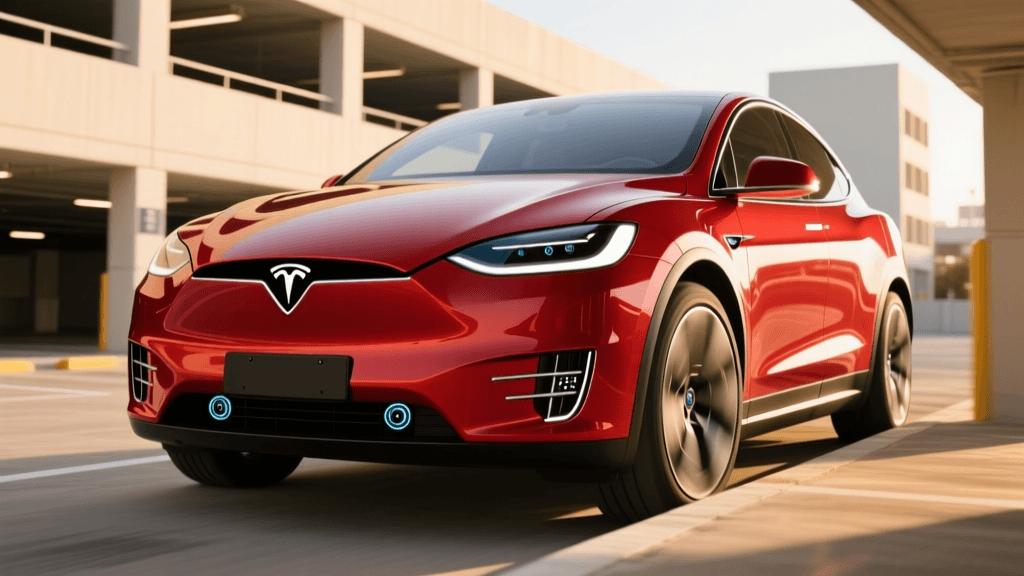
In a highly controversial move, Tesla recently removed ultrasonic sensors (USS) from its production vehicles, opting instead for a pure-vision approach branded as "Tesla Vision." Auto Park and Smart Summon now rely entirely on the vehicle's 8-camera array and powerful onboard neural networks (running on the HW4 or AI5 computer).
The Tech: Tesla uses end-to-end neural networks that process raw pixel data to estimate depth and construct a 3D vector space.
Real-World Performance: The vision-only approach allows for continuous over-the-air (OTA) improvements without hardware constraints. However, it is highly susceptible to environmental degradation. Heavy rain, direct sun glare, or mud on the camera lenses can severely degrade Auto Park's confidence, leading to aborted maneuvers or phantom braking. Smart Summon, which allows the car to navigate a parking lot to the user's phone location, has historically been jerky, though recent FSD v12 updates have significantly smoothed out the acceleration and steering profiles.
BMW: Parking Assistant Professional and Reversing Assistant
BMW takes a highly structured, hardware-redundant approach. The Parking Assistant Professional utilizes a dense array of ultrasonic sensors combined with high-resolution 360-degree cameras and precise wheel-odometry tracking.
The Tech: BMW's standout feature is the Reversing Assistant. The vehicle continuously records the GPS and steering telemetry of the last 50 meters driven forward at speeds under 22 mph. If you find yourself trapped in a narrow alley or a tight parking garage spiral, activating the Reversing Assistant will cause the car to autonomously back out, perfectly retracing your exact forward path.
Real-World Performance: BMW's system is widely regarded as the most reliable and smoothest in the luxury segment. The inclusion of Remote Manoeuvring allows the driver to stand outside the vehicle and use a smartphone app to guide the car into tight spaces, provided the driver maintains a constant connection via the app's dead-man's switch.
Hyundai/Kia: Remote Smart Parking Assist (RSPA)
Hyundai and Kia have optimized their automated parking tech for the specific pain point of narrow urban garages and tight suburban driveways.
The Tech: RSPA relies heavily on traditional ultrasonic sensors paired with a bird's-eye-view camera system. Unlike BMW's smartphone app requirement, Hyundai integrates the remote control directly into the vehicle's smart key fob.
Real-World Performance: By holding down the specific lock or unlock button on the fob, the driver can command the vehicle to move linearly forward or backward. The system handles the steering micro-adjustments to keep the car centered in the space. It is incredibly practical, highly responsive, and eliminates the need to pull out a smartphone or maintain a Wi-Fi/Bluetooth handshake with an app. However, it is limited to linear movements and cannot execute complex parallel parking geometry autonomously from outside the car.
Automated Parking System Specification Matrix
| Feature / Metric | Tesla Auto Park (Vision) | BMW Parking Assistant Pro | Hyundai RSPA |
|---|---|---|---|
| Primary Sensors | 8x Cameras (No Ultrasonics) | Ultrasonics + 360 Cameras | Ultrasonics + 360 Cameras |
| Remote Operation | Smart Summon via App | Remote Maneuvering via App | Linear Move via Smart Key Fob |
| Max Operating Speed | ~15 mph (Summon) | ~22 mph (Reversing Assist) | ~2 mph (Linear Remote) |
| Path Retracing | No (Relies on real-time mapping) | Yes (Last 50 meters) | No |
| Weather Resilience | Low (Vision impaired by rain/snow) | High (Ultrasonic redundancy) | High (Ultrasonic redundancy) |
| Best Use Case | Navigating large lots to user | Escaping tight garages / dead-ends | Straight-line narrow garage entry |
Real-World Limitations and Driver Responsibility
Despite the marketing terminology implying full autonomy, these systems are strictly Level 2 ADAS features. The Insurance Institute for Highway Safety (IIHS) continually warns against automation complacency. When utilizing any automated parking system, the driver remains legally and financially liable for any collisions that occur.
From a practical standpoint, sensor maintenance is critical. A thick layer of road salt, mud, or ice over an ultrasonic puck will blind the sensor, causing the system to abort the parking maneuver or, worse, misjudge the distance to a concrete pillar. Similarly, camera lenses must be kept clean; a single water droplet over a fisheye lens can distort the neural network's depth perception. Drivers should always keep their foot hovering over the brake pedal (or their thumb ready on the remote stop button) to instantly override the system if a rogue shopping cart or pedestrian enters the vehicle's blind spot.
The Future: Automated Valet Parking (AVP)
The next frontier in parking technology is Level 4 Automated Valet Parking (AVP). Currently being tested in select smart-garages globally, AVP relies on Vehicle-to-Infrastructure (V2X) communication. Instead of the car processing the environment solely with onboard sensors, the parking garage itself is equipped with LiDAR and edge-computing servers. The driver simply exits the vehicle at the garage entrance, and the infrastructure guides the car to an available space, optimizing for spatial efficiency and retrieving the car upon the user's return. Until V2X infrastructure becomes ubiquitous, the hybrid sensor-fusion approaches utilized by BMW and Hyundai, alongside the rapidly evolving neural networks of Tesla, remain the pinnacle of consumer automated parking technology.