The Great ADAS Divide: Premium Tech vs. Democratized Safety
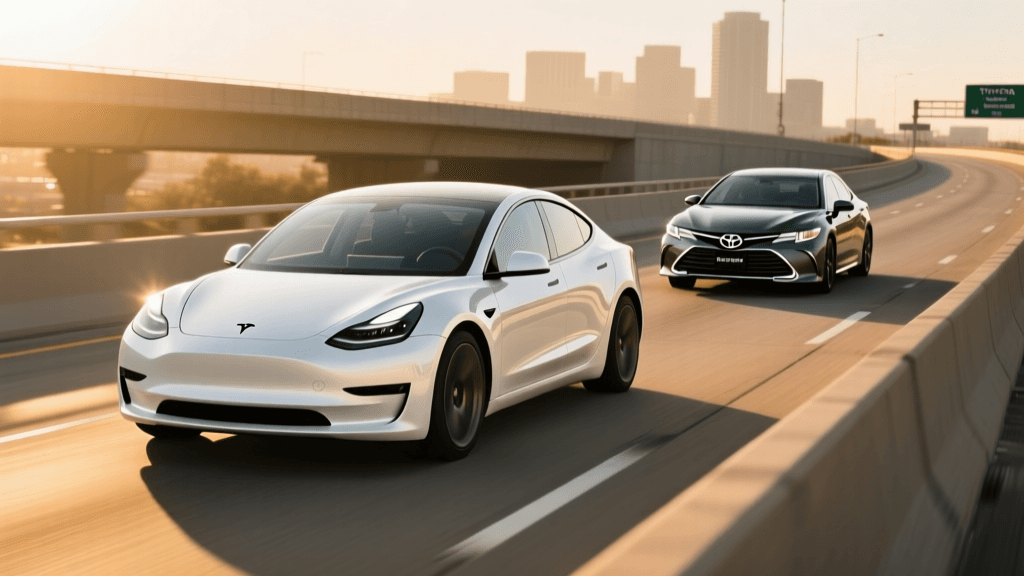
When evaluating Advanced Driver Assistance Systems (ADAS), the automotive industry is largely split into two distinct philosophies. On one side, you have legacy automakers like Toyota, which view foundational safety technology as a standard human right that should be included in every vehicle, regardless of trim level. On the other side, you have Tesla, which treats advanced autonomy and driver assistance as premium, high-margin software products that can be unlocked via substantial upfront payments or monthly subscriptions.
For the modern car buyer, this creates a complex financial calculus. Is it better to pay a premium for Tesla's industry-leading Autopilot and Full Self-Driving (FSD) capabilities, or does the democratized, zero-cost approach of Toyota Safety Sense (TSS) offer a superior long-term value proposition? In this comprehensive cost and value breakdown, we analyze the upfront pricing, hidden repair costs, insurance implications, and resale value impacts of Tesla Autopilot versus Toyota Safety Sense.
Upfront Pricing: Standard Inclusion vs. The Software Paywall
The most immediate difference between the two systems is how they impact the initial purchase price of the vehicle. Toyota has committed to democratizing safety. According to Toyota's official safety portal, Toyota Safety Sense (currently in its 3.0 iteration) is standard equipment on almost every new model they sell. Whether you are purchasing a base-model Corolla starting around $22,000 or a fully loaded Tundra Capstone nearing $75,000, TSS 3.0 is included at no additional cost. This suite includes a Pre-Collision System with Pedestrian Detection, Lane Departure Alert with Steering Assist, Automatic High Beams, and Dynamic Radar Cruise Control.
Tesla's approach is distinctly tiered. Basic Autopilot, which includes Traffic-Aware Cruise Control and basic Autosteer (lane centering on clearly marked highways), is included in the base price of every Tesla vehicle. However, the true technological prowess of Tesla's ADAS is locked behind significant paywalls. Enhanced Autopilot (EAP) costs an additional $6,000, while Full Self-Driving (FSD) capability requires a massive $8,000 upfront fee, or a $99 monthly subscription. For a buyer purchasing a $40,000 Tesla Model 3, adding FSD represents a 20% increase in the total purchase price of the car—a massive premium for software that, despite its name, still requires active driver supervision.
Feature-by-Feature Value Comparison
To understand the financial value, we must look at what you actually get for your money. Below is a structured comparison of the feature sets across the different pricing tiers.
| Feature | Toyota Safety Sense 3.0 | Tesla Basic Autopilot | Tesla Enhanced Autopilot ($6k) | Tesla FSD ($8k) |
|---|---|---|---|---|
| Adaptive Cruise Control | Standard | Standard | Standard | Standard |
| Lane Centering Assist | Standard | Standard | Standard | Standard |
| Auto Lane Change | No | No | Yes | Yes |
| Navigate on Autopilot | No | No | Yes | Yes |
| Traffic Light & Stop Sign Control | No | No | No | Yes |
| Predictive Crash Avoidance | Standard (Radar/Camera) | Standard (Vision) | Standard (Vision) | Standard (Vision) |
From a pure feature-density perspective, Toyota offers immense baseline value. You get robust highway cruising and lane-keeping without spending an extra dime. Tesla's EAP and FSD offer superior convenience features like automated lane changes and off-ramp navigation, but the financial leap from $0 to $6,000 for these specific conveniences is a tough pill to swallow for budget-conscious consumers.
The Hidden Costs: Insurance, Repairs, and Sensor Calibration
The cost of ADAS does not end at the dealership. Modern safety suites rely on complex sensor arrays, and when these sensors are damaged in minor collisions, repair bills can skyrocket. The Insurance Institute for Highway Safety (IIHS) has extensively documented how ADAS components significantly inflate collision repair costs and, consequently, insurance premiums.
Toyota's Radar and Camera Fusion
Toyota Safety Sense utilizes a fusion of a monocular windshield-mounted camera and a millimeter-wave radar unit typically hidden behind the front Toyota emblem or lower grille. If you are rear-ended, or if you back into a pole, that front radar unit can be destroyed. Replacing and recalibrating a Toyota radar emblem and windshield camera typically costs between $800 and $1,500. While not cheap, these parts are widely available, and third-party repair shops are increasingly equipped to handle Toyota's calibration requirements.
Tesla Vision and Proprietary Repair Networks
Tesla has moved entirely to 'Tesla Vision,' relying exclusively on a suite of eight exterior cameras. While eliminating radar and ultrasonic sensors theoretically reduces hardware complexity, it places immense importance on the windshield and front fascia cameras. A simple rock chip that requires a windshield replacement on a Tesla also requires a proprietary software recalibration of the Autopilot cameras. Furthermore, Tesla's proprietary repair ecosystem, high parts costs, and elevated collision rates have led to notoriously high insurance premiums. In many regions, insuring a Tesla equipped with Autopilot hardware can cost 30% to 50% more annually than insuring a comparably priced Toyota, severely eating into any potential fuel savings.
Long-Term Ownership: Subscriptions, Updates, and Resale Value
When calculating the total cost of ownership (TCO), depreciation and software longevity play massive roles. Toyota's TSS is hardware-locked to the capabilities of the vehicle at the time of manufacture. While it will not receive over-the-air (OTA) updates that add new features, it also will not depreciate as a separate software asset. The safety suite is simply baked into the vehicle's trim value.
Tesla's software model introduces unique depreciation risks. If you pay $8,000 for FSD upfront, that investment is tied to the car. When you go to sell the vehicle on the used market, buyers are notoriously reluctant to pay a premium for used software. A used Tesla with FSD might fetch only $2,000 to $3,000 more than an identical model without it, meaning you lose over 60% of your software investment to depreciation the moment you drive off the lot.
Alternatively, Tesla's $99/month FSD subscription offers a more palatable value for short-term owners or those who only want the feature for long road trips. However, over a standard five-year ownership cycle, that subscription will cost you nearly $6,000—roughly the same as buying EAP outright, but without adding any residual asset value to the car. According to market analyses referenced by Tesla's official Autopilot documentation, the value of the software is constantly evolving via OTA updates, but the financial return on investment for the end-user remains highly speculative.
Final Verdict: Which Approach Wins on Value?
The answer depends entirely on how you define 'value' as a consumer.
- The Financial Pragmatist (Winner: Toyota): If value means getting the most safety for the lowest total cost of ownership, Toyota Safety Sense is the undisputed champion. By including TSS 3.0 as standard equipment, Toyota ensures that every driver benefits from automatic emergency braking and adaptive cruise control without inflating the purchase price, repair costs, or insurance premiums. It is a masterclass in democratized automotive value.
- The Tech Enthusiast (Winner: Tesla): If value is defined by cutting-edge capability, continuous improvement, and highway convenience, Tesla's tiered approach makes sense. While the $6,000 to $8,000 price tags for EAP and FSD are steep, they offer a level of automated lane navigation and traffic management that Toyota simply does not offer. For high-mileage commuters who spend hours on mapped highways, the subscription model or upfront cost can be justified by the reduction in driver fatigue.
Ultimately, Toyota proves that life-saving ADAS technology does not need to be a luxury upsell, while Tesla proves that consumers are willing to pay a massive premium for the promise of tomorrow's autonomy today. For the average buyer focused strictly on the bottom line, Toyota's standard-inclusion approach remains the smartest financial play in the modern automotive market.