The Sensor Architecture Paradigm: How Subaru Defies the Industry Standard
When evaluating Advanced Driver Assistance Systems (ADAS), the automotive industry has largely converged on a standardized sensor fusion model: a monocular camera mounted behind the rearview mirror paired with a millimeter-wave radar unit hidden behind the front grille or emblem. Brands like Toyota (Safety Sense), Honda (Sensing), and Ford (Co-Pilot360) rely heavily on this radar-camera handshake to achieve adaptive cruise control and automatic emergency braking (AEB). Subaru, however, has historically charted a different engineering path with its EyeSight system, relying primarily on a sophisticated stereo camera setup.
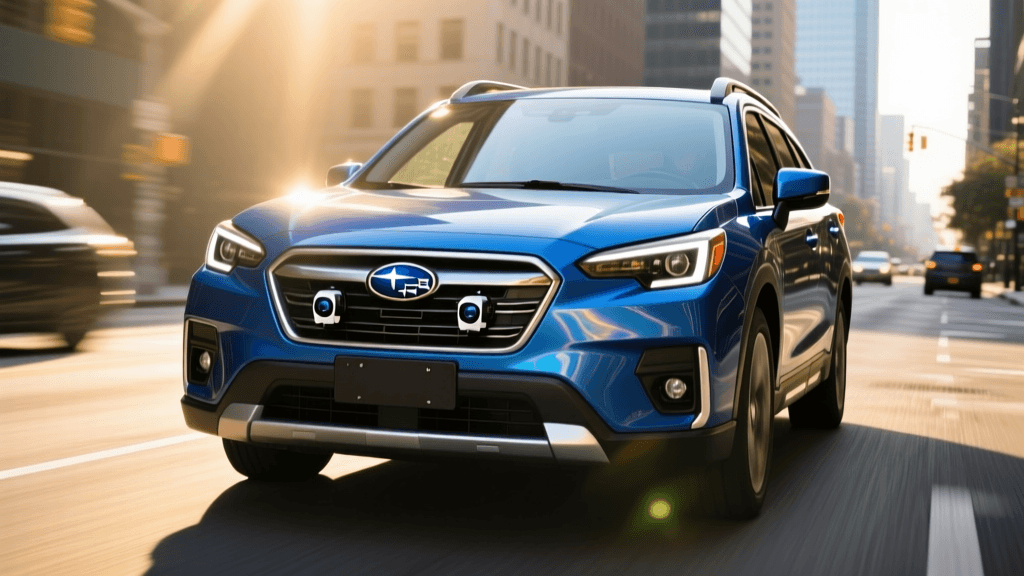
The core of Subaru EyeSight utilizes two high-definition color cameras spaced apart to mimic human binocular vision. By calculating the parallax between the two lenses, the system generates a real-time 3D point cloud of the environment, allowing it to accurately judge distance, object size, and relative velocity without the immediate need for forward-facing radar. With the rollout of Generation 4 EyeSight (introduced on models like the Outback, Ascent, and WRX), Subaru expanded the field of view and added a wide-angle monocular camera to bridge the gap between pure stereo vision and industry-standard radar capabilities. But how does this camera-centric architecture stack up against radar-dominant systems in empirical testing? In this data-driven comparison, we break down the performance, limitations, and ownership costs of both paradigms.
Data Table: Stereo Camera vs. Radar + Monocular Camera
To understand the fundamental differences in ADAS architectures, we must look at the raw operational data. Below is a comparative analysis of Subaru’s Gen 4 Stereo Camera system versus the industry-standard Radar + Monocular Camera fusion system.
| Metric / Capability | Subaru EyeSight (Gen 4 Stereo Camera) | Industry Standard (Radar + Mono Camera) |
|---|---|---|
| Primary Forward Sensor | Dual Color Stereo Cameras + Wide-Angle Mono | 77GHz Millimeter-Wave Radar + Mono Camera |
| Effective Forward Range | ~150 meters (visual dependent) | ~200 to 250+ meters (radar penetrates) |
| Horizontal Field of View (FOV) | ~50 degrees (Gen 4 nearly 2x wider than Gen 3) | ~120 degrees (Radar sweep) / ~50 deg (Camera) |
| Stationary Object Classification | Excellent (3D shape recognition) | Poor (Radar filtering required to avoid false positives) |
| Heavy Fog / Snow Performance | >Poor (Optical sensors blinded by particulates)Good (Radio waves penetrate light fog/snow) | |
| Nighttime / Low Light AEB | Good (Relies on headlight illumination / IR assist) | Excellent (Radar is independent of ambient light) |
| Windshield Recalibration Required | Yes, mandatory upon glass replacement | Yes for camera; Radar (in bumper) usually unaffected |
Real-World Stopping Distances and IIHS Testing Data
The true measure of any ADAS suite is its ability to mitigate or prevent collisions. The Insurance Institute for Highway Safety (IIHS) rigorously tests vehicle-to-vehicle and vehicle-to-pedestrian AEB systems at varying speeds. Historically, radar-based systems held a slight advantage in high-speed closure rates due to their superior long-range velocity detection. However, Subaru’s stereo camera system has proven exceptionally competitive, particularly in complex urban environments where object classification is just as critical as distance measurement.
In recent IIHS vehicle-to-vehicle tests, Subaru’s Gen 4 EyeSight system consistently achieved superior ratings (Advanced or Superior) in both 12 mph and 25 mph parallel and perpendicular impact scenarios. The stereo camera’s ability to recognize the distinct 3D profile of a pedestrian or a cyclist allows the system to initiate braking earlier in complex, cluttered backgrounds compared to some radar systems that struggle to separate a pedestrian from a nearby metal guardrail.
According to data aggregated by the National Highway Traffic Safety Administration (NHTSA), AEB systems reduce rear-end crashes by approximately 50%. Subaru’s camera-based approach excels in these exact scenarios because stereo vision inherently understands the physical volume of an object, reducing the latency between object detection and brake actuation in stop-and-go traffic.
The "Ghost Braking" Problem and Stationary Objects
One of the most significant vulnerabilities of radar-based ADAS is the phenomenon known as "ghost braking." Millimeter-wave radar is exceptional at detecting moving objects and calculating their relative speed via the Doppler effect. However, radar struggles immensely with stationary objects. If a radar system registers every stationary metal object (overpasses, bridge abutments, road signs, parked cars on a curve) as an imminent collision threat, the vehicle would slam on its brakes constantly. To prevent this, engineers program radar systems to aggressively filter out stationary returns.
This filtering creates a dangerous blind spot: if a vehicle ahead of you suddenly swerves to avoid a stationary obstacle (like a stalled car or a dropped mattress), the radar may not register the stationary object until the camera confirms it, often resulting in delayed braking. Subaru’s stereo camera does not suffer from this specific radar-filtering flaw. Because it builds a 3D topographical map of the road ahead, it inherently understands the difference between a lane of traffic and a physical barrier, providing more confident and timely braking responses to stationary hazards in the vehicle’s direct path.
Environmental Degradation: Weather, Lighting, and Glare
Where radar systems decisively beat Subaru’s camera-centric approach is in adverse environmental conditions. Optical sensors, by their very nature, require light and clear air to function. In scenarios involving heavy, blinding snow, dense fog, or torrential rain, the Subaru EyeSight system will predictably disable itself, displaying a "EyeSight Disabled: Poor Visibility" warning on the driver information display. The cameras simply cannot see through a wall of white particulates.
Conversely, 77GHz millimeter-wave radar operates independently of the visible light spectrum. It penetrates fog, light snow, and darkness with ease. While heavy rain can cause some radar scatter, radar-dominant systems from brands like Volvo (Pilot Assist) and Mercedes-Benz (Drive Pilot) maintain adaptive cruise control functionality in weather conditions that would force a Subaru driver to take full manual control. Furthermore, extreme sun glare directly hitting the windshield at dawn or dusk can temporarily blind stereo cameras, a limitation that radar does not share.
Total Cost of Ownership: Calibration and Repair Data
When purchasing a vehicle equipped with advanced ADAS, buyers must consider the long-term repair costs associated with these sensors. The National Safety Council (NSC) and various automotive insurance bodies have noted that ADAS calibration significantly inflates minor collision repair bills. For Subaru owners, this is intrinsically linked to the windshield.
Because the EyeSight stereo cameras are mounted directly against the glass behind the rearview mirror, any windshield replacement necessitates a precise, dealer-level optical recalibration. A standard windshield replacement for a mid-size SUV might cost between $300 and $400. However, replacing a windshield on a modern Subaru equipped with Gen 4 EyeSight requires specialized calibration targets, proprietary software, and certified technician time, frequently pushing the total invoice past $900 to $1,200.
In contrast, vehicles utilizing a radar-dominant system often house the primary radar unit behind the front bumper or grille emblem. While the monocular camera behind the mirror still requires calibration if the windshield is replaced, minor front-end collisions that damage a bumper will require expensive radar recalibration on a Toyota or Honda, whereas the Subaru’s primary forward-vision sensors remain safely protected behind the windshield glass. Ultimately, both architectures carry a premium repair cost, but the trigger events (windshield vs. bumper damage) differ significantly.
The Verdict: Which Architecture Wins?
The choice between Subaru’s stereo camera architecture and the industry’s radar-dominant standard ultimately depends on your driving environment and priorities. If you frequently navigate dense urban environments, complex intersections, and areas with high pedestrian and cyclist traffic, Subaru’s EyeSight offers superior object classification and highly reliable low-speed AEB performance. Its ability to map the 3D volume of the world provides a nuanced understanding of the road that radar filtering algorithms often miss.
However, if your daily commute involves high-speed highway driving in regions prone to heavy fog, blowing snow, or extreme low-light conditions, a radar-fused system (like Toyota Safety Sense or Ford BlueCruise) offers a broader safety net and more consistent adaptive cruise control availability in poor weather. Subaru’s addition of a wide-angle monocular camera in Gen 4 narrows the gap, but the laws of physics still dictate that optical sensors cannot see through a blizzard, whereas radio waves can. Understanding these data-driven limitations is the key to selecting the ADAS architecture that best aligns with your real-world driving demands.