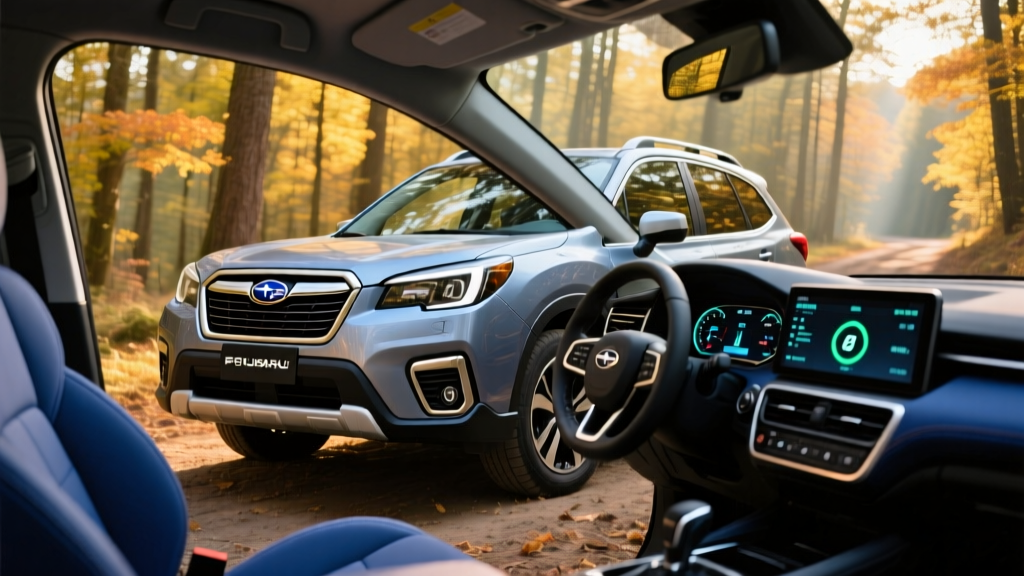
The compact SUV segment has no shortage of hybrid options, but the 2026 Subaru Forester Hybrid carves out a specific niche: standard all-wheel drive, genuine off-road capability, and a powertrain tuned for real-world efficiency rather than hypermiling records. After the Forester's full redesign for the 2025 model year, Subaru expanded the hybrid lineup for 2026, refining the series-parallel hybrid system and adding a new Hybrid Premium trim. Here's everything buyers need to know about specs, fuel economy, and ownership costs.
HEV vs PHEV: What the Forester Hybrid Actually Is
Before examining the numbers, it's critical to understand the Forester Hybrid's architecture. This is a conventional hybrid (HEV), not a plug-in hybrid (PHEV). That distinction drives every ownership experience difference:
| Feature | Forester Hybrid (HEV) | Typical PHEV SUV | Full EV (BEV) |
|---|---|---|---|
| Plug in to charge? | No — self-charging via engine & regen | Yes — Level 1 or Level 2 | Yes — Level 1, 2, or DC fast |
| Electric-only driving | Brief low-speed assist (~1 mi) | 25–40 miles typical | 250–350+ miles |
| Battery size | ~1.1 kWh (small buffer) | 12–20 kWh | 60–100+ kWh |
| Gasoline engine | Yes — primary power source | Yes — kicks in after EV range | None |
| Tailpipe emissions | Reduced, not zero | Zero on EV range, reduced otherwise | Zero |
The Forester Hybrid captures energy through regenerative braking and the gasoline engine to charge its small battery pack. You never plug it in. The electric motor assists during acceleration and enables very short electric-only movement in stop-and-go traffic, but the 2.5-liter flat-four engine does the heavy lifting. This makes it ideal for drivers who lack access to home or workplace charging but still want meaningful fuel savings over the gas-only Forester.
Fuel Economy: EPA Estimates and Real-World MPG
The headline number for the 2026 Forester Hybrid is 39 MPG combined, a substantial improvement over the gas-only Forester's 29 MPG combined. Here's the full EPA breakdown per fueleconomy.gov:
| Driving Cycle | Forester Hybrid (AWD) | Forester Gas (AWD) | Difference |
|---|---|---|---|
| City | 40 MPG | 26 MPG | +14 MPG |
| Highway | 37 MPG | 33 MPG | +4 MPG |
| Combined | 39 MPG | 29 MPG | +10 MPG |
The city-highway split reveals the hybrid system's strength: urban efficiency. The electric motor handles initial acceleration and low-speed crawling, where gasoline engines waste the most fuel. Highway driving is where the advantage narrows, since aerodynamic drag dominates and the engine runs continuously at cruise.
Powertrain and Performance Specs
Subaru pairs its updated FB25 2.5-liter horizontally opposed four-cylinder engine with a hybrid module integrated into the Lineartronic CVT. The system operates in series-parallel mode, meaning it can drive the wheels with the engine alone, the motor alone (briefly), or both simultaneously.
| Specification | 2026 Forester Hybrid |
|---|---|
| Engine | 2.5L flat-4 (FB25) |
| Engine horsepower | 180 HP @ 5,600 RPM |
| Electric motor output | 29 HP (21.5 kW) |
| Combined system output | 194 HP |
| Combined torque | 186 lb-ft |
| Transmission | Lineartronic CVT w/ hybrid module |
| Drivetrain | Symmetrical AWD (standard) |
| 0–60 mph | ~8.4 seconds |
| Hybrid battery | ~1.1 kWh, lithium-ion |
| Towing capacity | 1,500 lbs |
| Cargo volume (rear seats up) | 28.9 cu ft |
| Cargo volume (rear seats folded) | 74.4 cu ft |
| Ground clearance | 8.7 inches |
The 194 combined horsepower represents a modest bump over the gas-only Forester's 180 HP, but the electric motor's instant torque delivery makes the hybrid feel noticeably more responsive from a stoplight. The CVT keeps the engine in its efficient band, and Subaru's X-Mode with Hill Descent Control carries over for light off-road duty. The 1,500-lb towing rating is unchanged from the gas model — adequate for a small trailer or dirt bikes, but this isn't a tow rig.
Pricing, Trims, and Tax Credit Eligibility
Subaru positions the Forester Hybrid across three trims for 2026, with the hybrid system adding approximately $2,000 over equivalent gas-only trims:
| Trim | MSRP (incl. destination) | Key Features |
|---|---|---|
| Hybrid | $34,995 | EyeSight, 11.6" infotainment, dual-zone climate, X-Mode |
| Hybrid Premium | $37,495 | Panoramic sunroof, heated seats, power liftgate, wireless CarPlay |
| Hybrid Limited | $40,995 | Leather, Harman Kardon audio, heated steering wheel, blind-spot monitoring |
Without the tax credit, the hybrid's value proposition rests on fuel savings. At $3.50/gallon and 12,000 miles/year, the hybrid saves roughly $450–$550 annually over the gas Forester. That pays back the ~$2,000 hybrid premium in about 4 years — reasonable, though not spectacular. The higher residual value of hybrids (strong used demand) partially offsets this.
Hybrid vs PHEV vs EV: Which Fits Your Situation?
The Forester Hybrid occupies a specific slot in the electrification spectrum. Here's a practical decision framework:
Choose the Forester Hybrid (HEV) if:
- You lack reliable access to Level 2 charging at home or work
- You live in a cold or mountainous climate where AWD and ground clearance matter year-round
- You want fuel savings without changing any habits — no plugging in, no range planning
- You regularly drive beyond 300 miles between stops (the hybrid's 500+ mile range eliminates any planning)
Consider a PHEV SUV instead if:
- You can install a Level 2 charger at home and your daily commute is under 35 miles
- You want to drive most weekdays on electricity (zero tailpipe emissions on short trips) while keeping gas for road trips
- You want to access the §30D federal tax credit (up to $7,500) to offset a higher purchase price
Consider a full EV (BEV) if:
- You have home Level 2 charging and rarely drive more than 250 miles in a single day
- You want the lowest per-mile fuel cost (electricity at ~$0.04–0.06/mile vs. gas at ~$0.10–0.14/mile)
- You want zero tailpipe emissions and minimal drivetrain maintenance
For Subaru-loyal buyers who need a compact AWD SUV and can't charge at home, the Forester Hybrid is essentially the only option in its segment. The Toyota RAV4 Hybrid is its closest competitor (39 MPG combined, similar pricing), but the Forester's 8.7 inches of ground clearance and standard X-Mode give it a genuine edge for buyers who encounter snow, mud, or unpaved roads regularly.
Reliability, Battery Warranty, and Replacement Costs
Hybrid battery longevity is the most common concern among first-time hybrid buyers. Subaru addresses this with a comprehensive warranty:
Subaru's hybrid system is relatively conservative compared to Toyota's decades of hybrid development, but the FB25 engine has been in production since 2010 and is well-understood. The hybrid battery pack is small (~1.1 kWh) and operates within a narrow state-of-charge window (roughly 40–80%), which is the least stressful operating range for lithium-ion cells. Based on industry data from similar systems, hybrid battery packs routinely last 150,000–200,000+ miles before meaningful degradation.
If replacement is needed out of warranty, the Forester Hybrid's small battery pack is significantly cheaper to replace than a full EV battery. Expect $2,000–$3,500 for a replacement hybrid battery (parts and labor) at a dealership — a fraction of the $10,000–$20,000 an EV traction battery might cost. Third-party remanufactured packs may be available for less as the platform ages.
The Forester earned a 2025 IIHS Top Safety Pick+ rating, and the 2026 model carries over the same structure and EyeSight 4.0 driver-assistance suite. Subaru's EyeSight includes adaptive cruise control, lane-keeping assist, pre-collision braking, and lead vehicle start alert — all standard on every trim.
Pros, Cons, and the Bottom Line
Pros
- 39 MPG combined with standard AWD — best-in-class for off-road-capable compact SUVs
- 8.7" ground clearance and X-Mode for genuine light off-road use
- No charging infrastructure required — zero habit change from a gas car
- Strong city MPG (40) where most compact SUVs struggle
- Standard EyeSight 4.0 safety suite on all trims
- 10-year hybrid battery warranty in CARB states
Cons
- No federal tax credit — $2,000 hybrid premium pays back slowly
- 1,500-lb tow rating is low for the segment (RAV4 Hybrid tows 1,750 lbs)
- CVT drone under hard acceleration; not a sporty driving experience
- No plug-in hybrid Forester option for buyers who want electric-only commuting
- Highway MPG (37) is only modestly better than the gas model (33)
- Hybrid trims not available with the Wilderness off-road package
The 2026 Forester Hybrid isn't trying to be a technology showcase. It's a pragmatic efficiency upgrade for buyers who already know they want a Subaru: standard AWD, high ground clearance, good visibility, and a reputation for longevity. The hybrid system delivers where it counts most — in city and suburban driving — without asking the owner to change a single habit. If you can charge at home and want electric-only commuting, a PHEV from Toyota or Hyundai will save more fuel and money (with the tax credit). But if your life involves unpaved roads, mountain passes, or apartment living without charging access, the Forester Hybrid is the most capable vehicle in its class.
Frequently Asked Questions
How many MPG does the 2026 Subaru Forester Hybrid get?
The EPA rates it at 40 city / 37 highway / 39 combined MPG. In real-world city driving, many owners report 41–43 MPG. Highway driving at 75+ mph typically yields 34–36 MPG. Cold weather reduces efficiency by roughly 5–8%.
Does the Forester Hybrid need to be plugged in?
No. The Forester Hybrid is a conventional hybrid (HEV), not a plug-in. It charges its own small battery through regenerative braking and the gasoline engine. You fuel it exactly like a gas car — just less often.
Does the 2026 Forester Hybrid qualify for any federal tax credit?
No. The IRS §30D Clean Vehicle Credit applies only to plug-in electric vehicles (PHEVs and BEVs) meeting battery sourcing and MSRP/income requirements. Conventional hybrids are excluded. Some state or utility rebates may apply — check your local programs.
How long will the hybrid battery last, and what does replacement cost?
Subaru warranties the hybrid battery for 8 years/100,000 miles (10 years/150,000 miles in CARB states). Based on industry data, lithium-ion hybrid packs operating in a narrow charge window commonly last 150,000–200,000+ miles. Out-of-warranty replacement runs approximately $2,000–$3,500 — far less than an EV battery.
Is the Forester Hybrid better than the gas Forester?
For most buyers, yes. The hybrid delivers 10 MPG better combined fuel economy (39 vs. 29), more low-end torque from the electric motor, and similar cargo space and ground clearance. The ~$2,000 price premium pays back in roughly 4 years of average driving through fuel savings, plus hybrids tend to hold higher resale value.
Why doesn't Subaru offer a Forester plug-in hybrid (PHEV)?
Subaru discontinued the previous Crosstrek PHEV after low sales and has focused its electrification strategy on conventional hybrids and upcoming dedicated EVs (the Solterra, developed with Toyota). A Forester PHEV would require a larger battery pack, more complex packaging, and a higher price point. For 2026, Subaru is keeping the Forester lineup simple: gas or conventional hybrid.
How does the Forester Hybrid compare to the Toyota RAV4 Hybrid?
Both achieve 39 MPG combined with standard AWD. The RAV4 Hybrid offers slightly more cargo space (37.6 cu ft vs. 28.9 cu ft behind the rear seats) and a higher tow rating (1,750 lbs). The Forester Hybrid counters with more ground clearance (8.7" vs. 8.1"), standard X-Mode for off-road traction, and a more upright greenhouse for better visibility. If off-road capability is a priority, the Forester wins. If cargo space and resale value are paramount, the RAV4 has the edge.