Quick Verdict: The Highlander Hybrid Still Holds Up
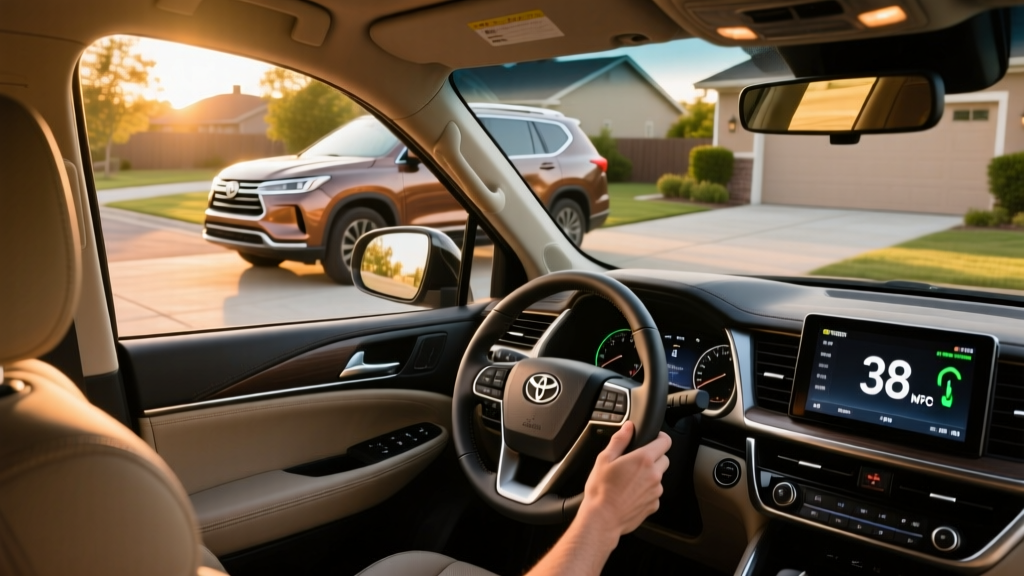
Five years after its debut on the TNGA-K platform, the 2021 Toyota Highlander Hybrid remains one of the most efficient three-row SUVs you can buy used or certified pre-owned. With an EPA-rated 35 MPG combined, standard all-wheel drive, and Toyota's proven fourth-generation hybrid system, it delivers minivan-like efficiency in a midsize SUV package — without ever needing a plug.
This is a conventional hybrid (HEV), not a plug-in hybrid (PHEV). That distinction matters: you'll never search for a charger, but you also won't get any electric-only driving range. For families who want set-it-and-forget-it fuel savings without lifestyle changes, the 2021 Highlander Hybrid occupies a practical sweet spot that full EVs and PHEVs can't always match.
HEV vs PHEV vs EV: Where the Highlander Hybrid Fits
Understanding the three electrified options:
- HEV (Conventional Hybrid): The 2021 Highlander Hybrid is this type. A small battery (1.6 kWh) recharges through regenerative braking and the gas engine. No plug, no charger needed. You simply fill up at a gas station and drive. Electric motor assists the engine for better MPG.
- PHEV (Plug-In Hybrid): Larger battery (typically 13-18 kWh), can be plugged in for 25-40 miles of electric-only range before the gas engine kicks in. Examples: Toyota RAV4 Prime, Chrysler Pacifica Hybrid. Requires home charging access to maximize value.
- BEV (Battery Electric Vehicle): No gas engine at all. 200-350+ miles of range from a large battery (60-100+ kWh). Requires regular charging. Examples: Tesla Model Y, Kia EV9, Hyundai Ioniq 5.
The Highlander Hybrid is the lowest-commitment option. If you live in an apartment without charging access, take frequent long road trips, or simply don't want to think about charging logistics, the HEV route eliminates range anxiety entirely while still cutting fuel consumption roughly in half compared to the gas-only Highlander.
Fuel Economy: EPA Ratings vs Real-World MPG
The 2021 Highlander Hybrid's fuel economy is its headline feature. Here's how the EPA rates it across all trims (LE, XLE, Limited, Platinum), all of which come with electronic on-demand AWD:
| Metric | EPA Rating | Real-World Expectation |
|---|---|---|
| City MPG | 35 MPG | 34–37 MPG (hybrids often beat EPA in stop-and-go) |
| Highway MPG | 35 MPG | 30–33 MPG (aerodynamic drag hurts hybrids at 75+ mph) |
| Combined MPG | 35 MPG | 32–35 MPG |
| Annual Fuel Cost | ~$1,650 (15k mi/yr) | Varies with local gas prices |
Real-world note: According to fueleconomy.gov, owner-reported MPG for the 2021 Highlander Hybrid clusters around 30–34 MPG combined in mixed driving. Highway-heavy commuters at sustained speeds above 70 mph should expect the lower end. City-dominant drivers frequently report matching or slightly exceeding the 35 MPG city rating, since hybrids recapture the most energy during low-speed stop-and-go driving where regenerative braking is most effective.
For comparison — the gas-only 2021 Highlander: The non-hybrid 2021 Highlander with the 2.4L turbo four-cylinder (introduced mid-cycle) or the older 3.5L V6 rates at roughly 21 city / 29 highway / 24 combined with FWD. The hybrid's 35 MPG combined represents a ~46% improvement in fuel economy.
Powertrain & Performance Specs
The 2021 Highlander Hybrid pairs a 2.5-liter inline-four Atkinson-cycle engine with three electric motors — one integrated into the transaxle for front-wheel drive and two on the rear axle for electronic on-demand AWD. There's no mechanical driveshaft to the rear wheels; the rear motors engage only when traction is needed.
| Specification | 2021 Highlander Hybrid |
|---|---|
| Engine | 2.5L inline-4 Atkinson cycle |
| Engine Output | 186 hp / 175 lb-ft torque |
| Front Electric Motor | 134 kW (180 hp) |
| Rear Electric Motors | 40 kW (54 hp) combined |
| Net System Horsepower | 243 hp |
| Hybrid Battery | 1.6 kWh nickel-metal hydride (NiMH) |
| Transmission | eCVT (planetary gearset, no belt) |
| Drivetrain | Electronic on-demand AWD (standard) |
| 0–60 mph | ~7.8 seconds |
| Towing Capacity | 3,500 lbs |
| Cargo Volume (behind 3rd row) | 16.1 cu ft |
| Cargo Volume (max) | 84.3 cu ft |
The 243 net horsepower is adequate for a 4,500-pound SUV, though it won't feel quick off the line the way a turbocharged gas engine or an EV would. The eCVT is smooth and never drones under moderate acceleration, but flooring it on a highway on-ramp reveals the inherent compromise of a hybrid powertrain tuned for efficiency over sportiness. For the target buyer — a family hauling kids and cargo — the powertrain delivers exactly the right balance of responsiveness and thrift.
Reliability, Battery Lifespan & Warranty Coverage
Toyota's hybrid system is among the most battle-tested in the industry, with over two decades of real-world data from the Prius, Camry Hybrid, and RAV4 Hybrid. The Highlander Hybrid uses the same fundamental architecture, which is a strong reliability signal.
Hybrid Battery Warranty: Toyota covers the 2021 Highlander Hybrid's battery for 10 years or 150,000 miles (whichever comes first) under the Hybrid System Warranty. This applies to the original owner and is transferable to subsequent owners. In California and states that follow CARB emissions standards, coverage extends to 10 years / 150,000 miles as well.
Powertrain Warranty: 5 years / 60,000 miles.
Basic Warranty: 3 years / 36,000 miles.
Battery replacement cost: If the hybrid battery fails outside of warranty, a replacement from Toyota typically costs between $3,000 and $5,000 including labor at a dealership. Independent hybrid specialists can often refurbish or replace individual battery modules for $1,500–$2,500. However, Toyota's NiMH hybrid batteries have demonstrated exceptional longevity — many Prius batteries last well beyond 200,000 miles with minimal degradation, and the Highlander uses a similar chemistry and management system.
Common issues to watch: The 2021 model year is generally solid. Some owners have reported minor infotainment glitches and wind noise at highway speeds, but no widespread powertrain or hybrid-system failures have emerged. Check NHTSA's recall database for any open recalls on a specific VIN before purchasing used.
Pricing & Tax Credit Eligibility
The 2021 Highlander Hybrid is no longer sold new, so buyers are looking at the used or certified pre-owned (CPO) market. Here's what original MSRP looked like and where used pricing sits today:
| Trim | Original MSRP (2021) | Est. Used Price (2026) |
|---|---|---|
| LE | $39,070 | $28,000–$32,000 |
| XLE | $41,070 | $30,000–$34,500 |
| Limited | $45,970 | $33,000–$38,000 |
| Platinum | $49,070 | $36,000–$41,000 |
Federal tax credit: The 2021 Highlander Hybrid does not qualify for the federal §30D new clean vehicle tax credit (up to $7,500) because it is a conventional hybrid, not a plug-in vehicle. The §30D credit applies only to BEVs and PHEVs that meet battery-sourcing, MSRP, and buyer income requirements per IRS guidelines.
Used EV credit (IRC §25E): The used clean vehicle credit (up to $4,000 or 30% of sale price, whichever is less) also applies only to used BEVs and PHEVs — not conventional hybrids. The Highlander Hybrid is ineligible.
State incentives: A handful of states offer rebates or HOV lane access for hybrids, but these programs vary widely and many have been phased out in favor of PHEV/BEV incentives. Check your state's energy or DMV website for current programs.
Who Should Choose the Highlander Hybrid vs an EV or PHEV?
Reasons to Choose the Highlander Hybrid
- You want three rows and top-tier MPG without plugging in
- You lack reliable home or workplace charging access
- You regularly drive 400+ miles between fuel stops
- You want proven Toyota hybrid reliability with a 10-year battery warranty
- You want AWD standard for snow/rain without a fuel-economy penalty
- You prefer a lower purchase price over a PHEV or EV equivalent
Reasons to Look at a PHEV or EV Instead
- You have home charging and want electric-only daily commuting (PHEV/BEV)
- You want to qualify for federal tax credits up to $7,500 (PHEV/BEV only)
- You want one-pedal driving and instant EV torque (BEV)
- Your daily commute is under 30 miles and you want zero tailpipe emissions (PHEV/BEV)
- You want the lowest possible per-mile energy cost (electricity is cheaper than gas)
- You want the latest ADAS or infotainment tech (2021 model shows its age vs 2025+ models)
Choose the Highlander Hybrid if: You need three rows, AWD, and 35 MPG combined in a package you can refuel at any gas station in 3 minutes. Ideal for road-trip-heavy families in areas with sparse charging infrastructure.
Choose a PHEV (like the Toyota Sienna Hybrid or a used Chrysler Pacifica Hybrid) if: You have home Level 2 charging and want 30+ miles of electric-only range for school runs and commutes, with a gas engine for longer trips.
Choose a BEV (like the Kia EV9 or Tesla Model Y) if: You have reliable home charging, want the lowest per-mile cost, qualify for the §30D tax credit, and are comfortable planning DC fast-charging stops on road trips.
Frequently Asked Questions
How many MPG does the 2021 Toyota Highlander Hybrid get?
The EPA rates it at 35 MPG city, 35 MPG highway, and 35 MPG combined. In real-world driving, expect 32–35 MPG combined, with city-dominant driving often matching or slightly exceeding the EPA city figure and sustained highway driving at 75+ mph dropping to around 30–33 MPG.
Does the Highlander Hybrid need to be plugged in?
No. The 2021 Highlander Hybrid is a conventional HEV. Its 1.6 kWh NiMH battery charges entirely through regenerative braking and the gasoline engine. You never plug it in — you just fill up at a gas station like any other vehicle.
Is there a plug-in hybrid (PHEV) version of the Highlander?
Toyota has never offered a Highlander PHEV. If you want a three-row Toyota with plug-in capability, the closest option is the Toyota Sienna (which is a hybrid-only minivan, not a PHEV) or looking outside Toyota to the Chrysler Pacifica Hybrid, which offers 32 miles of electric-only range.
How long will the hybrid battery last?
Toyota's NiMH hybrid batteries routinely last 150,000–200,000+ miles based on two decades of Prius data. The 2021 Highlander Hybrid's battery is covered for 10 years or 150,000 miles. If replacement is needed out of warranty, expect to pay $3,000–$5,000 at a dealer or $1,500–$2,500 at an independent hybrid shop.
Does the 2021 Highlander Hybrid qualify for any tax credit?
No. Federal clean vehicle tax credits (§30D for new, §25E for used) apply only to plug-in vehicles — BEVs and PHEVs. Conventional hybrids like the Highlander Hybrid do not qualify. Some states may offer minor incentives, but most have shifted focus to plug-in vehicles.
How does the Highlander Hybrid compare to the gas-only Highlander?
The gas-only 2021 Highlander (with the 2.4L turbo) rates around 24 MPG combined. The hybrid's 35 MPG combined saves roughly $600–$800 per year in fuel costs at 15,000 miles driven annually (depending on local gas prices). Over five years of ownership, that's $3,000–$4,000 in fuel savings — enough to offset much of the hybrid's original price premium over the gas model.
Is the 2021 Highlander Hybrid good in snow?
Yes. The electronic on-demand AWD system is standard on all trims and uses rear electric motors to provide rear-wheel traction when front wheels slip. It's not a dedicated off-road system, but it handles snowy commutes and wet highways confidently — and unlike mechanical AWD systems, it doesn't impose a fuel-economy penalty during normal dry-weather driving.
Final Assessment
The 2021 Toyota Highlander Hybrid earns its reputation as a pragmatic family hauler. It won't excite enthusiasts, and its infotainment and ADAS tech feel dated compared to 2025 models. But for the specific mission of moving seven people and their cargo while sipping fuel at 35 MPG — without ever needing a charging station — it remains one of the best vehicles in its class, new or used.
If you can install a Level 2 home charger and your daily driving stays under 40 miles, a PHEV or BEV will save you more money and reduce more emissions. But if charging access is uncertain or your mileage patterns are unpredictable, the Highlander Hybrid's no-compromise efficiency is hard to beat.