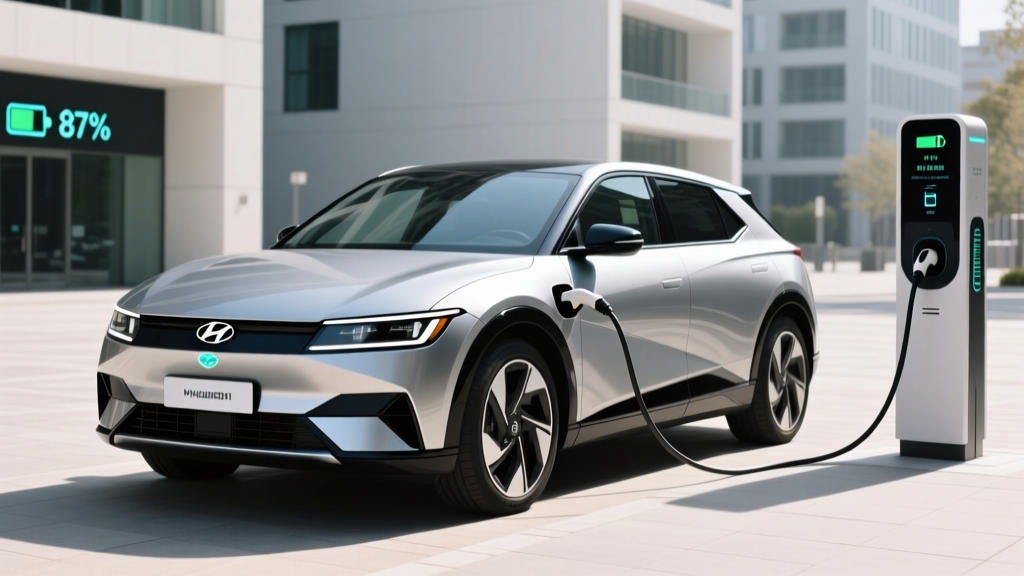
If you've been searching for a Hyundai Ioniq 5 hybrid, you're not alone — the keyword pulls steady interest every month from shoppers who love the Ioniq 5's retro-futuristic styling and spacious cabin but aren't quite ready to commit to a fully electric vehicle. Here's the essential truth up front: the Hyundai Ioniq 5 is a battery-electric vehicle (BEV), not a hybrid or plug-in hybrid. There is no hybrid variant in the 2026 lineup, and Hyundai has not announced one.
But that doesn't mean you're out of options. Hyundai offers two electrified paths that capture what most "Ioniq 5 hybrid" seekers actually want: the all-electric Ioniq 5 (now with NACS native charging and up to 318 miles of EPA range) and the Hyundai Tucson Plug-In Hybrid, which delivers 33 miles of electric-only driving plus a gas engine for road trips. This guide breaks down exactly what each offers so you can make the right call.
The Ioniq 5 Is Electric-Only — Here's What That Means
The Hyundai Ioniq 5 rides on the E-GMP (Electric-Global Modular Platform), a dedicated 800-volt battery-electric architecture shared with the Kia EV6 and Genesis GV60. This platform was engineered exclusively for battery-electric powertrains — there's no room for a gasoline engine, and retrofitting one isn't engineering-feasible or economically rational for Hyundai.
For the 2026 model year, the Ioniq 5 lineup includes:
| Trim | Battery (kWh usable) | Drivetrain | Horsepower | EPA Range | Peak DC Charge | 10–80% Time | Base MSRP |
|---|---|---|---|---|---|---|---|
| SE Standard Range | 63.0 (LFP) | RWD | 168 hp | 245 mi | ~150 kW | ~22 min | $42,600 |
| SE / SEL Long Range | 84.0 (NMC) | RWD | 225 hp | 318 mi | ~240 kW | ~18 min | $46,650 |
| SEL / Limited AWD | 84.0 (NMC) | AWD | 320 hp | 290 mi | ~240 kW | ~18 min | $50,100 |
| Ioniq 5 N | 84.0 (NMC) | AWD | 641 hp | 221 mi | ~240 kW | ~18 min | $66,200 |
What "Ioniq 5 Hybrid" Searchers Actually Want: The Tucson PHEV
Most shoppers searching for a Hyundai Ioniq 5 hybrid are really after one of two things: (1) the Ioniq 5's design and tech with the safety net of a gas engine, or (2) a Hyundai SUV with plug-in capability that eliminates range anxiety. The closest match in Hyundai's 2026 lineup is the Tucson Plug-In Hybrid.
HEV vs PHEV — Understanding the Difference
Before we get to specs, it's critical to distinguish the two hybrid types Hyundai offers in the Tucson:
Conventional Hybrid (HEV)
No plug needed. A small battery recharges via regenerative braking and the gas engine. The electric motor assists the engine but cannot drive the car on electricity alone for meaningful distances. Think of it as a more efficient gas car.
Plug-In Hybrid (PHEV)
Plug in to charge. A larger battery provides 30+ miles of pure electric driving for daily commutes. Once the battery depletes, the gas engine takes over seamlessly. Best of both worlds for many drivers.
| Metric | Tucson PHEV (AWD) | Tucson HEV (AWD) |
|---|---|---|
| Electric-Only Range | 33 miles | N/A |
| Combined MPGe (electric + gas) | 80 MPGe | N/A |
| Gas-Only MPG (combined) | 35 MPG | 38 MPG |
| City MPG (gas-only) | 36 MPG | 40 MPG |
| Highway MPG (gas-only) | 34 MPG | 37 MPG |
| Total Combined Range | ~420 miles | ~530 miles |
| Battery Capacity | 13.8 kWh (NMC) | 1.49 kWh |
| Combined Horsepower | 261 hp | 232 hp |
| Engine | 1.6L turbo I4 + 98 kW motor | 1.6L turbo I4 + 47 kW motor |
Tucson PHEV Charging: What to Expect
The Tucson PHEV's 13.8 kWh battery can be charged in two ways:
| Charging Level | Power (kW) | 0–100% Time | Where |
|---|---|---|---|
| Level 1 (120V household) | ~1.4 kW | ~10 hours | Standard outlet |
| Level 2 (240V home/public) | 7.2 kW | ~2 hours | Home wallbox, public L2 |
| DC Fast Charge | Not supported | N/A | N/A |
Critical note: The Tucson PHEV does not support DC fast charging. This is typical for PHEVs — the battery is small enough that Level 2 fully replenishes it in about two hours, which covers overnight home charging and opportunistic top-ups at workplace or shopping-center chargers. If you need DC fast charging for road trips, that's a capability only the all-electric Ioniq 5 provides (10–80% in ~18 minutes at a 250+ kW station).
Pricing and Federal Tax Credit Eligibility
2026 Tucson PHEV Pricing
- SEL: ~$40,200 MSRP
- Limited: ~$46,500 MSRP
2026 Tucson HEV Pricing
- Blue: ~$34,400 MSRP
- SEL Convenience: ~$37,600 MSRP
- Limited: ~$41,900 MSRP
Does the Tucson PHEV Qualify for a Federal Tax Credit?
Under current IRS §30D rules, the Tucson PHEV may qualify for up to $3,750 (not the full $7,500) depending on battery component and critical mineral sourcing requirements. Key eligibility criteria include:
- MSRP cap: SUVs must be under $80,000 — Tucson PHEV qualifies.
- Buyer income cap: Modified AGI must not exceed $150,000 (single) / $300,000 (joint).
- Battery sourcing: Partial credit ($3,750) requires meeting either critical minerals OR battery component thresholds. Full $7,500 requires meeting both.
- Point-of-sale transfer: Eligible buyers can apply the credit as a down-payment reduction at the dealership.
The all-electric Ioniq 5 (BEV) qualifies for up to $7,500 under §30D, subject to the same income caps and sourcing requirements. Verify current eligibility at IRS.gov's qualified vehicle list, as sourcing compliance can change model-by-model and quarter-by-quarter.
Real-World MPG: What Owners Actually Report
Hybrids, particularly conventional HEVs, tend to exceed their EPA city estimates in real-world stop-and-go driving because regenerative braking recaptures energy that gas-only vehicles waste as heat. The Tucson HEV's EPA city rating of 40 MPG is conservative — many owners report 42–45 MPG in urban commuting. Highway driving is where hybrids lose their advantage, since the electric motor provides less benefit at sustained high speeds.
For the Tucson PHEV, real-world electric range of 33 EPA miles is generally accurate in moderate temperatures with light acceleration. Expect 25–28 miles in cold weather (below 35°F) or aggressive driving. Once the battery depletes, the 35 MPG combined gas rating holds up well in mixed driving.
Ioniq 5 BEV vs Tucson PHEV vs Tucson HEV — Which Fits You?
Choose the Ioniq 5 (BEV) If:
- You can install a Level 2 home charger
- Your daily driving is under 200 miles
- You want 18-min DC fast charging for road trips
- You want the full $7,500 federal credit
- You prefer the Ioniq 5's design and 800V platform
Choose the Tucson PHEV If:
- Your commute is under 30 miles round-trip
- You take frequent long road trips
- You can't install a home charger but have L2 access
- You want an SUV with more cargo room (38.7 cu ft)
- You want the gas-engine safety net
Choose the Tucson HEV If:
- You want maximum simplicity — no plug, no charging
- Your budget is tighter (~$34,400 starting)
- You drive mostly in the city (40+ MPG real-world)
- You don't have access to any charging infrastructure
Reliability and Long-Term Battery Costs
Hyundai's hybrid and PHEV powertrains have proven reliable in the Tucson platform. The 1.6L turbocharged engine is well-established, and the electric motor adds minimal mechanical complexity (no traditional transmission — the Tucson uses a 6-speed automatic optimized for hybrid duty).
Battery replacement cost: If the high-voltage battery requires replacement out of warranty, expect $4,000–$7,000 for the Tucson PHEV's 13.8 kWh pack and $8,000–$14,000 for the Ioniq 5's 84 kWh pack. However, Hyundai's 10-year/100,000-mile hybrid battery warranty covers most owners through the vehicle's primary ownership life. Data from long-term Hyundai hybrid owners shows minimal degradation — most Tucson HEVs retain 90%+ battery capacity at 100,000 miles.
Frequently Asked Questions
Is there a Hyundai Ioniq 5 hybrid or plug-in hybrid?
No. The 2026 Hyundai Ioniq 5 is exclusively a battery-electric vehicle (BEV). Hyundai has not announced any hybrid variant. The E-GMP platform is designed solely for electric powertrains.
How many MPG does the Tucson PHEV get?
The 2026 Tucson PHEV achieves 80 MPGe combined when using both electric and gas power, and 35 MPG combined (36 city / 34 highway) once the battery is depleted and running on gasoline alone.
How far can the Tucson PHEV drive on electric only?
The EPA rates the Tucson PHEV at 33 miles of electric-only range. Real-world range is typically 28–33 miles in moderate weather, dropping to 25–28 miles in cold conditions.
Does the Tucson PHEV qualify for a federal tax credit?
It may qualify for up to $3,750 under IRS §30D, depending on battery sourcing compliance, buyer income limits ($150K single / $300K joint), and the $80K SUV MSRP cap. The all-electric Ioniq 5 may qualify for up to $7,500. Always verify on IRS.gov.
Is Hyundai's hybrid system reliable?
Yes. Hyundai backs all hybrid, PHEV, and EV batteries with a 10-year/100,000-mile warranty. Real-world degradation data shows Hyundai hybrid batteries retain 90%+ capacity well past 100,000 miles. Out-of-warranty replacement runs $4,000–$7,000 for the PHEV pack.
Should I wait for a hybrid Ioniq 5?
There is no indication Hyundai plans to build a hybrid Ioniq 5. The E-GMP platform is BEV-exclusive. If you want Hyundai's hybrid tech in a similarly sized SUV, the Tucson PHEV or HEV is your current option. If you want the Ioniq 5 specifically, the BEV is the only path.