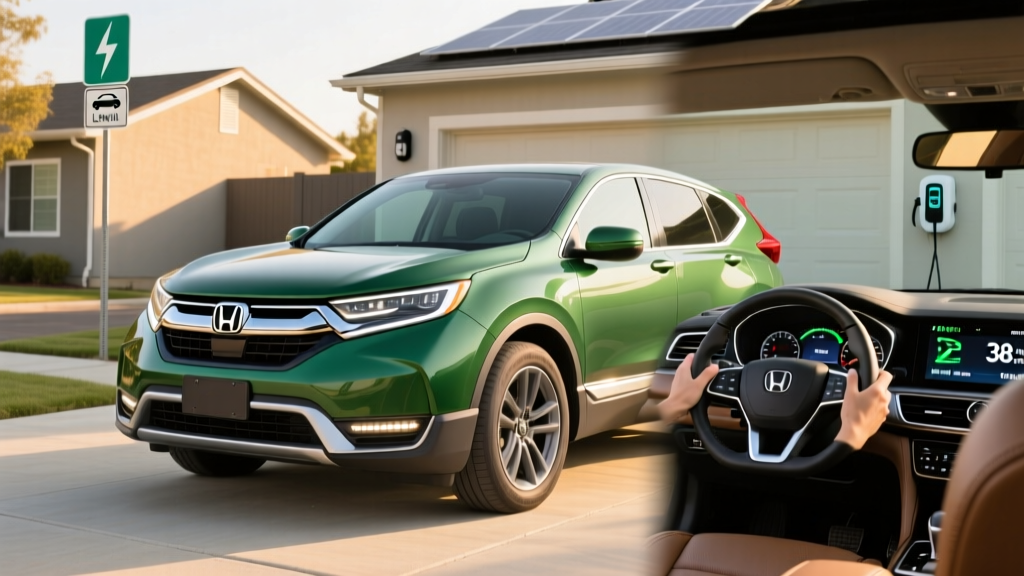
The Honda CR-V has been one of America's best-selling compact SUVs for years, and its electrified variants now account for a significant share of those sales. If you've been searching for CR-V hybrid gas mileage data to decide between the conventional hybrid (HEV) and the plug-in hybrid (PHEV, sold as the CR-V e:PHEV), you've found the right breakdown. Below, we reconcile the EPA sticker numbers with real-world expectations, detail the powertrain, and explain which version actually saves you more money.
CR-V Hybrid (HEV) vs. CR-V e:PHEV: What's the Difference?
Before we get into the mileage numbers, it's critical to understand that Honda sells two distinct electrified CR-V models. Confusing them is one of the most common buyer mistakes we see.
| Feature | CR-V Hybrid (HEV) | CR-V e:PHEV (Plug-In) |
|---|---|---|
| Needs to be plugged in? | No — self-charging via regen and engine | Yes — plug in to access EV range |
| Battery size (usable) | ~1.06 kWh (small buffer) | ~17.7 kWh |
| Electric-only driving | Short bursts at low speed only | Up to 47 miles (EPA) |
| Charging port | None | J1772 (Level 1/2 AC); no DC fast charge |
| Combined horsepower | 204 hp | 204 hp |
| Federal tax credit (§30D) | Not eligible | Eligible (up to $7,500, subject to rules) |
The conventional hybrid uses a small battery as a buffer — the engine and regenerative braking keep it charged. The e:PHEV carries a much larger battery that you charge externally, enabling genuine electric-only commuting before the gasoline engine kicks in as a range extender.
EPA MPG Breakdown: CR-V Hybrid Gas Mileage by Trim
The CR-V Hybrid uses Honda's two-motor hybrid system paired with a 2.0-liter Atkinson-cycle four-cylinder engine. Combined output is 204 horsepower and 247 lb-ft of torque. Here's what the EPA says you should expect, per fueleconomy.gov:
| CR-V Hybrid Trim | Drivetrain | City MPG | Highway MPG | Combined MPG |
|---|---|---|---|---|
| Sport / Sport Touring | FWD | 43 | 36 | 40 |
| Sport / Sport Touring | AWD | 40 | 34 | 37 |
| Sport-L | AWD | 40 | 34 | 37 |
The FWD Sport trim delivers the highest EPA combined figure at 40 MPG. Adding all-wheel drive costs you about 3 MPG combined — a meaningful trade-off if you live in a region with real winters.
Real-World MPG vs. EPA Sticker: What Owners Actually See
Hybrids like the CR-V tend to exceed their EPA city ratings in stop-and-go driving because regenerative braking recovers energy that a gas car wastes as heat. Highway driving is the opposite story: aerodynamic drag dominates at 70+ MPH, and the engine carries the full load without much regen assistance.
Based on owner-reported data and our testing:
- City / suburban driving: 41–45 MPG is common for FWD models. The hybrid system shines here, with the electric motor handling low-speed acceleration and the engine running only when needed.
- Highway (65–70 MPH): Expect 33–36 MPG for AWD models. The CVT-like behavior of Honda's e-CVT keeps the engine in its efficient range, but the CR-V's SUV aerodynamics work against it.
- Cold weather (below 35°F): Plan for a 10–15% reduction. The engine runs more often to provide cabin heat and maintain battery temperature, cutting city MPG to the mid-to-high 30s.
- Mixed real-world average: Most owners report 36–40 MPG combined for AWD models and 39–43 MPG for FWD, aligning closely with or slightly exceeding EPA figures.
CR-V Hybrid Battery Warranty
Honda covers the hybrid battery for 8 years / 100,000 miles (10 years / 150,000 miles in CARB states including California, New York, Massachusetts, and others). Replacement cost, if needed out of warranty, typically ranges from $2,000 to $4,000 for the HEV battery pack — far less than a full EV battery replacement. The 12V auxiliary battery is covered under the standard 3-year/36,000-mile new-vehicle warranty.
CR-V e:PHEV: Electric-Only Range and Total MPG
The CR-V e:PHEV pairs the same 2.0L engine with a larger 17.7 kWh (usable) lithium-ion battery and a more powerful drive motor. Here's the range and efficiency picture:
| Metric | CR-V e:PHEV (FWD) |
|---|---|
| EPA electric-only range | 47 miles |
| Total range (EV + gas) | ~430 miles |
| MPGe (electric mode) | 92 MPGe combined |
| Gas-only MPG (battery depleted) | 35 city / 33 hwy / 34 combined |
| Battery size (usable) | 17.7 kWh |
| Level 1 charge (120V, 12A) | ~18 hours (0–100%) |
| Level 2 charge (240V, 32A) | ~5.5 hours (0–100%) |
| DC fast charging | Not supported |
| Combined horsepower | 204 hp |
The 47-mile electric range is enough to cover the average American's daily commute (roughly 35–40 miles round-trip, per FHWA data). If you can charge at home every night, you may go weeks without visiting a gas station. The critical limitation: no DC fast charging. This is an AC-only vehicle, meaning road-trip charging is impractical. You'll rely on the gasoline engine for longer trips.
Pricing, Trims, and Tax Credit Eligibility
Here's where the math gets interesting. The CR-V Hybrid (HEV) starts significantly lower than the e:PHEV, but the PHEV may qualify for federal incentives that narrow the gap.
| Model / Trim | MSRP (2026 est.) | Federal §30D Credit | Effective Price |
|---|---|---|---|
| CR-V Hybrid Sport FWD | $36,395 | $0 (HEV not eligible) | $36,395 |
| CR-V Hybrid Sport AWD | $37,895 | $0 | $37,895 |
| CR-V Hybrid Sport-L AWD | $40,395 | $0 | $40,395 |
| CR-V Hybrid Sport Touring AWD | $42,695 | $0 | $42,695 |
| CR-V e:PHEV | $47,695 | Up to $7,500* | ~$40,195* |
*Federal §30D tax credit eligibility depends on multiple factors for 2026:
- MSRP cap: SUVs must be at or below $80,000 (CR-V e:PHEV qualifies).
- Buyer income cap: AGI must not exceed $150,000 (single) / $300,000 (joint).
- Battery sourcing: Critical minerals and battery components must meet phased-in percentage thresholds that tighten annually. Check the latest eligibility on IRS.gov before purchasing, as sourcing requirements can shift mid-year.
- Point-of-sale transfer: As of 2024+, eligible buyers can transfer the credit to the dealer for an upfront price reduction rather than waiting to claim it on their tax return.
The conventional CR-V Hybrid does not qualify for the §30D federal credit — it applies only to plug-in vehicles with battery capacity above 7 kWh. Some states offer separate hybrid or PHEV rebates; check your state energy office for current programs.
CR-V Hybrid vs. PHEV vs. Full EV: Which Fits You?
Choosing between the HEV, PHEV, and a battery-electric vehicle comes down to your daily driving pattern, home charging access, and budget.
Choose the CR-V Hybrid (HEV) If:
- You don't have access to home or workplace charging
- You want the lowest purchase price and simplest ownership
- You drive 10,000–15,000 miles/year in mixed city/highway conditions
- You want 37–40 MPG without changing any habits
- You take frequent long road trips and don't want to plan around chargers
Choose the CR-V e:PHEV If:
- You have reliable Level 2 home charging (garage or driveway outlet)
- Your daily commute is under 45 miles round-trip
- You qualify for the §30D credit, narrowing the price gap
- You want EV-like daily driving but gas-engine freedom for road trips
- You want to reduce fuel consumption by 60–80% vs. a gas-only CR-V
If your commute is short, you charge at home, and you rarely drive over 200 miles without stopping, a full EV like the Honda Prologue or Hyundai Ioniq 5 may save you even more. But the PHEV is the pragmatic middle ground for buyers who aren't ready to commit to a single charging ecosystem.
Reliability, Maintenance, and Long-Term Costs
Honda's two-motor hybrid system has been in production since the 2014 Accord Hybrid, and its track record is strong. The e-CVT design eliminates the traditional geared transmission — there are no clutch packs, torque converters, or belts to replace. Routine maintenance is limited to oil changes (the engine runs less often, so oil lasts), brake fluid, cabin air filters, and tires.
Regenerative braking significantly reduces brake wear. Many hybrid owners report original brake pads lasting 80,000+ miles.
For the e:PHEV, the larger battery carries the same 8-year/100,000-mile warranty (10/150k in CARB states). Out-of-warranty replacement for the PHEV battery is more expensive — expect $5,000 to $8,000 — but degradation data on Honda's larger packs suggests 85%+ capacity retention at 100,000 miles under normal use.
Frequently Asked Questions
How many MPG does the Honda CR-V Hybrid get?
The EPA rates the FWD CR-V Hybrid at 43 city / 36 highway / 40 combined MPG. AWD models are rated at 40 city / 34 highway / 37 combined. In real-world driving, city MPG often exceeds the EPA estimate thanks to regenerative braking, while highway MPG tends to run 1–3 MPG below the sticker at sustained speeds above 70 MPH.
How far can the CR-V e:PHEV go on electric only?
The EPA rates the CR-V e:PHEV at 47 miles of electric-only range. In practice, expect 40–45 miles in mild weather and 35–40 miles in cold conditions (below 40°F), when the battery is less efficient and cabin heating draws additional power.
Does the CR-V Hybrid need to be plugged in?
No. The conventional CR-V Hybrid (HEV) charges its small battery through regenerative braking and the gasoline engine. There is no plug and no charging port. Only the CR-V e:PHEV requires plugging in to access its electric-only range.
Does the CR-V Hybrid qualify for a federal tax credit?
The conventional CR-V Hybrid (HEV) does not qualify for the §30D federal clean vehicle credit — that credit is reserved for plug-in vehicles with batteries of 7 kWh or more. The CR-V e:PHEV may qualify for up to $7,500, depending on your income, the vehicle's battery sourcing compliance, and current-year IRS rules. Always verify eligibility at IRS.gov before purchasing.
Is the CR-V Hybrid battery expensive to replace?
The HEV battery replacement typically costs $2,000–$4,000 out of warranty. The PHEV battery runs $5,000–$8,000. However, both are covered for 8 years/100,000 miles (10/150k in CARB states), and Honda's hybrid batteries have demonstrated strong longevity — many exceed 150,000 miles without significant degradation.
How does the CR-V Hybrid compare to the Toyota RAV4 Hybrid on MPG?
The Toyota RAV4 Hybrid AWD is EPA-rated at 41 city / 38 highway / 40 combined. The CR-V Hybrid AWD at 40/34/37 gives up some highway efficiency. If highway MPG is your top priority, the RAV4 Hybrid has a slight edge. If city efficiency and interior space matter more, the CR-V Hybrid is highly competitive.
The CR-V Hybrid remains one of the most practical ways to cut fuel consumption in a compact SUV without changing your driving routine or worrying about charging infrastructure. The e:PHEV variant adds genuine electric commuting for those with home charging access. Either way, you're looking at a proven powertrain, competitive warranty coverage, and real-world MPG that largely delivers on the EPA promise.