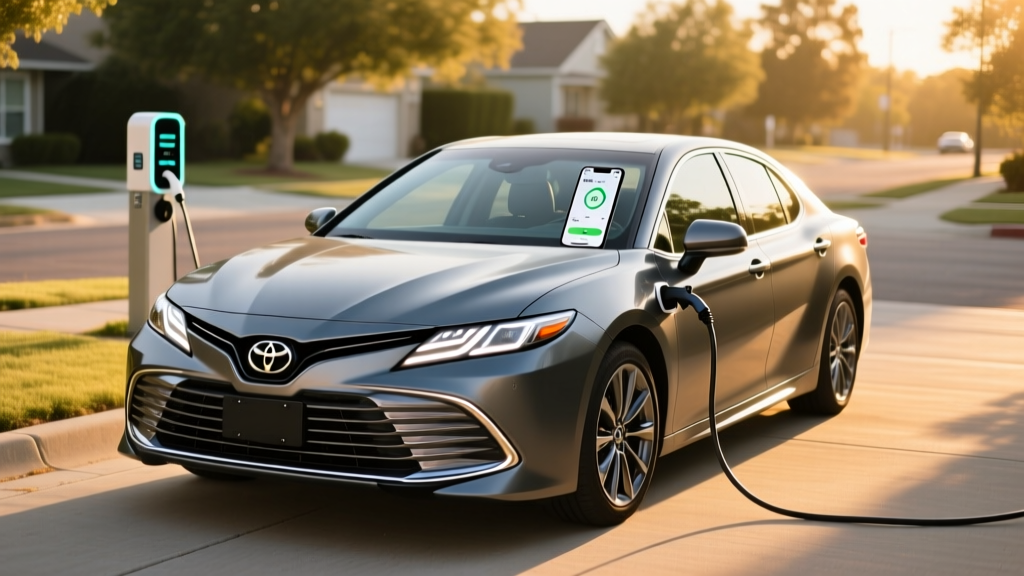
The 2025 Toyota Camry is now exclusively a hybrid. Toyota dropped the four-cylinder gas model entirely, making the ninth-generation Camry a hybrid-only sedan built on the fifth generation of Toyota's Hybrid System (THS 5). The result: a midsize sedan that returns up to 51 MPG combined in front-wheel-drive form, offers available electronic all-wheel drive, and starts under $29,000.
For buyers weighing the Camry Hybrid against plug-in hybrids like the Toyota Prius Prime or full battery-electric vehicles, this guide breaks down the exact specs, real-world efficiency, ownership costs, and whether the 2025 Camry Hybrid fits your driving needs.
HEV vs PHEV: Where the 2025 Camry Hybrid Fits
The 2025 Camry is a conventional hybrid electric vehicle (HEV). It does not plug in. A small lithium-ion battery recharges through regenerative braking and the gasoline engine. You fuel it like any other car — no charging cable, no home charger installation, no range anxiety about finding a plug.
Conventional Hybrid (HEV) vs Plug-In Hybrid (PHEV)
| Feature | HEV (2025 Camry Hybrid) | PHEV (e.g., Prius Prime) | BEV (e.g., Tesla Model 3) |
|---|---|---|---|
| Plug-in charging | No | Yes | Yes |
| Electric-only range | ~1 mile at low speed | 32–44 miles | 250–360+ miles |
| Battery size | ~1.1 kWh (small buffer) | 13.6 kWh usable | 50–82 kWh usable |
| Fueling | Gas station only | Gas station + plug | Plug only |
| Home charging install | Not needed | Recommended (Level 2) | Required |
| Federal tax credit (§30D) | Not eligible | Up to $7,500* | Up to $7,500* |
*PHEV/BEV credit subject to MSRP caps, income limits, and battery sourcing rules per IRS §30D. Verify eligibility with a tax professional.
The Camry Hybrid is engineered for drivers who want maximum fuel efficiency without altering their fueling routine. If you can't charge at home or in your apartment garage, a conventional HEV like the Camry avoids the biggest barrier to electrification.
Fuel Economy: EPA MPG and Real-World Numbers
The 2025 Camry Hybrid comes in two drivetrain configurations with distinct EPA ratings. Front-wheel-drive (FWD) models are the efficiency leaders, while electronic on-demand all-wheel drive (AWD) models sacrifice a small amount of fuel economy for added traction.
| Trim / Drivetrain | City MPG | Highway MPG | Combined MPG | Source |
|---|---|---|---|---|
| LE (FWD) | 53 | 50 | 51 | EPA |
| SE / XLE / XSE (FWD) | 48 | 47 | 47 | EPA |
| LE (AWD) | 51 | 49 | 50 | EPA |
| SE / XLE / XSE (AWD) | 46 | 46 | 46 | EPA |
Real-World MPG: What Owners Actually See
Toyota hybrids historically meet or exceed their EPA city ratings in stop-and-go traffic because regenerative braking recovers energy that a gas car wastes as heat. On fueleconomy.gov, Camry Hybrid owners have reported real-world averages between 45 and 52 MPG combined.
Expect the following adjustments from the sticker:
- City-heavy driving: FWD LE owners often see 52–55 MPG — the electric motor handles low-speed propulsion, and the engine shuts off frequently.
- Highway cruising at 75+ mph: Expect 42–46 MPG. Hybrid advantage shrinks at sustained high speed where the gas engine does most of the work.
- Cold weather (below 35°F): Expect a 5–10% drop. The engine runs more often to maintain cabin heat and battery temperature.
- Mountainous terrain: Regen on descents partially offsets the climbing penalty, but net efficiency drops 5–8%.
Range on a Single Tank
With a 13.2-gallon fuel tank and 51 MPG combined, the FWD LE delivers approximately 673 miles of total range. Even the AWD sport trims at 46 MPG combined yield roughly 607 miles per fill-up — enough for most drivers to visit a gas station once every two to three weeks.
Powertrain Specs: 225 Horsepower, Fifth-Gen THS
The 2025 Camry Hybrid pairs a 2.5-liter four-cylinder engine with one or two electric motors, depending on drivetrain. Here's the full breakdown:
| Specification | FWD Models | AWD Models |
|---|---|---|
| Engine | 2.5L 4-cylinder (184 hp) | 2.5L 4-cylinder (184 hp) |
| Front electric motor | 134 hp | 134 hp |
| Rear electric motor | — | 40 hp (on-demand) |
| Net combined horsepower | 225 hp | 232 hp |
| 0–60 mph (est.) | ~7.1 seconds | ~6.9 seconds |
| Transmission | eCVT | eCVT |
| Drivetrain | FWD | Electronic AWD |
| Battery type | Lithium-ion | Lithium-ion |
| Battery capacity | ~1.1 kWh (buffer) | ~1.1 kWh (buffer) |
| Curb weight | ~3,450 lbs | ~3,560 lbs |
The eCVT isn't a belt-and-pulley continuously variable transmission — it's a planetary gearset that blends engine and motor power seamlessly. There are no fixed "gears," which eliminates shift shock and keeps the engine in its most efficient RPM range.
The AWD system uses a dedicated rear electric motor that engages only when slip is detected or during hard acceleration. There's no mechanical driveshaft to the rear wheels, reducing weight and parasitic loss. In practice, it's a traction aid for rain and light snow, not an off-road system.
Pricing, Trims, and Tax Credit Eligibility
The 2025 Camry Hybrid is offered in four trims. All-wheel drive is a $1,525 option on every trim except the XSE, where it's standard.
| Trim | FWD MSRP | AWD MSRP | Key Features |
|---|---|---|---|
| LE | $28,700 | $30,225 | 8" touchscreen, wireless CarPlay/Android Auto, TSS 3.0 |
| SE | $30,900 | $32,425 | Sport-tuned suspension, 18" wheels, paddle shifters |
| XLE | $33,400 | $34,925 | Leather-trimmed seats, 12.3" display, heated front seats |
| XSE | $35,200 | $35,900 | Sport appearance, 19" wheels, standard AWD |
Prices include destination charge. Verify current MSRP at Toyota.com.
Does the 2025 Camry Hybrid Qualify for a Tax Credit?
No. The federal §30D Clean Vehicle Credit applies only to plug-in electric vehicles (PHEVs and BEVs) with a minimum battery capacity of 7 kWh and plug-in charging capability. The Camry Hybrid's ~1.1 kWh battery and lack of a charge port make it ineligible.
However, the Camry Hybrid's low purchase price — starting under $29,000 — means buyers avoid the higher upfront premiums of PHEVs and BEVs. The fuel savings alone offset the lack of a credit:
- Annual fuel cost (15,000 miles, $3.30/gal, 47 MPG combined): ~$1,053
- Comparable gas-only midsize sedan (30 MPG combined): ~$1,650/year
- Annual savings vs gas: ~$597
- 5-year fuel savings: ~$2,985
Some states and local utilities offer rebates for hybrid purchases. Check your state energy office or utility provider for current programs — these vary widely by jurisdiction and change frequently.
Reliability and Hybrid Battery Warranty
Toyota's hybrid system is among the most proven in the industry, with over 25 years of continuous production since the original 1997 Prius. The 2025 Camry Hybrid carries Toyota's standard hybrid battery warranty:
2025 Camry Hybrid Battery Warranty
- Hybrid battery: 10 years / 150,000 miles (whichever comes first)
- Hybrid system components: 8 years / 100,000 miles
- Basic vehicle warranty: 3 years / 36,000 miles
- Powertrain warranty: 5 years / 60,000 miles
What Does Hybrid Battery Replacement Cost?
If the hybrid battery fails outside warranty coverage, replacement costs typically range from $2,000 to $4,000 for a new OEM battery pack, including labor. Refurbished or reconditioned packs are available for $1,000–$2,000. Given the 10-year/150,000-mile warranty and Toyota's track record — many Prius and Camry Hybrid batteries last well beyond 200,000 miles — out-of-pocket replacement is uncommon for first owners.
The lithium-ion pack in the 2025 model is smaller and less stressed than earlier nickel-metal-hydride packs. It operates in a narrow state-of-charge window (roughly 40–80% SoC), which Toyota's battery management system maintains to maximize longevity. The engine and regenerative braking keep the battery in this sweet spot automatically — no owner intervention required.
Overall Reliability Outlook
Toyota consistently ranks at or near the top of J.D. Power and Consumer Reports reliability surveys, and the Camry nameplate has decades of fleet and taxi service validating its durability. The eCVT transmission has no friction bands or clutch packs to wear out — it's a gearset with far fewer failure points than a conventional automatic. Brake pad life is extended significantly by regenerative braking, with many owners reporting 60,000–80,000 miles on original pads.
Camry Hybrid vs Prius Prime vs Full EV: Which Fits You?
2025 Camry Hybrid Pros
- Up to 51 MPG combined, 673 miles per tank
- No plug-in charging required — fuel anywhere
- Starting MSRP under $29,000
- Spacious midsize cabin, 15.1 cu-ft trunk
- Available AWD for inclement weather
- 10-year/150,000-mile hybrid battery warranty
- Toyota Safety Sense 3.0 standard (adaptive cruise, lane keeping, auto emergency braking)
2025 Camry Hybrid Cons
- No federal tax credit eligibility
- No electric-only driving beyond low-speed creep
- eCVT drone under hard acceleration
- Sport trims (SE/XSE) drop to 46–47 MPG
- No DC fast charging (not applicable to HEV)
- Higher-mileage highway drivers see less hybrid benefit
The Decision Framework
Choose the 2025 Camry Hybrid if:
- You can't charge at home (apartment, street parking, no garage outlet)
- You want a midsize sedan with 50+ MPG and no behavioral changes
- Your budget is under $35,000 and you want low total cost of ownership
- You drive a mix of city and highway with a city-heavy commute
- You live in a region with extreme cold where EV range loss is a concern
Choose a PHEV (Prius Prime, RAV4 Prime) if:
- You can install a Level 2 charger at home and want 32–44 miles of electric-only commuting
- Your daily round-trip commute is under 40 miles (you may rarely use gas)
- You want the §30D federal tax credit (up to $7,500, subject to eligibility)
Choose a full BEV (Tesla Model 3, Hyundai Ioniq 6) if:
- You have reliable home charging and want zero tailpipe emissions
- Your daily driving is under 250 miles and you road-trip infrequently
- You want the lowest per-mile "fuel" cost (electricity vs gasoline)
- You want to access HOV lanes (varies by state)
Safety and Driver Assistance
Every 2025 Camry Hybrid comes standard with Toyota Safety Sense 3.0, which includes:
- Pre-Collision System with Pedestrian Detection
- Full-Speed Range Dynamic Radar Cruise Control
- Lane Departure Alert with Steering Assist
- Lane Tracing Assist
- Road Sign Assist
- Automatic High Beams
- Proactive Driving Assist (gentle braking/deceleration support)
This is a SAE Level 2 driver-assistance system. The driver must remain fully engaged — hands on the wheel, eyes on the road — at all times. It is not autonomous driving. The Camry Hybrid earned top marks from the IIHS in prior model years, and the 2025 generation continues that safety focus with a reinforced structure and standard blind-spot monitoring on SE and above trims.
Frequently Asked Questions
How many MPG does the 2025 Camry Hybrid get?
The FWD LE trim achieves an EPA-estimated 53 city / 50 highway / 51 combined MPG. Sport and luxury trims (SE, XLE, XSE) with larger wheels and AWD rate at 46–47 MPG combined. Real-world results for city-heavy drivers often exceed EPA estimates by 2–4 MPG.
Does the 2025 Camry Hybrid need to be plugged in?
No. The Camry Hybrid is a conventional HEV. Its small lithium-ion battery charges through regenerative braking and the gasoline engine. You fuel it exclusively at gas stations — there is no charge port.
Is the 2025 Camry Hybrid available with AWD?
Yes. Electronic on-demand AWD is available on all trims ($1,525 option) and standard on the XSE. The system uses a 40-hp rear electric motor that activates only when needed, minimizing the fuel economy penalty to just 1–2 MPG versus FWD.
How long will the hybrid battery last?
Toyota warrants the hybrid battery for 10 years or 150,000 miles. Real-world data from previous-generation Camry Hybrids and Priuses shows many batteries lasting 200,000+ miles without significant degradation. The battery management system keeps the pack in a conservative state-of-charge window to maximize cycle life.
What does it cost to replace the hybrid battery?
Out-of-warranty replacement runs $2,000–$4,000 for a new OEM pack including labor. Refurbished packs are available for $1,000–$2,000. Given the generous warranty and Toyota's longevity track record, most first and second owners never face this expense.
Does the 2025 Camry Hybrid qualify for any federal tax credit?
No. The IRS §30D Clean Vehicle Credit requires plug-in capability and a minimum 7 kWh battery. The Camry Hybrid's ~1.1 kWh battery and lack of a charge port disqualify it. Check your state and local utility for possible hybrid rebates, which vary by jurisdiction.
How does the Camry Hybrid compare to the Prius?
The Prius (conventional HEV) achieves up to 57 MPG combined in LE FWD form but offers less interior space and a lower starting price. The Camry Hybrid trades 6 MPG for a roomier cabin, more refined ride, and midsize sedan comfort. The Prius Prime (PHEV) offers 44 miles of electric-only range and may qualify for the federal tax credit, but requires home charging access to realize its efficiency advantage.
Is the Camry Hybrid good for highway driving?
It's competent, but hybrids shine most in city traffic where regenerative braking recovers the most energy. At sustained 75–80 mph highway speeds, expect 42–46 MPG depending on trim — still excellent for a midsize sedan, but the advantage over an efficient gas car narrows. The 225-hp combined output provides confident highway merging, and the cabin remains quiet at cruising speed.