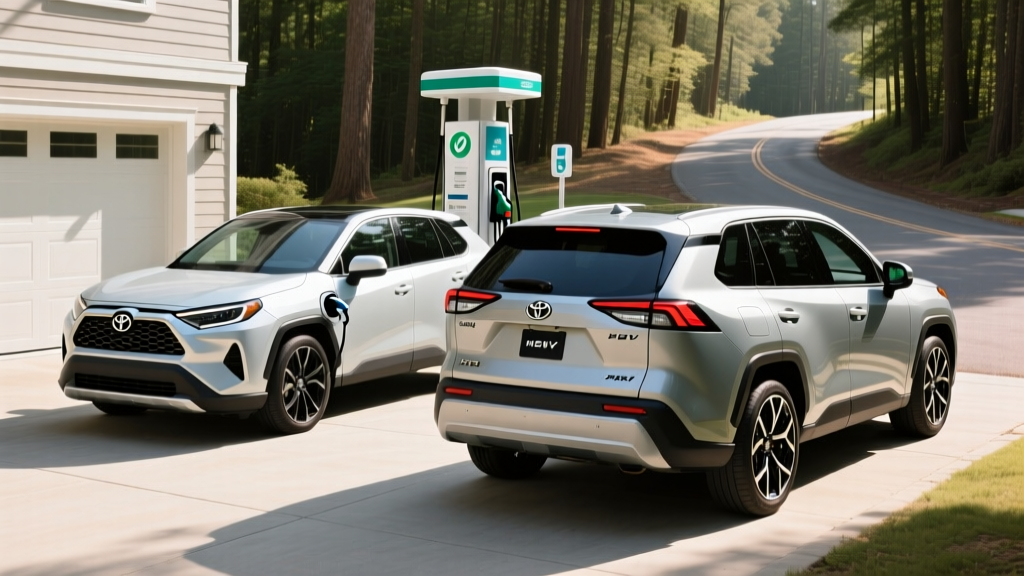
Hybrid RAV4 MPG at a Glance: What the EPA Says (and What You'll Actually See)
Toyota's RAV4 Hybrid and RAV4 Prime plug-in hybrid remain two of the most fuel-efficient compact SUVs on the market, but their MPG stories diverge sharply depending on how you drive. The conventional hybrid (HEV) delivers a strong EPA-estimated 41 city / 38 highway / 39 combined MPG across most trims, while the RAV4 Prime PHEV adds 42 miles of electric-only range and a 94 MPGe combined rating when its battery is charged. Below, we break down every number that matters — and where the real-world data departs from the sticker.
| Model | City MPG | Highway MPG | Combined MPG | MPGe (PHEV) | EV-Only Range |
|---|---|---|---|---|---|
| RAV4 Hybrid (HEV) AWD | 41 | 38 | 39 | N/A | N/A |
| RAV4 Prime (PHEV) AWD | 40 (hybrid mode) | 36 (hybrid mode) | 38 (hybrid mode) | 94 | 42 mi |
Source: fueleconomy.gov — EPA estimates. Actual mileage varies with driving conditions, climate, and tire selection.
RAV4 Hybrid (HEV) vs. RAV4 Prime (PHEV): What's the Difference?
The naming convention trips up many shoppers. Here's the clean distinction:
RAV4 Hybrid (HEV)
- No plug required. The battery charges entirely through regenerative braking and the gasoline engine.
- 219 combined horsepower from a 2.5L 4-cylinder engine paired with front and rear electric motors.
- 1.6 kWh battery (nickel-metal hydride) — small buffer for electric assist only.
- No electric-only driving range beyond brief low-speed creeping.
- Fill up at any gas station. No charging infrastructure needed.
RAV4 Prime (PHEV)
- Plugs in to charge. An 18.1 kWh lithium-ion battery provides 42 miles of electric-only range.
- 302 combined horsepower — the most powerful RAV4 outside the discontinued gas-only TRD models.
- Level 1 (120V) charging: ~12 hours. Level 2 (240V): ~2.5 hours. No DC fast charging.
- Once the battery depletes, it operates as a conventional hybrid at ~38 MPG combined.
- Eligible for a federal tax credit (subject to IRS §30D rules — see below).
The HEV is a gas car that sips fuel. The Prime is an EV for your daily commute that happens to have a gas tank for road trips. Both use Toyota's eAWD system with an independent rear electric motor — no mechanical driveshaft connecting the axles.
Powertrain, Battery & Charging Specs
| Specification | RAV4 Hybrid (HEV) | RAV4 Prime (PHEV) |
|---|---|---|
| Engine | 2.5L DOHC 4-cyl (176 hp) | 2.5L DOHC 4-cyl (177 hp) |
| Combined System HP | 219 hp | 302 hp |
| 0–60 mph | 7.4 sec | 5.7 sec |
| Traction Battery | 1.6 kWh NiMH | 18.1 kWh lithium-ion |
| EV-Only Range | N/A | 42 mi (EPA) |
| Total Range (full tank + full charge) | ~580 mi | ~600 mi |
| Level 1 Charge (120V) | N/A | ~12 hours |
| Level 2 Charge (240V, 3.3 kW) | N/A | ~4.5 hours |
| Level 2 Charge (240V, 6.6 kW) | N/A | ~2.5 hours |
| DC Fast Charging | N/A | Not available |
| Fuel Tank | 14.5 gal | 14.5 gal |
| Drivetrain | eAWD | eAWD |
| Towing Capacity | 1,750 lbs | 2,500 lbs |
The Prime's lack of DC fast charging is a notable limitation. If you frequently need to top up mid-trip, you'll rely on Level 2 public chargers, which add roughly 10–12 miles of EV range per 30 minutes at 3.3 kW. For most owners, overnight home charging on a 240V outlet covers the daily commute entirely on electricity.
Real-World MPG: What Owners Actually Report
EPA estimates are a starting point. The real-world data from owner fuel logs and long-term tests tells a more nuanced story:
- RAV4 Hybrid city driving: Owners consistently report 40–44 MPG in warm-weather urban driving. Toyota's hybrid system excels at low speeds where the electric motor handles most of the work and regenerative braking recaptures energy at every stop.
- RAV4 Hybrid highway driving: Expect 35–37 MPG at 70–80 mph. The 2.5L engine carries more of the load at sustained speed, and aerodynamic drag penalizes the RAV4's boxy SUV shape versus a sleeker sedan like the Camry Hybrid (51 combined MPG).
- RAV4 Prime in EV mode: The 42-mile EPA electric range holds up well in mild weather. In winter (below freezing), expect 32–36 miles before the engine engages, due to cabin heating demands and reduced lithium-ion efficiency.
- RAV4 Prime in hybrid mode: Once the battery is depleted, the Prime returns roughly 36–38 MPG combined — slightly less than the lighter HEV, due to the Prime's ~300 lb additional weight from the larger battery pack.
Pricing, Trims & Federal Tax Credit Eligibility
| Trim | RAV4 Hybrid MSRP | RAV4 Prime MSRP |
|---|---|---|
| LE / SE (base) | $33,450 | $44,900 |
| XLE / XSE | $35,200 | $47,800 |
| Woodland Edition | $36,500 | N/A |
| Limited | $39,000 | $51,200 |
| XSE Premium | N/A | $53,500 |
All prices include destination. AWD is standard on all RAV4 Hybrid and Prime trims. Actual dealer pricing may vary.
Does the RAV4 Hybrid or Prime Qualify for a Tax Credit?
RAV4 Hybrid (HEV): No. Conventional hybrids do not qualify for the federal §30D clean vehicle credit. That credit is reserved for plug-in electric vehicles with a minimum battery capacity of 7 kWh.
RAV4 Prime (PHEV): The RAV4 Prime has historically qualified for a partial federal tax credit. Under current IRS §30D rules, eligibility depends on three factors that change periodically:
- MSRP cap: SUVs must have an MSRP at or below $80,000 (all Prime trims qualify).
- Buyer income cap: Modified AGI must not exceed $150,000 (single), $225,000 (head of household), or $300,000 (joint).
- Battery sourcing requirements: Critical minerals and battery components must meet phased-in percentages from US or free-trade-agreement countries. Toyota's supply chain compliance has fluctuated — verify current eligibility on the IRS qualified vehicle list before purchasing.
The point-of-sale transfer option allows eligible buyers to apply the credit as an immediate price reduction at the dealership rather than waiting for tax filing. Consult a tax professional to confirm your personal eligibility, as IRS rules and the qualified vehicle list are updated regularly.
Battery Warranty, Reliability & Replacement Cost
Toyota Hybrid Battery Warranty
RAV4 Hybrid (HEV): 10 years / 150,000 miles (whichever comes first) on the hybrid battery, effective for 2020 and newer model years.
RAV4 Prime (PHEV): 10 years / 150,000 miles on the traction battery, with a minimum capacity retention threshold (typically 70% of original capacity during the warranty period).
Hybrid system components (inverter, transaxle, control module): 8 years / 100,000 miles.
Warranty applies to original owners and is transferable to subsequent owners for the remainder of the term.
How Long Do Toyota Hybrid Batteries Last?
Toyota's hybrid battery track record is among the strongest in the industry. The original Prius fleet (2001–present) demonstrated that NiMH hybrid batteries routinely exceed 150,000–200,000 miles before significant degradation. The RAV4 Hybrid's NiMH pack operates within a narrow state-of-charge window (roughly 40–80%), which dramatically reduces stress and extends cycle life.
The RAV4 Prime's larger lithium-ion battery sees deeper daily cycling (full charge to depletion), but Toyota's thermal management system and conservative buffer strategy protect long-term health. Based on data from earlier Toyota PHEVs (Prius Prime), owners can expect the battery to retain 85–90% of its original capacity after 100,000 miles.
Battery Replacement Cost
- RAV4 Hybrid (NiMH): $2,000–$4,000 for a new OEM replacement battery, plus ~$500–$800 labor. Refurbished/remanufactured units are available for $1,200–$2,000.
- RAV4 Prime (lithium-ion): $6,000–$9,000 for a new OEM pack. This higher cost reflects the larger capacity and more complex lithium-ion chemistry. Independent hybrid shops may offer rebuilt packs at lower cost in the future as more Primes age out of warranty.
For context, IIHS and long-term reliability surveys consistently rate the RAV4 Hybrid as one of the most dependable vehicles in the compact SUV segment. The hybrid system adds complexity but eliminates the conventional starter motor, alternator, and traditional transmission — components that fail regularly in gas-only vehicles.
Hybrid vs. PHEV vs. Full EV: Which RAV4 Fits Your Life?
Choose the RAV4 Hybrid (HEV) if…
- You can't charge at home (apartment, street parking)
- You want maximum simplicity — no plugs, no apps, no charging planning
- Your budget is under $40,000
- You drive a mix of city and highway and want consistent 38–42 MPG everywhere
- You don't want to think about battery charging — ever
Choose the RAV4 Prime (PHEV) if…
- You have a garage or driveway with a 240V outlet for Level 2 charging
- Your daily round-trip commute is under 40 miles
- You want EV-like silent, zero-tailpipe-emission daily driving but need gas flexibility for road trips
- You want 302 hp and 5.7-second 0–60 performance
- You qualify for the federal tax credit, narrowing the price gap with the HEV
Consider a Full EV (like the bZ4X) if…
- You have reliable home Level 2 charging
- Your daily driving is under 200 miles and you rarely take 400+ mile road trips
- You want the lowest per-mile fuel cost (~$0.04–0.06/mi on home electricity vs. ~$0.10–0.12/mi in the hybrid)
- You want zero engine maintenance — no oil changes, no spark plugs, no exhaust system
- You qualify for the full $7,500 federal EV tax credit
Pros & Cons: 2026 RAV4 Hybrid Lineup
✓ Pros
- Class-leading hybrid MPG with proven long-term reliability
- Standard eAWD across all trims — no FWD-only base model
- 10-year/150,000-mile hybrid battery warranty
- Prime offers genuine 42-mile EV commute with gas backup
- Strong resale value — Toyota RAV4 consistently tops depreciation charts
- No range anxiety — fill up at any gas station in 3 minutes
✗ Cons
- Prime PHEV starts ~$11,000 above the Hybrid HEV
- Prime has no DC fast charging — road-trip EV top-ups are slow
- Highway MPG (36–38) trails city MPG — less efficient on long interstate trips
- Cabin noise under hard acceleration (CVT drone from the 2.5L engine)
- Infotainment and driver-assist tech lags behind Hyundai/Kia rivals
- HEV does not qualify for any federal tax credit
Frequently Asked Questions
How many MPG does the RAV4 Hybrid actually get?
The EPA rates the 2026 RAV4 Hybrid at 41 city / 38 highway / 39 combined MPG. In real-world driving, owners report 40–44 MPG in city and suburban conditions and 35–37 MPG on the highway at 75+ mph. Cold weather reduces these figures by roughly 5–12%.
How far can the RAV4 Prime go on electric power alone?
The EPA rates the RAV4 Prime at 42 miles of electric-only range on a full charge. In mild weather (50–80°F), that figure is achievable. In freezing temperatures, expect 32–36 miles before the gasoline engine activates for cabin heating and battery protection.
Do I need to plug in the RAV4 Hybrid to charge it?
No. The conventional RAV4 Hybrid (HEV) never needs to be plugged in. Its small 1.6 kWh battery charges automatically through regenerative braking and the gasoline engine. Only the RAV4 Prime (PHEV) requires plugging in to access its 42-mile electric-only range.
Is the RAV4 Hybrid reliable, and what does a battery replacement cost?
Toyota's hybrid system has an exceptional reliability record spanning two decades. The hybrid battery is warranted for 10 years / 150,000 miles. If replacement is needed out of warranty, a new NiMH pack for the HEV costs $2,000–$4,000 installed, while the Prime's lithium-ion pack runs $6,000–$9,000. Most hybrid batteries outlast 200,000 miles.
Does the RAV4 Hybrid or Prime qualify for a federal tax credit?
The standard RAV4 Hybrid (HEV) does not qualify for the federal §30D clean vehicle credit — it's reserved for plug-in vehicles. The RAV4 Prime (PHEV) may qualify for a partial or full credit depending on current IRS battery-sourcing requirements, your income, and the vehicle's MSRP. Always verify eligibility on the IRS qualified vehicle list before purchase, as compliance status can change.
Should I get the Hybrid or the Prime?
If you can charge at home and your daily commute is under 40 miles round-trip, the Prime lets you drive on electricity most days while keeping gas for longer trips — and the tax credit can offset much of the price premium. If you can't charge at home, want a lower purchase price, or simply want to fill up and go without thinking about it, the standard Hybrid at 39 combined MPG is the more practical choice.