The Midsize Sedan's Hybrid Renaissance: Value Meets Versatility
In an automotive landscape increasingly dominated by crossovers and battery-electric vehicles, the traditional midsize sedan has quietly evolved into a masterclass of cost-efficiency and practical engineering. The Honda Accord Hybrid stands at the pinnacle of this segment. By offering the top-tier EX-L, Sport-L, and Touring trims exclusively with a hybrid powertrain, Honda has made a clear statement: electrification is no longer just an eco-friendly niche; it is the premium standard. But how does this translate to your wallet? For buyers weighing the transition to a hybrid, understanding the real-world cost and value breakdown across different driving scenarios—specifically the daily commute and the weekend road trip—is essential. This comprehensive review dissects the Honda Accord Hybrid's financial footprint, proving why it remains one of the smartest vehicular investments on the market today.
The Two-Motor e:HEV System: Engineering Efficiency
To understand the Accord Hybrid's value proposition, you must first understand its powertrain. Unlike traditional parallel hybrids that simply bolt an electric motor to a transmission, Honda utilizes an innovative two-motor hybrid system. In city driving, the 2.0-liter Atkinson-cycle four-cylinder engine acts primarily as a generator, sending electricity to a powerful drive motor that turns the wheels. This provides the smooth, instant torque of an EV without the range anxiety or charging infrastructure requirements. On the highway, a lock-up clutch engages, allowing the gas engine to drive the wheels directly, bypassing the electric motor to eliminate parasitic losses. This brilliant engineering is the foundation of the Accord Hybrid's exceptional cost-saving capabilities, as validated by the EPA Fuel Economy Guide.
The Daily Commute: City MPG and Real-World Savings
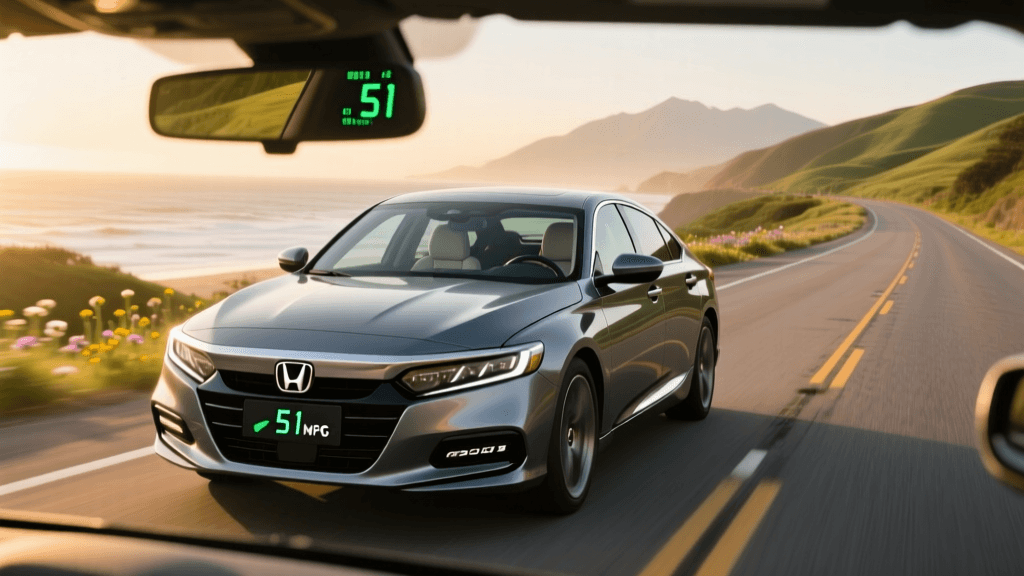
The daily grind is where the Accord Hybrid truly flexes its financial muscles. The EPA rates the EX-L and Sport-L trims at an astonishing 51 MPG in the city, while the heavier, feature-laden Touring trim achieves a still-impressive 48 MPG. Let us break down the math for a typical commuter.
Commuting Cost Scenario: 40 Miles Per Day
- Annual Commute Distance: 10,000 miles (assuming 200 working days at 40 miles round-trip).
- Average City Fuel Economy: 51 MPG (EX-L/Sport-L).
- Gallons Consumed Annually: ~196 gallons.
- Estimated Annual Fuel Cost: At a national average of $3.40 per gallon, your annual commute costs roughly $666.
Compare this to the turbocharged 1.5L gas-only Accord (rated at 29 MPG city), which would consume 344 gallons and cost roughly $1,170 for the exact same commute. Over a standard five-year ownership cycle, the Accord Hybrid saves you over $2,500 in city fuel costs alone. Furthermore, the regenerative braking system, controlled by steering-wheel-mounted deceleration paddles, significantly reduces wear and tear on the physical brake pads, lowering long-term maintenance costs during stop-and-go traffic.
The Road Trip Test: Highway Efficiency, Comfort, and Cargo
While hybrids historically struggled on the open highway, the Accord Hybrid's direct-drive engine clutch ensures it remains highly efficient during road trips. The EPA highway rating sits at 44 MPG. Combined with a 12.8-gallon fuel tank, the Accord Hybrid boasts a theoretical highway range of over 560 miles. This means a road trip from New York to Washington D.C., or Los Angeles to San Francisco, can be completed on a single tank of gas, entirely bypassing the congested and often unreliable public EV charging networks.
Road Trip Value-Adds: Comfort and Utility
Value is not solely defined by fuel savings; it is also about the quality of the experience. The Accord Hybrid excels in long-haul comfort:
- Acoustic Insulation: Active Noise Cancellation and standard acoustic glass on upper trims drastically reduce wind and tire drone, minimizing driver fatigue on 8-hour drives.
- Suspension Tuning: The low center of gravity, aided by the under-floor battery placement, results in a planted, confident ride that rivals entry-level luxury sedans.
- Cargo Capacity: Because the lithium-ion battery pack is mounted beneath the rear floor, the Accord Hybrid retains a massive 16.7 cubic feet of trunk space. Unlike many older hybrids or EVs that sacrifice cargo room for batteries, the Accord easily swallows four large suitcases and a cooler for a weekend getaway.
- Safety Tech: The standard Honda Sensing suite includes Adaptive Cruise Control with Low-Speed Follow and Lane Keeping Assist, acting as a virtual co-pilot on monotonous interstate stretches. The Accord consistently earns top marks from the Insurance Institute for Highway Safety (IIHS), ensuring your family's safety is never compromised.
Cost & Value Comparison Chart
How does the Accord Hybrid stack up against its internal combustion sibling and its fiercest rival, the Toyota Camry Hybrid? Below is a breakdown of the core metrics that define value in the midsize segment.
| Metric | Honda Accord Hybrid (EX-L) | Honda Accord 1.5T (EX) | Toyota Camry Hybrid (SE) |
|---|---|---|---|
| Starting MSRP | $34,395 | $29,990 | $33,490 |
| City / Highway MPG | 51 / 44 MPG | 29 / 37 MPG | 44 / 47 MPG |
| Combined Range (Est.) | ~615 miles | ~420 miles | ~520 miles |
| Cargo Space | 16.7 cu-ft | 16.7 cu-ft | 15.1 cu-ft |
| Powertrain Warranty | 8 yrs / 100k miles (Hybrid System) | 5 yrs / 60k miles | 8 yrs / 100k miles (Hybrid System) |
Total Cost of Ownership (TCO) and Maintenance Value
When evaluating the true cost of a vehicle, the purchase price is merely the entry fee. Total Cost of Ownership (TCO) encompasses depreciation, insurance, maintenance, and fuel. According to long-term data aggregated by automotive analysts at Edmunds, Honda vehicles consistently suffer from below-average depreciation, and the Accord Hybrid is no exception. The desirability of high-MPG vehicles in the used market protects your equity when it is time to sell or trade in.
Maintenance and Reliability
One common misconception is that hybrid vehicles are expensive to maintain due to complex battery systems. In reality, the Accord Hybrid's e:HEV system eliminates the traditional starter motor, alternator, and accessory drive belts, removing several common failure points found in gas-only cars. Honda backs the hybrid battery and related components with an 8-year/100,000-mile warranty (extended to 10 years/150,000 miles in states that follow CARB emissions standards). Routine maintenance is limited to standard oil changes, cabin air filters, and tire rotations, keeping annual service costs remarkably low.
Final Verdict: Is the Accord Hybrid Worth the Premium?
If your driving routine consists of a mix of congested urban commuting and long-distance highway road trips, the Honda Accord Hybrid is an unparalleled value proposition. While the initial MSRP carries a premium over the base gas-only models, the break-even point via fuel savings is reached much faster than most buyers realize, especially given current fuel price volatility. Beyond the spreadsheet math, you are purchasing a vehicle that offers EV-like smoothness in the city, exceptional road-trip range without charging anxiety, luxury-adjacent interior comfort, and top-tier safety ratings. The Honda Accord Hybrid does not just make financial sense; it elevates the daily driving experience, proving that the smartest choice on the lot is often the most rewarding to drive.