Quick Verdict: Stealth Family Hauler With Hybrid Efficiency
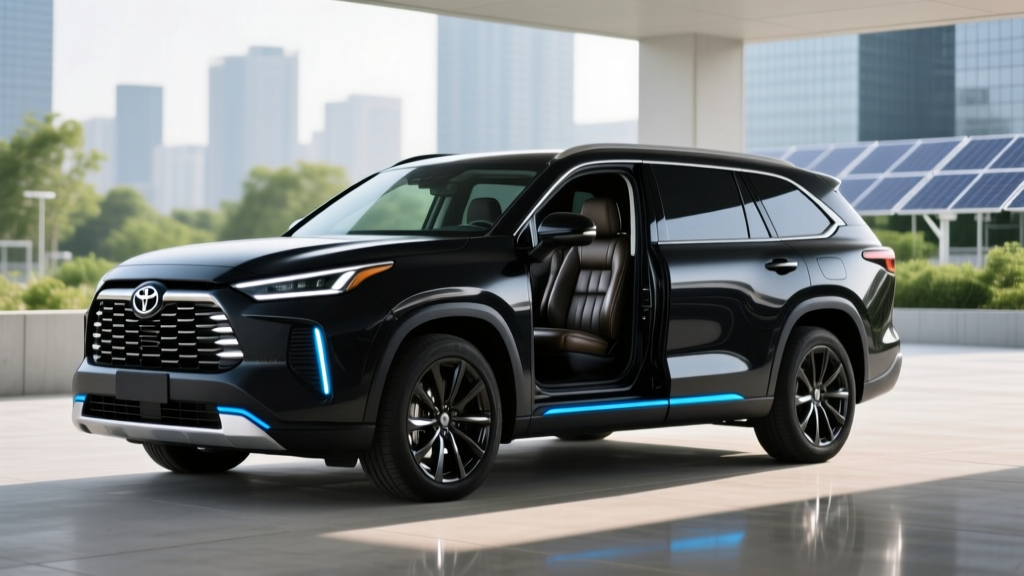
The 2026 Toyota Grand Highlander Hybrid Nightshade threads a specific needle: three-row family utility, blacked-out aesthetic curb appeal, and the fuel-thrifty mechanics of Toyota's proven hybrid system — all without ever plugging in. It is a conventional hybrid (HEV), not a plug-in hybrid (PHEV), which means zero lifestyle change from a gas vehicle. You fill it with regular unleaded and go. The Nightshade edition layers gloss-black 20-inch wheels, black exterior badges, black roof rails, and a black-trimmed interior over the already-capable Grand Highlander Hybrid platform, landing at a price point that undercuts most three-row SUV competitors on cost-per-mile.
If you need three rows, want to avoid range anxiety entirely, and don't have reliable access to home or workplace charging for a full EV or PHEV, this is one of the strongest options on the market. If you want electric-only commuting or federal tax credits, look elsewhere.
Powertrain Specs: What's Under the Hood
The Grand Highlander Hybrid Nightshade uses Toyota's fourth-generation hybrid system, pairing a 2.5-liter inline-four engine with front and rear electric motors for standard electronic all-wheel drive (AWD). Here's the exact breakdown:
| Specification | Value |
|---|---|
| Engine | 2.5L DOHC 4-cylinder + 3 electric motors |
| Combined Net Horsepower | 245 hp |
| Drivetrain | Electronic AWD (eAWD) |
| Transmission | Electronically controlled CVT (eCVT) |
| Hybrid Battery | ~1.6 kWh NiMH (sealed, self-charging) |
| Hybrid Type | Conventional HEV (no plug-in required) |
| Towing Capacity | 3,500 lbs (with tow prep) |
| 0–60 mph (est.) | ~7.8 seconds |
This is the same hybrid architecture Toyota has refined across the Highlander, RAV4 Hybrid, and Camry Hybrid lineups for over a decade. The 245 hp figure is net combined output — the gas engine contributes approximately 186 hp while the electric motors fill in torque gaps, particularly at low speeds where the electric motors provide instant response. The result is smooth, linear acceleration that feels quicker than the 0–60 time suggests in everyday driving.
Fuel Economy: EPA Ratings vs. Real-World MPG
This is where the Grand Highlander Hybrid earns its keep. For a three-row, AWD SUV that weighs over 4,600 pounds, these numbers are exceptional:
| Driving Cycle | EPA Rating |
|---|---|
| City | 36 MPG |
| Highway | 32 MPG |
| Combined | 34 MPG |
Compared to the gas-only Grand Highlander (which returns roughly 24 MPG combined with the turbo-four), the hybrid saves approximately 3–4 gallons per 100 miles. At $3.50/gallon and 15,000 miles per year, that translates to roughly $1,800–$2,100 in annual fuel savings — meaningful money that partially offsets the Nightshade trim's premium.
HEV vs. PHEV vs. Full EV: Which Is Right for You?
The Grand Highlander Hybrid is a conventional HEV. It cannot plug in, has no electric-only driving mode, and does not qualify for federal EV tax credits. Here's how the three electrified powertrain types compare for a buyer in this segment:
| Factor | HEV (This Vehicle) | PHEV (e.g., Chrysler Pacifica Hybrid) | Full EV (e.g., Kia EV9) |
|---|---|---|---|
| Plug-in required? | No | Yes (for EV range) | Yes (always) |
| Electric-only range | 0 miles | 30–40 miles typical | 250–300+ miles |
| Federal tax credit (§30D) | Not eligible | Up to $7,500 (if eligible) | Up to $7,500 (if eligible) |
| Home charging needed? | No | Recommended for EV benefit | Essential |
| Fuel cost per mile | ~$0.10 | ~$0.04 (EV mode) / ~$0.12 (gas) | ~$0.03–$0.05 |
| Maintenance complexity | Low (proven Toyota hybrid) | Moderate (two full systems) | Low (fewer moving parts) |
| Three-row availability | Yes | Minivans only | Limited (EV9, etc.) |
Choose a PHEV or full EV if: You have a Level 2 home charger, your daily commute is under 35 miles (PHEV sweet spot), you want federal tax credit savings, or you want to minimize or eliminate gasoline use.
Nightshade-Specific Features and Interior
The Nightshade treatment on the Grand Highlander Hybrid is primarily cosmetic but meaningfully elevates the SUV's visual presence. Key Nightshade-exclusive additions include:
- Gloss-black 20-inch alloy wheels (replacing the standard silver-finish wheels)
- Black exterior badges and mirror caps
- Black roof rails and window trim accents
- Black-trimmed SofTex interior with contrast stitching
- Dark headliner and black interior trim pieces
- Available in Wind Chill Pearl, Midnight Black Metallic, and Cement exterior colors
Functionally, the Nightshade shares its equipment list with the XLE and Limited hybrid trims. You get a 12.3-inch touchscreen with wireless Apple CarPlay and Android Auto, Toyota Safety Sense 3.0 (including adaptive cruise control, lane-keeping assist, and automatic emergency braking), a power liftgate, heated front seats, and a 10-inch head-up display on upper configurations. Cargo volume behind the third row is approximately 18.4 cubic feet, expanding to 57.9 cubic feet with the third row folded and 97.5 cubic feet with both rear rows down — competitive with the Mazda CX-90 and slightly behind the Kia Telluride.
Pricing, Trims, and Tax Credit Eligibility
The 2026 Grand Highlander Hybrid Nightshade positions itself in the mid-$50,000 range:
| Item | Amount |
|---|---|
| Base MSRP (Nightshade AWD) | ~$54,500 |
| Destination charge | ~$1,450 |
| Federal EV tax credit (§30D) | Not eligible (HEV, not PHEV/BEV) |
| State hybrid incentives | Varies — check your state's energy office |
The Nightshade's ~$54,500 starting price places it roughly $3,000–$4,000 above a comparably equipped XLE Hybrid and about $4,000 below the Hybrid MAX Nightshade (which uses the more powerful turbo-hybrid powertrain rated at 362 hp but returns only ~27 MPG combined). For most buyers, the standard hybrid Nightshade offers the best balance of efficiency, features, and style.
Battery Warranty, Reliability, and Replacement Cost
This is the question every hybrid buyer asks — and it's the right one. Here are the facts:
Toyota's hybrid battery track record is among the best in the industry. The Prius, now in its third decade, has demonstrated hybrid battery lifespans routinely exceeding 200,000 miles. The Grand Highlander's sealed nickel-metal hydride (NiMH) pack is relatively small (~1.6 kWh) and operates within a conservative state-of-charge window, which dramatically reduces degradation stress compared to the large lithium-ion packs in full EVs.
Should the battery need replacement out of warranty: A Toyota hybrid battery replacement currently costs between $3,000–$5,000 including labor at a dealership, or roughly $2,000–$3,500 through independent hybrid specialists. Refurbished battery packs are increasingly available for $1,500–$2,500. Given the 10-year/150,000-mile warranty and Toyota's reliability data, most original owners will never face this cost.
For reliability data, the Grand Highlander carries strong predicted reliability scores from IIHS and Toyota's brand-level dependability consistently ranks at or near the top of J.D. Power's Vehicle Dependability Study. The hybrid variant has fewer wear items than the turbo-four gas model (no turbocharger, regenerative braking extends pad life, no traditional starter motor).
Pros, Cons, and Bottom Line
✓ Pros
- 34 MPG combined in a three-row AWD SUV
- No plug-in required — zero lifestyle adjustment from gas
- 10-year / 150,000-mile hybrid battery warranty
- Proven Toyota hybrid reliability with massive service network
- Nightshade styling adds visual premium without luxury-SUV pricing
- Standard AWD with 3,500-lb towing capacity
✗ Cons
- No federal tax credit eligibility (HEV, not PHEV/BEV)
- Nightshade premium adds ~$3,000+ over XLE Hybrid for cosmetic changes
- No electric-only driving mode, even at low speeds
- Third-row space tight for adults on long trips
- ~$54,500 starting price is significant without credit offset
- Hybrid MAX Nightshade (362 hp) makes standard hybrid feel modest
The 2026 Grand Highlander Hybrid Nightshade is the right choice for families who want three-row practicality, standout styling, and hybrid efficiency without the infrastructure demands of a plug-in vehicle. It won't save you $7,500 at tax time, and it won't let you commute on electricity alone — but it will deliver 34+ MPG on regular gas, start every morning regardless of temperature, and run reliably for well over a decade. That's a formula with enduring appeal.
Frequently Asked Questions
How many MPG does the Grand Highlander Hybrid Nightshade get?
The EPA rates it at 36 city / 32 highway / 34 combined MPG. In real-world city driving, many owners report 36–39 MPG thanks to the hybrid system's regenerative braking. Highway-only driving at 75+ mph typically yields 29–32 MPG.
Does the Grand Highlander Hybrid need to be plugged in?
No. It is a conventional hybrid (HEV). The small hybrid battery charges automatically through regenerative braking and the gas engine. There is no plug, no charging cable, and no electric-only driving mode.
Does the Grand Highlander Hybrid Nightshade qualify for a tax credit?
No. The IRS §30D federal tax credit applies only to plug-in electric vehicles (BEVs and qualifying PHEVs). Conventional hybrids are not eligible. Check your state energy office for any state-level hybrid incentives, which vary by jurisdiction.
How long will the hybrid battery last?
Toyota covers the hybrid battery for 10 years / 150,000 miles. Based on Toyota's long hybrid track record (Prius, Camry Hybrid, RAV4 Hybrid), these batteries routinely last 200,000+ miles. Out-of-warranty replacement costs $3,000–$5,000 at a dealer, less through independent specialists.
Is the Nightshade trim worth the premium over the XLE Hybrid?
The Nightshade adds approximately $3,000–$4,000 over the XLE Hybrid, primarily for black 20-inch wheels, blacked-out exterior trim, and black SofTex interior. If the monochrome aesthetic matters to you, the premium is reasonable. If not, the XLE Hybrid delivers identical mechanicals and MPG at a lower price.
How does it compare to the Hybrid MAX Nightshade?
The Hybrid MAX uses a turbocharged 2.4L engine paired with a more powerful electric system for 362 hp combined, but returns only about 27 MPG combined and starts around $58,000+. The standard hybrid Nightshade (245 hp, 34 MPG) is the efficiency play; the MAX is the performance play.
Can the Grand Highlander Hybrid tow?
Yes. The hybrid AWD model is rated for up to 3,500 pounds of towing capacity with the available tow prep package — sufficient for a small boat trailer, utility trailer, or a pair of personal watercraft.