Quick Verdict: The Accord Hybrid EX Remains the Midsize Sedan Benchmark
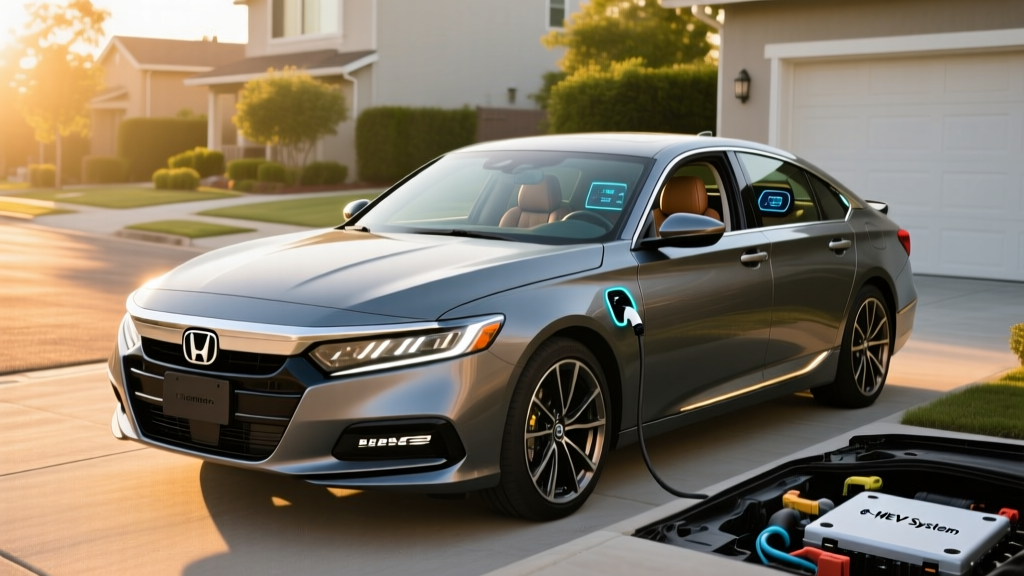
The 2026 Honda Accord Hybrid EX occupies a specific and increasingly valuable niche: a midsize sedan that sips fuel without requiring a plug, a lifestyle change, or a charging-station app. For buyers who want electrified efficiency without the infrastructure dependency of a full EV or the limited electric-only range of a plug-in hybrid, this conventional hybrid (HEV) delivers where it counts — at the pump, in daily drivability, and over long-term ownership.
The EX trim sits mid-range in the Accord Hybrid lineup, offering the same two-motor hybrid powertrain as the pricier Sport-L and Touring trims but at a lower entry price. With an EPA-estimated 48 MPG combined and a starting MSRP around $33,900, it undercuts many competitors on cost-per-mile while maintaining Honda's reputation for powertrain durability.
Fuel Economy: EPA Numbers and Real-World MPG
The Accord Hybrid's two-motor system is optimized for efficiency across all driving conditions, but like most hybrids, it shines brightest in city driving where regenerative braking recaptures energy constantly.
| Metric | City | Highway | Combined |
|---|---|---|---|
| EX / Sport-L | 51 MPG | 44 MPG | 48 MPG |
| Sport / Touring (19" wheels) | 46 MPG | 41 MPG | 44 MPG |
Source: fueleconomy.gov
Real-World MPG: What to Actually Expect
The EPA's 51 MPG city estimate for the EX trim is genuinely achievable — and many owners exceed it. Hybrid systems recapture the most energy in stop-and-go traffic, so urban commuters regularly report 50–54 MPG in warm-weather city driving. Highway driving is a different story: at sustained 70–80 mph speeds, expect 40–43 MPG. The gasoline engine does more direct work at highway speeds, and aerodynamic drag increases exponentially.
In cold weather (below 40°F), expect a 5–10% efficiency reduction. The engine runs more frequently to generate cabin heat and maintain battery temperature, reducing regenerative braking contribution. A typical winter commute that yields 50 MPG in July might return 44–46 MPG in January.
Over a 13.5-gallon tank, the real-world range sits between 540 and 650 miles depending on your driving mix — enough for most owners to visit a gas station once every two to three weeks.
Powertrain: Two-Motor Hybrid System Explained
The Accord Hybrid uses Honda's fourth-generation two-motor hybrid system, which pairs a 2.0-liter Atkinson-cycle four-cylinder engine with two electric motors — one functioning primarily as a generator and the other as the drive motor.
| Specification | Value |
|---|---|
| Combined System Horsepower | 204 hp |
| Combined System Torque | 247 lb-ft |
| Gasoline Engine | 2.0L Atkinson-cycle I4 (146 hp) |
| Drive Motor Output | 184 hp / 247 lb-ft |
| Hybrid Battery | ~1.0 kWh lithium-ion (NMC) |
| Transmission | e-CVT (single-speed direct drive + engine clutch) |
| Drivetrain | Front-wheel drive |
| 0–60 mph (est.) | ~7.5 seconds |
The system operates in three modes seamlessly and without driver input:
- EV Drive: Battery powers the drive motor alone at low speeds and light loads (short distances, typically under 1–2 miles)
- Hybrid Drive: Engine spins the generator motor, which feeds electricity to the drive motor — the engine never directly turns the wheels in this mode
- Engine Drive: At highway cruising speeds, a lock-up clutch connects the engine directly to the wheels for maximum efficiency
The result is a powertrain that feels more like an EV in city driving (instant electric torque, smooth acceleration) while retaining the efficiency of a direct engine connection at highway speeds. The 204 combined horsepower is competitive with turbocharged rivals, and the 247 lb-ft of torque — available from the electric motor near zero RPM — gives the Accord Hybrid strong off-the-line responsiveness that its EPA numbers might not suggest.
Hybrid vs PHEV vs EV: Which Powertrain Fits You?
The Accord Hybrid EX makes sense for a specific buyer profile. Here's how it compares to the alternatives:
| Factor | HEV (Accord Hybrid) | PHEV (e.g., Prius Prime) | BEV (e.g., Tesla Model 3) |
|---|---|---|---|
| Plug-in required? | No | Yes (for max benefit) | Yes |
| Electric-only range | ~1 mile (low speed) | 25–44 miles | 250–360 miles |
| Home charging install | Not needed | Recommended ($500–$2,000) | Required ($800–$3,000) |
| Federal tax credit (§30D) | Not eligible | Up to $7,500 (if eligible) | Up to $7,500 (if eligible) |
| Fuel/energy cost per mile | ~$0.07 (gas) | ~$0.04–$0.07 | ~$0.03–$0.05 |
| Road-trip convenience | Gas stations everywhere | Gas stations everywhere | Requires route planning |
Choose the Accord Hybrid EX If:
- You lack reliable home or workplace charging access
- You want maximum fuel efficiency with zero behavior change
- Your budget is under $35,000 and you don't qualify for EV tax credits
- You take frequent long road trips and don't want to plan around chargers
- You want proven long-term reliability with minimal maintenance
Look at a PHEV or EV Instead If:
- You have home Level 2 charging and a commute under 30 miles (PHEV covers it on electricity)
- You qualify for the full $7,500 federal tax credit on a PHEV or EV, narrowing the price gap
- You want to minimize or eliminate tailpipe emissions for environmental reasons
- You want the quiet, instant-torque driving experience of electric propulsion for most trips
Pricing, Trims, and Tax Credit Eligibility
| Trim | MSRP | MPG Combined | Key Features |
|---|---|---|---|
| EX | $33,900 | 48 | 12.3" touchscreen, wireless CarPlay/Android Auto, heated seats, sunroof |
| Sport | $35,400 | 44 | 19" wheels, sport styling, black accents |
| Sport-L | $36,900 | 48 | Leather seats, wireless charging pad, sport + luxury blend |
| Touring | $39,900 | 44 | Bose audio, ventilated seats, head-up display, low-speed braking control |
Prices include destination charge. Source: Honda Automobiles
Federal Tax Credit: Not Eligible
The Honda Accord Hybrid EX does not qualify for the federal §30D clean vehicle tax credit. That credit applies only to plug-in electric vehicles (BEVs and PHEVs) with battery capacities of at least 7 kWh. The Accord Hybrid's ~1.0 kWh battery is far below this threshold, and as a conventional HEV, it is not classified as a plug-in vehicle under IRS rules.
Some states and utilities offer rebates for conventional hybrids, but these are increasingly rare as incentive programs shift focus to plug-in vehicles. Check your state energy office or utility provider for any local hybrid incentives, but do not count on them.
Battery Warranty, Reliability, and Replacement Cost
Long-Term Reliability Track Record
Honda's hybrid system has proven remarkably durable over multiple generations. The Accord Hybrid's battery pack is small (~1.0 kWh) and operates within a narrow state-of-charge window — the system rarely allows it to fully charge or fully deplete, which dramatically reduces stress on the cells. This conservative battery management strategy is a key reason Honda hybrid batteries routinely last 150,000–200,000+ miles before requiring attention.
The two-motor e-CVT design also eliminates the traditional automatic transmission — no torque converter, no planetary gearsets, no transmission fluid changes. The only "transmission" maintenance is the drive motor reduction gear fluid, which Honda typically recommends inspecting but rarely requires replacement.
Battery Replacement Cost
If the hybrid battery does fail outside of warranty, replacement costs typically range from $2,000 to $4,000 including parts and labor at a Honda dealer. Third-party hybrid battery specialists and refurbished packs can reduce this to $1,200–$2,500. Given the small battery size and Honda's track record, this is a low-probability expense for most owners — but it's worth budgeting for if you plan to keep the car past 200,000 miles.
For context, a conventional automatic transmission replacement on a competing non-hybrid sedan can cost $3,000–$5,000, so the hybrid powertrain does not carry a significant long-term cost penalty.
Ownership Economics: 5-Year Cost Breakdown
The Accord Hybrid EX's value proposition becomes clearest when you calculate total fuel costs over time. Here's a comparison based on 15,000 miles per year and $3.40/gallon regular unleaded:
| Vehicle | MPG Combined | Gallons Used | 5-Year Fuel Cost |
|---|---|---|---|
| Accord Hybrid EX | 48 | 1,563 | $5,313 |
| Accord 1.5T (gas-only) | 32 | 2,344 | $7,969 |
| Toyota Camry (gas I4) | 32 | 2,344 | $7,969 |
| Hyundai Sonata (gas) | 30 | 2,500 | $8,500 |
The Accord Hybrid EX saves approximately $2,650 in fuel costs over five years compared to its own gas-only sibling. That nearly covers the ~$1,500 price premium the hybrid carries over the gas Accord, meaning the hybrid pays for itself in fuel savings within 3–4 years for a typical driver.
Insurance costs for the Accord Hybrid are comparable to the gas version — unlike many EVs, hybrids rarely carry an insurance premium surcharge. Maintenance costs are also similar or slightly lower: regenerative braking reduces brake pad wear significantly (many hybrid owners report 60,000–80,000 miles on original brake pads), and there are no spark plugs, timing belts, or traditional transmission fluid to service.
Pros and Cons
✓ Pros
- 48 MPG combined EPA — class-leading for midsize sedans
- 204 hp with strong low-end electric torque — not a slow econobox
- No plug required — works with existing gas-station infrastructure
- Spacious interior with 16.7 cu ft trunk (hybrid battery doesn't eat cargo space)
- Proven Honda hybrid reliability with 8–10 year battery warranty
- Honda Sensing ADAS suite standard on all trims
- Low maintenance costs (regen saves brakes, no traditional transmission)
✗ Cons
- No PHEV option — can't drive on electricity alone for commutes
- No federal tax credit eligibility
- 19" wheel trims drop to 44 MPG combined
- e-CVT drone under hard acceleration (common hybrid characteristic)
- AWD not available (FWD only)
- Modest 1.0 kWh battery means very limited EV-mode coasting
- Higher base price than gas Accord LX ($29,900)
Frequently Asked Questions
How many MPG does the Honda Accord Hybrid EX get?
The EPA rates the 2026 Accord Hybrid EX at 51 MPG city, 44 MPG highway, and 48 MPG combined. Real-world city driving often matches or exceeds the 51 MPG city figure thanks to regenerative braking, while sustained highway driving at 75+ mph typically returns 40–43 MPG. Cold weather can reduce efficiency by 5–10%.
Does the Accord Hybrid need to be plugged in?
No. The Accord Hybrid is a conventional hybrid (HEV), not a plug-in hybrid. It charges its small battery through regenerative braking and the gasoline engine. There is no charging port, no plug, and no electric-only driving range to manage. You simply fill it with gas like any other car.
Is the Honda Accord Hybrid reliable?
Yes. Honda's two-motor hybrid system has been refined over four generations and has an excellent reliability record. The hybrid battery is warranted for 8 years/100,000 miles (10 years/150,000 miles in CARB states). The e-CVT design eliminates traditional transmission failure points, and the conservative battery management strategy — keeping the battery in a narrow charge window — contributes to long cell life. Many Honda hybrid batteries exceed 200,000 miles without replacement.
What does it cost to replace the Accord Hybrid battery?
A new OEM hybrid battery replacement at a Honda dealer typically costs $2,000–$4,000 including labor. Refurbished or third-party batteries can reduce this to $1,200–$2,500. Given the battery's track record and Honda's warranty coverage, most original owners will never face this expense.
Does the Accord Hybrid qualify for any tax credit?
The Accord Hybrid does not qualify for the federal §30D clean vehicle tax credit because it is a conventional hybrid without a plug and its battery capacity (~1.0 kWh) falls far below the 7 kWh minimum. Some states or utilities may offer small hybrid rebates, but these are becoming uncommon as incentive programs prioritize plug-in vehicles.
Hybrid vs PHEV vs EV — which should I choose?
Choose the Accord Hybrid if you lack home charging, want maximum simplicity, take frequent road trips, or have a budget under $35K. Choose a PHEV (like the Toyota Prius Prime) if you have home charging and a short commute you can cover on electricity while retaining gas-engine range for longer trips. Choose a full EV (like the Tesla Model 3 or Hyundai Ioniq 6) if you have reliable home charging, want the lowest per-mile energy cost, qualify for the $7,500 federal tax credit, and your daily driving plus occasional road trips fit within DC fast-charging infrastructure.
How does the Accord Hybrid compare to the Toyota Camry Hybrid?
The Camry Hybrid (52 MPG combined with LE trim) slightly edges the Accord Hybrid on EPA fuel economy and offers available AWD. The Accord Hybrid counters with more horsepower (204 vs 208 combined — nearly identical), a slightly larger trunk, and Honda's interior design. Both are excellent choices; the decision often comes down to brand preference, dealer relationship, and whether you want AWD availability (Camry) or a marginally more premium interior feel (Accord).