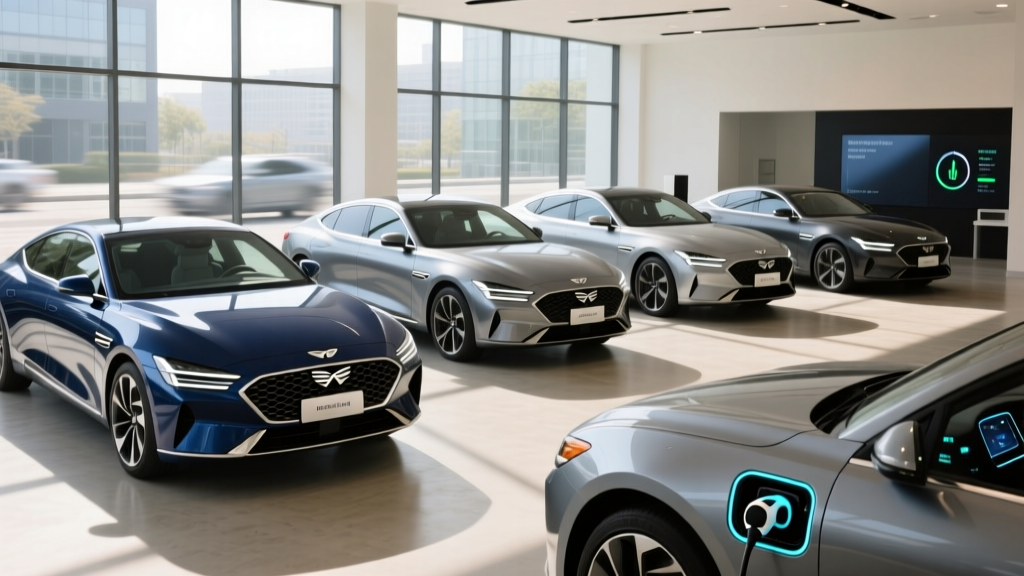
Genesis has carved out a distinct position in the luxury electrification space. Rather than offering a sprawling catalog of hybrid variants, the brand focuses on fully electric luxury vehicles under its "Electrified" sub-brand, alongside conventional powertrains. For shoppers specifically searching for a Genesis PHEV — a plug-in hybrid that blends a gas engine with a chargeable battery for electric-only commuting — the picture in 2026 requires some clarification.
This guide breaks down every electrified Genesis model available for the 2026 model year, explains where plug-in hybrid technology fits (and where it doesn't), and gives you the exact numbers — MPGe, range, kWh, pricing, and tax-credit eligibility — you need to make a smart luxury-EV purchase decision.
The 2026 Genesis Electrified Lineup at a Glance
As of the 2026 model year, Genesis offers three fully electric vehicles (BEVs) in the U.S. market. Genesis does not currently sell a plug-in hybrid (PHEV) or conventional hybrid (HEV) in the United States. The brand's electrification strategy has moved directly from internal combustion to full battery electric. Here is the current lineup:
| Model | Type | Battery (kWh) | EPA Range | MPGe (Combined) | Peak DC Charge | 0-60 mph | Base MSRP |
|---|---|---|---|---|---|---|---|
| Electrified G80 | BEV (AWD) | 87.2 usable | 282 mi | 89 MPGe | ~175 kW (10-80% in ~22 min) | 4.9 sec | $79,850 |
| GV60 (Advanced AWD) | BEV (AWD) | 77.4 usable | 248 mi | 95 MPGe | ~235 kW (10-80% in ~18 min) | 5.5 sec | $60,850 |
| Electrified GV70 (AWD) | BEV (AWD) | 77.4 usable | 236 mi | 91 MPGe | ~235 kW (10-80% in ~18 min) | 4.5 sec | $68,350 |
Sources: fueleconomy.gov, Genesis USA press site. All figures are EPA estimates for the 2026 model year. Real-world range will vary based on temperature, driving style, and terrain.
Why Genesis Skipped the PHEV Step
Many luxury competitors — BMW (X5 xDrive50e), Volvo (XC60 Recharge), Jeep (Grand Cherokee 4xe) — offer plug-in hybrids as a bridge technology. A PHEV typically pairs a turbocharged engine with a 15–25 kWh battery, delivering 25–40 miles of electric-only range before the gas engine takes over. For buyers who can charge at home but still want gas-station flexibility on road trips, the PHEV format is compelling.
Genesis, however, has positioned itself differently. Backed by Hyundai Motor Group's deep EV platform investment (the E-GMP architecture shared with Hyundai Ioniq 5 and Kia EV6), Genesis committed to a full-BEV strategy for its electrified models. The brand's conventional gas vehicles (G70, G80, GV70, GV80 with ICE powertrains) remain available without any hybrid assistance.
- HEV (Conventional Hybrid): Small battery (~1–2 kWh), charged by regenerative braking and the engine. Cannot plug in. Typical fuel economy: 35–55 MPG combined. Example: Toyota RAV4 Hybrid.
- PHEV (Plug-in Hybrid): Larger battery (~15–25 kWh), plugs into a wall or charger for 25–40 miles of electric-only driving. Gas engine kicks in after battery depletes. Example: BMW X5 xDrive50e.
- BEV (Battery Electric Vehicle): Large battery (~75–100+ kWh), no gas engine. Charges exclusively from the grid. Range: 230–400+ miles. Example: Genesis Electrified G80.
Deep Dive: The 2026 Electrified G80
The Electrified G80 is the closest thing to a flagship Genesis EV sedan. It rides on a modified version of the G80's architecture, fitted with dual motors and an 87.2 kWh (usable) NMC lithium-ion battery.
Range and Efficiency
The EPA rates the Electrified G80 at 282 miles of combined range and 89 MPGe. In real-world highway testing at 70–75 mph in moderate temperatures, expect approximately 240–260 miles before needing a charge. In cold weather (below 30°F), range can drop to roughly 210–230 miles due to cabin heating demands and reduced battery efficiency — a common trait across all BEVs without dedicated heat-pump optimization at extreme temperatures. The Electrified G80 does include a heat pump, which mitigates some cold-weather loss compared to resistive heating systems.
Charging Speed
On a DC fast charger, the Electrified G80 peaks at approximately 175 kW. A 10–80% session takes roughly 22 minutes under ideal conditions (preconditioned battery, warm ambient temperature, charger capable of 200+ kW). Note that unlike the GV60 and Electrified GV70, the G80's E-GMP variant does not support the full 800V ultra-fast charging architecture, so its charge curve tapers earlier above 60% SoC.
Level 2 home charging at 11 kW (48A, 240V) replenishes the battery from empty to full in approximately 8–9 hours, making overnight charging straightforward for most owners with a Level 2 home installation.
Powertrain
Dual electric motors produce a combined 365 horsepower and 516 lb-ft of torque, routed through standard all-wheel drive. The 0–60 mph sprint lands at 4.9 seconds — brisk for a luxury sedan focused on refinement rather than outright sportiness.
Deep Dive: The 2026 GV60
The GV60 is Genesis's dedicated EV crossover, built from the ground up on the E-GMP 800V platform — the same architecture underpinning the Ioniq 5 and EV6. This gives it a meaningful charging advantage.
Range, Efficiency, and Charging
In the Advanced AWD trim (the volume seller), the GV60 delivers 248 miles EPA and 95 MPGe combined. The 77.4 kWh NMC battery supports peak DC charging at ~235 kW, and thanks to the 800V architecture, a 10–80% session completes in approximately 18 minutes on a 350 kW charger. This is among the fastest charging speeds in the luxury compact crossover segment.
Real-world highway range settles around 210–230 miles at 70+ mph. The Select RWD trim pushes EPA range to 294 miles but sacrifices AWD traction.
Powertrain and Performance
The Advanced AWD GV60 produces 314 hp and 446 lb-ft. The Performance trim bumps output to 429 hp (483 lb-ft with Boost mode engaged), dropping the 0–60 time to 4.0 seconds.
Deep Dive: The 2026 Electrified GV70
The Electrified GV70 adapts the popular compact luxury SUV into a BEV. It shares the 77.4 kWh battery and 800V E-GMP platform with the GV60, though its taller, heavier body reduces range slightly.
EPA range sits at 236 miles with 91 MPGe combined. Dual motors deliver 429 hp (483 lb-ft in Boost mode), and the 0–60 time is a quick 4.5 seconds. DC fast charging mirrors the GV60: peak ~235 kW, 10–80% in roughly 18 minutes.
Real-world range expectation: 200–220 miles highway, less in cold weather. The GV70's boxier profile creates more aerodynamic drag than the GV60's sleeker shape, which accounts for the range gap despite identical battery capacity.
Pricing, Tax Credits, and Ownership Costs
Federal tax credit eligibility under IRS §30D is one of the most consequential factors in an EV purchase. For 2026, the rules require:
- MSRP caps: Vans, SUVs, and pickups must not exceed $80,000; sedans must not exceed $55,000.
- Buyer income caps: Modified AGI of $150,000 (single), $225,000 (head of household), or $300,000 (joint).
- Battery component and critical mineral sourcing: Increasingly strict percentages must be sourced from the U.S. or free-trade-agreement countries.
- Point-of-sale transfer: Eligible buyers can apply the credit as a discount at the dealership rather than waiting for a tax refund.
| Model | Base MSRP | Vehicle Class | MSRP Cap Met? | Estimated §30D Credit |
|---|---|---|---|---|
| Electrified G80 | $79,850 | Sedan ($55K cap) | No — exceeds cap | $0 |
| GV60 (Advanced AWD) | $60,850 | SUV ($80K cap) | Yes | Up to $3,750–$7,500* |
| Electrified GV70 (AWD) | $68,350 | SUV ($80K cap) | Yes | Up to $3,750–$7,500* |
*Exact credit amount depends on battery-sourcing compliance for the specific build month. The GV60 and GV70, assembled in South Korea, face critical-mineral and battery-component sourcing requirements that may reduce or eliminate the credit depending on supply-chain shifts. Always verify current eligibility on fueleconomy.gov before purchasing. Income caps apply to the buyer regardless of vehicle eligibility.
All 2026 Genesis Electrified models include an 8-year / 100,000-mile high-voltage battery warranty, covering defects and capacity loss below a specified threshold (typically 70% state of health). The basic vehicle warranty is 5 years / 60,000 miles, and the powertrain warranty extends to 10 years / 100,000 miles. This is competitive with BMW, Mercedes, and Audi EV warranties, and slightly exceeds the federal minimum of 8 years / 80,000 miles for emissions-related components.
Real-World Ownership: What Genesis EV Owners Report
Beyond EPA stickers, ownership experience hinges on charging access, build quality, and long-term battery health. Genesis benefits from Hyundai Motor Group's mature E-GMP supply chain, and early reliability data from the GV60 and Electrified GV70 (on sale since 2023–2024 model years) has been favorable, with no widespread battery degradation or motor failure reports.
Charging ecosystem: Genesis EVs use the CCS1 connector natively. With Tesla opening its Supercharger network to CCS-equipped vehicles via adapter (included or available from Genesis), long-distance travel coverage has expanded significantly. Electrify America remains the primary CCS fast-charging backbone, with growing 350 kW station density along major corridors.
Home charging: A Level 2 home installation (240V, 48A circuit) typically costs $800–$2,500 including a quality EVSE (e.g., ChargePoint Home Flex, Emporia Level 2) and electrician labor, assuming your electrical panel has capacity. Homes with older 100A panels may need a $1,500–$3,000 panel upgrade. A licensed electrician should perform a load calculation before installation.
Insurance: Luxury EVs carry higher premiums than their gas counterparts. Expect annual insurance costs 15–30% above equivalent ICE luxury vehicles, driven by higher repair costs for battery and structural components. Get quotes before purchasing — premiums vary dramatically by state, ZIP code, and driving record.
Genesis PHEV Alternatives: What to Consider Instead
If you specifically want plug-in hybrid flexibility — electric commuting during the week, gas-powered road trips on weekends — Genesis does not currently serve that need. Here are the closest luxury PHEV competitors worth cross-shopping:
| Model | Battery (kWh) | EV Range | Combined MPG (after EV depletion) | Combined HP | Base MSRP |
|---|---|---|---|---|---|
| BMW X5 xDrive50e | ~25.7 | ~38 mi | ~22 MPG | 483 hp | $72,500 |
| Volvo XC60 Recharge T8 | ~18.8 | ~35 mi | ~25 MPG | 455 hp | $59,950 |
| Porsche Cayenne E-Hybrid | ~25.9 | ~30 mi | ~21 MPG | 389 hp | $91,000 |
Each of these qualifies for partial or full §30D credits depending on sourcing and MSRP, and each offers the gas-engine safety net that a full BEV does not. If you lack reliable home charging access, a PHEV from another brand may be a more practical choice than a Genesis BEV.
Decision Framework: Should You Buy a Genesis EV or Look Elsewhere?
Choose a Genesis Electrified BEV if:
- You have reliable Level 2 home charging (garage or driveway with 240V access).
- Your daily commute is under 150 miles round-trip, well within the 236–282 mile EPA range.
- You value luxury interior materials, a quiet cabin, and Genesis's strong dealer-service experience.
- You take road trips infrequently enough that DC fast-charging stops (18–22 minutes per session) are acceptable.
- The GV60 or Electrified GV70 qualifies for the §30D credit in your purchase month, reducing effective cost.
Look at a luxury PHEV from BMW, Volvo, or Porsche if:
- You cannot install a Level 2 charger at home and rely on slower or inconsistent public charging.
- You regularly drive 300+ miles in a single day and do not want to plan around charging infrastructure.
- You live in an area with sparse DC fast-charging coverage (rural regions, parts of the Mountain West).
- You want to reduce fuel consumption without committing to full electric operation.
Stick with a conventional gas Genesis (G80 2.5T, GV70 2.5T) if:
- You have no charging access at home or work.
- The higher upfront cost of an EV (even after credits) doesn't justify the fuel savings over your planned ownership period.
- You prefer the lowest-complexity ownership experience with no charging logistics to manage.
Frequently Asked Questions
Does Genesis make a plug-in hybrid (PHEV)?
As of the 2026 model year, Genesis does not sell a PHEV in the United States. The brand's electrified lineup consists entirely of battery electric vehicles (BEVs): the Electrified G80 sedan, GV60 crossover, and Electrified GV70 SUV. Conventional gas models are available without hybrid assistance. If you need PHEV technology in a luxury vehicle, BMW, Volvo, Porsche, and Land Rover offer competitive options.
How much does it cost to charge a Genesis EV at home?
At the U.S. average residential electricity rate of approximately $0.17/kWh (2025 EIA data), fully charging the GV60's 77.4 kWh battery costs roughly $13.16. For the Electrified G80's 87.2 kWh battery, a full charge runs about $14.82. That translates to roughly $0.05–$0.06 per mile — compared to $0.14–$0.18 per mile for a gas-powered Genesis G80 at $3.50/gallon and 25 MPG.
What is the battery replacement cost for a Genesis EV?
Out-of-warranty high-voltage battery replacement for E-GMP-based Genesis vehicles is estimated at $12,000–$18,000 depending on the model and labor. However, battery replacements due to normal degradation are extremely rare within the first 8–10 years. The 8-year/100,000-mile battery warranty covers capacity loss below ~70% state of health, so most owners will never face this expense during typical ownership.
Can the Genesis GV60 or Electrified GV70 use Tesla Superchargers?
Yes. Tesla has opened its Supercharger network to non-Tesla EVs via the Magic Dock (built-in CCS adapter) at select stations, and via a Tesla-provided NACS adapter for vehicles equipped with the appropriate software update. Genesis has confirmed compatibility with the adapter system. This significantly expands DC fast-charging options for Genesis owners, especially on long-distance routes where Supercharger density exceeds Electrify America coverage.
Is a Genesis EV reliable compared to gas-powered Genesis models?
Early reliability data for the GV60 and Electrified GV70 is positive, with fewer moving parts than ICE vehicles (no transmission, no exhaust system, no oil changes). The E-GMP platform has been in production since 2021 across Hyundai, Kia, and Genesis models with no systemic battery or motor recalls. Genesis's 10-year/100,000-mile powertrain warranty provides additional long-term confidence. However, luxury EVs can carry higher repair costs for body damage, suspension, and electronics — factor this into your insurance and maintenance budget.