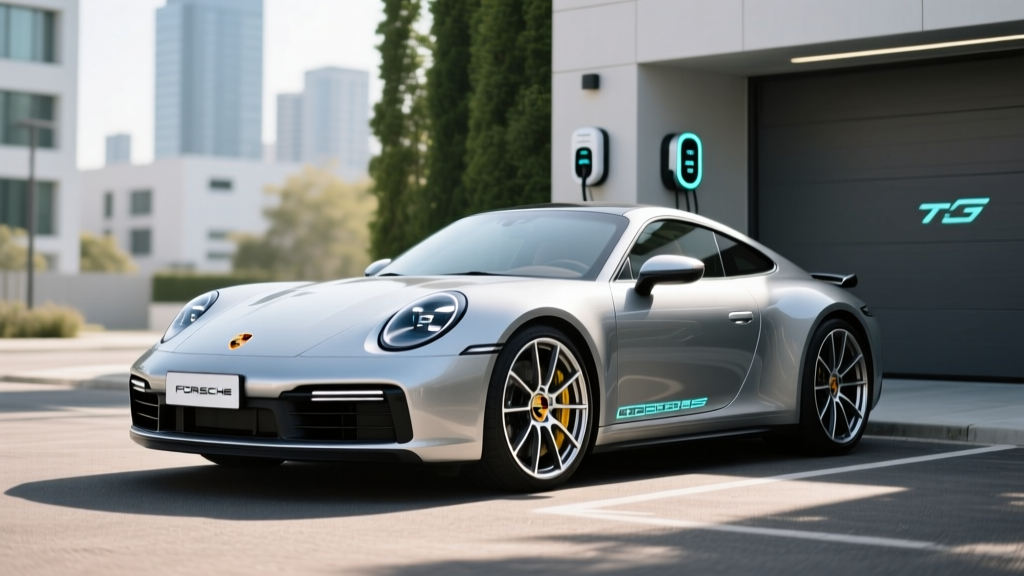
The 2026 Porsche 911 Carrera GTS introduces something the nameplate has never seen in over 60 years: a hybrid powertrain. But the Porsche 911 hybrid — officially branded the T-Hybrid — is not a plug-in. It's a performance-oriented conventional hybrid (HEV) that uses a tiny 1.9 kWh battery and an electric motor integrated into the eight-speed PDK transmission to eliminate turbo lag and add torque, not to chase fuel economy. The result is 481 combined horsepower, a 0–60 mph time of 2.9 seconds, and a slightly improved EPA fuel-economy rating over its predecessor.
This guide breaks down everything buyers and enthusiasts need to know about the 992.2-generation 911 T-Hybrid: real-world MPG expectations, how the system works, pricing, reliability outlook, and whether a performance hybrid makes sense compared to a full EV sports car or the outgoing turbocharged 911.
What Exactly Is the Porsche 911 T-Hybrid System?
Porsche's T-Hybrid is a conventional hybrid (HEV), not a plug-in hybrid (PHEV). This is a critical distinction. The system cannot be plugged in to charge, has no electric-only driving mode, and offers no all-electric range. Instead, it uses a compact high-voltage battery and an electric motor as a performance assist to the 3.6-liter flat-six engine.
HEV (conventional hybrid): Charges via regenerative braking and the engine. No plug. Small battery (typically 1–2 kWh). Optimizes performance or efficiency in the background. The 911 T-Hybrid is this type.
PHEV (plug-in hybrid): Larger battery (typically 10–30 kWh). Plugs into a wall or charger. Offers 20–50 miles of electric-only range before the gas engine kicks in. Examples: Toyota RAV4 Prime, Jeep Wrangler 4xe.
The 911 T-Hybrid has zero electric-only range and no charging port. It is purely a performance HEV.
The system consists of three key components:
- 3.6-liter twin-turbo flat-six engine — a new, slightly larger displacement than the prior 3.0L, producing 353 hp on its own
- Electric motor integrated into the PDK transmission — contributes up to 54 hp and 110 lb-ft of torque, powered by a 400-volt architecture
- 1.9 kWh lithium-ion high-voltage battery — located under the rear deck, roughly the size of a conventional 12V battery, weighing just 60 lbs
An electric turbocharger complements the system. Rather than relying on exhaust gas alone to spool the turbo, the e-turbo uses an electric motor to spin the compressor wheel almost instantly, eliminating the lag that plagues traditional turbocharged engines. The result is throttle response that feels closer to a naturally aspirated engine — a deliberate engineering choice by Porsche.
Fuel Economy: EPA MPG and Real-World Expectations
Performance was the priority, but the T-Hybrid does deliver modest efficiency gains over the outgoing 911 Carrera GTS. Here's what the EPA rates it at:
| Metric | Coupe (RWD) | Coupe (AWD / 4) | Cabriolet (AWD / 4) |
|---|---|---|---|
| City MPG | 20 | 19 | 18 |
| Highway MPG | 27 | 26 | 25 |
| Combined MPG | 23 | 22 | 21 |
Source: EPA Fuel Economy (fueleconomy.gov)
For context, the previous-generation 911 Carrera GTS (3.0L twin-turbo, no hybrid) was rated at 20 MPG combined. The T-Hybrid's 22–23 MPG combined represents a 10–15% improvement — not Prius territory, but meaningful for a 481-hp sports car.
Real-world expectations: Hybrid systems tend to overperform their EPA city rating because regenerative braking recaptures energy in stop-and-go traffic. Expect the RWD coupe to achieve 21–23 MPG in mixed city driving. Highway cruising at 75+ mph will likely return 25–27 MPG for the RWD model, as the electric assist is less beneficial at steady speeds and aerodynamic drag dominates. Track days and aggressive canyon driving will drop figures into the mid-teens, which is true of any performance vehicle.
Performance Specs: Powertrain and Driving Dynamics
| Specification | Value |
|---|---|
| Combined Horsepower | 481 hp |
| Combined Torque | 420 lb-ft |
| Engine | 3.6L twin-turbo flat-six + e-motor in PDK |
| Electric Motor Output | 54 hp / 110 lb-ft |
| High-Voltage Battery | 1.9 kWh (400V architecture) |
| Transmission | 8-speed PDK dual-clutch |
| 0–60 mph | 2.9 seconds (Coupe AWD) |
| Top Track Speed | 190 mph |
| Curb Weight (approx.) | ~3,500 lbs |
| Electric-Only Range | None (HEV, not PHEV) |
The 0–60 mph time of 2.9 seconds for the all-wheel-drive Coupe 4 makes this the quickest Carrera GTS ever produced, shaving roughly 0.4 seconds off the previous generation. The electric motor's instant torque fill is most noticeable at low RPMs, where traditional turbocharged engines are still building boost. Off-the-line launches and mid-range passing maneuvers both benefit.
Porsche also revised the chassis for the 992.2 generation. The T-Hybrid includes rear-axle steering, Porsche Dynamic Chassis Control (PDCC) active anti-roll bars, and PASM adaptive dampers as standard on the GTS trim. The added weight of the hybrid system is approximately 100 lbs over the outgoing GTS — modest by hybrid standards and well-managed by the chassis.
Pricing, Trims, and Tax Credit Eligibility
The 2026 911 T-Hybrid powertrain is currently available exclusively on the Carrera GTS trim. Porsche has not extended it to the base Carrera, Carrera S, or Turbo models as of the 2026 model year.
| Model | Starting MSRP |
|---|---|
| 911 Carrera GTS Coupe (RWD) | $164,900 |
| 911 Carrera GTS Coupe 4 (AWD) | $171,100 |
| 911 Carrera GTS Cabriolet (RWD) | $178,100 |
| 911 Carrera GTS Cabriolet 4 (AWD) | $184,300 |
Source: Porsche USA — prices exclude $1,350 destination charge.
No. The Porsche 911 Carrera GTS T-Hybrid does not qualify for the IRS §30D Clean Vehicle Credit. There are two reasons:
- It is a conventional hybrid (HEV), not a plug-in. The §30D credit applies only to plug-in electric vehicles (BEVs and PHEVs) with a battery capacity of at least 7 kWh. The 911's 1.9 kWh battery and lack of a charging port disqualify it entirely.
- MSRP cap. Even if it were a PHEV, the §30D credit caps eligibility at $55,000 for sedans and $80,000 for SUVs/trucks/vans. At $164,900+, the 911 GTS far exceeds any cap.
Reliability, Battery Warranty, and Long-Term Ownership
Porsche's hybrid technology in the 911 is new for the 992.2 generation, but it is not untested. Porsche has deployed similar high-voltage hybrid architectures in the Panamera E-Hybrid and Cayenne E-Hybrid lineups for years, and the 919 Hybrid race car (a Le Mans winner) used a comparable e-turbo and regenerative system.
High-voltage battery: 8 years / 100,000 miles (whichever comes first), covering defects and capacity loss below a defined threshold.
Powertrain warranty: 4 years / 50,000 miles (Porsche's standard limited warranty).
Hybrid-specific components (e-motor, power electronics): Covered under the 8-year hybrid component warranty.
Confirm exact terms with your dealer, as warranty specifics can vary by model year.
Battery replacement cost: Because the 1.9 kWh battery is small and relatively simple compared to a full EV pack, replacement costs are estimated in the $3,000–$5,000 range — significantly less than a PHEV or BEV battery replacement. However, given the battery's size and the fact that it operates within a narrow state-of-charge window (never fully depleted or fully charged), degradation should be minimal over the vehicle's lifespan.
General reliability outlook: Porsche's PDK transmission and flat-six engines have strong long-term reliability records. The addition of the e-motor and e-turbo introduces new components, but they are less complex than a full PHEV system with a large battery, cooling circuits, and onboard charger. The 911 also retains a conventional 12V battery for accessories, so there is no risk of being stranded by a dead high-voltage pack.
911 T-Hybrid vs Full EV vs Gas: Which Should You Choose?
- You want the quintessential 911 experience — flat-six sound, rear-engine balance, PDK shifts — with sharper throttle response
- You have no home charging access and don't want to rely on public charging infrastructure
- You want a sports car you can drive 400+ miles on a single tank without planning charging stops
- You value the 911's heritage and don't want the sound-dampened experience of an EV sports car
- Instant torque and sub-3-second 0–60 at a lower price matter (Tesla Model S Plaid: ~$90K, 1.99s 0–60)
- You have home Level 2 charging and want $0.04–0.06/mile "fuel" costs vs the 911's ~$0.20+/mile on premium gas
- You want zero tailpipe emissions for daily commuting
- You don't need 400+ mile range without stops (most EV sports cars: 250–400 miles EPA)
- You want a lighter car — the T-Hybrid adds ~100 lbs over the prior GTS
- You prefer a manual transmission (not available on the T-Hybrid; PDK only)
- Budget is a priority — a used 992.1 Carrera GTS saves $40K–$60K
The 911 T-Hybrid occupies a specific niche: buyers who want cutting-edge performance engineering in a traditional sports car form factor, without the lifestyle changes that EV ownership requires. It's not trying to be a Prius. It's trying to be a better 911.
Frequently Asked Questions
How many MPG does the Porsche 911 hybrid get?
The 2026 911 Carrera GTS T-Hybrid is EPA-rated at 23 MPG combined (20 city / 27 highway) for the RWD coupe, and 22 MPG combined (19/26) for the AWD coupe. Real-world mixed driving typically returns 21–24 MPG depending on driving style. Aggressive driving and track use will significantly reduce these figures.
How far can the 911 T-Hybrid go on electric only?
It can't. The 911 T-Hybrid is a conventional hybrid (HEV), not a plug-in hybrid (PHEV). It has no electric-only driving mode and no charging port. The 1.9 kWh battery and 54-hp electric motor exist solely to assist the gas engine — filling in torque during acceleration and spooling the e-turbo. Total driving range is the same as a conventional 911: approximately 400+ miles on a full 16.9-gallon tank.
Is the Porsche 911 hybrid reliable and what does battery replacement cost?
The T-Hybrid system is new to the 911 but builds on technology Porsche has used in the Panamera, Cayenne, and 919 race car. The high-voltage battery is covered by an 8-year/100,000-mile warranty. Because the battery is small (1.9 kWh) and operates in a narrow charge window, degradation should be minimal. Estimated out-of-warranty replacement cost is $3,000–$5,000 — far less than an EV battery replacement.
Does the Porsche 911 hybrid qualify for any tax credit?
No. The federal §30D Clean Vehicle Credit applies only to plug-in vehicles (BEVs and PHEVs) with at least 7 kWh of battery capacity. The 911 T-Hybrid is a conventional hybrid with a 1.9 kWh battery and no plug. It also exceeds the MSRP caps ($55K for cars, $80K for SUVs). No federal tax credit is available. Some states offer minor incentives for hybrids, but these are uncommon and vary by jurisdiction — check your state's energy office for details.
Will Porsche offer a plug-in hybrid 911 or a full electric 911?
Porsche has confirmed the 718 Boxster/Cayman will go fully electric, but the company has stated the 911 will be "the last Porsche to go electric." The T-Hybrid is expected to remain the 911's electrification strategy for the foreseeable future, potentially expanding to additional 911 trims beyond the GTS. A fully electric 911 is not expected before 2030 at the earliest.
Does the hybrid system change how the 911 drives?
Yes, but subtly. The e-motor eliminates turbo lag almost entirely, making throttle response feel more immediate and linear — closer to a naturally aspirated engine. The e-turbo also allows the engine to operate more efficiently at partial load. Drivers familiar with the 992.1 GTS will notice sharper low-end punch and smoother power delivery. The flat-six soundtrack is slightly different due to the 3.6L displacement and revised exhaust tuning, but it remains unmistakably a 911.