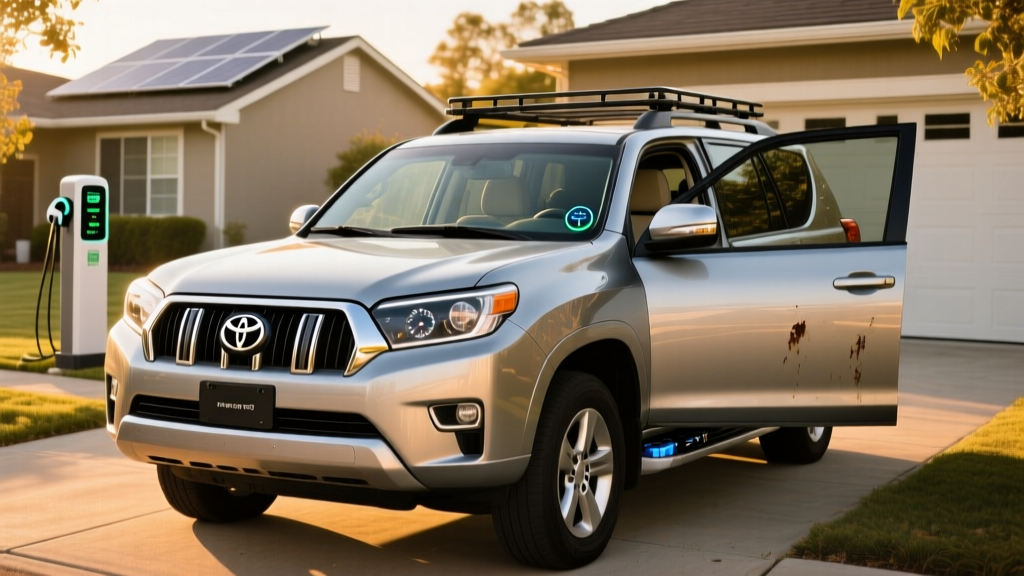
If you're searching for a Toyota SUV hybrid 2012 model year, you're likely looking at the used market for a fuel-efficient family hauler with Toyota's legendary hybrid reliability. In 2012, Toyota offered one hybrid SUV in the U.S.: the Highlander Hybrid. The RAV4 EV existed that year, but it was a fully electric vehicle (not a hybrid), and the RAV4 Hybrid didn't arrive until the 2016 model year. This guide gives you the exact specs, real-world fuel economy, battery longevity data, and 2026 ownership economics you need before buying a 14-year-old hybrid SUV.
2012 Toyota Highlander Hybrid: Quick Specs
| Spec | 2012 Highlander Hybrid |
|---|---|
| Powertrain | 3.5L V6 + 2 electric motors (AWD-i) |
| Combined Horsepower | 280 hp (net system) |
| EPA MPG (City / Hwy / Combined) | 28 / 28 / 28 |
| Drivetrain | Electronic on-demand AWD (e-Four) |
| Hybrid Battery | ~1.9 kWh NiMH (sealed, non-plug-in) |
| 0–60 mph | ~7.8 seconds |
| Towing Capacity | 3,500 lbs |
| Seating | 7 passengers |
| Original MSRP (Base) | $38,900 |
| 2026 Used Price Range | $7,000 – $13,000 |
| Hybrid Battery Warranty (Original) | 8 years / 100,000 miles (10 yr/150k in CARB states) |
HEV vs. PHEV: What the 2012 Highlander Hybrid Actually Is
The 2012 Highlander Hybrid is a conventional hybrid electric vehicle (HEV). It does not plug in. The small 1.9 kWh nickel-metal hydride (NiMH) battery recharges exclusively through regenerative braking and the gasoline engine. You cannot drive it on electric-only power for meaningful distances — the EV mode, when activated, operates only at very low speeds (under ~25 mph) for roughly one mile before the V6 kicks back in.
This is fundamentally different from a plug-in hybrid (PHEV) like the current Toyota RAV4 Prime, which carries an 18.1 kWh battery, offers 42 miles of electric-only range, and plugs into a Level 2 charger. If you want plug-in capability from a Toyota SUV, you'll need a 2021-or-newer RAV4 Prime or a 2023-or-newer Highlander PHEV (available in select markets).
Fuel Economy: EPA Ratings vs. Real-World MPG
| Driving Condition | EPA Rating | Real-World Expectation |
|---|---|---|
| City | 28 MPG | 27–31 MPG (hybrids often exceed EPA in stop-and-go) |
| Highway | 28 MPG | 25–27 MPG (less regen benefit at sustained speed) |
| Combined | 28 MPG | 26–29 MPG |
The 2012 Highlander Hybrid's 28 MPG combined was impressive for a 4,500-pound, 7-seat AWD SUV when new. According to fueleconomy.gov, it beats the non-hybrid 2012 Highlander V6 AWD (19/25/21 MPG combined) by a substantial 7 MPG — a 33% improvement.
Real-world caveat: Owner-reported data on Fuelly and similar tracking platforms shows many drivers averaging 25–27 MPG combined in mixed driving. Highway-heavy commutes at 75+ mph push consumption closer to 24 MPG. Cold weather (below 30°F) can drop MPG by 10–15% due to increased engine idling for cabin heat and reduced battery efficiency in the NiMH pack. If you're buying one in 2026 with 130,000+ miles, expect fuel economy at the lower end of the range unless the hybrid battery has been recently replaced or reconditioned.
Powertrain Deep Dive: V6 + Dual Electric Motors
The 2012 Highlander Hybrid uses Toyota's Hybrid Synergy Drive system, pairing a 3.5-liter 2GR-FXE V6 (producing 245 hp and 228 lb-ft on its own) with a front electric motor integrated into the transaxle and a separate rear electric motor for all-wheel drive. Combined net system output is 280 hp.
The AWD-i system is fully electronic — there's no mechanical driveshaft connecting the front and rear axles. The rear motor engages automatically when the front wheels slip or during hard acceleration, providing traction without the parasitic loss of a traditional mechanical AWD system. This is a key reliability advantage: fewer moving parts means fewer things to break.
The continuously variable transmission (eCVT) uses a planetary gearset rather than a belt-and-pulley design. This is one of the most durable transmissions Toyota has ever built, routinely lasting 200,000+ miles with basic fluid changes.
Hybrid Battery Lifespan, Reliability & Replacement Cost
Original warranty: 8 years / 100,000 miles (10 years / 150,000 miles in California Air Resources Board states including CA, NY, MA, CT, RI, VT, ME, NJ, OR, WA, CO, MD).
2026 status: Every 2012 Highlander Hybrid is now well outside its original hybrid battery warranty window. Battery replacement is an out-of-pocket expense.
The 2012 Highlander Hybrid's NiMH battery pack is one of the most proven hybrid batteries on the road. Data from long-term ownership communities and repair shops specializing in Toyota hybrids shows:
- Average lifespan: 150,000–200,000 miles or 12–18 years, whichever comes first
- Common failure mode: Individual cell degradation rather than total pack failure — one or two weak cells drag down the entire pack's performance
- Symptoms of degradation: Noticeable MPG drop (2–5 MPG), more frequent engine cycling, reduced EV-mode availability, and eventually a hybrid system warning light
Replacement cost breakdown (2026 estimates):
- New OEM battery (Toyota dealer): $3,000–$4,500 installed
- Remanufactured/reconditioned battery (specialist shop): $1,500–$2,500 installed
- Individual cell replacement (DIY or specialist): $400–$800 if only 1–2 cells are weak
- Junkyard/salvage battery: $500–$900 (risky — unknown remaining life)
For a vehicle worth $7,000–$13,000 in 2026, a $4,500 OEM battery replacement is a significant percentage of the car's value. Most owners opt for reconditioned packs from shops like Green Bean Battery or Fix My Hybrid, which offer 2–3 year warranties on refurbished NiMH packs.
Is the 2012 Highlander Hybrid Still Reliable in 2026?
Toyota's hybrid system is arguably the most reliable electrified powertrain ever mass-produced. The 2GR-FXE V6 is a proven engine, the eCVT planetary gearset is nearly bulletproof, and the AWD-i rear motor has very few failure points. The IIHS gave the 2012 Highlander top marks in moderate overlap front and side crash tests.
However, 2026 buyers must account for age-related wear that has nothing to do with the hybrid system:
- Inverter coolant pump: Known failure point on 2010–2013 Highlander Hybrids; replacement runs $400–$700. Check for recall completion (NHTSA recall 11V-274).
- Brake actuator assembly: The regenerative braking system uses an electro-hydraulic brake actuator that can fail at 120,000–180,000 miles. Replacement is $1,200–$1,800 at a dealer.
- Suspension components: Struts, bushings, and sway bar links are wear items that are likely due on a 14-year-old SUV regardless of powertrain.
- 12V auxiliary battery: Like any car, the standard 12V battery needs replacement every 4–6 years ($150–$250).
Hybrid vs. PHEV vs. EV: Which Toyota SUV Fits You?
Choose the 2012 Highlander Hybrid (used HEV) if:
- Your budget is under $15,000
- You need 7-passenger seating and 3,500-lb towing
- You can't install a home charger (apartment, street parking)
- You want zero behavior change — just fill it with gas and drive
- You drive 10,000–15,000 miles/year and want 26–29 MPG
Choose a current Toyota RAV4 Prime (PHEV) if:
- You can charge at home (Level 2, 240V)
- Your daily commute is under 42 miles (electric-only covers it)
- You want 94 MPGe on electric + 38 MPG on gas for longer trips
- You're eligible for the federal §30D tax credit (up to $7,500, subject to MSRP caps, income limits, and battery sourcing rules — verify current-year eligibility with a tax professional)
- Budget allows $45,000–$55,000 new
Choose a full EV (e.g., Toyota bZ4X, Hyundai Ioniq 5) if:
- You have reliable home Level 2 charging
- Your daily driving is under 200 miles
- You want minimal maintenance (no oil changes, no transmission fluid, fewer moving parts)
- Local electricity rates make per-mile cost significantly cheaper than gas
Tax Credit Eligibility for the 2012 Highlander Hybrid
The 2012 Highlander Hybrid does not qualify for any federal EV tax credit. The IRS §30D credit applies only to new plug-in electric vehicles (BEVs and PHEVs) meeting current battery sourcing, critical mineral, MSRP cap ($80,000 for SUVs), and buyer income limits ($300,000 joint / $150,000 single). A 2012 conventional hybrid is ineligible on multiple fronts: it's not a plug-in vehicle, it's not new, and the hybrid credit that existed under the Energy Policy Act of 2005 expired for Toyota in 2007.
Some states offer used-EV rebates or local utility incentives, but these almost universally require plug-in capability. Check your state's energy office or utility provider for any legacy hybrid incentives, but don't count on them.
2026 Used Market Value & Ownership Cost
At $7,000–$13,000 in 2026 (depending on mileage, condition, and trim), the 2012 Highlander Hybrid offers strong value for a 7-seat AWD SUV averaging 28 MPG. For comparison, a 2012 non-hybrid Highlander V6 AWD runs $6,000–$11,000 but delivers only 21 MPG combined.
5-year fuel cost comparison (15,000 miles/year, $3.50/gallon):
- 2012 Highlander Hybrid (28 MPG): $9,375 in fuel over 5 years
- 2012 Highlander V6 AWD (21 MPG): $12,500 in fuel over 5 years
- Savings with hybrid: ~$3,125 over 5 years
That fuel savings is meaningful, but it can be wiped out by a single hybrid battery replacement. Budget-conscious buyers should set aside $2,000–$3,000 in a "battery reserve" fund from day one, or buy from a seller who can provide documentation of a recent battery replacement or reconditioning.
Pros
- 28 MPG combined in a 7-seat AWD SUV
- Proven Toyota Hybrid Synergy Drive reliability
- eCVT planetary gearset — virtually no transmission failures
- 3,500-lb towing capacity
- No plug-in required — zero infrastructure dependency
- Low 2026 used pricing ($7k–$13k)
Cons
- Hybrid battery likely near end of life on un-replaced packs
- No federal or state tax credit eligibility
- NiMH battery less efficient than modern lithium-ion packs
- Dated interior tech (no Apple CarPlay/Android Auto, small screen)
- Brake actuator replacement is expensive if it fails
- Only one Toyota hybrid SUV available for 2012 (no RAV4 Hybrid option)
Frequently Asked Questions
How many MPG does the 2012 Toyota Highlander Hybrid get?
The EPA rates it at 28 MPG city, 28 MPG highway, and 28 MPG combined. Real-world driving typically yields 25–29 MPG combined depending on driving style, climate, and hybrid battery health. City driving often matches or slightly exceeds the EPA rating thanks to regenerative braking, while sustained highway speeds above 70 mph tend to return 25–27 MPG.
Can the 2012 Highlander Hybrid drive on electric power only?
Only in very limited circumstances. The EV mode allows electric-only driving at speeds under approximately 25 mph for about one mile — useful for creeping through a parking lot or a quiet neighborhood. For any real driving, the V6 engine engages automatically. This is a conventional HEV, not a PHEV, and it does not plug in.
Is the hybrid battery reliable, and what does replacement cost?
Toyota's NiMH hybrid batteries are among the most reliable ever produced, typically lasting 150,000–200,000 miles or 12–18 years. Since every 2012 Highlander Hybrid is now 14 years old in 2026, many original batteries are at or past their expected lifespan. Replacement costs range from $1,500–$2,500 for a reconditioned pack to $3,000–$4,500 for a new OEM battery from Toyota. Individual cell replacement by a specialist can cost as little as $400–$800 if only one or two cells have degraded.
Does the 2012 Highlander Hybrid qualify for any tax credit?
No. The 2012 Highlander Hybrid does not qualify for the federal §30D clean vehicle credit, which is limited to new plug-in electric vehicles (BEVs and PHEVs) meeting battery sourcing, income, and MSRP requirements. The original hybrid tax credit that existed when this vehicle was new expired for Toyota vehicles in 2007. Some states may offer minimal used-vehicle incentives, but these typically require plug-in capability.
Should I buy a 2012 Highlander Hybrid or save for a newer RAV4 Hybrid?
It depends on budget and needs. If you need 7 seats, AWD, 3,500-lb towing, and your budget is under $15,000, the 2012 Highlander Hybrid is a strong choice — just budget for a potential battery replacement. If you only need 5 seats and can spend $28,000–$40,000, a 2019–2025 RAV4 Hybrid (41 MPG combined, lithium-ion battery, modern safety tech, Apple CarPlay) offers substantially better fuel economy and technology. The RAV4 Hybrid's lithium-ion battery also has a longer expected lifespan and better cold-weather performance than the Highlander's NiMH pack.
What should I check before buying a used 2012 Highlander Hybrid?
Request a hybrid battery health check from a Toyota dealer or hybrid specialist — they can read the pack's internal resistance and individual cell voltages. Verify that NHTSA recall 11V-274 (inverter coolant pump) was completed. Check for brake actuator warning lights or unusual brake pedal feel. Review maintenance records for transmission fluid changes (Toyota WS fluid, recommended every 60,000 miles). And as with any 14-year-old vehicle, a pre-purchase inspection by an independent mechanic is essential.