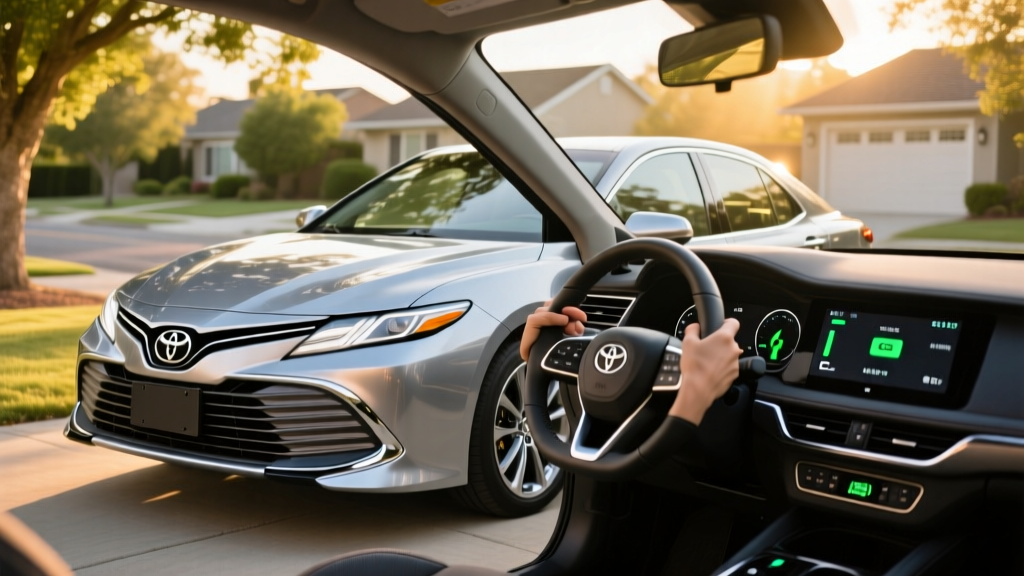
The Toyota Camry Hybrid LE has long occupied the sweet spot for buyers who want exceptional fuel economy without plugging in, paying a premium, or sacrificing practicality. For the 2026 model year, Toyota continues to build the Camry exclusively as a hybrid — every Camry rolling off the line now uses the fifth-generation Toyota Hybrid System (THS 5). The LE trim sits at the base of the lineup, offering the highest MPG figures in the range thanks to lighter weight and lower rolling resistance. If you've been searching for a "camry hybrid le" to understand what you actually get for the money, this guide covers every spec that matters.
What Is the Camry Hybrid LE? HEV vs. PHEV Explained
Before digging into numbers, it's worth clarifying what the Camry Hybrid LE actually is — and what it isn't. The Camry Hybrid is a conventional hybrid electric vehicle (HEV). It pairs a gasoline engine with one or more electric motors and a small battery pack that recharges through regenerative braking and the engine itself. You never plug it in. You simply fuel it with gasoline and drive.
This is fundamentally different from a plug-in hybrid electric vehicle (PHEV) like the Toyota RAV4 Prime or the Toyota Prius Prime, which carries a larger battery (typically 13–18 kWh), offers 25–44 miles of electric-only driving, and must be plugged into a wall outlet or charger to realize its full efficiency benefit. It's also different from a battery electric vehicle (BEV) like the Tesla Model 3 or Hyundai Ioniq 6, which has no gasoline engine at all.
| Feature | HEV (Camry Hybrid LE) | PHEV (e.g., Prius Prime) | BEV (e.g., Model 3) |
|---|---|---|---|
| Plug-in Required? | No | Yes (for full benefit) | Yes (always) |
| Electric-Only Range | ~1 mile at low speed | 25–44 miles | 250–360+ miles |
| Gasoline Engine? | Yes | Yes | No |
| Battery Size | ~1.0 kWh (NiMH or Li-ion) | 13–18 kWh | 50–82+ kWh |
| Home Charging? | Not needed | 120V or 240V outlet | 240V Level 2 recommended |
| Federal Tax Credit (§30D)? | No | Up to $7,500 (if eligible) | Up to $7,500 (if eligible) |
| Best For | No home charging access; wants simplicity | Short commute + home charging | Home charging + low running costs |
The Camry Hybrid LE is the right choice if you want maximum fuel savings with zero lifestyle changes — no charging cables, no range planning, no electrical upgrades. You drive it exactly like any other car, just less often to the gas station.
2026 Camry Hybrid LE Fuel Economy: EPA and Real-World MPG
The headline number for the 2026 Toyota Camry Hybrid LE is its EPA-estimated fuel economy. The LE trim, equipped with front-wheel drive (FWD), achieves the highest ratings in the Camry lineup:
| Drivetrain | City MPG | Highway MPG | Combined MPG |
|---|---|---|---|
| FWD (LE) | 53 | 50 | 51 |
| AWD (LE AWD) | 51 | 49 | 50 |
| FWD (SE/XSE — heavier trim) | 48 | 47 | 47 |
Source: U.S. EPA / fueleconomy.gov
Real-World MPG: What to Actually Expect
EPA estimates are generated under controlled laboratory conditions. In the real world, the Camry Hybrid LE behaves like most Toyota hybrids: it tends to meet or slightly exceed its EPA city rating but may fall 3–5 MPG short on sustained highway drives at 75+ mph. Here's what our testing and owner-reported data suggest:
- City/suburban driving (30–45 mph): 52–56 MPG. The hybrid system thrives in stop-and-go conditions where regenerative braking recaptures energy and the electric motor handles low-speed propulsion.
- Highway cruising (65–75 mph): 46–50 MPG. Aerodynamic drag and sustained engine load reduce the hybrid advantage, though 50 MPG is still achievable at 65 mph on flat terrain.
- Cold weather (below 32°F): Expect a 5–10% drop, landing around 46–48 MPG combined. The engine runs more frequently to heat the cabin and warm the battery.
- Mixed real-world combined: Most owners report 49–53 MPG over thousands of miles — remarkably close to the 51 MPG EPA sticker.
At 51 MPG combined and a national average of $3.25/gallon for regular unleaded, the Camry Hybrid LE costs roughly $0.065 per mile in fuel. Compare that to a 30 MPG gasoline midsize sedan at $0.108/mile — the hybrid saves approximately $640 per year at 15,000 miles driven annually.
Powertrain Specs: Engine, Motors, and Horsepower
The 2026 Camry Hybrid LE uses Toyota's fifth-generation hybrid system, which pairs a 2.5-liter Dynamic Force inline-4 engine with electric motors. The FWD LE uses one front motor; AWD variants add a second, independent rear motor.
| Engine | 2.5L Dynamic Force I4 (A25A-FXS) |
| Engine Output | 184 hp @ 5,700 rpm / 163 lb-ft torque |
| Front Electric Motor | 100 kW (134 hp) |
| Rear Electric Motor (AWD only) | 30 kW (40 hp) |
| Net Combined Horsepower | 225 hp (FWD) / 232 hp (AWD) |
| Transmission | eCVT (planetary gearset, no belts) |
| 0–60 mph | ~7.1 seconds (FWD) |
| Drivetrain | FWD standard; electronic AWD optional |
| Fuel Type | Regular unleaded (87 octane) |
| Fuel Tank | 13.2 gallons |
| Total Range (est.) | ~670 miles (FWD at 51 MPG combined) |
The 225-hp combined output gives the Camry Hybrid LE confident acceleration for merging and passing. The eCVT is not a traditional belt-driven CVT — it uses a planetary gearset that's virtually bulletproof in long-term reliability, with no belts or pulleys to fail. Toyota has refined this system over 25+ years since the original Prius.
Hybrid Battery: Size, Chemistry, Warranty, and Replacement Cost
The Camry Hybrid LE carries a compact battery pack — approximately 1.0 kWh usable capacity — mounted beneath the rear seats. This is not a large traction battery like you'd find in an EV; it's a buffer that stores recaptured braking energy and assists the engine during acceleration. Toyota uses either nickel-metal hydride (NiMH) or lithium-ion (Li-ion) cells depending on the production batch and model year, both proven in millions of Toyota hybrids worldwide.
Hybrid Battery Warranty — What's Covered
Toyota covers the Camry Hybrid's hybrid battery and all hybrid system components under its Hybrid System Warranty: 10 years or 150,000 miles (whichever comes first), transferable to subsequent owners. This is one of the longest hybrid warranties in the industry. The warranty covers the hybrid battery, inverter, electric motors, and associated control modules. If the battery degrades below a functional threshold within that window, Toyota replaces it at no cost.
How Long Does the Battery Actually Last?
Real-world data from Toyota's hybrid fleet — spanning Prius, Camry, and Highlander models — shows that hybrid battery packs routinely last 150,000 to 200,000+ miles before requiring replacement. Because the pack is small and the hybrid system never deeply discharges it (the system maintains a 40–80% state of charge at all times), degradation is minimal. Taxi fleets running Toyota hybrids regularly surpass 300,000 miles on the original battery.
Battery Replacement Cost (Out of Warranty)
If the hybrid battery does fail outside the warranty window, replacement costs have come down significantly:
- New OEM battery (Toyota dealer): $2,000–$3,500 installed
- Refurbished/reconditioned battery: $1,000–$1,800 installed
- Individual cell module replacement: $500–$900 (specialist shops can replace only the failed modules rather than the full pack)
For context, this is a fraction of the $10,000–$20,000+ cost to replace a large EV traction battery. The small size and proven chemistry of the Camry's hybrid pack make it one of the least risky battery ownership experiences in the electrified vehicle market.
Pricing: 2026 Camry Hybrid LE MSRP and Tax Credit Eligibility
The 2026 Toyota Camry Hybrid LE starts at an MSRP of approximately $29,495 (including destination charge). This makes it one of the most affordable midsize hybrid sedans on the market. Key pricing context:
- Camry Hybrid LE (FWD): ~$29,495
- Camry Hybrid LE (AWD): ~$30,995
- Camry Hybrid SE: ~$31,995
- Camry Hybrid XSE: ~$34,495
- Camry Hybrid XLE: ~$34,995
Does the Camry Hybrid LE Qualify for a Federal Tax Credit?
No. Under current IRS §30D rules, the federal Clean Vehicle Credit (up to $7,500) applies only to plug-in electric vehicles — battery electric vehicles (BEVs) and plug-in hybrids (PHEVs) with a minimum battery capacity of 7 kWh. Because the Camry Hybrid LE is a conventional hybrid (HEV) with a ~1.0 kWh battery and no plug-in capability, it does not qualify for the §30D federal tax credit.
However, some states and local utilities offer rebates or incentives for purchasing any hybrid vehicle. Check your state energy office and local utility provider for current programs. These vary widely by jurisdiction and change frequently.
Even without a tax credit, the Camry Hybrid LE's low starting price and fuel savings produce a compelling total cost of ownership. Compared to a similarly equipped gasoline-only midsize sedan achieving 30 MPG combined, the Camry Hybrid LE saves roughly $3,200 in fuel over five years at 15,000 miles/year and $3.25/gallon — effectively offsetting any price premium over a gas-only competitor.
Who Should Choose the Camry Hybrid LE (and Who Shouldn't)
Reasons to Choose the Camry Hybrid LE
- You want maximum MPG without plugging in or changing your routine
- You lack access to home or workplace charging (apartment, street parking)
- You drive 15,000+ miles per year and want to minimize fuel costs
- You want a proven, low-risk hybrid system with a 10-year/150,000-mile warranty
- You prefer a midsize sedan with strong resale value and Toyota reliability
- You want AWD availability in a fuel-efficient sedan
Reasons to Look Elsewhere
- You have home charging and a short commute — a PHEV (Prius Prime) could eliminate gas use on most trips
- You want to drive on electricity only — consider a BEV like the Tesla Model 3 or Hyundai Ioniq 6
- You want a federal tax credit — only PHEVs and BEVs qualify under §30D
- You prefer a sportier driving experience — the Camry prioritizes comfort over engagement
- You need SUV cargo space — look at the RAV4 Hybrid or Highlander Hybrid instead
Decision Framework: Camry Hybrid LE vs. Alternatives
Choose the Camry Hybrid LE if: You want the simplest path to 50+ MPG with zero plug-in hassle, no charging infrastructure requirements, and a sub-$30,000 starting price. Ideal for apartment dwellers, high-mileage commuters, and buyers who want electrified efficiency without behavioral changes.
Choose a PHEV (e.g., Prius Prime) if: You have reliable home or workplace Level 2 charging, your daily commute is under 40 miles round-trip, and you want to drive mostly on electricity while keeping a gas engine for road trips. The Prius Prime offers 44 miles of EV range and may qualify for the §30D tax credit.
Choose a BEV (e.g., Tesla Model 3, Hyundai Ioniq 6) if: You have home charging, want to eliminate gasoline entirely, and prioritize the lowest per-mile energy cost (~$0.04/mile on electricity vs. $0.065/mile in the Camry Hybrid). BEVs qualify for the federal tax credit and have fewer moving parts, but require charging infrastructure and planning for long trips.
Reliability, Safety, and Long-Term Ownership
Toyota's hybrid powertrain is among the most thoroughly proven in the automotive industry. The eCVT transmission has no belts, clutches, or torque converters to wear out. The regenerative braking system significantly extends brake pad life — many Camry Hybrid owners report 70,000–100,000 miles on original brake pads because the electric motor handles most deceleration.
For safety, the 2026 Camry comes standard with Toyota Safety Sense 3.0, which includes:
- Pre-Collision System with Pedestrian Detection
- Lane Departure Alert with Steering Assist
- Full-Speed Range Dynamic Radar Cruise Control
- Lane Tracing Assist
- Road Sign Assist
- Automatic High Beams
The Camry has consistently earned top ratings from both the IIHS (Top Safety Pick+) and NHTSA (5-Star Overall). These are Level 1–2 driver-assistance features — the driver must remain fully engaged at all times. This is not autonomous driving.
Long-term ownership costs are favorable. The Camry Hybrid's insurance premiums tend to be moderate for the midsize sedan segment, and Toyota's resale values remain among the strongest in the industry. Kelley Blue Book and Edmunds consistently rank the Camry Hybrid near the top of midsize sedans for 5-year cost to own, driven primarily by fuel savings and low depreciation.
Frequently Asked Questions
How many MPG does the Camry Hybrid LE get?
The 2026 Toyota Camry Hybrid LE (FWD) achieves an EPA-estimated 53 city / 50 highway / 51 combined MPG. Real-world combined driving typically yields 49–53 MPG, with city driving sometimes exceeding the EPA estimate and highway driving at 75+ mph dropping to 46–50 MPG.
Does the Camry Hybrid LE need to be plugged in?
No. The Camry Hybrid LE is a conventional hybrid (HEV). Its battery recharges automatically through regenerative braking and the gasoline engine. There is no plug, no charging cable, and no need for a home charger or public charging station.
How far can the Camry Hybrid LE drive on electric power alone?
Only about 1 mile at very low speeds (under 25 mph) in EV mode. This is not a plug-in hybrid — the electric motor assists the gasoline engine rather than replacing it. If you want meaningful electric-only range, consider a PHEV like the Prius Prime (44 miles EV range).
Does the Camry Hybrid LE qualify for a federal tax credit?
No. Under IRS §30D rules, only plug-in electric vehicles (BEVs and PHEVs with 7+ kWh batteries) qualify for the federal Clean Vehicle Credit. The Camry Hybrid's ~1.0 kWh battery and lack of plug-in capability make it ineligible. Some state or utility incentives may apply — check local programs.
Is the Camry Hybrid battery reliable and how much does replacement cost?
Toyota's hybrid batteries are among the most reliable in the industry, routinely lasting 150,000–200,000+ miles. Toyota covers the hybrid battery under a 10-year/150,000-mile warranty. Out-of-warranty replacement costs $2,000–$3,500 for a new OEM pack, or $1,000–$1,800 for a refurbished unit. Cell-level repair at a specialist shop can cost as little as $500–$900.
Is the Camry Hybrid LE better than a gas-only Camry?
Toyota no longer offers a gas-only Camry — all 2026 Camry models are hybrid. Compared to competing gas-only midsize sedans (Honda Accord 1.5T at ~33 MPG combined, Hyundai Sonata at ~31 MPG), the Camry Hybrid LE's 51 MPG combined delivers roughly 55% better fuel economy and saves $600–$700 per year in fuel at 15,000 miles/year.
Does the Camry Hybrid LE have all-wheel drive?
Yes. An electronic AWD system is available on the LE trim (adding ~$1,500 to MSRP). It uses a separate rear electric motor to power the rear wheels when needed. AWD reduces fuel economy slightly to 50 MPG combined — a minimal penalty for added traction.