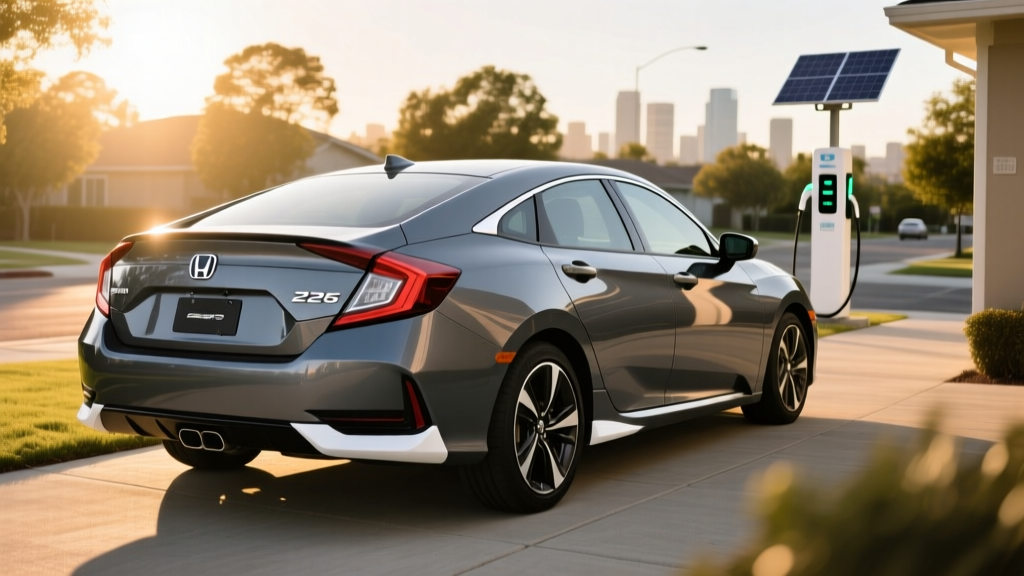
The 2026 Honda Civic Hybrid returns as one of the most fuel-efficient compact sedans on the market, pairing a 2.0-liter Atkinson-cycle engine with a two-motor hybrid system to deliver up to 50 MPG combined. Unlike plug-in hybrids or full electric vehicles, this is a conventional hybrid (HEV) — it never needs to be plugged in and refuels at any gas station. For buyers searching for a 03 honda civic hybrid or researching the latest Civic Hybrid generation, this guide covers every number that matters: EPA ratings, real-world MPG, powertrain output, pricing, and long-term battery reliability.
HEV vs PHEV: What the Civic Hybrid Actually Is
Before diving into specs, it's essential to understand what the Civic Hybrid is — and what it isn't. Honda offers the Civic Hybrid exclusively as a conventional hybrid (HEV). There is no plug-in hybrid (PHEV) variant of the Civic in the U.S. market for 2026.
| Feature | HEV (Civic Hybrid) | PHEV (e.g., Toyota Prius Prime) | BEV (e.g., Tesla Model 3) |
|---|---|---|---|
| Plugs in? | No | Yes | Yes |
| Electric-only range | ~1 mi (low-speed) | 25–44 mi | 250–360 mi |
| Total range | ~500+ mi | ~400–600 mi | 250–360 mi |
| Home charging needed? | No | Recommended | Essential |
| Federal tax credit (§30D) | No | Up to $7,500* | Up to $7,500* |
| Starting MSRP (2026) | ~$29,845 | ~$33,445 | ~$38,990 |
*PHEV/BEV tax credit eligibility depends on MSRP caps, buyer income limits, and battery-sourcing requirements per IRS §30D rules. Consult a tax professional.
The Civic Hybrid's battery recharges through regenerative braking and the gasoline engine. You simply fill up with gas and drive — no charging cables, no range anxiety, no home electrical upgrades.
Fuel Economy: EPA Ratings vs Real-World MPG
Fuel economy is the Civic Hybrid's headline act. Honda offers the hybrid powertrain in the Sport Hybrid and Sport Touring Hybrid trims for 2026, with EPA ratings that vary slightly by trim and wheel size.
| Trim | City MPG | Highway MPG | Combined MPG | Fuel Tank (gal) | Total Range (mi) |
|---|---|---|---|---|---|
| Sport Hybrid (18" wheels) | 50 | 47 | 49 | 10.6 | ~519 |
| Sport Touring Hybrid (18" wheels) | 50 | 47 | 49 | 10.6 | ~519 |
Honda's hybrid system excels in city driving, where the electric motor handles most low-speed propulsion. In real-world mixed driving, owners commonly report 47–52 MPG combined. Highway-heavy commutes at 75+ mph may drop to 42–45 MPG, as the gasoline engine takes on more of the load. Cold weather (below 30°F) can reduce fuel economy by 5–10% due to engine warm-up cycles and cabin heating demands. Source: fueleconomy.gov
Compared to the gas-only 2026 Civic (which achieves 31 city / 40 highway / 35 combined with the 2.0L engine), the hybrid delivers a 40% improvement in combined fuel economy. At $3.50/gallon and 12,000 miles per year, that translates to roughly $530 in annual fuel savings over the gas model.
Powertrain Specs: Horsepower, Motors, and Performance
The 2026 Civic Hybrid uses Honda's fourth-generation two-motor hybrid system, which is fundamentally a series-hybrid architecture at low speeds. The gasoline engine primarily acts as a generator, while the electric drive motor propels the wheels. At highway speeds, a lock-up clutch allows the engine to drive the wheels directly for efficiency.
| Engine | 2.0L DOHC Atkinson-cycle 4-cylinder |
| Engine output | 143 hp @ 6,000 rpm / 134 lb-ft torque |
| Drive motor output | 184 hp / 232 lb-ft torque |
| Combined system output | 200 hp / 232 lb-ft torque |
| Transmission | e-CVT (no traditional gears) |
| Drivetrain | Front-wheel drive |
| 0–60 mph (est.) | ~7.2 seconds |
| Hybrid battery | Lithium-ion, ~1.0 kWh (non-plug-in) |
| Drive modes | Normal, Econ, Sport, Individual |
The 200 combined horsepower is a meaningful upgrade over the 158 hp gas-only Civic. The electric motor's instant 232 lb-ft of torque gives the hybrid noticeably stronger acceleration from a stop and more confident highway merging. In Sport mode, throttle response sharpens and the powertrain holds higher RPMs for more urgent acceleration.
Pricing, Trims, and Tax Credit Eligibility
For 2026, the Civic Hybrid is available in two trims. Pricing includes Honda's destination charge:
- Sport Hybrid: ~$29,845 MSRP
- Sport Touring Hybrid: ~$32,045 MSRP
The Sport Touring adds features like a Bose 12-speaker audio system, wireless phone charging, heated rear seats, a larger 9-inch touchscreen with wireless Apple CarPlay/Android Auto, and Honda's full Honda Sensing suite with low-speed braking control.
No. The federal §30D Clean Vehicle Credit applies only to plug-in electric vehicles (PHEVs and BEVs) with a minimum battery capacity of 7 kWh and plug-in charging capability. The Civic Hybrid's ~1.0 kWh battery and conventional HEV powertrain do not qualify. Some states or local utilities may offer rebates for high-efficiency hybrids — check your state energy office or utility provider for current programs.
Battery Warranty, Lifespan, and Replacement Cost
Battery longevity is consistently the top concern for hybrid buyers. Honda backs the Civic Hybrid's lithium-ion battery pack with a robust warranty:
- Hybrid battery warranty: 8 years / 100,000 miles (10 years / 150,000 miles in CARB states including CA, NY, MA, and others)
- Hybrid system components warranty: 8 years / 100,000 miles
- Powertrain warranty: 5 years / 60,000 miles
In practice, Honda's hybrid batteries have demonstrated strong longevity. Real-world data from Honda Insight and Accord Hybrid owners shows most batteries retain sufficient capacity well past 150,000 miles. The small ~1.0 kWh battery in the Civic Hybrid undergoes shallow charge/discharge cycles (typically operating between 20% and 80% state of charge), which significantly reduces degradation compared to full EVs that cycle through larger portions of battery capacity.
If replacement is eventually needed out of warranty, a new OEM hybrid battery for the Civic Hybrid typically costs $2,000–$3,500 installed. Third-party refurbished batteries are available for $1,200–$2,000. This is a fraction of full EV battery replacement costs, which can exceed $10,000–$18,000.
Who Should Choose the Civic Hybrid?
- Up to 50 MPG city — class-leading efficiency
- 200 hp with strong electric torque feel
- No plug-in required — zero lifestyle change from gas cars
- 500+ mile total range per tank
- Lower starting price than PHEVs and BEVs
- Strong hybrid battery warranty (8–10 yr)
- Honda Sensing ADAS standard on all trims
- No federal tax credit (HEV, not PHEV/BEV)
- No electric-only driving beyond very low speeds
- FWD only — no AWD option (unlike Toyota Prius)
- Highway MPG drops to ~42–45 at sustained 75+ mph
- Engine drone under hard acceleration (e-CVT characteristic)
- Choose the Civic Hybrid if: You want maximum MPG without changing your fueling routine, you lack access to home or workplace charging, you drive a mix of city and highway miles, and you want a proven, affordable powertrain.
- Choose a PHEV (e.g., Prius Prime) if: You have home Level 2 charging, your daily commute is under 40 miles (so you can drive mostly on electricity), and you want the option of electric-only driving with a gas-engine safety net.
- Choose a full BEV if: You have reliable home charging, want zero tailpipe emissions, qualify for the $7,500 federal tax credit, and your daily driving is under 250 miles with access to DC fast charging for road trips.
Driving Impressions and Daily Livability
The 2026 Civic Hybrid drives like a slightly more refined Civic. The two-motor system is smooth in stop-and-go traffic, where the electric motor handles most propulsion and regenerative braking recaptures energy seamlessly. The transition between electric and gas power is nearly imperceptible during normal driving.
In Sport mode, the hybrid system delivers genuinely quick off-the-line acceleration thanks to the electric motor's 232 lb-ft available from 0 rpm. Highway passing is confident, though the e-CVT does produce the characteristic engine drone during sustained hard acceleration — a trait shared with the Toyota Prius and other series-hybrid designs.
The regenerative braking system offers adjustable deceleration via steering-wheel paddles, though it doesn't achieve true one-pedal driving like a full EV. The strongest regen setting slows the car significantly but still requires the brake pedal for a complete stop.
Frequently Asked Questions
How many MPG does the 2026 Honda Civic Hybrid get?
The EPA rates the 2026 Civic Hybrid at 50 city / 47 highway / 49 combined MPG. Real-world testing shows most drivers achieve 47–52 MPG in mixed driving, with city-heavy routes often exceeding the EPA estimate. Highway-only driving at 75+ mph typically yields 42–45 MPG.
Does the Civic Hybrid need to be plugged in?
No. The Civic Hybrid is a conventional hybrid (HEV), not a plug-in hybrid. Its small lithium-ion battery recharges through regenerative braking and the gasoline engine. You fuel it exactly like a standard gas car.
How far can the Civic Hybrid go on electric only?
Essentially zero meaningful miles. The electric motor assists at very low speeds (parking lots, creeping in traffic), but the gasoline engine engages almost immediately during normal driving. This is by design — the HEV system optimizes fuel efficiency, not electric-only range. If electric-only driving is a priority, consider a PHEV like the Toyota Prius Prime (44 miles electric-only) or a full BEV.
Is the Honda Civic Hybrid reliable?
Honda's hybrid systems have a strong reliability track record across the Insight, Accord Hybrid, and CR-V Hybrid lineages. The Civic Hybrid's powertrain uses fewer moving parts than a conventional automatic transmission (no torque converter, no gear shifts), which can reduce long-term maintenance. The hybrid battery is warranted for 8 years/100,000 miles (10 years/150,000 miles in CARB states).
What does a Civic Hybrid battery replacement cost?
An OEM replacement hybrid battery costs approximately $2,000–$3,500 installed at a Honda dealer. Refurbished or aftermarket options range from $1,200–$2,000. However, most Honda hybrid batteries last well beyond 150,000 miles based on owner data, and many never require replacement during the vehicle's lifetime.
Does the Civic Hybrid qualify for any tax credit?
The Civic Hybrid does not qualify for the federal §30D Clean Vehicle Credit, which requires plug-in capability and a minimum 7 kWh battery. The Civic Hybrid has a ~1.0 kWh battery and no plug. Some state or utility programs may offer small rebates for high-MPG hybrids — check IRS.gov and your local energy provider for current programs.
How does the Civic Hybrid compare to the Toyota Prius?
The 2026 Toyota Prius achieves up to 57 MPG combined (LE trim) and offers an AWD option, giving it an edge in pure efficiency and all-weather capability. The Civic Hybrid counters with 200 hp (vs. the Prius's 194 hp in FWD form), a more conventional and engaging driving feel, and Honda's well-regarded interior quality. Both are excellent choices — the Prius wins on peak MPG, while the Civic Hybrid wins on driving dynamics and power.