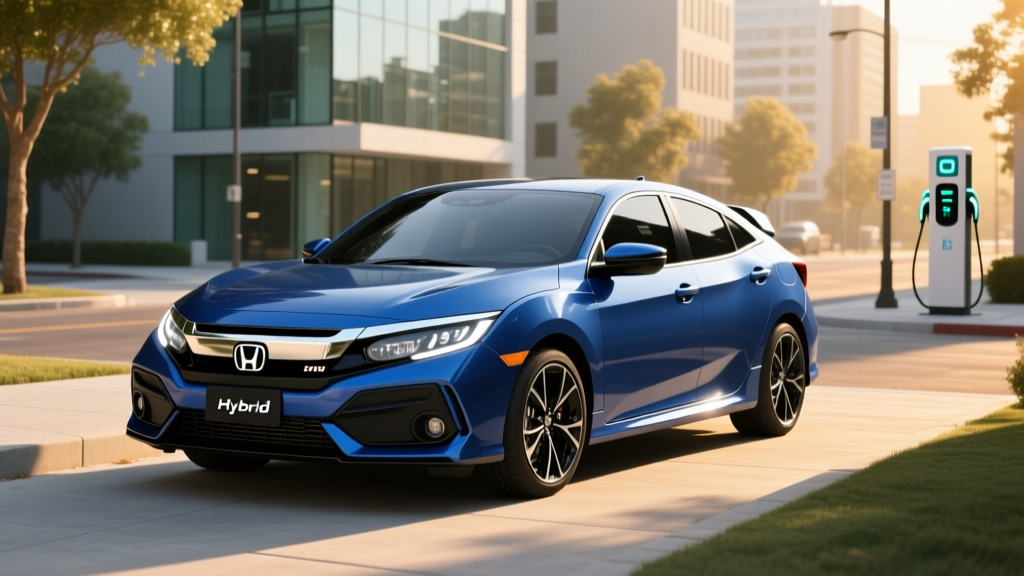
The 2026 Honda Civic Hatchback Hybrid slots into a sweet spot that few competitors can match: genuine hatchback utility, 200 combined horsepower, and EPA-rated fuel economy that routinely beats its sticker in real-world city driving. For buyers weighing a transition away from a conventional gas car but not yet ready to commit to a battery electric vehicle (BEV), the Civic Hatch Hybrid makes a compelling, data-backed case.
In this guide, we'll cover the Civic Hatch Hybrid's powertrain, real-world MPG performance, ownership economics, and how it compares to plug-in hybrids and full EVs — so you can decide if it's the right electrified vehicle for your daily routine.
2026 Civic Hatch Hybrid Powertrain and Performance Specs
The 2026 Civic Hatch Hybrid uses Honda's fourth-generation two-motor hybrid system. Unlike many turbocharged gas competitors, Honda pairs a 2.0-liter Atkinson-cycle four-cylinder engine with two electric motors for seamless torque delivery. This is a conventional hybrid (HEV) — it charges its own small battery through regenerative braking and the engine. You never plug it in.
| Spec | Value |
|---|---|
| Powertrain | 2.0L Atkinson-cycle I4 + two-motor hybrid system |
| Combined Horsepower | 200 hp |
| Combined Torque | 232 lb-ft |
| 0–60 mph | ~7.2 seconds (est.) |
| Drivetrain | Front-wheel drive (FWD) |
| Transmission | e-CVT (direct-drive) |
| Hybrid Type | HEV (self-charging, no plug) |
| Hybrid Battery | Lithium-ion, ~1.0 kWh (nominal) |
| Cargo Volume (rear seats up) | 24.5 cu ft |
| Cargo Volume (rear seats folded) | ~47 cu ft |
The 232 lb-ft of torque is available almost instantly from the electric motors, which gives the Civic Hatch Hybrid a punchy, responsive feel around town that belies its efficiency-first tuning. The e-CVT operates without traditional gear shifts, and Honda's system can run in EV Drive (electric only at low speeds), Hybrid Drive (engine generates electricity for the motors), or Engine Drive (direct mechanical connection at highway cruise).
Fuel Economy: EPA Ratings vs. Real-World MPG
Fuel economy is the headline number for any hybrid buyer, and the Civic Hatch Hybrid delivers. Per fueleconomy.gov, the EPA rates the 2026 Civic Hatch Hybrid at:
| Driving Condition | EPA MPG |
|---|---|
| City | 50 MPG |
| Highway | 45 MPG |
| Combined | 48 MPG |
Compared to the non-hybrid Civic Hatchback (which achieves roughly 30 MPG combined with the 1.5L turbo), the hybrid variant cuts fuel consumption by approximately 35–40%. At $3.50/gallon and 12,000 miles/year, that translates to roughly $500–$600 in annual fuel savings versus the gas model.
HEV vs. PHEV vs. Full EV: Which Fits Your Driving Life?
The Civic Hatch Hybrid is a conventional HEV — but how does it compare to plug-in hybrids and battery electric vehicles? Here's a direct breakdown:
| Factor | HEV (Civic Hatch Hybrid) | PHEV (e.g., Toyota Prius Prime) | BEV (e.g., Chevy Equinox EV) |
|---|---|---|---|
| Plug-in Required? | No | Yes (for EV range) | Yes (always) |
| Electric-Only Range | ~1 mi at low speed | 35–44 mi | 250–320 mi |
| Total Range | ~480 mi | ~440–600 mi | 250–320 mi |
| Home Charging Needed? | No | Recommended (Level 2) | Essential (Level 2) |
| Federal Tax Credit | Not eligible | Up to $7,500 (§30D) | Up to $7,500 (§30D) |
| Best For | No home charging access; city-heavy commute | Short EV commute + long road trips | Home charging + mostly under 250 mi/day |
| Maintenance | Low (no plug, small battery) | Moderate (engine + EV systems) | Lowest (no engine, no oil changes) |
The Civic Hatch Hybrid is ideal if: You don't have access to home or workplace charging, you want maximum simplicity with zero behavior change from your current gas car, and your commute is city-heavy where regenerative braking maximizes MPG.
Consider a PHEV instead if: You can install a Level 2 home charger, your daily commute is under 40 miles round-trip, and you still want a gas engine for road trips. The federal §30D tax credit (up to $7,500) can make a PHEV competitive on price after incentives.
Consider a full BEV if: You have reliable home charging, your daily driving stays under 200 miles, and you want the lowest per-mile energy cost (roughly $0.04–$0.06/mile on electricity vs. $0.08–$0.12/mile on gas at 48 MPG).
Pricing, Trims, and Tax Credit Eligibility
The 2026 Civic Hatch Hybrid is offered in three trims. Pricing starts competitive with well-equipped compact hatchbacks:
| Trim | MSRP (est.) |
|---|---|
| Sport Hybrid | $29,995 |
| Sport Touring Hybrid | $33,995 |
Note: Destination charges (~$1,095) apply. Final pricing confirmed at model launch.
Some states and utilities offer rebates or HOV-lane access for hybrids, but these vary widely by jurisdiction. Check your state energy office or utility provider for local programs.
Battery Warranty, Reliability, and Replacement Costs
Hybrid battery longevity is consistently the top concern among first-time hybrid buyers. Here's what the data shows:
Honda's hybrid systems have an excellent long-term reliability record. The Civic's hybrid battery is relatively small (~1.0 kWh) and operates in a shallow charge-discharge window — typically between 40% and 70% State of Charge — which drastically reduces degradation compared to a full EV battery that cycles through a wider range.
Real-world battery lifespan: Based on data from Honda's earlier hybrid models (Insight, Accord Hybrid), hybrid battery packs routinely last 150,000–200,000+ miles before significant degradation. Many first-generation Insight and Civic Hybrid batteries exceeded 200,000 miles.
Replacement cost if out of warranty: A hybrid battery replacement for the Civic Hatch Hybrid is estimated at $2,000–$4,000 (parts and labor) based on current Honda hybrid battery pricing. This is a fraction of EV battery replacement costs ($8,000–$20,000+) because the pack is much smaller. Third-party refurbishers also offer rebuilt hybrid batteries for $1,200–$2,500.
For context, the IIHS has historically rated the Civic lineup highly for safety. Check IIHS for the latest crash-test results when available.
Daily Ownership: What Living With the Civic Hatch Hybrid Is Like
Day-to-day, the Civic Hatch Hybrid drives like a well-tuned Civic with bonus torque and fewer stops at the gas station. Here are the practical ownership details that matter:
- Refueling: The ~12.4-gallon tank gives approximately 480+ miles of total range at the EPA combined rating. You'll visit the gas station roughly once every two weeks at 12,000 miles/year.
- No charging needed: The hybrid battery charges itself. There is no plug, no charging cable, and no home electrical work required.
- Maintenance: Honda recommends oil changes every 7,500–10,000 miles. The hybrid system adds no routine maintenance items — the e-CVT has no traditional transmission fluid service interval. Brake pad life is often extended because regenerative braking reduces friction brake use.
- Cold-weather MPG: Hybrids see a modest fuel economy dip in winter (roughly 5–10% lower MPG) as the engine runs more frequently to provide cabin heat. This is far less impactful than the 20–30% range loss a full EV experiences in freezing temperatures.
- Cargo practicality: The hatchback design offers 24.5 cu ft behind the rear seats — more than the Civic Sedan's 14.8 cu ft trunk. With seats folded, you get nearly 47 cu ft, enough for furniture, bikes, or camping gear.
Pros and Cons
Pros
- 48 MPG combined EPA; often exceeds in city driving
- 200 hp / 232 lb-ft — peppy acceleration
- No plug-in charging required
- Excellent cargo versatility (24.5 cu ft hatch)
- 8–10 year hybrid battery warranty
- Low estimated battery replacement cost ($2K–$4K)
- Honda's strong reliability and resale value history
Cons
- No federal tax credit (HEV, not PHEV/BEV)
- FWD only — no AWD option (unlike Toyota Prius)
- Highway MPG drops to ~40–43 at 75+ mph
- ~1.0 kWh battery means virtually no electric-only driving
- Starting price ~$30K is higher than base gas Civic Hatch
- e-CVT drone under hard acceleration
Frequently Asked Questions
How many MPG does the 2026 Civic Hatch Hybrid get?
The EPA rates it at 50 city / 45 highway / 48 combined MPG. Real-world city driving often yields 48–54 MPG thanks to regenerative braking. Highway-only driving at high speeds typically returns 40–43 MPG.
Does the Civic Hatch Hybrid need to be plugged in?
No. It is a conventional hybrid (HEV), not a plug-in hybrid (PHEV). The battery charges through regenerative braking and the gasoline engine. There is no plug, no charging cable, and no home charger required.
How far can it go on electric power alone?
Only about 1 mile at very low speeds (under 25 mph) in EV Drive mode. The ~1.0 kWh battery is designed for assist, not standalone propulsion. If you want meaningful electric-only range (35–44 miles), you'd need a PHEV like the Toyota Prius Prime.
Is the Civic Hatch Hybrid reliable, and what does battery replacement cost?
Honda's hybrid systems have a strong reliability track record spanning two decades. The hybrid battery is warranted for 8 years/100,000 miles (10/150,000 in CARB states). Real-world data suggests packs last 150,000–200,000+ miles. Out-of-warranty replacement runs approximately $2,000–$4,000.
Does the Civic Hatch Hybrid qualify for any tax credit?
Not the federal §30D Clean Vehicle Credit — that applies only to plug-in vehicles (PHEVs and BEVs). Some state or utility programs may offer small rebates for hybrids, but eligibility varies by location. Check your state energy office for details.
How does it compare to the Toyota Prius?
The Prius (57 MPG combined) beats the Civic Hatch Hybrid on pure fuel economy and offers an AWD option. However, the Civic delivers more horsepower (200 vs. 196), a sportier driving feel, and Honda's hatchback cargo layout. The Prius also uses a conventional hybrid system with no plug-in requirement on its base trims.
Should I buy the Civic Hatch Hybrid or a full EV?
If you have no access to home or workplace charging, or you regularly drive more than 250 miles between stops, the Civic Hatch Hybrid is the practical choice — zero behavior change, no range anxiety, and 48 MPG. If you can charge at home and mostly drive under 200 miles daily, a BEV will deliver lower per-mile energy costs and near-zero routine maintenance.