Audi's Plug-In Hybrid SUV Strategy for 2026
Audi does not sell a conventional hybrid (HEV) SUV in the United States. Every electrified Audi SUV on American soil is a plug-in hybrid electric vehicle (PHEV), meaning it pairs a turbocharged gasoline engine with a larger battery pack and electric motor that you charge from a wall outlet or public charger. For buyers searching for an Audi SUV hybrid, this distinction matters: you get meaningful electric-only driving for daily commutes, plus a gas engine for road trips — but you do need access to a plug to unlock the efficiency gains.
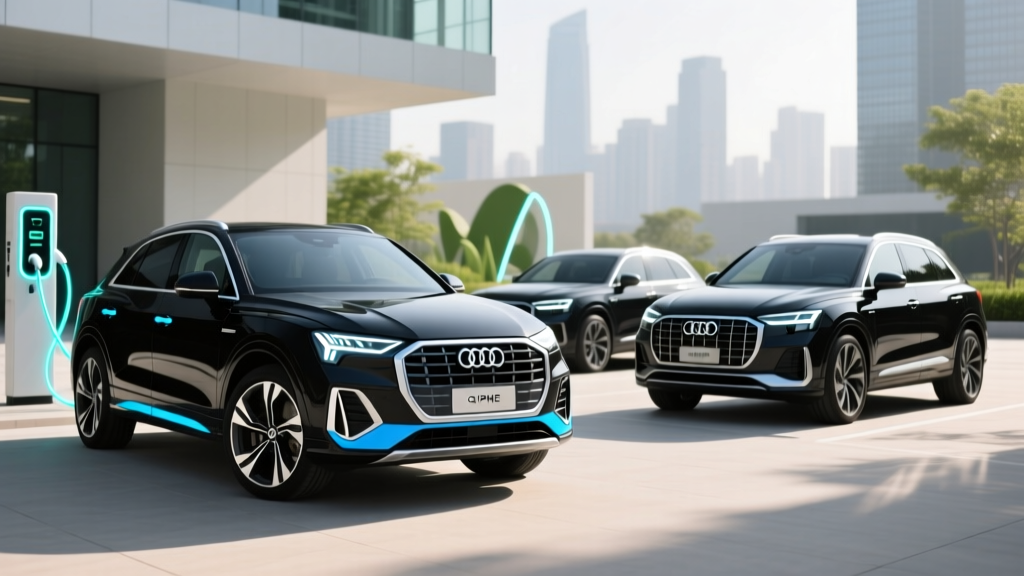
For the 2026 model year, Audi offers three PHEV SUVs in the US market: the midsize Q5 55 TFSI e, the three-row Q7 55 TFSI e, and the coupe-styled Q8 55 TFSI e. All three use variations of Audi's 2.0-liter turbocharged four-cylinder engine paired with an electric motor integrated into the transmission. Here is everything you need to know about range, efficiency, pricing, and whether a PHEV Audi fits your lifestyle better than a full EV or a gas-only alternative.
HEV vs. PHEV: What's the Difference?
Conventional Hybrid (HEV): A small battery recharged by regenerative braking and the engine. No plug. Electric-only driving is limited to very low speeds and short distances (typically under 1 mile). Think Toyota RAV4 Hybrid.
Plug-In Hybrid (PHEV): A larger battery (typically 14–26 kWh) that you charge via a plug. Offers 20–40 miles of electric-only range at highway speeds before the gas engine activates. All current Audi SUV hybrids in the US are PHEVs.
2026 Audi PHEV SUV Spec Comparison
| Spec | Q5 55 TFSI e | Q7 55 TFSI e | Q8 55 TFSI e |
|---|---|---|---|
| Engine | 2.0L Turbo I4 | 2.0L Turbo I4 | 2.0L Turbo I4 |
| Combined HP | 362 hp | 375 hp | 375 hp |
| Combined Torque | 369 lb-ft | 369 lb-ft | 369 lb-ft |
| Battery (usable) | ~17.9 kWh | ~17.9 kWh | ~17.9 kWh |
| EPA Electric Range | 23 mi | 20 mi | 21 mi |
| EPA Combined MPG (gas) | 25 MPG | 22 MPG | 22 MPG |
| MPGe (combined) | 61 MPGe | 56 MPGe | 56 MPGe |
| 0–60 mph | 5.5 sec | 5.7 sec | 5.6 sec |
| Level 2 Charge (0–100%) | ~2.5 hrs (7.2 kW) | ~2.5 hrs (7.2 kW) | ~2.5 hrs (7.2 kW) |
| DC Fast Charge | No | No | No |
| Base MSRP | $58,995 | $72,495 | $78,995 |
| Federal Tax Credit (§30D) | Up to $3,750* | Up to $3,750* | Up to $3,750* |
*Tax credit eligibility depends on battery sourcing, buyer income, and MSRP caps under IRS §30D rules. PHEVs with batteries under 16 kWh (gross) may qualify for a reduced credit of $3,750. Consult a tax professional.
Fuel Economy Breakdown: EPA vs. Real-World MPG
| Model | City MPG | Highway MPG | Combined MPG | Combined MPGe |
|---|---|---|---|---|
| Q5 55 TFSI e | 26 | 24 | 25 | 61 |
| Q7 55 TFSI e | 23 | 21 | 22 | 56 |
| Q8 55 TFSI e | 23 | 21 | 22 | 56 |
Source: fueleconomy.gov (EPA estimates).
Real-World MPG: What to Actually Expect
The MPG figures above apply only after the battery is depleted and you are driving on gasoline alone. The MPGe figure (miles per gallon equivalent) captures the combined efficiency when you start with a full charge and use both electric and gas power.
In real-world use, your experience depends entirely on your charging habits:
- Charge daily, commute under 20 miles: You will burn almost no gasoline on weekdays. Expect effective "MPG" in the hundreds when measured over a month, because most driving happens on electricity.
- Never plug in: The Q5 will return roughly 24–27 MPG combined as a heavy hybrid — about 2–3 MPG better than the gas-only Q5 45 TFSI (rated 23 MPG combined), but far below the sticker's 61 MPGe promise.
- Cold weather (below 30°F): Expect electric-only range to drop 20–30%, shrinking the Q5's 23-mile EPA electric range to roughly 16–18 miles. The gas engine will also engage more aggressively to heat the cabin unless you precondition while plugged in.
- Highway road trips (battery depleted): Expect 23–25 MPG in the Q5 at 70–75 mph, and 19–21 MPG in the Q7/Q8. Aerodynamic drag and the added weight of the battery pack (roughly 400 lbs over gas models) work against highway efficiency.
Electric-Only Range and Charging: The Daily-Commute Equation
Every 2026 Audi PHEV SUV uses a ~17.9 kWh usable lithium-ion battery pack (NMC chemistry). The EPA-rated electric-only ranges are modest compared to rivals like the BMW X5 xDrive50e (38 miles) or the Jeep Grand Cherokee 4xe (25 miles):
- Q5 55 TFSI e: 23 miles electric-only
- Q7 55 TFSI e: 20 miles electric-only
- Q8 55 TFSI e: 21 miles electric-only
Real-World Electric Range Callout
The Q5's 23-mile EPA electric range translates to roughly 18–20 miles in mixed driving and as low as 15–16 miles in cold weather or sustained highway speeds above 70 mph. If your one-way commute exceeds 15 miles, you will likely need the gas engine to finish the trip unless you charge at your destination.
Charging Speeds and Hardware
Audi PHEV SUVs accept Level 2 AC charging at up to 7.2 kW via a J1772 connector (with a NACS adapter available from Audi for Tesla destination chargers). A full 0–100% charge takes approximately 2.5 hours on a Level 2 home charger.
No DC fast charging is available on any current Audi PHEV SUV. This is a meaningful limitation: you cannot top up quickly on a road trip. The battery is small enough that Level 2 charging is adequate for overnight replenishment, but it means public DC fast-charger networks (Electrify America, EVgo, Tesla Superchargers) are not useful for these vehicles.
| Charging Level | Power | 0–100% Time | Connector |
|---|---|---|---|
| Level 1 (120V outlet) | ~1.4 kW | ~12–14 hours | Standard outlet |
| Level 2 (240V) | 7.2 kW | ~2.5 hours | J1772 / NACS adapter |
| DC Fast Charge | N/A | N/A | Not supported |
Powertrain Performance and Driving Dynamics
All three Audi PHEV SUVs pair a 2.0-liter turbocharged inline-four (producing roughly 261 hp on its own) with an electric motor integrated into the seven-speed S tronic dual-clutch transmission. Combined output reaches 362 hp in the Q5 and 375 hp in the Q7 and Q8, with 369 lb-ft of torque available from low RPM thanks to the electric motor's instant torque delivery.
Audi's quattro all-wheel drive is standard on all PHEV variants. The electric motor drives the front axle while the engine primarily powers the rear, though the system can blend torque distribution as traction demands.
Driving modes include:
- EV mode: Pure electric driving up to ~84 mph (electronically limited). The gas engine stays off unless you floor the accelerator.
- Hybrid mode: The car decides when to use electric, gas, or both based on navigation data, traffic, and battery state of charge.
- Battery Hold: Preserves current charge level for later use — useful if you want to save electric range for a city zone after a highway segment.
- Battery Charge: The engine runs harder to recharge the battery while driving. Fuel economy suffers significantly in this mode, but it can be strategic before entering an emissions-restricted zone or arriving home without a charger.
0–60 mph times range from 5.5 to 5.7 seconds — brisk enough for confident highway merging and passing, though not in the same league as the SQ5 or SQ7 performance variants.
Pricing, Trims, and Federal Tax Credit Eligibility
The 2026 Audi PHEV SUV lineup carries a price premium of roughly $5,000–$7,000 over equivalent gas-only trims:
- Q5 55 TFSI e Premium: $58,995 (Premium Plus: ~$63,495 / Prestige: ~$68,995)
- Q7 55 TFSI e Premium: $72,495 (Premium Plus: ~$77,995 / Prestige: ~$83,495)
- Q8 55 TFSI e Premium Plus: $78,995 (Prestige: ~$85,495)
Federal Tax Credit (§30D) for Audi PHEVs
§30D Tax Credit Eligibility Checklist
- Battery capacity: Must be ≥7 kWh (all Audi PHEVs qualify)
- MSRP cap: SUVs must be ≤$80,000 (Q5 and Q7 base trims qualify; Q8 Prestige may exceed the cap)
- Buyer income cap: ≤$150,000 single / ≤$300,000 married filing jointly
- Battery sourcing: Critical minerals and battery components must meet phased-in percentage thresholds — this is where Audi PHEVs may only qualify for the $3,750 partial credit rather than the full $7,500, depending on supply-chain compliance for the specific build month
- Point-of-sale transfer: You can transfer the credit to the dealer at purchase for an immediate price reduction, or claim it on your federal tax return
Source: IRS.gov — New Clean Vehicle Credit. Rules are subject to change; verify eligibility with your dealer and tax advisor before purchase.
Many states also offer additional incentives for PHEVs (California's CVRP, Colorado's innovative motor vehicle credit, etc.), but amounts vary by jurisdiction and funding availability. Check your state energy office or DMV for current programs.
Battery Warranty, Reliability, and Long-Term Costs
Audi PHEV Battery Warranty
Coverage: 8 years / 100,000 miles (whichever comes first)
Capacity retention threshold: Audi warrants the high-voltage battery against defects and excessive capacity loss. If the battery falls below approximately 70% of original capacity within the warranty period, Audi will repair or replace it.
Out-of-warranty replacement cost: Estimated $8,000–$12,000 for the PHEV battery pack (parts + labor), based on current dealer pricing for similar VW Group PHEV systems. This is significantly less than a full BEV battery replacement ($15,000–$25,000) because the pack is smaller.
Reliability Considerations
Audi's PHEV powertrain is derived from the Volkswagen Group's widely deployed MLB evo platform, shared with the Porsche Cayenne E-Hybrid and Volkswagen Touareg R. Long-term PHEV battery degradation data from this platform suggests 10–15% capacity loss over 8–10 years under normal use — meaning a Q5 that starts with 23 miles of electric range may offer 19–20 miles after a decade.
The more common reliability concerns with Audi PHEVs are not battery-related but involve the added complexity of dual powertrains: the electric motor, power electronics, charging port, and the software managing the transition between electric and gas modes. J.D. Power and Consumer Reports have rated Audi's overall reliability as average to slightly below average in recent years, with electrical and infotainment systems being the most frequent complaint categories.
Maintenance costs are slightly lower than gas-only Audis (no need for frequent brake pad replacement thanks to regenerative braking, and the engine runs fewer hours), but dealer service rates for PHEV-specific diagnostics can be higher. Budget $1,200–$1,800 annually for maintenance after the included 3-year/30,000-mile Audi Care plan expires.
Audi SUV Hybrid vs. Full EV vs. Gas: Which Fits You?
Choose the Audi PHEV if...
- Your daily commute is under 20 miles round-trip and you can charge at home overnight
- You take road trips of 200+ miles several times per year and don't want to plan around charging stops
- You want Audi's interior quality and quattro AWD without full EV commitment
- Your household has one garage circuit available for Level 2 charging
Choose a Full EV (Audi Q4 e-tron, Q8 e-tron) if...
- Your commute is under 30 miles and you rarely drive more than 250 miles in a day
- You want zero tailpipe emissions and the lowest per-mile fuel cost (~$0.04–$0.06/mi on home electricity)
- You qualify for the full $7,500 federal tax credit on eligible BEV models
- You want minimal drivetrain maintenance (no oil changes, no transmission fluid, fewer moving parts)
Choose Gas-Only (Q5 45 TFSI) if...
- You cannot install a home charger (apartment, street parking, no garage)
- Your budget is tighter — the gas Q5 starts ~$6,000 lower than the PHEV
- You drive fewer than 8,000 miles per year, so fuel savings won't offset the PHEV premium
- You want simpler long-term maintenance without high-voltage system complexity
Pros and Cons of the 2026 Audi PHEV SUVs
Pros
- Seamless electric-to-gas transition with no range anxiety
- Premium interior, strong build quality, standard quattro AWD
- 362–375 hp provides confident acceleration
- Can drive on electricity alone for daily commutes (15–23 mi)
- Eligible for partial federal tax credit ($3,750) and state incentives
- Regenerative braking extends brake pad life
Cons
- Electric-only range (20–23 mi) is short vs. rivals like the BMW X5 xDrive50e (38 mi)
- No DC fast charging — unusable at public fast-charger stations
- Gas-only MPG (22–25 combined) is only marginally better than gas-only Q5
- $5,000–$7,000 price premium over gas models takes years to recoup via fuel savings
- Cargo space slightly reduced due to battery pack placement
- Partial tax credit only ($3,750 vs. $7,500 for many BEVs)
Frequently Asked Questions
How many MPG does the Audi Q5 hybrid get?
The 2026 Audi Q5 55 TFSI e is rated by the EPA at 26 city / 24 highway / 25 combined MPG when running on gasoline after the battery is depleted. When factoring in electric-only driving from a full charge, the combined rating is 61 MPGe. Real-world gas-only MPG tends to land between 23–27 depending on driving style and conditions. If you charge daily and commute under 20 miles, you may use very little gasoline at all.
How far can the Audi Q5 PHEV go on electric only?
The EPA rates the Q5 55 TFSI e at 23 miles of electric-only range. In real-world mixed driving, expect 18–20 miles. In cold weather (below 30°F) or at sustained highway speeds above 70 mph, that drops to roughly 15–16 miles. The Q7 and Q8 PHEVs are rated at 20 and 21 miles respectively.
Does the Audi Q5 PHEV qualify for a federal tax credit?
Yes, but likely only the partial $3,750 credit under IRS §30D, due to battery component and critical-mineral sourcing requirements. Full $7,500 eligibility depends on the specific build month's supply-chain compliance. The buyer must also meet income caps ($150K single / $300K joint) and the SUV's MSRP must be under $80,000. The credit can be transferred to the dealer at point of sale for an immediate price reduction. Verify current eligibility on fueleconomy.gov and with your tax professional.
Is the Audi PHEV battery reliable, and what does replacement cost?
Audi covers the high-voltage battery for 8 years / 100,000 miles, warranting it against defects and excessive capacity loss (typically below 70% of original capacity). Real-world data from the VW Group MLB evo PHEV platform suggests 10–15% degradation over a decade. Out-of-warranty replacement is estimated at $8,000–$12,000 — expensive, but less than a full BEV battery swap. The bigger reliability risk is the added complexity of dual powertrains and associated electronics.
Can I charge an Audi PHEV at a public DC fast charger?
No. Current Audi PHEV SUVs (Q5, Q7, Q8 55 TFSI e) do not support DC fast charging. They can only charge via AC Level 1 (120V) or Level 2 (240V) at up to 7.2 kW. This means Electrify America, EVgo, and Tesla Supercharger stalls are not usable for these vehicles. All charging will happen at home, at work, or at Level 2 destination chargers.
Is an Audi PHEV SUV better than a full EV like the Q4 e-tron?
It depends on your driving pattern. If you regularly drive 200+ miles in a day (road trips, rural commutes) and cannot rely on charging infrastructure along your routes, the PHEV's gas engine eliminates range anxiety entirely. If most of your driving is under 100 miles per day and you have reliable home charging, a full EV like the Audi Q4 e-tron (EPA range 265 miles, eligible for up to $7,500 in tax credits) offers lower running costs, zero tailpipe emissions, and less mechanical complexity. The PHEV is the bridge solution; the BEV is the destination.
Do I need to plug in the Audi PHEV every night?
You don't have to — the car functions perfectly as a conventional hybrid without plugging in, returning 22–25 MPG. But you will miss the entire point of the PHEV. Without regular charging, you are carrying 400+ lbs of battery dead weight and paying a premium for capability you never use. To get value from an Audi PHEV, plan to plug in at least once daily, ideally overnight on a Level 2 home charger that fully replenishes the battery in ~2.5 hours.