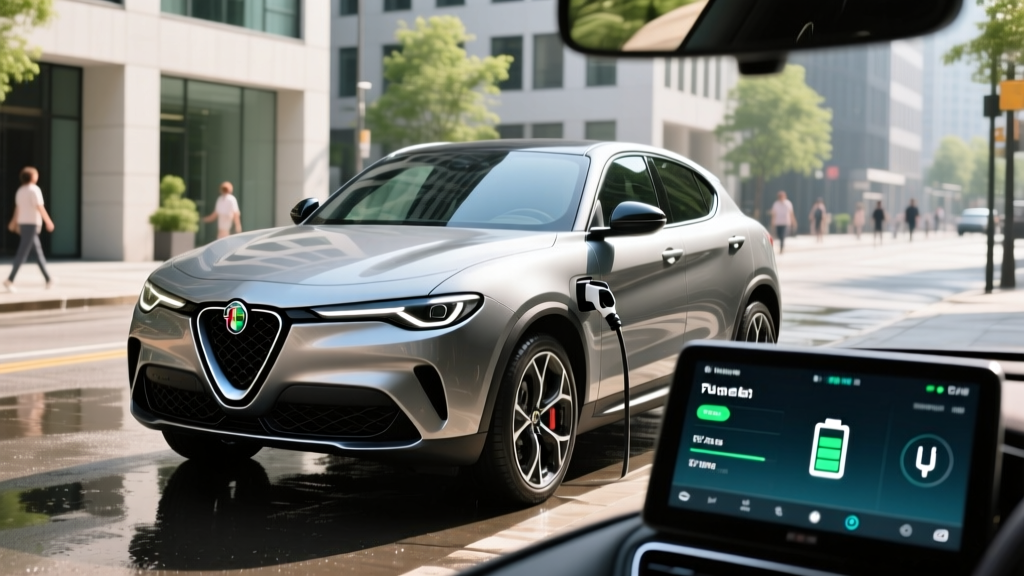
The Alfa Romeo Tonale Plug-In Hybrid occupies a narrow lane in the compact luxury crossover segment: Italian styling and all-wheel-drive performance with a plug-in powertrain that can handle short commutes on electricity alone. For 2025 and 2026, it remains one of the few PHEVs in its class that pairs a turbocharged engine with a rear-axle electric motor to deliver genuine AWD traction — not just torque-fill.
But does the Tonale PHEV's real-world efficiency justify its premium price? And how does it stack up against a full EV or a conventional hybrid? This guide breaks down every number that matters.
Alfa Romeo Tonale PHEV Powertrain: 285 HP and Q4 AWD
The Tonale plug-in hybrid pairs a 1.3-liter turbocharged inline-four engine driving the front wheels with a 90 kW (121 hp) electric motor powering the rear axle. Combined system output is 285 horsepower and 350 lb-ft of torque. This "Q4" all-wheel-drive system is not a mechanical link between axles — it's an electrically actuated rear drive, meaning the car can operate in front-wheel drive (engine only), rear-wheel drive (motor only), or full AWD when both systems engage.
| Spec | Value |
|---|---|
| Combined Horsepower | 285 hp |
| Combined Torque | 350 lb-ft |
| Engine | 1.3L Turbo I-4 (180 hp) |
| Electric Motor | 90 kW / 121 hp (rear axle) |
| Battery (Total / Usable) | 15.5 kWh / ~12.0 kWh usable |
| Battery Chemistry | NMC (Nickel Manganese Cobalt) |
| EPA Electric Range | 30 miles |
| Total Combined Range | ~320 miles (gas + electric) |
| MPGe (Electric + Gas) | 77 MPGe combined |
| MPG (Gas Only, Combined) | 29 MPG combined |
| 0–60 mph | 6.0 seconds |
| Transmission | 6-speed automatic |
| Drivetrain | Q4 AWD (electric rear axle) |
| Max AC Charging | 7.4 kW (Level 2) |
| DC Fast Charging | Not available |
| Level 2 Charge Time (0–100%) | ~2.5 hours |
| Level 1 Charge Time (120V) | ~8–9 hours |
The 15.5 kWh battery pack is mounted beneath the rear seats and cargo floor. Alfa Romeo quotes approximately 12.0 kWh of usable capacity — the remainder is a buffer to protect long-term battery health. This is a relatively small pack compared to rivals like the Toyota RAV4 Prime (18.1 kWh) or the Hyundai Tucson PHEV (13.8 kWh usable), and it directly explains the Tonale's modest 30-mile electric range.
Fuel Economy: EPA MPG and Real-World Expectations
According to fueleconomy.gov, the Tonale PHEV Q4 delivers:
| Driving Mode | City | Highway | Combined |
|---|---|---|---|
| Charge-Sustaining (Gas Only) | 28 MPG | 29 MPG | 29 MPG |
| Charge-Depleting (Electric + Gas) | 77 MPGe combined | ||
The 29 MPG combined figure in charge-sustaining mode (after the battery is depleted) is unremarkable for a compact luxury crossover. The BMW X3 xDrive30e achieves a similar 28 MPG combined in gas-only mode, while the RAV4 Prime manages an impressive 38 MPG combined — a gap driven largely by Toyota's larger battery and more efficient Atkinson-cycle engine.
Real-world note: Plug-in hybrids often exceed their EPA city ratings in stop-and-go driving because regenerative braking recaptures energy that a gas car wastes as heat. Expect 30–32 MPG around town once the battery is depleted. Highway driving at 75+ mph will likely drop to 26–27 MPG, especially with the AWD system engaged. In cold weather (below 30°F), the electric range shrinks by roughly 20–30%, dropping from 30 miles to approximately 21–24 miles, as the battery's internal resistance increases and cabin heating draws power.
Electric-Only Range and Charging: 30 Miles, No DC Fast Charge
The EPA rates the Tonale PHEV at 30 miles of electric-only range. In practice, that number is achievable in mild weather at city speeds (under 45 mph). Highway driving at 70 mph will reduce electric range to roughly 22–25 miles because aerodynamic drag scales with the square of speed, and a 12 kWh usable battery has limited energy to give.
Real-World Expectation: 24–28 miles (mixed driving), 18–22 miles (highway or cold weather)
Total Combined Range: ~320 miles (11.9-gallon tank + full battery)
Charging is limited to AC only. The onboard charger accepts up to 7.4 kW on Level 2 (240V), which replenishes the battery from empty to full in approximately 2.5 hours. On a standard 120V household outlet (Level 1, ~1.4 kW), a full charge takes 8–9 hours — fine for overnight top-ups if you drive less than 30 miles daily.
No DC fast charging is available. This is typical for PHEVs in this class — the small battery doesn't justify the added cost and weight of DCFC hardware. If you need rapid charging on road trips, the gas engine takes over seamlessly.
HEV vs. PHEV vs. Full EV: Which Powertrain Fits You?
| Factor | Conventional Hybrid (HEV) | Plug-In Hybrid (PHEV) | Battery Electric (BEV) |
|---|---|---|---|
| Plugs In? | No — charges via regen and engine | Yes — also charges via regen and engine | Yes — only way to charge |
| Electric-Only Range | 0–1 miles (low-speed creep) | 20–45 miles typical | 200–400+ miles |
| Gas Engine? | Yes | Yes | No |
| Home Charging Needed? | No | Strongly recommended (or you waste the PHEV premium) | Essential |
| Tax Credit Eligible? | No federal credit | Some models qualify (see §30D rules) | Many models qualify |
| Best For | No charging access; want better MPG | Home charging + short commute + road trips | Home charging + mostly under 250 mi/day |
The Tonale PHEV makes the most sense if you can charge at home (or at work) and your daily driving falls within its 25–30-mile electric envelope. If your commute is 15 miles each way and you plug in every night, you'll burn almost no gasoline on weekdays. But if you can't plug in regularly, you're carrying 400+ pounds of dead battery and motor for no benefit — you'd be better served by a conventional hybrid like the Toyota RAV4 Hybrid (39 MPG combined) or a mild-hybrid luxury crossover.
If your daily driving exceeds 60 miles and you have reliable home charging, a full EV like the Tesla Model Y (310+ mile range) or the Hyundai Ioniq 5 (303 miles) will deliver far lower per-mile energy costs and eliminate oil changes entirely.
Pricing, Trims, and Federal Tax Credit Eligibility
For the 2025 model year (carrying into 2026 with minimal changes), the Alfa Romeo Tonale PHEV Q4 starts at approximately $47,490 (including destination) for the Sprint trim. The Ti trim starts around $49,490, and the range-topping Veloce reaches approximately $52,490. These prices position the Tonale above the RAV4 Prime (~$44,500) and the Hyundai Tucson PHEV (~$38,000) but below the BMW X3 xDrive30e (~$53,000).
- Vehicle MSRP Cap: SUVs must be under $80,000 — the Tonale PHEV clears this easily.
- Buyer Income Cap: Modified AGI must not exceed $150,000 (single), $225,000 (head of household), or $300,000 (joint).
- Battery Sourcing: As of 2024–2026, critical minerals and battery components must meet escalating domestic/free-trade-partner thresholds. The Tonale PHEV's battery is manufactured by Samsung SDI with supply chain ties that have historically limited its §30D eligibility.
- Point-of-Sale Transfer: If eligible, the credit can be transferred to the dealer at purchase for an immediate price reduction.
- Current Status: The Tonale PHEV has not consistently appeared on the IRS qualified vehicle list for the full $7,500 credit. Check the latest list at fueleconomy.gov or consult a tax professional before relying on credit eligibility.
State incentives vary widely. California's CVRP program, Colorado's state credit, and other local programs may offer additional savings — check your state energy office for current amounts.
Battery Warranty, Reliability, and Replacement Cost
Coverage Threshold: Battery must retain at least 70% of original capacity during the warranty period.
Powertrain Warranty: 4 years / 50,000 miles
The 8-year/100,000-mile hybrid battery warranty is federally mandated for PHEVs and matches what Toyota, Hyundai, and BMW offer. Alfa Romeo's general bumper-to-bumper warranty (4 years/50,000 miles) is average for the luxury segment, though some competitors like Hyundai offer longer basic coverage (5 years/60,000 miles).
On reliability, Alfa Romeo as a brand has scored below average in Consumer Reports annual surveys and JD Power dependability studies. The Tonale is relatively new (introduced for 2024), so long-term data is limited. The PHEV powertrain itself — the 1.3L turbo and rear electric motor — is shared with other Stellantis products in Europe, where it has accumulated more service history.
Battery replacement cost: Out of warranty, a PHEV battery pack replacement typically runs $6,000–$10,000 including parts and labor. However, NMC lithium-ion packs in PHEVs rarely require full replacement — individual module swaps or cell rebalancing can address degradation issues at lower cost. Most PHEV batteries retain 85–90% capacity after 100,000 miles based on industry-wide data from similar-sized packs.
Driving Impressions: Performance Meets Practicality
The 6.0-second 0–60 mph time makes the Tonale PHEV genuinely quick for its class. The instant torque from the rear electric motor provides sharp off-the-line response, and the transition between electric and gas power is mostly seamless — you'll feel a slight surge when the turbo spools up under hard acceleration, but it's not jarring.
Ride quality leans firm, consistent with Alfa Romeo's sporty brand identity. The steering is quicker and more communicative than most compact luxury crossovers, though the added weight of the PHEV system (~3,900 lbs curb weight) is noticeable in tight corners. Regenerative braking offers mild deceleration when you lift off the accelerator, but the Tonale does not offer true one-pedal driving — you'll still use the brake pedal for most stops.
Cargo volume drops slightly versus the gas-only Tonale due to the battery pack: expect approximately 20 cubic feet behind the rear seats and 50 cubic feet with them folded. There is no frunk.
Pros and Cons
- 285 hp and 6.0s 0–60 — genuinely quick for the class
- True AWD via electric rear axle — no mechanical driveshaft
- Distinctive Italian styling in a segment of look-alikes
- 30-mile electric range covers most daily commutes
- Under $80K MSRP — clears §30D SUV cap if sourcing rules are met
- 29 MPG gas-only is below rivals (RAV4 Prime: 38 MPG)
- Small 12 kWh usable battery limits electric highway range
- No DC fast charging capability
- Below-average brand reliability scores
- Federal tax credit eligibility uncertain due to battery sourcing
- Premium price vs. mainstream PHEV alternatives
Who Should Buy the Alfa Romeo Tonale PHEV?
- You want a luxury-badged PHEV with sporty handling and Italian design
- Your daily commute is under 30 miles and you can charge at home
- You need AWD for snow or rain but don't want a full EV in a cold climate
- Performance (285 hp, 6.0s 0–60) matters more than maximum MPG
- Fuel efficiency is the top priority → Toyota RAV4 Prime (38 MPG gas, 42 mi electric)
- You want a lower price with similar PHEV utility → Hyundai Tucson PHEV (~$38K)
- You're ready for full electric → Tesla Model Y or Hyundai Ioniq 5
- Reliability track record is critical → Lexus NX 450h+ (37 mi electric, Lexus dependability)
Frequently Asked Questions
How many MPG does the Alfa Romeo Tonale plug-in hybrid get?
The EPA rates the Tonale PHEV at 29 MPG combined (28 city / 29 highway) in charge-sustaining mode after the battery is depleted. In real-world city driving with regenerative braking, expect 30–32 MPG. Highway cruising at 75+ mph will likely return 26–27 MPG. When the battery is charged, the combined rating is 77 MPGe.
How far can the Tonale PHEV go on electric only?
The EPA rates it at 30 miles of electric-only range. In real-world mixed driving, expect 24–28 miles. Highway speeds and cold weather reduce this to 18–22 miles. The total combined range (gas tank + full battery) is approximately 320 miles.
Does the Alfa Romeo Tonale PHEV qualify for the federal tax credit?
Possibly, but it's not guaranteed. The Tonale PHEV's MSRP is well under the $80,000 SUV cap, but the §30D credit also depends on battery component and critical mineral sourcing rules that tighten annually. The Tonale has not consistently appeared on the IRS qualified vehicle list for the full $7,500 credit. Always verify current eligibility before purchasing, and consult a tax professional regarding income limits ($150K single / $300K joint).
Is the Tonale PHEV reliable, and what does a battery replacement cost?
Alfa Romeo as a brand has scored below average in major reliability surveys. The Tonale is too new for long-term data, though its PHEV powertrain is used in other Stellantis vehicles in Europe. The hybrid battery is warranted for 8 years/100,000 miles with a 70% capacity retention threshold. Out-of-warranty replacement runs approximately $6,000–$10,000, though partial repairs are often possible at lower cost.
Can the Tonale PHEV DC fast charge?
No. The Tonale PHEV supports AC charging only — up to 7.4 kW on Level 2 (240V), taking about 2.5 hours for a full charge. On a 120V Level 1 outlet, expect 8–9 hours. This is standard for plug-in hybrids, which have small batteries that don't require DCFC infrastructure.
Hybrid vs. PHEV vs. EV — which should I choose?
If you can't charge at home, a conventional hybrid (HEV) like the RAV4 Hybrid gives better MPG with no plug. If you can charge at home and commute under 30 miles, the Tonale PHEV lets you drive mostly on electricity while keeping a gas engine for road trips. If you have home charging, drive under 250 miles daily, and want the lowest running costs, a full EV eliminates gasoline entirely and requires less maintenance.