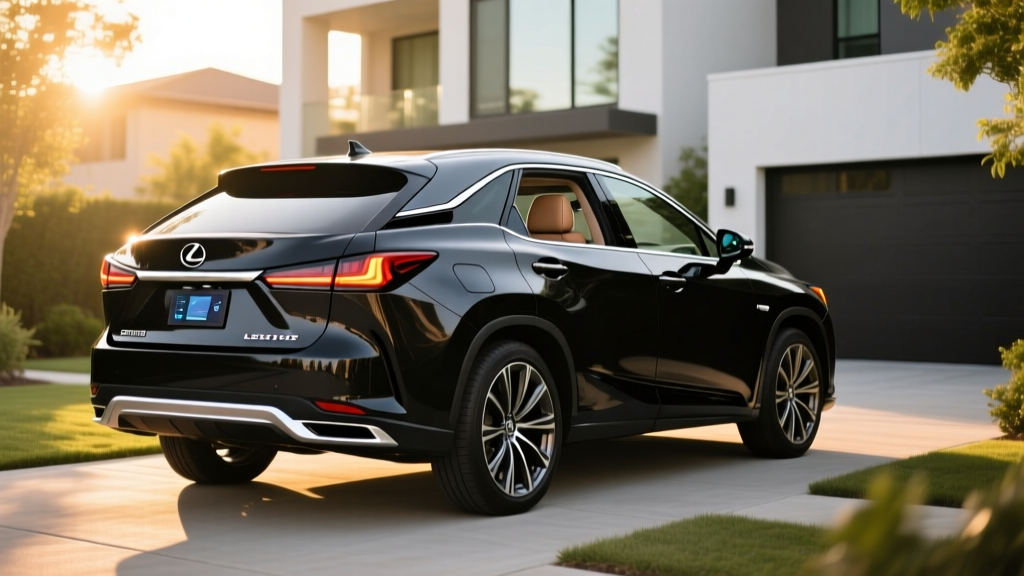
Quick Verdict: The Hybrid Lexus RX 350h in 2026
The Lexus RX has been the best-selling luxury SUV in America for years, and the current-generation hybrid variant — the RX 350h — is the version that makes the most sense for the majority of buyers. It delivers 36 MPG combined without ever needing a plug, retains the RX's refined ride quality, and undercuts the plug-in hybrid RX 500h+ on price by a significant margin.
If you want luxury-crossover comfort with genuinely low fuel costs and zero charging hassle, the hybrid Lexus RX 350h is the default recommendation. It is not a performance hybrid (that role belongs to the RX 500h F Sport Performance), and it is not a plug-in. It is a conventional hybrid electric vehicle (HEV) that recovers energy through regenerative braking and engine optimization — no outlet required.
| Spec | Value |
|---|---|
| Powertrain | 2.5L 4-cyl + 2 electric motors (AWD) |
| Combined Horsepower | 246 hp |
| EPA MPG (City / Hwy / Combined) | 37 / 34 / 36 |
| Fuel Tank | 17.2 gallons |
| Total Range | ~619 miles |
| 0–60 mph | 7.4 seconds |
| Drivetrain | AWD (e-motor rear axle) |
| Hybrid Battery | ~1.6 kWh NiMH (self-charging) |
| Base MSRP (Premium trim) | ~$52,000 |
| Hybrid Battery Warranty | 10 years / 150,000 miles |
HEV vs PHEV: Which Lexus RX Hybrid Is Which?
Lexus sells two hybrid RX variants, and the naming can confuse first-time hybrid shoppers. Here is the distinction:
| Attribute | RX 350h (HEV) | RX 500h+ (PHEV) |
|---|---|---|
| Type | Conventional Hybrid | Plug-in Hybrid |
| Plug-in Charging | No — self-charging | Yes — Level 1/2 AC |
| Electric-Only Range | N/A (motor assists engine) | ~37 miles (EPA est.) |
| Combined MPG / MPGe | 36 MPG | ~35 MPG (gas) / 83 MPGe (electric) |
| Combined HP | 246 hp | 302 hp |
| 0–60 mph | 7.4 sec | 6.2 sec |
| Hybrid Battery | ~1.6 kWh NiMH | ~18.1 kWh lithium-ion |
| Starting MSRP | ~$52,000 | ~$62,000 |
| Federal Tax Credit (§30D) | Not eligible | Potentially up to $7,500* |
The RX 350h is the conventional hybrid. You never plug it in. The gasoline engine and regenerative braking keep the small hybrid battery charged. The RX 500h+ is the plug-in hybrid with a larger battery you charge at home for short electric-only commutes before the gas engine kicks in.
*PHEV tax credit eligibility depends on IRS §30D rules including buyer income caps, MSRP caps ($80,000 for SUVs), battery component sourcing, and critical mineral requirements. Always verify current eligibility at irs.gov or with a tax professional.
Fuel Economy: EPA Numbers and Real-World MPG
The EPA rates the 2026 Lexus RX 350h at 37 MPG city, 34 MPG highway, and 36 MPG combined with standard all-wheel drive. That is exceptional for a 4,500-pound luxury crossover, and it translates to roughly 619 miles of total range on a full 17.2-gallon tank.
| Driving Condition | EPA Rating | Real-World Expectation |
|---|---|---|
| City | 37 MPG | 36–40 MPG (hybrids excel in stop-and-go) |
| Highway | 34 MPG | 30–34 MPG (aero drag reduces hybrid advantage) |
| Combined | 36 MPG | 33–37 MPG (depends on driving mix) |
| Cold Weather (below 32°F) | — | 29–33 MPG (engine runs more for cabin heat) |
Why Hybrids Often Beat EPA in the City
Conventional hybrids like the RX 350h tend to exceed their EPA city rating in real-world stop-and-go driving. Every time you brake, the electric motors recapture kinetic energy and store it in the hybrid battery. In heavy traffic, the engine shuts off frequently, and the electric motors handle low-speed movement. Owners in urban environments regularly report 38–40 MPG in warm-weather city driving.
Highway driving is where the hybrid advantage narrows. At sustained 70–80 mph speeds, the gasoline engine does most of the work and aerodynamic drag dominates. Expect 30–34 MPG on long highway trips. In cold weather, fuel economy drops further because the engine must run continuously to provide cabin heat and maintain battery temperature — a 10–15% reduction is typical.
Powertrain: How the RX 350h Hybrid System Works
The RX 350h pairs a 2.5-liter inline-four Atkinson-cycle engine with two electric motor-generators and an electronically controlled CVT (eCVT). The front axle is driven by the engine and a primary electric motor, while a separate rear electric motor provides all-wheel-drive traction without a mechanical driveshaft.
Combined system output is 246 horsepower. That is modest for the luxury segment, but the electric motors deliver instant torque at low speeds, making the RX 350h feel responsive in city driving and highway merging. The 0–60 mph time of 7.4 seconds is adequate rather than quick — if acceleration is a priority, the turbocharged RX 500h (366 hp) or the plug-in RX 500h+ (302 hp) are the performance choices.
The hybrid battery is a compact nickel-metal hydride (NiMH) pack with approximately 1.6 kWh of capacity. Unlike plug-in hybrids or full EVs, this battery is not designed for sustained electric-only driving. It acts as an energy buffer — storing recaptured braking energy and deploying it to assist the engine during acceleration or to power the vehicle at very low speeds.
Pricing, Trims, and Tax Credit Eligibility
The 2026 Lexus RX 350h is offered across several trims, all with standard AWD:
- Premium: ~$52,000 MSRP — heated/ventilated front seats, 9.8-inch touchscreen, power liftgate
- Premium+: ~$54,500 — adds panoramic roof, larger 14-inch infotainment display
- Luxury: ~$57,000 — upgraded leather, heated rear seats, premium audio
- F Sport Handling: ~$56,000 — sport-tuned suspension, unique styling, 21-inch wheels
Does the RX 350h Qualify for a Federal Tax Credit?
No. The federal §30D clean vehicle credit applies only to plug-in electric vehicles (BEVs and PHEVs) with sufficient battery capacity. The RX 350h is a conventional hybrid with a small NiMH battery and no plug-in capability. It does not qualify for the federal EV tax credit.
If tax credit eligibility is a priority, the plug-in RX 500h+ may qualify for up to $7,500 under current §30D rules, depending on battery component sourcing, critical mineral content, your adjusted gross income, and the vehicle's MSRP (the SUV cap is $80,000). Point-of-sale transfer is available for eligible buyers, reducing the purchase price at the dealer. Check current rules at irs.gov before relying on credit estimates.
Some states offer separate rebates or HOV lane access for conventional hybrids — check your state's energy or DMV website for specifics, as these vary widely by jurisdiction.
Battery Longevity, Warranty, and Replacement Cost
Hybrid battery longevity is the single most common concern among first-time hybrid buyers. Here is what the data shows:
Lexus RX 350h Hybrid Battery Warranty
Coverage: 10 years or 150,000 miles (whichever comes first), applicable to the original owner and transferable to subsequent owners in most states.
What it covers: Battery capacity loss below a defined threshold, defects in materials or workmanship, and associated hybrid system components (inverter, motor-generators).
Source: Lexus hybrid warranty terms per lexus.com owner resources.
How Long Do Lexus Hybrid Batteries Actually Last?
Lexus and Toyota have the longest track record in hybrid battery durability. The NiMH chemistry used in the RX 350h is less energy-dense than the lithium-ion packs in EVs, but it is extremely stable and tolerant of the shallow charge-discharge cycles that characterize hybrid operation. The battery management system keeps the pack within a narrow state-of-charge window (roughly 40–80%), which dramatically reduces degradation.
Real-world evidence from Lexus and Toyota hybrid owners (including RX 400h and RX 450h models from the 2000s and 2010s) shows that hybrid batteries routinely last 150,000–200,000+ miles before requiring replacement. Many original batteries outlast the vehicles themselves.
Replacement Cost If the Battery Fails
If the hybrid battery does need replacement outside of warranty, expect to pay between $3,000 and $5,000 for a new OEM battery pack including labor at a Lexus dealer. Independent hybrid specialists and refurbished battery options can reduce this to $1,500–$3,000. For context, this is far less than EV battery replacement ($10,000–$20,000+) because the hybrid pack is much smaller.
Reliability and Ownership Costs
Lexus consistently ranks at or near the top of J.D. Power and Consumer Reports reliability surveys, and the RX line specifically has been a benchmark for long-term dependability. The hybrid powertrain adds electric motors and a power-control unit, but these components have proven highly durable — there are no high-voltage contactors cycling thousands of times per day as in a full EV, and the eCVT has no conventional transmission clutches or bands to wear out.
Compared to the gas-only RX 350 (turbocharged 2.4L, 275 hp, ~26 MPG combined), the RX 350h sacrifices 29 horsepower but gains roughly 10 MPG. Over 15,000 miles per year at $3.50/gallon, that is approximately $600–$700 in annual fuel savings. Over a 5-year ownership period, the hybrid saves roughly $3,000–$3,500 in fuel — enough to offset its modest price premium over the gas model and then some.
Insurance costs are comparable to the gas RX 350. Maintenance is slightly lower because regenerative braking reduces brake pad wear, and the engine runs less frequently (reducing oil degradation). Lexus recommends synthetic oil changes every 10,000 miles.
Who Should Buy the Hybrid Lexus RX 350h?
Pros
- 36 MPG combined — best in the luxury midsize crossover class
- No plug-in charging needed — works with your existing routine
- Standard AWD with electric rear motor
- 10-year / 150,000-mile hybrid battery warranty
- Excellent long-term reliability record
- Quiet, comfortable ride quality
Cons
- 246 hp feels modest for a luxury SUV at highway speeds
- No federal tax credit (conventional hybrid)
- eCVT can drone under hard acceleration
- No electric-only driving mode
- Rear cargo space slightly reduced vs. gas RX (~29 cu ft vs. ~30 cu ft)
The Decision Framework
Choose the RX 350h (HEV) if: You want maximum fuel efficiency without changing your habits. You don't have access to home charging. You drive a mix of city and highway miles and want a luxury crossover that sips fuel in traffic. You value proven reliability and low total cost of ownership over performance.
Choose the RX 500h+ (PHEV) if: You have home Level 2 charging and a commute under 37 miles. You want electric-only daily driving with gas-engine flexibility for road trips. You may qualify for the §30D tax credit and want stronger acceleration (302 hp).
Choose a full EV (e.g., Tesla Model X, BMW iX) if: You have reliable home charging, drive under 300 miles between charges, want zero tailpipe emissions, and are ready to leave gasoline behind entirely.
Frequently Asked Questions
How many MPG does the hybrid Lexus RX 350h get?
The EPA rates the RX 350h at 37 MPG city, 34 MPG highway, and 36 MPG combined. Real-world city driving often yields 38–40 MPG thanks to regenerative braking, while sustained highway driving may return 30–34 MPG. Cold weather reduces efficiency by roughly 10–15%.
Does the Lexus RX 350h need to be plugged in?
No. The RX 350h is a conventional hybrid (HEV). Its small hybrid battery charges automatically through regenerative braking and the gasoline engine. There is no charging port and no electric-only driving range. If you want plug-in capability, look at the RX 500h+ PHEV.
Is the hybrid Lexus RX 350h reliable?
Yes. Lexus and Toyota have the longest production history of any hybrid manufacturer, and the RX line is one of their most dependable models. The hybrid battery is warranted for 10 years/150,000 miles, and real-world data shows these batteries commonly last 150,000–200,000+ miles. The eCVT transmission has no conventional wear items.
What does a Lexus RX hybrid battery replacement cost?
Out of warranty, a new OEM hybrid battery replacement costs approximately $3,000–$5,000 at a Lexus dealer, including labor. Refurbished or aftermarket options from independent hybrid specialists can reduce this to $1,500–$3,000. Most owners never need to replace the battery during typical ownership.
Does the RX 350h qualify for any tax credit?
The RX 350h does not qualify for the federal §30D clean vehicle tax credit because it is a conventional hybrid, not a plug-in vehicle. The plug-in RX 500h+ may qualify for up to $7,500 depending on current IRS sourcing rules, your income, and MSRP caps. Some states offer separate hybrid incentives — check local programs.
Hybrid vs PHEV vs EV — which RX is right for me?
If you lack home charging or want zero lifestyle change, the RX 350h (HEV) is the simplest path to 36 MPG. If you can charge at home and commute under 37 miles, the RX 500h+ (PHEV) lets you drive electric daily while keeping gas flexibility. If you have home charging and rarely exceed 300 miles between stops, a full EV eliminates gas entirely but requires more planning for road trips.
How does the RX 350h compare to the gas-only RX 350?
The gas RX 350 (275 hp turbo, ~26 MPG combined) is quicker to 60 mph (~7.1 sec) but costs roughly $600–$700 more per year in fuel. The RX 350h (246 hp, 36 MPG) is more efficient, quieter at low speeds, and has lower long-term maintenance costs due to regenerative braking. The price premium for the hybrid is typically recovered within 3–4 years through fuel savings.
Sources: EPA fuel economy data via fueleconomy.gov, Lexus official specifications via lexus.com, IRS clean vehicle credit rules via irs.gov.