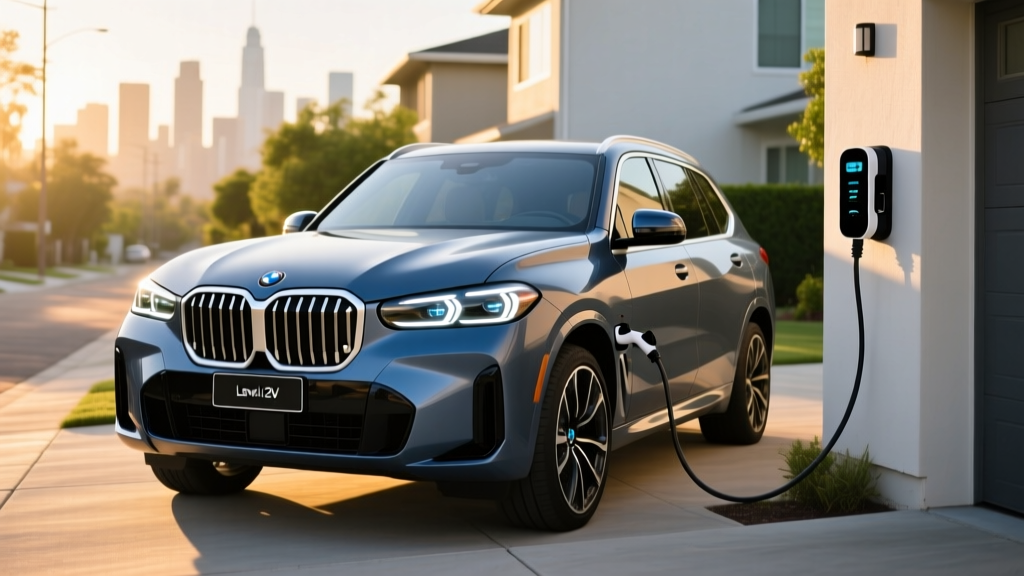
If you want a luxury midsize SUV that can handle school runs on electrons alone and cross-country road trips without a second thought, the BMW X5 xDrive50e plug-in hybrid deserves a serious look. Now in its second model year on the current G05-generation platform, the 2026 X5 PHEV pairs a turbocharged inline-six with a more potent electric motor and a larger battery than its predecessor — delivering meaningful gains in electric-only range and overall efficiency.
This guide breaks down everything you need to know: EPA fuel economy, real-world MPG, electric-only range, charging logistics, battery longevity, tax-credit eligibility, and how the X5 PHEV stacks up against full EVs and conventional hybrids in the luxury SUV segment.
HEV vs PHEV: Where the X5 xDrive50e Fits
Before diving into specs, it helps to clarify the two hybrid architectures you'll encounter in this class:
Conventional Hybrid (HEV)
A standard hybrid like the Toyota Highlander Hybrid uses a small battery (typically 1–2 kWh) recharged by the engine and regenerative braking. You never plug it in. It improves fuel economy by 20–35% over a gas-only equivalent but offers no meaningful electric-only driving — maybe a mile or two at very low speeds.
Plug-In Hybrid (PHEV)
The BMW X5 xDrive50e is a PHEV. It carries a much larger battery — 25.7 kWh usable in the 2026 model — that you charge via a plug (Level 1 or Level 2). That battery enables roughly 38 miles of electric-only driving at highway-capable speeds before the gasoline engine kicks in. Once the battery is depleted, it operates as a conventional hybrid, blending engine and motor for efficiency.
The practical distinction matters enormously: if your daily commute is under 40 miles round-trip and you can charge at home, the X5 PHEV functions as an EV on most weekdays while retaining a 400+ mile total range for road trips. If you can't charge at home, you're carrying extra battery weight for little benefit, and a conventional HEV or efficient gas SUV may make more sense.
Fuel Economy and Electric-Only Range
The EPA rates the 2026 BMW X5 xDrive50e at 56 MPGe combined when operating in charge-depleting (electric + gas blended) mode, and 22 MPG combined once the battery is depleted and the vehicle runs as a conventional hybrid. Here is the full breakdown from fueleconomy.gov:
| Mode | City | Highway | Combined |
|---|---|---|---|
| Charge-Sustaining (Gas Hybrid) | 21 MPG | 23 MPG | 22 MPG |
| Charge-Depleting (Blended) | — | — | 56 MPGe |
| Electric-Only Range | 38 miles (EPA est.) | ||
| Total Combined Range | ~440 miles (est.) | ||
How Many MPG Does the X5 PHEV Actually Get?
If you charge nightly and drive under 38 miles per day, your gasoline consumption approaches zero — you'll see effective MPGe figures well above 56. Owners who charge regularly and commute short distances commonly report using one tank of gas every 6–8 weeks. If you never plug in, expect a steady 21–23 MPG combined, which is respectable for a twin-turbo six-cylinder luxury SUV but not class-leading against four-cylinder hybrid competitors.
Powertrain, Performance, and Driving Dynamics
| Specification | 2026 BMW X5 xDrive50e |
|---|---|
| Engine | 3.0L turbocharged inline-6 (312 HP / 330 lb-ft) |
| Electric Motor | Integrated in transmission (184 HP / 207 lb-ft) |
| Combined System Output | 483 HP / 516 lb-ft torque |
| 0–60 mph | 4.6 seconds (BMW est.) |
| Drivetrain | xDrive AWD, 8-speed automatic |
| Battery (Usable) | 25.7 kWh (NMC lithium-ion) |
| Curb Weight | ~5,430 lbs |
| Towing Capacity | 5,000 lbs (properly equipped) |
The B58 inline-six is one of the best engines BMW has ever built, and pairing it with a 184-HP electric motor gives the X5 PHEV the effortless low-end torque that makes a heavy SUV feel genuinely quick. The transition between electric and gas power is remarkably seamless — you'll rarely feel the engine start unless you're watching the tachometer. Regenerative braking offers adjustable levels through the iDrive menu, though it doesn't quite achieve true one-pedal driving at a full stop.
Charging: Times, Connectors, and Home Setup
The 2026 X5 xDrive50e charges via the J1772 connector (AC charging only). BMW includes a dual-voltage portable charging cable (Flexible Fast Charger) capable of Level 1 (120V) and Level 2 (240V) charging. Critically, the X5 PHEV does not support DC fast charging — a limitation shared with nearly every PHEV on the market, since the battery is too small to justify the cost and thermal complexity of a DC inlet.
| Level | Voltage / Power | Time (0–100%) | Miles Added per Hour |
|---|---|---|---|
| Level 1 | 120V / ~1.4 kW | ~18 hours | ~2 mi/hr |
| Level 2 | 240V / 7.4 kW (onboard charger max) | ~3.5 hours | ~11 mi/hr |
For most owners, a Level 2 home charger is the move. A full overnight charge at 7.4 kW takes roughly 3.5 hours — meaning you could plug in at 10 PM and be fully charged well before morning. The onboard charger maxes out at 7.4 kW, so there's no benefit to installing a 48-amp (11.5 kW) charger specifically for the X5 PHEV, though doing so future-proofs your garage for a full EV down the road.
Home Level 2 installation typically costs $800–$2,000 all-in (charger hardware + electrician + permit), assuming your electrical panel has spare capacity. If a panel upgrade to 200A is needed, add $1,500–$3,000. Consult a licensed electrician for a site-specific quote.
Pricing, Trims, and Tax Credit Eligibility
The 2026 BMW X5 xDrive50e starts at an MSRP of approximately $75,900 (including destination), placing it squarely in the premium PHEV SUV segment. Options like the M Sport package, Executive Package, and Driving Assistance Professional can push a well-equipped build past $90,000.
Does the X5 PHEV Qualify for the Federal Tax Credit?
Under current IRS §30D rules, the BMW X5 xDrive50e does not qualify for the $7,500 federal clean vehicle tax credit. The credit requires final assembly in North America, and the X5 is manufactured in Spartanburg, South Carolina — which does qualify on that front — but the battery's critical-mineral and component sourcing requirements have not been met at the levels needed for either the $3,750 half or the full $7,500. Additionally, the §30D credit has an MSRP cap of $80,000 for SUVs, meaning heavily optioned X5 PHEVs could exceed the cap regardless.
§30D Federal Tax Credit Checklist (2026 rules):
- Final assembly in North America: ✅ (Spartanburg, SC)
- MSRP under $80,000 (SUV cap): ⚠️ (base qualifies; optioned builds may not)
- Buyer AGI under $150K single / $300K joint: ✅ (buyer-dependent)
- Battery critical-mineral sourcing threshold: ❌ (not met)
- Battery component sourcing threshold: ❌ (not met)
- Point-of-sale transfer available: N/A (credit not available)
Tax rules change frequently. Consult a tax professional and check IRS.gov before purchasing. Some states offer separate PHEV rebates — check your local DMV or energy office.
Battery Warranty, Reliability, and Replacement Costs
• High-voltage battery: 8 years / 80,000 miles (capacity retention above 70%)
• Powertrain (engine + transmission + motor): 4 years / 50,000 miles
• Basic vehicle: 4 years / 50,000 miles
• Complimentary maintenance: 3 years / 36,000 miles
Is the X5 PHEV Reliable? What Does Battery Replacement Cost?
BMW's B58 inline-six has proven to be one of the most dependable engines in the industry, with few systemic issues reported across hundreds of thousands of units in the 3-Series, 5-Series, and X5 lineups. The electric motor and power electronics add complexity but have low failure rates in BMW's PHEV fleet.
The 25.7 kWh NMC battery pack is liquid-cooled and managed conservatively — BMW locks away a buffer at the top and bottom of the state-of-charge window to prevent degradation-accelerating extremes. Based on data from the previous-generation X5 xDrive45e (which used a similar chemistry), owners typically see 5–8% capacity loss over the first 3–4 years. The 8-year/80,000-mile warranty covers replacement if capacity drops below 70%.
If you need an out-of-warranty high-voltage battery replacement, expect a dealer quote in the range of $12,000–$18,000 (parts and labor). Independent EV battery shops may offer refurbished modules for $6,000–$10,000. However, the vast majority of PHEV batteries outlast the vehicle's ownership lifecycle — premature replacement is rare and usually covered by warranty.
For reliability data, the X5 has historically scored average to above-average in IIHS crash testing and carries strong safety ratings from NHTSA. Long-term reliability surveys from Consumer Reports place BMW mid-pack among luxury brands, with PHEV-specific issues being uncommon.
Who Should Buy the X5 PHEV — And Who Shouldn't?
Choose the X5 xDrive50e PHEV if:
- Your daily commute is under 35–38 miles and you can charge at home (Level 2 recommended)
- You take 4+ road trips per year and don't want to plan around DC fast-charging infrastructure
- You want luxury, performance (483 HP, 4.6s to 60), and towing (5,000 lbs) in one vehicle
- You're not ready for full EV ownership but want to reduce gasoline consumption significantly
Choose a Full EV (like the BMW iX) if:
- You have reliable home charging and rarely drive more than 250 miles in a day
- You want to eliminate oil changes, spark plugs, and transmission fluid entirely
- You want the lowest per-mile fuel cost (electricity vs. gasoline)
- You want access to the $7,500 federal tax credit (iX currently qualifies)
Choose a Conventional HEV (like the Volvo XC90 Recharge T8 or Lexus TX 500h) if:
- You cannot charge at home or at work (no garage, apartment living)
- You want hybrid efficiency without ever thinking about plugging in
- Your budget is lower and you don't need 483 HP
Pros
- 38-mile electric range covers most daily commutes
- 483 HP makes it one of the quickest PHEV SUVs available
- Seamless gas-electric transitions; refined inline-six
- 5,000-lb towing with AWD
- No range anxiety — 440+ miles total range
- Premium interior, iDrive 8.5, excellent ride quality
Cons
- No DC fast charging (PHEV limitation)
- Does not qualify for $7,500 federal tax credit
- $75,900+ MSRP is steep; options escalate quickly
- 22 MPG gas-only is average, not exceptional
- Heavy at 5,430 lbs — affects tire wear and braking
- Cargo space slightly reduced vs. gas X5 (battery under floor)
Hybrid vs PHEV vs EV: Which Powertrain Fits Your Life?
The X5 lineup gives buyers three distinct paths, and choosing the right one depends entirely on your charging access and driving patterns:
| Factor | X5 sDrive40i (Gas) | X5 xDrive50e (PHEV) | BMW iX xDrive50 (EV) |
|---|---|---|---|
| Starting MSRP | ~$67,000 | ~$75,900 | ~$87,000 |
| EPA Range / MPG | 24 MPG combined | 38 mi EV + 22 MPG | ~324 mi (EPA) |
| Home Charging Needed? | No | Yes (for EV benefit) | Yes (strongly recommended) |
| Federal Tax Credit | None | None (current sourcing) | Up to $7,500 |
| Best For | Low upfront cost, simplicity | Daily EV + road-trip flexibility | Full electric, lowest running cost |
The decision matrix is straightforward: if you can charge at home and your daily driving is under 38 miles, the PHEV pays for its premium through fuel savings and delivers the best of both worlds. If you can't charge, the gas X5 is the smarter buy. If you're ready to go fully electric and want the tax credit, the iX is BMW's answer.
Frequently Asked Questions
How far can the BMW X5 PHEV go on electric only?
The EPA rates the 2026 X5 xDrive50e at 38 miles of electric-only range. In real-world conditions, expect 32–36 miles in warm weather and 25–28 miles in cold weather (below freezing), where cabin heating and battery chemistry reduce efficiency. Highway speeds above 70 mph also reduce electric range more than city driving.
How many MPG does the X5 PHEV get when the battery is dead?
Once the high-voltage battery is depleted, the X5 xDrive50e operates as a conventional hybrid and returns an EPA-estimated 22 MPG combined (21 city / 23 highway). Real-world highway driving at 75+ mph typically yields 21–23 MPG, which is consistent with the EPA estimate. City driving with regenerative braking can occasionally exceed 23 MPG.
Does the BMW X5 PHEV qualify for the $7,500 federal tax credit?
As of 2026, the BMW X5 xDrive50e does not qualify for the §30D federal clean vehicle tax credit. Although it is assembled in South Carolina, the battery does not meet the critical-mineral and component-sourcing thresholds required by current IRS rules. Tax credit eligibility changes periodically — always verify on IRS.gov before purchasing.
How long will the X5 PHEV battery last, and what does replacement cost?
BMW covers the high-voltage battery for 8 years or 80,000 miles against capacity loss below 70%. Based on data from earlier BMW PHEV models, expect 5–8% degradation over the first 3–4 years with normal use. Out-of-warranty replacement costs approximately $12,000–$18,000 at a dealer, or $6,000–$10,000 through an independent EV battery specialist. Most PHEV batteries last the lifetime of the vehicle without needing replacement.
Can the X5 PHEV use DC fast chargers like Tesla Superchargers?
No. The BMW X5 xDrive50e uses a J1772 AC charging connector only, with a maximum onboard charge rate of 7.4 kW. It cannot connect to DC fast chargers (CCS, NACS, or CHAdeMO). This is standard for nearly all PHEVs — the battery is too small to benefit from DC fast charging, and the added hardware cost and weight aren't justified. Level 2 home charging at 7.4 kW fully replenishes the battery in about 3.5 hours.
Is the X5 PHEV more reliable than a full EV?
PHEVs carry both an internal combustion engine and an electric powertrain, which means more components that could theoretically fail — but BMW's B58 inline-six and electric motor have both proven durable. Full EVs have fewer moving parts and lower routine maintenance costs, but PHEVs eliminate range anxiety. Neither architecture has shown systemic reliability problems in recent model years. The X5 PHEV's 4-year/50,000-mile basic warranty and 8-year battery coverage are competitive with the luxury segment.