2009 Toyota Camry Hybrid: Does the Mileage Still Hold Up in 2026?
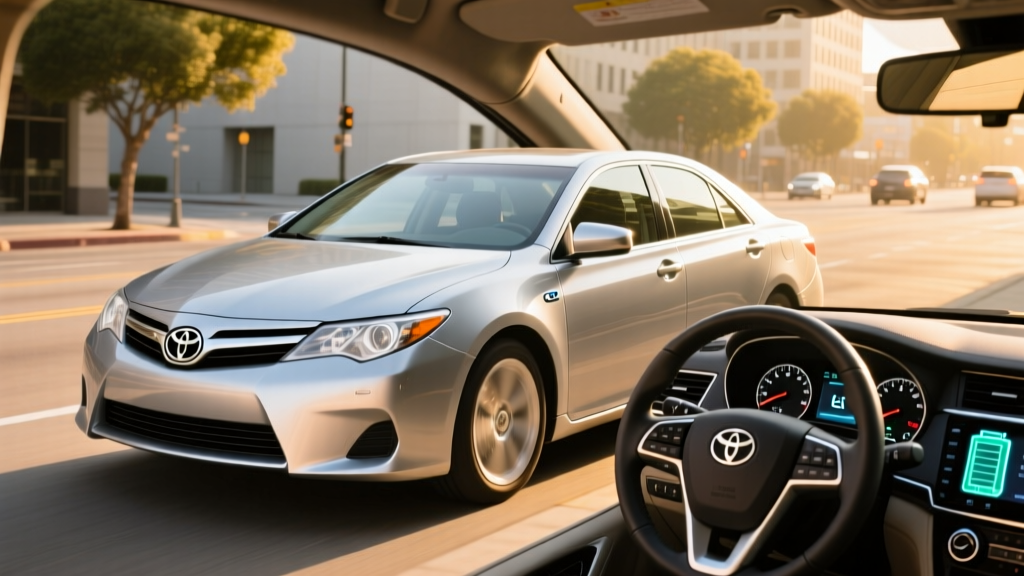
The 2009 Toyota Camry Hybrid was one of the earliest mainstream midsize sedans to pair a four-cylinder engine with an electric motor in a conventional hybrid (HEV) package. Over a decade later, used-car shoppers still search for 2009 Camry Hybrid mileage figures because this generation earned a reputation for frugal commuting and bulletproof reliability. But sticker MPG is only half the story — real-world driving conditions, battery age, and maintenance history all shape what you'll actually see at the pump in 2026.
This guide breaks down the EPA ratings, what owners report in mixed driving, the state of the hybrid battery after 15+ years of service, and whether this aging HEV still makes financial sense compared to a modern hybrid, plug-in hybrid, or full battery-electric vehicle.
EPA MPG Ratings vs. Real-World Fuel Economy
The 2009 Camry Hybrid is a conventional hybrid electric vehicle (HEV), meaning it cannot be plugged in. It generates all its electricity onboard through regenerative braking and engine-driven generation. There is no electric-only range — the gasoline engine and electric motor work in tandem at all speeds, with the motor handling low-speed crawling and assisting during acceleration.
| Metric | Value |
|---|---|
| City MPG | 33 MPG |
| Highway MPG | 34 MPG |
| Combined MPG | 34 MPG |
| Fuel Tank Capacity | 17.2 gallons |
| Total Driving Range | ~585 miles |
Source: EPA / fueleconomy.gov
The 2009 Camry Hybrid's EPA numbers are remarkably close to its real-world behavior — a rarity for vehicles of this era. In city-heavy commuting (stop-and-go traffic, short trips under 10 miles), many owners report 35–37 MPG because the electric motor shoulders more of the load at low speeds. On sustained highway driving at 70+ mph, expect 30–32 MPG as the gasoline engine runs continuously and aerodynamic drag increases.
If the hybrid battery has degraded significantly (common on units with 150,000+ miles that haven't been serviced), you may see combined economy drop to 28–30 MPG because the system can't rely as heavily on electric assist.
HEV vs. PHEV vs. EV: Where the 2009 Camry Hybrid Fits
Understanding what the 2009 Camry Hybrid is not is as important as understanding what it is. It does not plug in, it has no electric-only range, and it does not qualify for federal EV tax credits. Here's how it compares across the three main electrified vehicle categories:
| Feature | HEV (2009 Camry Hybrid) | PHEV (e.g., 2026 RAV4 Prime) | BEV (e.g., 2026 Tesla Model 3) |
|---|---|---|---|
| Plugs in? | No | Yes | Yes |
| Electric-only range | 0 miles | 42 miles | 358 miles |
| Combined efficiency | 34 MPG | 94 MPGe / 38 MPG gas | 132 MPGe |
| Federal tax credit | None | Up to $7,500 (§30D) | Up to $7,500 (§30D) |
| Home charging needed? | No | Recommended | Essential |
| Used market price (2026) | $4,000–$7,500 | $28,000–$42,000 | $22,000–$38,000 |
The 2009 Camry Hybrid is the right tool for a specific job: ultra-low-cost commuting with zero infrastructure requirements. You never need to install a charger, find a plug, or think about electricity. You just drive it and fill up at any gas station.
Powertrain Specs: Engine, Motor, and Combined Output
The 2009 Camry Hybrid uses Toyota's second-generation Hybrid Synergy Drive, pairing a 2.4-liter Atkinson-cycle four-cylinder engine with a permanent-magnet electric motor through an electronically controlled CVT (eCVT). This is not a traditional belt-driven CVT — Toyota's eCVT uses a planetary gearset to blend power from the engine and motor, which is why it has proven extraordinarily durable.
| Component | Specification |
|---|---|
| Gasoline Engine | 2.4L 4-cylinder Atkinson cycle |
| Engine Horsepower | 147 hp @ 6,000 rpm |
| Electric Motor Output | 40 hp (30 kW) |
| Combined Net Horsepower | 192 hp |
| Transmission | eCVT (planetary gearset) |
| Hybrid Battery | 1.3 kWh NiMH (nickel-metal hydride) |
| 0–60 mph | ~8.4 seconds |
| Curb Weight | 3,680 lbs |
That 1.3 kWh NiMH battery is tiny by modern standards — a 2026 RAV4 Prime PHEV carries 18.1 kWh of lithium-ion capacity. But the 2009 Camry Hybrid's battery isn't meant to store energy for electric driving; it's a buffer that captures regenerative braking energy and deploys it in short bursts to reduce engine load. Toyota's NiMH chemistry is less energy-dense than modern NMC or LFP lithium-ion, but it has proven remarkably tolerant of abuse and temperature extremes.
Hybrid Battery Longevity, Warranty, and Replacement Cost
Toyota warranted the 2009 Camry Hybrid's battery for 8 years / 100,000 miles (10 years / 150,000 miles in California Air Resources Board states). That warranty has long since expired on every 2009 model on the road today. Any battery failure is now the owner's financial responsibility.
This is the single biggest variable when buying a used 2009 Camry Hybrid in 2026. The NiMH battery pack is now 16–17 years old. Here's what the data tells us about longevity:
- Original batteries still in service: Many 2007–2011 Camry Hybrids have exceeded 200,000 miles on the original NiMH pack, particularly in moderate climates. Toyota's NiMH chemistry degrades more gracefully than early lithium-ion — it loses capacity gradually rather than failing catastrophically.
- Symptoms of degradation: Reduced MPG (2–5 MPG drop), the engine running more frequently at stops, reduced regenerative braking feel, and the battery state-of-charge gauge fluctuating rapidly.
- Complete failure: A fully failed hybrid battery will trigger a check-engine light (common codes: P0A80, P0A7F) and the car may enter a limp mode. The car is still drivable on the gasoline engine alone, but fuel economy drops to roughly 22–25 MPG.
| Option | Cost Range | Warranty | Notes |
|---|---|---|---|
| New OEM Toyota battery | $3,000–$4,000 | 1 year / 12,000 miles | Dealer-installed; diminishing availability for older models |
| Refurbished/remanufactored pack | $1,200–$2,000 | 1–3 years | Replaced weak cells with tested modules; widely available |
| Used salvage battery | $500–$900 | 30–90 days | Roll of the dice — condition unknown |
| Individual cell replacement (DIY) | $200–$500 | None | Requires technical skill; high-voltage risk |
For most buyers, a remanufactured battery from a specialist like Green Bean Battery or Exclusively Hybrid offers the best value. These services test and balance individual NiMH modules, replacing only the weak ones, and typically include a multi-year warranty. At $1,500–$2,000 installed, this is far more economical than a new OEM pack — and the remanufactured unit often performs nearly as well as new for daily commuting.
Reliability Record and Long-Term Ownership Costs
The 2009 Camry Hybrid benefits from one of the strongest reliability reputations in Toyota's history. The 2AZ-FXE engine (the Atkinson-cycle variant of Toyota's ubiquitous 2.4L) has no timing belt — it uses a timing chain that typically lasts the life of the engine. The eCVT planetary gearset has no friction bands or clutches to wear out, and the electric motor has no brushes or commutators.
Common issues that do arise on high-mileage examples:
- Hybrid battery degradation (detailed above) — the primary expense.
- Hybrid system inverter coolant pump — a $200–$400 part that occasionally fails around 120,000–150,000 miles. Toyota issued a recall on some model years for this component.
- Brake actuator assembly — the regenerative braking system uses an electrohydraulic brake actuator that can fail at high mileage ($1,200–$1,800 replacement). This is uncommon but expensive when it occurs.
- 12V auxiliary battery — like any car, the standard 12V battery needs replacement every 4–5 years. The 2009 Camry Hybrid uses a trunk-mounted AGM-type battery (~$150–$250).
With a healthy hybrid battery and routine maintenance (oil changes every 5,000 miles, brake fluid flushes, transmission fluid drain-and-fill at 60,000-mile intervals), these cars routinely reach 250,000–300,000 miles without major mechanical failure.
Does the 2009 Camry Hybrid Qualify for Any Tax Credit?
No. The 2009 Camry Hybrid does not qualify for the federal IRS §30D Clean Vehicle Credit. That credit applies only to plug-in electric vehicles (PHEVs and BEVs) meeting battery capacity, critical-mineral sourcing, MSRP cap, and buyer income requirements.
Conventional hybrids (HEVs) like the 2009 Camry Hybrid have never been eligible for the federal EV tax credit. The original Clean Energy Act incentives for hybrids expired years ago, and no current federal program provides a tax credit for purchasing a used or new conventional hybrid.
Some states offer modest incentives for hybrid purchases, but these vary widely by jurisdiction and typically target new vehicles. Check your state's energy office or department of revenue for current programs.
2026 Used Market Pricing and Value Proposition
As of early 2026, the 2009 Toyota Camry Hybrid trades in the used market at:
- High-mileage examples (150,000+ miles, fair condition): $3,500–$5,000
- Average examples (100,000–140,000 miles, good condition): $5,000–$7,000
- Low-mileage examples (under 90,000 miles, excellent condition): $7,000–$9,500
At these prices, the value proposition is straightforward: a $6,000 Camry Hybrid getting 34 MPG combined will use roughly $1,350 in gasoline per year (assuming 15,000 miles driven and $3.50/gallon). A comparable 2009 Camry V6 (22 MPG combined) would burn about $2,386 per year — a difference of over $1,000 annually in fuel savings alone.
That fuel savings typically pays back the purchase price differential within 1–2 years compared to a gas-only equivalent, and the Camry Hybrid's lower maintenance costs (longer brake life from regenerative braking, no timing belt, less engine wear from auto stop-start) compound the advantage.
Pros
- 34 MPG combined real-world proven over millions of miles
- Exceptional powertrain reliability — eCVT and NiMH battery are proven durable
- No plug-in infrastructure needed — works for apartment dwellers
- Low annual fuel cost: ~$1,350/year at 15K miles
- Strong parts availability and mechanic familiarity
- Comfortable midsize sedan with 15.1 cu ft trunk
Cons
- Hybrid battery likely needs replacement ($1,200–$4,000) if original
- 192 hp feels slow by 2026 standards (8.4s 0–60)
- No federal tax credit eligibility
- Outdated infotainment — no Apple CarPlay, Android Auto, or Bluetooth audio streaming
- No modern ADAS features (no automatic emergency braking, lane keep, etc.)
- Highway MPG (34) is unremarkable vs. modern hybrids
Who Should Buy a 2009 Camry Hybrid in 2026?
Decision Framework
Choose the 2009 Camry Hybrid if: You need an ultra-cheap daily commuter, you can't charge at home, your budget is under $8,000, and you want proven reliability with low running costs. It's ideal for a second car, a student vehicle, or a budget-conscious commuter driving 15,000+ miles per year.
Choose a modern PHEV (like a 2026 RAV4 Prime) if: You have home charging, want 40+ miles of electric-only commuting, need modern safety tech, and qualify for the §30D tax credit. The upfront cost is 5–6× higher, but per-mile operating cost drops dramatically on electric.
Choose a full BEV if: You have reliable home or workplace charging, your daily driving is under 250 miles, and you want the lowest possible per-mile energy cost (electricity at $0.12/kWh = ~$0.04/mile vs. $0.09/mile in the Camry Hybrid).
Frequently Asked Questions
How many MPG does the 2009 Camry Hybrid actually get?
The EPA rates it at 33 city / 34 highway / 34 combined. In real-world city driving, expect 35–37 MPG. On sustained highway trips at 70+ mph, expect 30–32 MPG. A degraded hybrid battery can drop combined economy to 28–30 MPG.
Does the 2009 Camry Hybrid need to be plugged in?
No. It is a conventional hybrid (HEV), not a plug-in hybrid (PHEV). It generates all electricity onboard through regenerative braking and engine-driven generation. You never plug it in — you only refuel with gasoline.
How long does the hybrid battery last?
Toyota's NiMH packs in this generation commonly last 150,000–250,000 miles or 12–18 years before significant degradation. Some original batteries from 2007–2009 models are still functional at 200,000+ miles. When replacement is needed, a remanufactured pack costs $1,200–$2,000 installed.
Is the 2009 Camry Hybrid expensive to maintain?
No. Outside of potential hybrid battery replacement, maintenance costs are comparable to or lower than a gas-only Camry. Regenerative braking extends brake pad life (60,000–100,000 miles is common), the timing chain never needs replacement, and the eCVT requires only periodic fluid changes.
What's the total annual cost to own a 2009 Camry Hybrid?
Budget approximately $1,350/year for fuel (15,000 miles at $3.50/gal), $400–$600/year for insurance (varies by state and driver), $300–$500/year for routine maintenance, and set aside $100–$150/month as a battery replacement reserve if the original pack is still installed.
How does 2009 Camry Hybrid mileage compare to a 2026 hybrid?
Modern hybrids have improved significantly. The 2026 Toyota Camry Hybrid achieves 52 MPG combined — a 53% improvement. However, a 2026 model costs $28,000+ new. The 2009 model at $5,000–$7,000 used still delivers strong value per dollar spent, even with the MPG gap.