Quick Verdict: The 2025 Honda CR-V Hybrid Sport-L Delivers Where It Counts
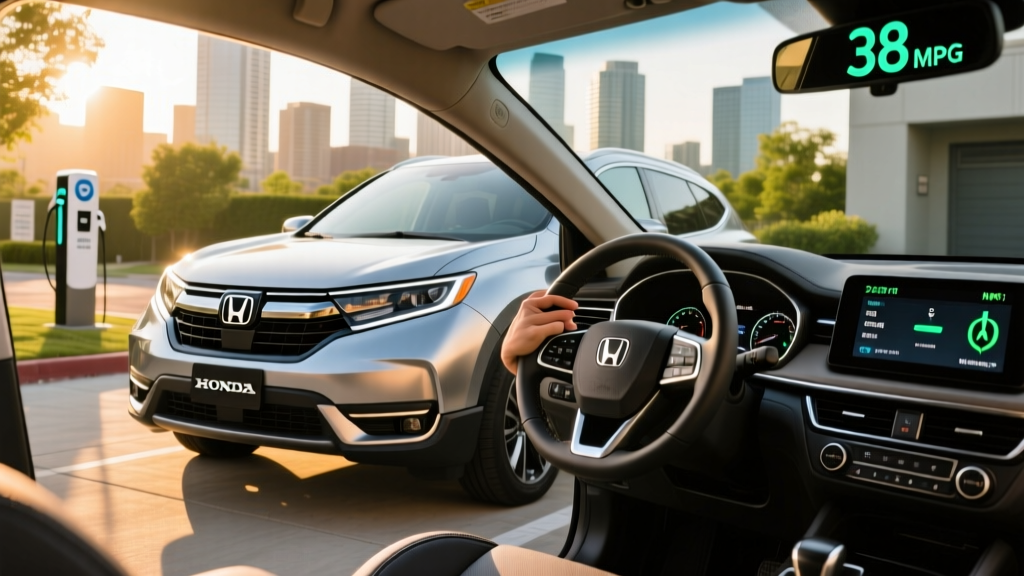
If you want a compact SUV that sips fuel without requiring you to change how you drive, the 2025 Honda CR-V Hybrid Sport-L sits in a pragmatic sweet spot. It pairs a 2.0-liter Atkinson-cycle engine with a two-motor hybrid system for a combined 204 horsepower, delivers an EPA-estimated 40 MPG combined with standard all-wheel drive, and wraps it all in a near-luxury interior at roughly $39,345 MSRP. It is a conventional hybrid (HEV)—not a plug-in—meaning you never need to plug it in. You simply fuel up and drive, while the hybrid system silently optimizes efficiency in the background.
The Sport-L trim sits near the top of the CR-V Hybrid lineup, adding leather-trimmed seats, a hands-free power tailgate, wireless phone charging, and upgraded interior materials over the Sport and Sport Touring trims. For buyers who want maximum efficiency without range anxiety, charging infrastructure worries, or a steep price premium, this is one of the strongest contenders in the compact hybrid SUV segment for 2025.
Fuel Economy: EPA Ratings and Real-World MPG
The headline number for any hybrid buyer is fuel economy. Here is how the 2025 CR-V Hybrid Sport-L (AWD) breaks down per the EPA on fueleconomy.gov:
| Metric | Value |
|---|---|
| City MPG | 40 MPG |
| Highway MPG | 34 MPG |
| Combined MPG | 37 MPG |
| Annual Fuel Cost (est.) | ~$1,550 (15,000 mi/yr at $3.50/gal) |
| Fuel Tank Capacity | 14.0 gallons |
| Total Range | ~518 miles |
One important note: the EPA combined figure of 37 MPG applies to the AWD configuration. Honda does not offer the CR-V Hybrid Sport-L in FWD for the 2025 model year—AWD is standard on all Hybrid trims, which is a meaningful value-add for buyers in snow-belt states.
HEV vs. PHEV: Understanding What the CR-V Hybrid Is (and Isn't)
A common point of confusion in the compact SUV segment is the difference between a conventional hybrid (HEV) and a plug-in hybrid (PHEV). The 2025 Honda CR-V Hybrid is an HEV. Here is what that means in practice:
| Feature | HEV (CR-V Hybrid) | PHEV (e.g., Toyota RAV4 Prime) |
|---|---|---|
| Plug-in charging | No — self-charging via regenerative braking and engine | Yes — plug in for electric-only miles |
| Electric-only range | Less than 1 mile at low speeds | Typically 25–42 miles |
| Battery size | ~1.06 kWh (small buffer) | 14–18 kWh |
| Federal tax credit (§30D) | Not eligible | Up to $7,500 (subject to sourcing/income rules) |
| Home charger needed | No | Recommended for daily EV driving |
| Price premium over gas model | ~$1,500–$2,500 | ~$5,000–$8,000 |
The CR-V Hybrid's small lithium-ion battery (approximately 1.06 kWh usable) acts as a buffer—it captures energy from regenerative braking and the engine, then deploys it for electric-only propulsion at low speeds, torque assist during acceleration, and engine-off coasting. You never think about it; the powertrain management system handles everything. This makes the HEV ideal for buyers who lack home charging access or who simply don't want the complexity of plugging in.
If you need 30+ miles of electric-only commuting and have access to a Level 2 home charger, a PHEV like the Toyota RAV4 Prime or Hyundai Tucson PHEV may be a better fit. But those vehicles cost significantly more and are often harder to find in stock.
Powertrain: 204 HP Two-Motor Hybrid System
| Specification | Detail |
|---|---|
| Engine | 2.0L DOHC Atkinson-cycle inline-4 |
| Engine Output | 145 hp @ 6,100 rpm / 134 lb-ft @ 4,500 rpm |
| Electric Motors | Two-motor hybrid system (drive + generator) |
| Drive Motor Output | 184 hp / 247 lb-ft torque |
| Combined System Output | 204 hp |
| Drivetrain | AWD (standard, rear-motor assisted) |
| Transmission | Electronically controlled CVT (e-CVT) |
| 0–60 mph (est.) | ~7.6 seconds |
| Towing Capacity | 1,000 lbs |
| Drive Modes | ECON, Sport, Snow, EV (limited low-speed) |
Honda's fourth-generation two-motor hybrid system is one of the most refined in the segment. Unlike Toyota's planetary-gear power-split device, Honda's system primarily operates as a series hybrid at low and moderate speeds—the engine drives a generator that powers the electric drive motor, which turns the wheels. At highway cruising speeds, a lock-up clutch mechanically connects the engine directly to the wheels for maximum efficiency. This design gives the CR-V Hybrid the smooth, linear acceleration feel of an EV around town, while the engine only audibly revs high under hard acceleration or steep hill climbs.
The 247 lb-ft of electric motor torque is available from near-zero RPM, which makes the CR-V Hybrid feel notably more responsive off the line than the non-hybrid 1.5L turbo CR-V (which produces 179 lb-ft). The Sport mode sharpens throttle response and steering weight, though it does increase fuel consumption by roughly 2–3 MPG in mixed driving.
Pricing, Trims, and Tax Credit Eligibility
The 2025 Honda CR-V Hybrid is offered in three trims: Sport, Sport-L, and Sport Touring. Here is the MSRP breakdown (destination charge included at ~$1,345):
| Trim | MSRP (AWD) | Key Additions Over Base Hybrid |
|---|---|---|
| Sport | ~$36,345 | Base hybrid trim, 18" wheels, heated seats, 7" display |
| Sport-L | ~$39,345 | Leather seats, power tailgate, wireless charging, 9" display |
| Sport Touring | ~$42,345 | Bose audio, panoramic moonroof, ventilated seats, 19" wheels |
Does the CR-V Hybrid Qualify for a Federal Tax Credit?
No. The 2025 Honda CR-V Hybrid is a conventional hybrid (HEV), not a plug-in electric vehicle. It does not qualify for the IRS §30D New Clean Vehicle Credit, which applies only to battery electric vehicles (BEVs) and plug-in hybrids (PHEVs) meeting battery sourcing, MSRP caps, and buyer income limits.
Some states may offer minimal incentives for high-efficiency hybrids, but these are uncommon and vary by jurisdiction. Check your state's energy office or department of environmental quality for any local programs. The CR-V Hybrid's value proposition rests on fuel savings and a modest price premium over the gas model—not tax incentives.
Compared to the gasoline-only 2025 CR-V EX-L AWD (~$38,345 MSRP), the Hybrid Sport-L commands roughly a $1,000 premium while delivering approximately 10–12 MPG more in combined driving. At 15,000 miles per year and $3.50/gallon, that efficiency gap saves roughly $400–$500 annually in fuel, meaning the hybrid premium pays for itself in roughly 2–3 years for most drivers.
Interior, Tech, and Daily Practicality
The Sport-L trim earns its "L" (leather) designation with perforated leather-trimmed seats, a leather-wrapped steering wheel, and an upgraded interior aesthetic. Standard technology includes:
- 9-inch touchscreen with wireless Apple CarPlay and Android Auto
- Wireless Qi phone charging pad
- 10.2-inch digital instrument cluster with hybrid energy flow display
- Hands-free power tailgate with walk-away close
- Dual-zone automatic climate control with rear vents
- Honda Sensing suite: adaptive cruise control, lane-keeping assist, collision mitigation braking, road departure mitigation, traffic sign recognition
Cargo space is 36.3 cubic feet behind the second row and 76.5 cubic feet with the rear seats folded—competitive with the segment and only marginally less than the non-hybrid CR-V (36.3/76.5 cu ft, identical in 2025 as Honda packaged the hybrid battery under the cargo floor without compromising volume).
The Honda Sensing ADAS suite is a SAE Level 2 driver-assistance system. It provides steering and braking support on highways and in traffic, but requires continuous driver attention and hands-on-wheel engagement. It is not autonomous driving, and you must remain alert and ready to take over at all times.
Reliability, Battery Warranty, and Long-Term Costs
- Hybrid battery: 8 years / 100,000 miles (10 years / 150,000 miles in CARB states including CA, CO, CT, ME, MA, NJ, NY, OR, RI, VT, WA)
- Hybrid system components: 8 years / 100,000 miles (inverter, control unit, drive motor)
- Bumper-to-bumper: 3 years / 36,000 miles
- Powertrain: 5 years / 60,000 miles
Is the CR-V Hybrid Reliable?
Honda's hybrid powertrain has demonstrated strong long-term reliability. The fourth-generation two-motor system has been in production since the 2023 model year in the CR-V, building on a hybrid architecture Honda has refined since the 2014 Accord Hybrid. The lithium-ion hybrid battery is modest in size (~1.06 kWh) and operates within a narrow state-of-charge window—the system never fully depletes or fully charges it, which significantly extends cell longevity.
Based on historical Honda hybrid data and industry battery degradation research, the CR-V Hybrid battery should last well beyond 150,000 miles under normal use. IIHS named the 2025 CR-V a Top Safety Pick, and Honda's hybrid components have not been a common failure point in long-term ownership surveys.
What Does Hybrid Battery Replacement Cost?
If the hybrid battery does fail outside warranty, replacement costs typically range from $2,000 to $4,000 including parts and labor at a Honda dealership. Independent hybrid specialists can often perform the replacement for $1,500–$2,500. This is dramatically less than a full EV battery replacement ($8,000–$20,000+), and the likelihood of needing one within the first 10–12 years of ownership is low.
Who Should Buy the CR-V Hybrid Sport-L — and Who Shouldn't
- You drive 12,000–20,000 miles per year and want to minimize fuel costs without changing your routine
- You lack reliable access to home or workplace EV charging
- You want AWD standard for snow/rain without a fuel-economy penalty
- You prefer a near-luxury interior (leather, power tailgate) without paying luxury-brand prices
- You plan to own the vehicle 8+ years and value long-term reliability
- You have Level 2 home charging and a daily commute under 40 miles
- You want to eliminate gasoline entirely and access the $7,500 federal tax credit
- You prioritize instant torque, silent operation, and minimal maintenance
- You have home charging and want 30–40 miles of electric-only commuting with gas-engine flexibility for road trips
- You qualify for the §30D tax credit and want to offset the PHEV price premium
- You drive fewer than 8,000 miles per year (the hybrid premium won't pay for itself in fuel savings)
- You want the lowest possible purchase price and don't prioritize fuel economy
- 40/34/37 MPG EPA — excellent for AWD compact SUV
- Smooth, EV-like driving feel at low speeds
- Standard AWD on all Hybrid trims
- Generous cargo space (36.3 cu ft) with no hybrid penalty
- Strong 8yr/100k hybrid battery warranty
- Honda Sensing ADAS included standard
- No federal tax credit eligibility (HEV, not PHEV/EV)
- 1,000-lb towing capacity (limited for trailers)
- Engine drone under hard acceleration (e-CVT character)
- Sport-L price approaches Sport Touring territory
- No DC fast charging capability (not applicable to HEV)
Frequently Asked Questions
How many MPG does the 2025 Honda CR-V Hybrid Sport-L get?
The EPA rates the 2025 CR-V Hybrid Sport-L AWD at 40 MPG city, 34 MPG highway, and 37 MPG combined. In real-world city driving, many owners report 42–45 MPG in moderate weather. Highway driving at 70+ mph typically yields 32–34 MPG.
Do I need to plug in the CR-V Hybrid?
No. The CR-V Hybrid is a conventional hybrid (HEV), not a plug-in. It charges its small battery through regenerative braking and the gasoline engine. You simply fill up at a gas station as you would with any other vehicle.
Does the CR-V Hybrid Sport-L qualify for any tax credit?
No. The federal §30D New Clean Vehicle Tax Credit applies only to plug-in electric vehicles (BEVs and PHEVs) that meet battery sourcing, MSRP, and income requirements. The CR-V Hybrid is an HEV and does not qualify. Check your state's energy office for any local hybrid incentives, though these are rare.
How long will the CR-V Hybrid battery last?
Honda covers the hybrid battery for 8 years/100,000 miles (10 years/150,000 miles in CARB states). Based on Honda's hybrid track record, the battery should last 150,000+ miles under normal use. The system's narrow state-of-charge operating window minimizes degradation.
What does it cost to replace the hybrid battery?
Out-of-warranty hybrid battery replacement typically costs $2,000–$4,000 at a Honda dealer, or $1,500–$2,500 at an independent hybrid specialist. This is significantly less than EV battery replacement and rarely needed within the first decade of ownership.
How does the CR-V Hybrid compare to the Toyota RAV4 Hybrid?
The 2025 RAV4 Hybrid AWD is rated at 41/38/40 MPG EPA (slightly higher combined), with 219 combined hp. The CR-V Hybrid offers a more refined interior, a smoother e-CVT experience, and more rear-seat legroom. The RAV4 Hybrid has a slight edge in highway MPG and offers a PHEV variant (RAV4 Prime) that the CR-V does not.
Is the CR-V Hybrid good in snow?
Yes. Standard AWD with a dedicated Snow drive mode, combined with the electric motor's instant low-speed torque, provides confident traction in winter conditions. The hybrid system does not compromise AWD capability.