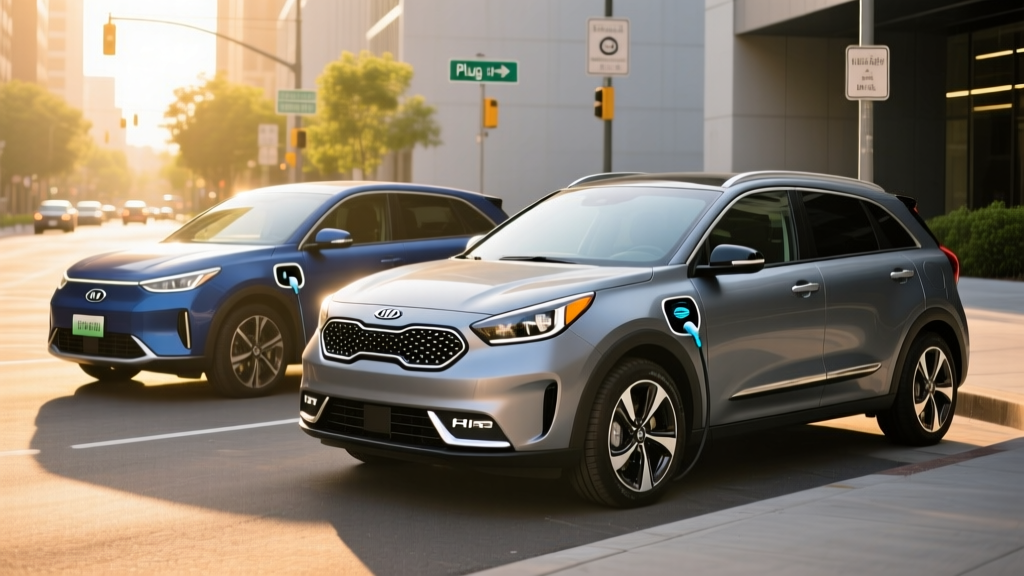
The 2019 Kia Niro arrived at a moment when buyers wanted hybrid efficiency without the polarizing look of a Prius. Offered as a conventional hybrid (HEV), a plug-in hybrid (PHEV), and a fully electric model (EV), the Niro lineup covered nearly every electrified powertrain option available. For used-car shoppers in 2026, the 2019 Kia Niro hybrid plug-in remains one of the most accessible entry points into plug-in ownership — combining a modest electric-only range with a fuel-sipping gasoline backup. But how does it hold up seven years later, and what should you actually expect from its battery, charging, and real-world MPG?
This guide covers both the 2019 Niro HEV and the 2019 Niro Plug-In Hybrid, with a focus on the PHEV variant that most searchers mean when they look up the "2019 Kia Niro hybrid plug-in." We'll break down exact EPA numbers, battery health considerations for a used purchase, and whether this compact crossover still makes financial sense against modern alternatives.
HEV vs PHEV: Which 2019 Niro Are We Talking About?
Kia sold the 2019 Niro in two distinct hybrid configurations, and confusing them is the most common mistake buyers make on the used market. Here's the fundamental difference:
2019 Kia Niro HEV (Conventional Hybrid)
No plug required. The HEV uses a small 1.56 kWh lithium-ion battery that recharges entirely through regenerative braking and the gasoline engine. You never plug it in. The electric motor assists the engine for improved fuel economy, but the car cannot drive on electricity alone for meaningful distances.
2019 Kia Niro Plug-In Hybrid (PHEV)
Plugs in to charge. The PHEV carries a larger 8.9 kWh lithium-ion battery that you charge via a standard J1772 connector (Level 1 or Level 2). It can drive approximately 26 miles on electricity alone before the gasoline engine engages, functioning as a conventional hybrid afterward.
Both variants share the same 1.6-liter Atkinson-cycle four-cylinder engine and six-speed dual-clutch automatic transmission, but the PHEV uses a more powerful electric motor (60 hp vs. 43 hp in the HEV) to enable that electric-only driving capability.
Fuel Economy and Electric-Only Range: The Exact Numbers
According to EPA data on fueleconomy.gov, the 2019 Niro lineup delivers the following efficiency figures:
| Metric | 2019 Niro HEV (FE Trim) | 2019 Niro HEV (LX/EX) | 2019 Niro PHEV |
|---|---|---|---|
| City MPG | 52 MPG | 51 MPG | 48 MPG (hybrid mode) |
| Highway MPG | 49 MPG | 46 MPG | 44 MPG (hybrid mode) |
| Combined MPG | 50 MPG | 49 MPG | 46 MPG (hybrid mode) |
| MPGe (electric mode) | N/A | N/A | 105 MPGe |
| Electric-Only Range | N/A | N/A | 26 miles |
| Total Range | ~590 miles | ~570 miles | ~560 miles |
| Fuel Tank | 11.9 gal | 11.9 gal | 11.4 gal |
Real-World MPG vs. EPA Sticker
HEV: The Niro HEV is one of those rare hybrids that frequently exceeds its EPA rating in city driving, where regenerative braking and electric assist work hardest. Owners regularly report 52-56 MPG in urban commutes. Highway efficiency drops to roughly 42-45 MPG at sustained 70+ mph speeds, where the gasoline engine does most of the work and aerodynamic drag dominates.
PHEV: The 26-mile EPA electric range is achievable in mild weather at moderate speeds. Expect 20-23 miles in cold weather (below 40°F) due to cabin heating draw and reduced battery efficiency. In summer city driving, some owners squeeze out 28-30 miles. Once the battery depletes, the PHEV operates as a conventional hybrid at roughly 43-46 MPG combined — slightly lower than the HEV due to the added battery weight.
Powertrain Specs: Engine, Motor, and Combined Output
| Specification | 2019 Niro HEV | 2019 Niro PHEV |
|---|---|---|
| Engine | 1.6L Atkinson-cycle I4 | 1.6L Atkinson-cycle I4 |
| Engine HP | 104 hp | 104 hp |
| Electric Motor HP | 43 hp (32 kW) | 60 hp (45 kW) |
| Combined System HP | 139 hp | 139 hp |
| Combined Torque | 195 lb-ft | 195 lb-ft |
| Transmission | 6-speed DCT | 6-speed DCT |
| Drivetrain | FWD | FWD |
| 0-60 mph | ~9.7 sec | ~9.4 sec |
| Battery Capacity | 1.56 kWh | 8.9 kWh |
| Battery Chemistry | Lithium-ion (NMC) | Lithium-ion (NMC) |
| Cargo Volume | 22.7 cu ft | 19.4 cu ft |
The PHEV's larger battery and motor reduce cargo space by about 3.3 cubic feet — the battery pack sits beneath the rear cargo floor. If maximum cargo capacity matters, the HEV has the edge. Both models seat five, though the rear seat is snug for tall adults on longer trips.
Charging the PHEV: Times, Connectors, and What to Expect
The 2019 Niro PHEV charges through a J1772 port located on the driver's side front fender. Here's the critical limitation: it cannot DC fast charge. There is no CCS or CHAdeMO capability. All charging is AC only.
| Charging Level | Power | Time (0-100%) | Notes |
|---|---|---|---|
| Level 1 (120V household) | ~1.2 kW | ~9 hours | Trickle charge; fine for overnight if you drive under 20 miles daily |
| Level 2 (240V home/public) | ~3.3 kW | ~2 hours 45 min | Recommended for daily use; full charge during workday or overnight |
| DC Fast Charge | N/A | N/A | Not supported on this model |
The onboard charger is rated at 3.3 kW. Even if you plug into a 7.2 kW or 11.5 kW Level 2 station, the Niro PHEV will only draw 3.3 kW. This is standard for PHEVs of this era — the battery is small enough that faster charging wasn't deemed necessary. For context, 3.3 kW adds roughly 14-16 miles of electric range per hour of charging.
Practical tip for used buyers: Verify that the original Level 1 charging cable (120V EVSE) is included with the vehicle. Replacement OEM cables run $200-$300. The PHEV does not come with a Level 2 cable — you'll need to purchase a J1772-compatible Level 2 EVSE ($250-$500) and have a 240V outlet installed if you want faster home charging.
Battery Health, Warranty, and Replacement Costs
Kia Hybrid Battery Warranty
Original coverage: 10 years / 100,000 miles (whichever comes first) for the hybrid battery pack and all hybrid-system components, including the electric motor, inverter, and onboard charger.
Transferability: Kia's 10-year/100,000-mile powertrain and hybrid battery warranty is not transferable to second owners. Upon resale, coverage drops to 5 years / 60,000 miles from the original in-service date — unless the vehicle is a Kia Certified Pre-Owned (CPO) purchase, which may restore some coverage.
For a 2019 model in 2026: The original 10-year/100,000-mile warranty remains valid through the 2029 model year or until the odometer hits 100,000 miles — but only for the original owner. If you're buying used, confirm the vehicle's mileage and whether you're purchasing from the original owner or a subsequent one.
Real-world battery degradation: The 8.9 kWh NMC battery in the PHEV has proven durable in owner reports. At 60,000-80,000 miles, most PHEV owners report 8-12% capacity loss — meaning the 26-mile electric range may shrink to roughly 22-24 miles. This is gradual and rarely sudden. The HEV's smaller 1.56 kWh battery experiences less noticeable degradation because it operates in a narrower state-of-charge window, managed by the vehicle's battery management system.
Battery replacement cost: If the high-voltage battery fails outside warranty, expect a replacement cost of $2,500-$4,000 for the PHEV pack (parts and labor) and $1,500-$2,500 for the HEV pack, based on 2026 dealer and independent hybrid-shop pricing. Refurbished and aftermarket cells are increasingly available at lower cost. According to Kia's official warranty documentation, hybrid battery coverage includes capacity loss below a defined threshold (typically 70% of original capacity within the warranty period).
2019 Niro Pricing in 2026: Used Market and Tax Credits
Original MSRP (2019):
- Niro HEV FE: $23,490
- Niro HEV LX: $24,490
- Niro HEV EX: $27,900
- Niro PHEV LX: $28,500
- Niro PHEV EX: $32,100
- Niro PHEV Touring: $34,500
Used market pricing (2026): As of early 2026, a 2019 Niro HEV with 60,000-80,000 miles typically sells for $14,000-$18,000 depending on trim and condition. The 2019 Niro PHEV commands $16,000-$21,000 in similar condition, with the Touring trim at the top of that range.
Tax credit eligibility:
- Federal §30D new-vehicle credit: Not applicable — this credit applies only to new vehicle purchases. The 2019 Niro PHEV originally qualified for a $4,543 federal tax credit when new, which has since expired for subsequent buyers.
- Federal used-EV credit (§25E): The IRS used clean vehicle credit offers up to $4,000 or 30% of the sale price (whichever is less) for qualifying used plug-in vehicles purchased from a dealer. The 2019 Niro PHEV qualifies if: the sale price is $25,000 or less, buyer income is under $75,000 (single) / $150,000 (joint), and the vehicle has not previously been used to claim this specific credit after 2023. The HEV does not qualify for this credit — it is only available for plug-in vehicles.
- State incentives: Vary by jurisdiction. Check your state's energy office or DMV for current rebates, HOV-lane access, or reduced registration fees for used PHEVs.
Who Should Buy the 2019 Niro HEV vs. PHEV vs. a Full EV?
Choose the 2019 Niro HEV if:
- You cannot charge at home or work (no garage, no outlet access)
- You want maximum cargo space (22.7 cu ft vs. 19.4 in the PHEV)
- Your budget is under $16,000
- You drive mostly city miles and want 50+ MPG without thinking about plugging in
Choose the 2019 Niro PHEV if:
- You can charge at home (even a 120V outlet works for daily needs)
- Your round-trip commute is 20-26 miles or less — you'll rarely burn gas
- You want to reduce fuel costs without committing to full electric range limitations
- You take occasional road trips where charging infrastructure is sparse
- You want to potentially claim the $4,000 used-EV federal credit
Choose a full EV instead if:
- You have reliable home Level 2 charging and your daily driving is under 200 miles
- You want zero gasoline maintenance (no oil changes, no fuel system)
- You're willing to spend $20,000+ on a used EV with 200+ miles of range (e.g., a used 2021-2022 Chevy Bolt, Nissan Leaf Plus, or Tesla Model 3)
Pros
- Excellent real-world city MPG (HEV exceeds 50 MPG regularly)
- PHEV covers most commutes on electricity alone
- Kia's hybrid system has proven reliable with minimal major issues
- Comfortable ride quality for a compact crossover
- Strong safety ratings (IIHS Top Safety Pick for 2019)
- Low used-market entry price for electrified driving
- 6-speed DCT feels more natural than the CVTs in competing hybrids
Cons
- PHEV has no DC fast-charging capability
- 3.3 kW onboard charger is slow by 2026 standards
- PHEV cargo space reduced to 19.4 cu ft
- Rear seat is tight for adults over 6 feet
- Infotainment system feels dated (no wireless CarPlay/Android Auto)
- Highway MPG drops noticeably above 70 mph
- Hybrid battery warranty not fully transferable to second owners
Frequently Asked Questions
How many MPG does the 2019 Kia Niro hybrid get?
The 2019 Niro HEV is EPA-rated at 52 city / 49 highway / 50 combined MPG on the fuel-economy FE trim. The LX and EX trims are rated at 51/46/49. In real-world city driving, many owners report 52-56 MPG thanks to aggressive regenerative braking. Highway driving at 75 mph drops efficiency to roughly 42-45 MPG.
How far can the 2019 Niro Plug-In Hybrid go on electric only?
The EPA rates the 2019 Niro PHEV at 26 miles of electric-only range. In real-world conditions, expect 20-23 miles in cold weather and up to 28-30 miles in mild city driving. After the battery depletes, the car operates as a conventional hybrid at approximately 46 MPG combined.
Is the 2019 Kia Niro hybrid reliable?
Yes. The Niro's hybrid powertrain has a strong reliability record. The 1.6L engine and 6-speed DCT are conventional components with well-understood maintenance needs. The hybrid battery and electric motor have shown minimal failure rates in owner surveys. IIHS named it a Top Safety Pick, and major powertrain issues are rare. The most commonly reported complaints involve the infotainment system and occasional DCT hesitation at low speeds — neither affects drivetrain longevity.
What does a hybrid battery replacement cost for the 2019 Niro?
Out-of-warranty replacement runs approximately $2,500-$4,000 for the PHEV's 8.9 kWh battery and $1,500-$2,500 for the HEV's 1.56 kWh battery. However, most Niro hybrid batteries last well beyond 100,000 miles with only moderate capacity loss (8-12%). The original 10-year/100,000-mile warranty may still cover the vehicle if you're the original owner.
Does the 2019 Niro PHEV qualify for any tax credit in 2026?
As a used vehicle, the 2019 Niro PHEV may qualify for the federal §25E used clean vehicle credit — up to $4,000 or 30% of the sale price (whichever is less). Requirements include a sale price of $25,000 or less, buyer income under $75,000 (single) or $150,000 (joint), and purchase from a licensed dealer. The conventional HEV does not qualify for this credit. Consult a tax professional and review current IRS guidelines before claiming.
Can the 2019 Niro PHEV charge at public DC fast-charging stations?
No. The 2019 Niro PHEV only supports AC charging via a J1772 connector at Level 1 (120V) or Level 2 (240V). It cannot use CCS, CHAdeMO, or NACS DC fast chargers. This is typical for PHEVs — the 8.9 kWh battery is small enough that Level 2 charging replenishes it in under three hours, making DC fast charging unnecessary for most use cases.
Hybrid vs PHEV vs EV — which fits my lifestyle?
If you can't charge at home, choose the HEV. If you can charge at home and your commute is under 26 miles round-trip, the PHEV lets you drive mostly on electricity while keeping a gas engine for longer trips. If you have home charging, drive under 200 miles daily, and want to eliminate gas entirely, consider a used full EV like a Chevy Bolt or Tesla Model 3 instead. The PHEV is the safest "bridge" option for buyers uncertain about going fully electric.