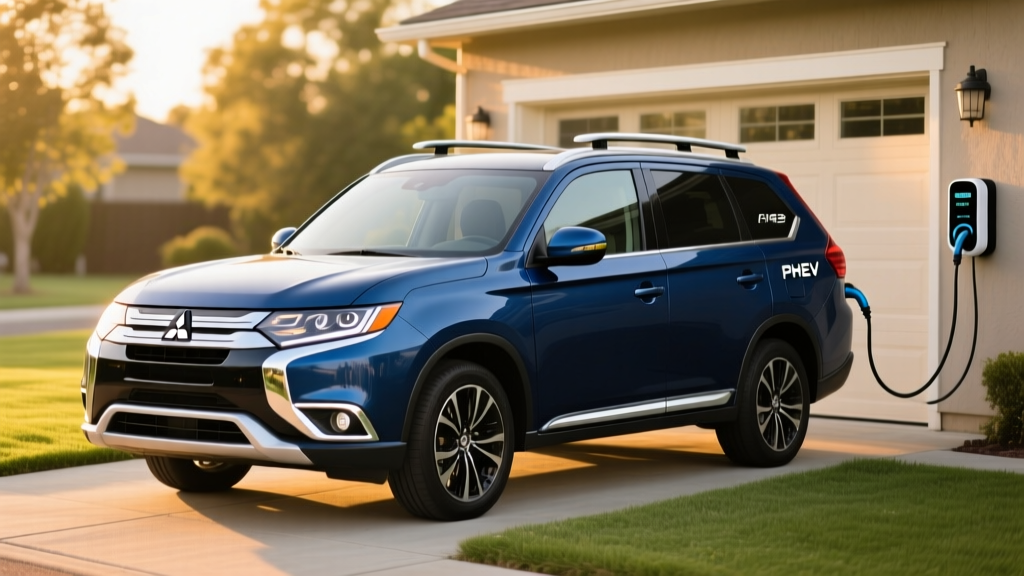
The 2018 Mitsubishi Outlander PHEV occupies a specific niche in the used electrified-vehicle market: it is a midsize, all-wheel-drive plug-in hybrid SUV with DC fast-charging capability — a feature almost unheard of among PHEVs of its era. If you are shopping the used market for a plug-in hybrid that can handle short electric commutes and longer gas-assisted road trips, this model deserves a close look. Below, we break down every number that matters: electric range, MPG, charging speeds, powertrain specs, battery health, and what ownership actually costs in 2026.
HEV vs PHEV: Understanding What the Outlander PHEV Actually Is
Before evaluating the 2018 Outlander PHEV, it is worth distinguishing the two hybrid categories, because Mitsubishi sells — and has sold — both:
Conventional Hybrid (HEV)
- Cannot be plugged in; charges via regenerative braking and the engine
- No meaningful electric-only range (typically under 1 mile at low speed)
- Smaller battery (1–2 kWh)
- Fuel economy advantage comes from engine-assist and regen
Plug-In Hybrid (PHEV)
- Plugs in to charge; has a larger battery you can deplete on electric-only driving
- Typically 15–40 miles of electric-only range
- Larger battery (8–20+ kWh); can also charge via regen and engine
- Operates as an EV for short trips, then switches to hybrid mode
The 2018 Outlander PHEV is firmly in the second category. It has a 12.0 kWh lithium-ion battery pack (approximately 10.0 kWh usable), a charge port, and an EPA-rated 22 miles of electric-only range. You plug it in to get the most from it, but if you forget or lack access to a charger, it still operates as a conventional hybrid — just with less efficiency than a dedicated HEV.
Electric Range, MPGe, and Gas MPG: The Full Picture
The EPA rates the 2018 Outlander PHEV across three metrics that together tell the complete efficiency story. Here is the official breakdown from fueleconomy.gov:
| Metric | EPA Rating | Real-World Expectation |
|---|---|---|
| Electric-only range | 22 miles | 18–20 mi (highway/cold); up to 24 mi (city/mild weather) |
| MPGe (electric + gas combined) | 74 MPGe | 65–75 MPGe depending on charge frequency |
| Gas-only MPG (combined) | 25 MPG | 23–26 MPG (city-favored; highway drops to ~22) |
| City MPG (charge-sustaining) | 25 MPG | 24–27 MPG (regen helps in stop-and-go) |
| Highway MPG (charge-sustaining) | 26 MPG | 22–24 MPG (aerodynamic drag, less regen benefit) |
| Total combined range | ~310 miles | ~280–320 miles depending on conditions |
MPGe — miles per gallon equivalent — measures how far the vehicle travels on a quantity of electricity with the same energy content as one gallon of gasoline (33.7 kWh). A 74 MPGe rating means the Outlander PHEV is moderately efficient in electric mode, though it trails newer PHEVs like the Toyota RAV4 Prime (94 MPGe). The real value of MPGe is comparing electric-mode efficiency across plug-in vehicles; for your actual fuel cost, the gas-only 25 MPG combined matters once the battery is depleted.
Powertrain: Twin Motors, One Engine, and Total Output
| Specification | 2018 Outlander PHEV |
|---|---|
| Engine | 2.0L inline-4 (117 hp, 137 lb-ft) |
| Front electric motor | 60 kW (80 hp, 101 lb-ft) |
| Rear electric motor | 60 kW (80 hp, 144 lb-ft) |
| Combined system output | ~197 hp (net) |
| Drivetrain | AWD (electric rear axle, no mechanical driveshaft) |
| 0–60 mph | ~9.5 seconds |
| Battery capacity (total / usable) | 12.0 kWh / ~10.0 kWh |
| Battery chemistry | Lithium-ion (NMC) |
| Cargo volume (behind 2nd row) | 30.4 cu ft |
| Towing capacity | 1,500 lbs |
The Outlander PHEV's powertrain architecture is unusual and worth understanding. The gasoline engine primarily acts as a generator (series-hybrid mode) at lower speeds, producing electricity to feed the motors. Above approximately 40 mph, a clutch engages and the engine can directly drive the front wheels (parallel-hybrid mode) for better highway efficiency. The rear axle is driven exclusively by its own electric motor — there is no mechanical connection between the engine and the rear wheels. This gives the Outlander PHEV genuine all-wheel-drive traction in all conditions, with torque vectoring at the rear axle via brake-based intervention.
Charging: Levels, Speeds, and the Rare DC Fast-Charge Advantage
One of the 2018 Outlander PHEV's most distinctive features is its CHAdeMO DC fast-charging port — something almost no other PHEV on the used market offers. Here is the full charging breakdown:
| Charging Level | Power (kW) | Connector | Time (0–100% or 0–80%) | Miles of EV Range Added |
|---|---|---|---|---|
| Level 1 (120V household) | ~1.4 kW | J1772 | ~8 hours (full) | ~3 mi/hr |
| Level 2 (240V home/public) | ~3.3 kW | J1772 | ~3.5 hours (full) | ~7 mi/hr |
| DC Fast Charge | ~22 kW peak | CHAdeMO | ~25 min (0–80%) | ~15+ mi in 25 min |
A few practical notes on charging this vehicle in 2026:
- CHAdeMO availability is declining. The North American charging infrastructure has standardized on CCS and NACS (Tesla's connector). While Electrify America and some regional networks still maintain CHAdeMO connectors at existing stations, new installations rarely include them. Check your local charging apps (PlugShare, ChargePoint) for CHAdeMO availability before relying on DC fast charging.
- Level 2 at 3.3 kW is slow by modern standards. The onboard charger maxes out at 3.3 kW, meaning even a 48-amp Level 2 home charger will not charge this vehicle any faster than a basic 16-amp unit. A full charge from empty still takes roughly 3.5 hours.
- Level 1 is viable for daily use if your commute is under 20 miles and you park for 8+ hours overnight. You will recover the full 22-mile EV range in a standard workday or overnight session.
Used Pricing in 2026 and Tax-Credit Eligibility
The 2018 Outlander PHEV originally carried an MSRP starting around $35,535 (GT trim) to $40,735 (GT with S-AWC and packages). In the 2026 used market, examples with 60,000–100,000 miles typically list between $14,000 and $20,000 depending on condition, mileage, and trim.
Regarding tax incentives, the federal §30D new-vehicle tax credit does not apply to a 2018 model purchased in 2026. However, the §25E used clean vehicle credit may be available if you meet the following criteria (per IRS guidelines):
- Credit amount: 30% of the sale price, up to a maximum of $4,000
- Vehicle price cap: Sale price must be $25,000 or less (most 2018 Outlander PHEVs qualify)
- Buyer income cap: AGI must not exceed $75,000 (single), $112,500 (head of household), or $150,000 (married filing jointly)
- Vehicle age: Must be at least 2 model years old (2018 qualifies)
- Dealer requirement: Must be purchased from a licensed dealer (private-party sales do not qualify)
- First-time transfer: The credit can only be claimed once per vehicle after August 16, 2022 — verify the specific VIN has not already been claimed
- Point-of-sale transfer: Eligible buyers can transfer the credit to the dealer for an immediate price reduction
At a typical $17,000 used price, 30% equals $5,100, but the cap limits you to $4,000. That brings the effective purchase price to approximately $13,000 — a strong value for an AWD plug-in hybrid SUV. Always verify eligibility with a tax professional and confirm the VIN's credit history with the dealer before finalizing the purchase.
Battery Warranty, Degradation, and Replacement Cost
10 years / 100,000 miles (whichever comes first) for the main traction battery in CARB states; 10 years / 100,000 miles in all 50 states for the 2018 model year. Warranty covers capacity loss below approximately 70% of original capacity.
For a 2018 model in 2026, the original battery warranty is either nearing expiration or has already expired depending on mileage and in-service date. A vehicle first sold in March 2018 would see its 10-year warranty expire in March 2028 — so many examples still carry partial warranty coverage. Always request the original in-service date from the dealer or run the VIN through Mitsubishi's warranty portal.
Degradation data: Owner reports and fleet data suggest the 2018 Outlander PHEV's NMC battery loses approximately 10–15% of its original capacity over the first 6–8 years of typical use. A vehicle that originally delivered 22 miles of EV range may show 18–20 miles at 80,000 miles — a noticeable but manageable decline. Mitsubishi's battery management system includes a conservative buffer (roughly 2 kWh held in reserve) that helps slow visible degradation.
Replacement cost: If the battery does require replacement out of warranty, a refurbished or new OEM pack typically runs between $5,000 and $8,000 including labor, based on current market pricing for Mitsubishi PHEV battery service. Third-party refurbishment options may be available for less. This is a significant expense, but it is comparable to a major transmission repair on a conventional vehicle and remains relatively rare below 120,000 miles.
Reliability and Known Issues
The 2018 Outlander PHEV benefits from a relatively mature platform — Mitsubishi introduced the PHEV variant globally in 2013 and the U.S. model in 2017. By 2018, most early-production issues had been addressed. Key reliability considerations include:
- Powertrain: The 2.0L 4B11 engine is a proven, low-stress design. The electric motors and inverter have shown strong longevity in global fleets.
- Brake system: Regenerative braking reduces wear on the friction brakes significantly. Pad replacements at 80,000+ miles are common.
- Climate control: The 2018 model uses a resistive heater (not a heat pump), which draws heavily from the battery in cold weather — the primary cause of reduced EV range in winter.
- Infotainment: The 2018 system is dated by modern standards. Apple CarPlay and Android Auto are not available on the base ES trim; they were added on SEL and GT trims. Aftermarket head-unit upgrades are common among owners.
- S-AWC (Super All-Wheel Control): The GT trim's torque-vectoring AWD system is robust but adds complexity. Fluid changes on the rear drive unit should not be skipped.
Overall, the 2018 Outlander PHEV rates as average to slightly above average for reliability among used PHEVs. It does not carry the same long-term reputation as a Toyota hybrid system, but its simpler series-parallel architecture and proven engine offset that concern.
Pros and Cons at a Glance
Pros
- Standard AWD with genuine electric rear axle
- CHAdeMO DC fast charging (rare for PHEVs)
- Competitive used pricing; eligible for up to $4,000 used-EV credit
- Spacious cabin with 30.4 cu ft cargo area
- Can operate as a conventional hybrid if unplugged
- Low-stress 2.0L engine with proven longevity
Cons
- Only 22 miles of EPA electric range (short by 2026 standards)
- 3.3 kW Level 2 onboard charger is slow
- CHAdeMO infrastructure is shrinking in North America
- Dated infotainment; no wireless CarPlay/Android Auto
- Modest 197 hp; 9.5-second 0–60 feels sluggish
- No heat pump — cold-weather EV range drops noticeably
- 1,500-lb towing capacity limits utility
Who Should Buy the 2018 Outlander PHEV — And Who Should Look Elsewhere
Choose the 2018 Outlander PHEV if:
- Your daily commute is under 20 miles and you can charge at home overnight
- You need AWD for snow or light off-road conditions but do not want a full EV
- Your budget is $13,000–$18,000 after the used-EV credit
- You take occasional road trips where charging infrastructure is uncertain
- You want a midsize SUV with reasonable cargo space and five seats
Look at a full EV (BEV) instead if:
- You have reliable home charging and want 200+ miles of range
- You want to eliminate gasoline costs and maintenance entirely
- You drive more than 40 miles daily and want to stay in electric mode
Look at a conventional hybrid (HEV) instead if:
- You cannot charge at home or at work
- You want maximum MPG without ever plugging in (consider a Toyota RAV4 Hybrid at ~40 MPG)
- You prefer a simpler ownership experience with no charging cables or ports
Frequently Asked Questions
How many MPG does the 2018 Mitsubishi Outlander PHEV get?
The EPA rates the 2018 Outlander PHEV at 25 MPG combined in charge-sustaining (gas-only) mode, with 25 city and 26 highway. In real-world driving, expect 23–26 MPG combined depending on conditions. When factoring in electric-mode driving, the combined rating is 74 MPGe.
How far can the 2018 Outlander PHEV go on electric only?
The EPA rates it at 22 miles of electric-only range. Real-world results range from about 16–18 miles in cold weather or at highway speeds, up to 24–25 miles in mild-weather city driving. After the battery is depleted, the gasoline engine takes over for a total combined range of approximately 310 miles.
Hybrid vs PHEV vs EV — which is right for me?
A conventional hybrid (HEV) is best if you cannot plug in and want better MPG with zero behavior change. A PHEV like the Outlander is ideal if you can charge at home, drive under 25 miles daily, but still need gas-engine range for road trips. A full EV (BEV) makes the most sense if you have home charging, want the lowest operating costs, and are comfortable with 200+ miles of range and occasional DC fast-charging stops on long trips.
Is the 2018 Outlander PHEV reliable, and what does battery replacement cost?
The 2018 Outlander PHEV rates average to slightly above average for reliability. The 2.0L engine and electric motors have proven durable. Battery degradation is typically 10–15% over 6–8 years. Out-of-warranty battery replacement runs approximately $5,000–$8,000, though this is uncommon below 120,000 miles. The original 10-year/100,000-mile battery warranty may still apply depending on the vehicle's in-service date.
Does the 2018 Outlander PHEV qualify for any tax credit?
The §30D new-vehicle credit does not apply. However, the §25E used clean vehicle credit may provide up to $4,000 (30% of sale price, capped at $4,000) if you purchase from a licensed dealer for $25,000 or less and your AGI is within IRS limits ($75K single / $150K married filing jointly). Verify VIN eligibility and consult a tax professional before purchase. Some states offer additional used-EV rebates — check your state energy office or AFDC state incentives database.
Can I DC fast charge the 2018 Outlander PHEV?
Yes, via the CHAdeMO connector at approximately 22 kW peak, reaching 80% in about 25 minutes. However, CHAdeMO infrastructure is declining in North America as the industry shifts to CCS and NACS. Confirm CHAdeMO availability at your preferred charging stations before relying on this feature.
What is the difference between kW and kWh?
kW (kilowatts) measures power — the rate at which energy flows, like the speed of water from a hose. kWh (kilowatt-hours) measures energy — the total amount stored or consumed, like the volume of water in a bucket. The Outlander PHEV's battery holds 12 kWh of energy, and it charges at up to 3.3 kW (Level 2) or 22 kW (DC fast charge).