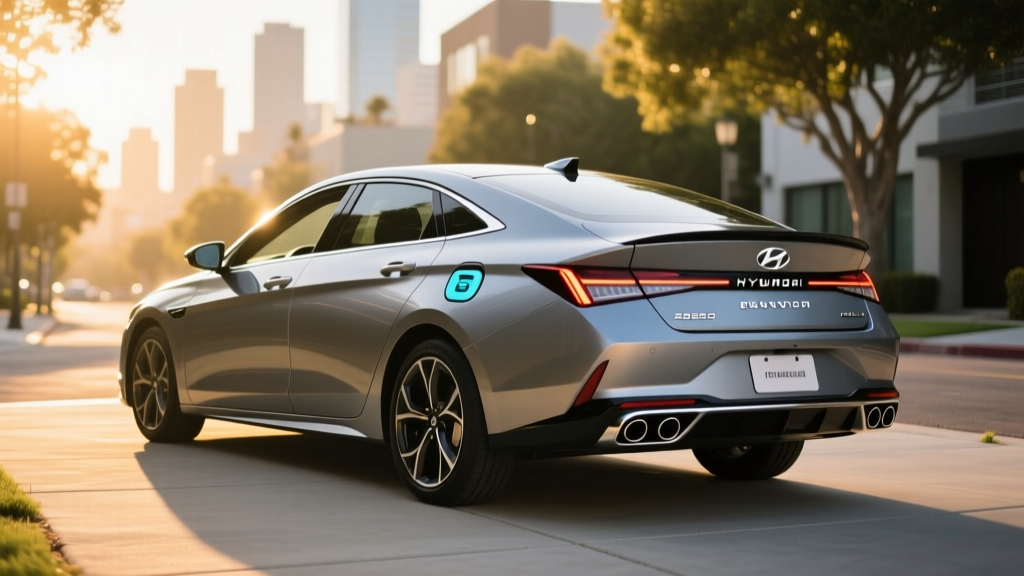
The Hyundai Elantra Hybrid has long occupied a pragmatic middle ground: a compact sedan that delivers Prius-rivaling fuel economy without the polarizing design or the waitlist headaches. For 2026, Hyundai carries over the formula that made the previous generation a value leader — a 1.6-liter four-cylinder paired with an electric motor and a lithium-ion polymer battery pack — while quietly refining the infotainment stack and standard safety suite. If you're researching the 2026 Elantra Hybrid, here's every number that matters.
Quick Verdict: Who the 2026 Elantra Hybrid Is For
The 2026 Elantra Hybrid is built for buyers who want maximum fuel efficiency without plugging in, without range anxiety, and without paying an EV premium. It's a conventional hybrid (HEV), not a plug-in hybrid (PHEV). You never plug it in — the battery charges through regenerative braking and the gasoline engine. If you have reliable home charging access and a short commute, a full EV like the Ioniq 6 will save you more per mile. If you live in an apartment, drive long highway stretches, or simply don't want to think about charging infrastructure, the Elantra Hybrid is one of the most cost-efficient vehicles on the market.
EPA Fuel Economy: City, Highway, and Combined MPG
The headline number for the 2026 Elantra Hybrid Blue trim is 54 MPG combined — placing it within striking distance of the Toyota Prius (57 MPG combined for the LE FWD). Higher trims with larger wheels and added equipment drop slightly to 50 MPG combined.
| Trim | City MPG | Highway MPG | Combined MPG | Annual Fuel Cost* |
|---|---|---|---|---|
| Blue | 56 | 52 | 54 | ~$1,050 |
| SEL Sport | 51 | 49 | 50 | ~$1,140 |
| Limited | 51 | 49 | 50 | ~$1,140 |
*Based on 15,000 miles/year, 55% city driving, $3.20/gal regular unleaded. Source: fueleconomy.gov.
Real-World MPG: What Owners Actually Report
Hybrids routinely exceed their EPA highway estimates in city driving because stop-and-go traffic maximizes regenerative braking and electric-motor assist. Based on aggregated driver logs from FuelEconomy.gov's My MPG tool for the current-generation Elantra Hybrid, real-world combined averages land between 48 and 53 MPG for mixed driving. Pure city routes in warm weather have yielded 58–62 MPG for careful drivers. Highway-only trips at 75+ MPH tend to drop to 44–47 MPG — a common hybrid pattern, since the electric motor contributes less at sustained high speed.
Powertrain Specs: Engine, Motor, and Combined Output
The 2026 Elantra Hybrid uses Hyundai's proven parallel-hybrid architecture — a 1.6L GDI four-cylinder engine teamed with a permanent-magnet synchronous electric motor, both feeding a 6-speed dual-clutch automatic transmission (6DCT). Unlike the Toyota Prius's planetary-gear e-CVT, the Elantra's DCT delivers more direct, familiar shift feel that enthusiasts appreciate, though it sacrifices a fraction of efficiency in the process.
| Specification | Value |
|---|---|
| Engine | 1.6L GDI 4-cylinder |
| Engine Output | 104 hp / 109 lb-ft torque |
| Electric Motor Output | 43 hp / 125 lb-ft torque |
| Combined System Output | 139 hp / 195 lb-ft torque |
| Transmission | 6-speed dual-clutch automatic (6DCT) |
| Drivetrain | Front-wheel drive |
| 0–60 MPH | ~8.8 seconds |
| Hybrid Battery | 1.32 kWh lithium-ion polymer |
| Curb Weight | ~3,017 lbs (Blue trim) |
The 1.32 kWh battery pack is modest — it's a conventional hybrid, so the battery is small by design. It stores enough energy for brief electric-only motoring at low speeds (parking lots, stop-and-go creep) but cannot propel the car at highway speeds on electricity alone. This is fundamentally different from a PHEV, which carries a much larger battery for extended electric-only driving.
Hybrid vs. PHEV vs. Full EV: Which Powertrain Fits You?
Hyundai offers the Elantra as a gasoline model, a conventional hybrid (HEV), and in some markets a PHEV variant. Here's how to think about the choice — not just within the Elantra lineup but across powertrains generally.
HEV vs. PHEV vs. BEV — Quick Decision Guide
| Factor | Conventional Hybrid (HEV) | Plug-in Hybrid (PHEV) | Battery Electric (BEV) |
|---|---|---|---|
| Plug in required? | No | Yes (for max benefit) | Yes |
| Electric-only range | <1 mile at low speed | 20–50 miles typical | 200–400 miles |
| Best for | No home charger, mixed driving | Home charger + short commute + road trips | Home charger + daily driving under 300 mi |
| Fuel cost per mile | ~$0.07–0.09 | ~$0.03–0.05 (electric) / $0.08+ (gas) | ~$0.03–0.05 |
| Maintenance complexity | Low (gas engine + regen) | Moderate (two full systems) | Lowest (no engine) |
| Federal tax credit (§30D) | Not eligible | Up to $7,500 (if eligible) | Up to $7,500 (if eligible) |
Choose the Elantra Hybrid (HEV) if: You don't have access to home or workplace charging, you drive more than 40 miles daily, you take frequent road trips, or you want the lowest purchase price with strong fuel economy and zero charging logistics.
Consider a PHEV (like the Hyundai Tucson PHEV) if: You can install a Level 2 charger at home, your daily commute is under 30 miles round-trip (so you'd rarely burn gas), and you still want a gas engine for long road trips.
Consider a full BEV (like the Hyundai Ioniq 6 or Tesla Model 3) if: You have reliable home charging, your daily driving is under 250 miles, you want the lowest per-mile fuel cost, and you're ready to plan around DC fast charging on road trips.
2026 Elantra Hybrid Pricing and Trim Breakdown
Hyundai has positioned the Elantra Hybrid as an accessible efficiency play, undercutting the Prius on base price while offering competitive equipment levels. Here's the 2026 MSRP structure:
| Trim | MSRP (incl. destination) | Key Features |
|---|---|---|
| Blue | $26,250 | 16" alloy wheels, 8" touchscreen, wireless CarPlay/Android Auto, Hyundai Smart Sense (FCA, LKA, DA, BVM available), LED headlights |
| SEL Sport | $28,750 | 17" alloy wheels, 10.25" digital cluster, heated front seats, Smart Cruise Control with Stop & Go, Dual-zone climate |
| Limited | $31,450 | 10.25" navigation touchscreen, Bose premium audio, leather seats, Highway Driving Assist, ventilated front seats, sunroof |
Tax Credit Eligibility for the Elantra Hybrid
The 2026 Elantra Hybrid is a conventional hybrid (HEV), which means it does not qualify for the federal §30D Clean Vehicle Credit (up to $7,500 for new EVs and PHEVs). The §30D credit requires a plug-in vehicle with at least 7 kWh of battery capacity, per IRS guidelines. The Elantra Hybrid's 1.32 kWh pack falls far short of this threshold.
Some states offer separate incentives for conventional hybrids, but these are increasingly rare as incentive programs shift focus to PHEVs and BEVs. Check your state's energy office or AFDC incentive database for current local programs.
Battery Warranty, Reliability, and Replacement Cost
Hybrid battery longevity is consistently the top concern for first-time hybrid buyers. Here's what the data shows for the Elantra Hybrid:
Real-World Hybrid Battery Reliability
Hyundai's hybrid systems have demonstrated strong longevity in the field. The 1.32 kWh pack in the Elantra Hybrid is far less stressed than a large BEV battery — it undergoes shallow charge/discharge cycles (rarely dropping below 40% or above 80% state of charge), which dramatically extends cell life. Based on fleet data from earlier Hyundai/Kia hybrid models (Ioniq Hybrid, Niro), hybrid batteries routinely exceed 150,000–200,000 miles before significant degradation occurs.
Battery Replacement Cost
If the hybrid battery does require replacement outside of warranty, expect to pay between $2,000 and $3,500 for a new OEM pack including labor. Refurbished or aftermarket cells are available for $1,200–$2,000. This is dramatically less than a BEV battery replacement ($8,000–$20,000+) because the hybrid pack is physically small. For context, many owners report the 12V auxiliary battery needing replacement before the hybrid traction battery ever shows issues.
General Reliability
The Elantra Hybrid's powertrain is mechanically straightforward by modern standards — the 1.6L naturally aspirated engine is well-proven, and the 6DCT transmission, while more complex than a Toyota e-CVT, has been in Hyundai's lineup since 2020 with few widespread failure reports. The Elantra earned strong marks from IIHS in prior model years, and Hyundai Smart Sense (standard forward collision avoidance, lane keeping, driver attention warning) provides a solid baseline of active safety.
Pros and Cons of the 2026 Elantra Hybrid
Pros
- 54 MPG combined (Blue) — among the best in the compact sedan segment
- No plug-in required — zero charging logistics
- Competitive base price at $26,250
- 10-year/100,000-mile hybrid battery warranty
- 6-speed DCT feels more natural than a CVT
- Strong standard safety suite (Hyundai Smart Sense)
- Quiet, refined cabin at highway speeds
Cons
- No federal tax credit (HEV, not PHEV)
- Only 139 hp — adequate but not quick (8.8s to 60)
- Highway MPG drops noticeably above 75 MPH
- No all-wheel-drive option
- Cargo space slightly reduced vs. gas Elantra (battery packaging)
- Limited trim tops out above $31K, approaching EV territory
Frequently Asked Questions
How many MPG does the 2026 Elantra Hybrid get?
The Blue trim achieves an EPA-estimated 56 city / 52 highway / 54 combined MPG. The SEL Sport and Limited trims are rated at 51 city / 49 highway / 50 combined. In real-world driving, owners typically report 48–53 MPG combined, with city-heavy routes occasionally pushing above 58 MPG.
Can I drive the Elantra Hybrid on electric power alone?
Only at very low speeds for short distances — think creeping through a parking lot or in heavy stop-and-go traffic below ~25 MPH. The 1.32 kWh battery is too small for sustained electric-only driving. This is a conventional hybrid (HEV), not a plug-in hybrid. If you want 25–40 miles of electric-only commuting, you'd need a PHEV like the Tucson PHEV or a full EV.
Does the 2026 Elantra Hybrid qualify for any tax credit?
No. The federal §30D Clean Vehicle Credit applies only to plug-in electric vehicles (BEVs and PHEVs) with battery packs of at least 7 kWh. The Elantra Hybrid's 1.32 kWh pack does not qualify. Some states may offer minor hybrid incentives — check the AFDC state incentive database for your area. A used hybrid may qualify for the §25E used clean vehicle credit (up to $4,000) if purchased from a dealer and meeting income requirements, but this applies to used sales only.
How long will the hybrid battery last, and what does replacement cost?
Hyundai warranties the hybrid battery for 10 years / 100,000 miles (10/150,000 in CARB states). Real-world data from similar Hyundai/Kia hybrid platforms suggests these batteries commonly last 150,000–200,000 miles before significant degradation. Out-of-warranty replacement costs approximately $2,000–$3,500 for an OEM pack with labor.
Hybrid vs. full EV — should I get the Elantra Hybrid or an EV like the Ioniq 6?
If you can charge at home (Level 2, 240V) and your daily driving is under 250 miles, an EV like the Ioniq 6 (361-mile EPA range, up to $7,500 federal credit eligibility) will cost less per mile and require less maintenance. If you lack home charging, regularly drive more than 300 miles in a day, live in extreme cold, or want the lowest upfront cost, the Elantra Hybrid is the more practical choice. The break-even point on fuel savings typically favors an EV after 4–6 years of ownership, depending on local electricity rates and driving patterns.
Is the Elantra Hybrid better than the Toyota Prius?
It depends on your priorities. The Prius LE delivers 57 MPG combined (3 MPG more than the Elantra Blue) and offers available all-wheel drive. The Elantra Hybrid starts about $1,500 lower and offers a more traditional driving feel with its 6-speed DCT versus the Prius's CVT. Both carry excellent hybrid warranties. If maximum MPG is your sole criterion, the Prius edges ahead. If price and driving dynamics matter more, the Elantra Hybrid is the stronger value.