What a Plug-In Hybrid Actually Is
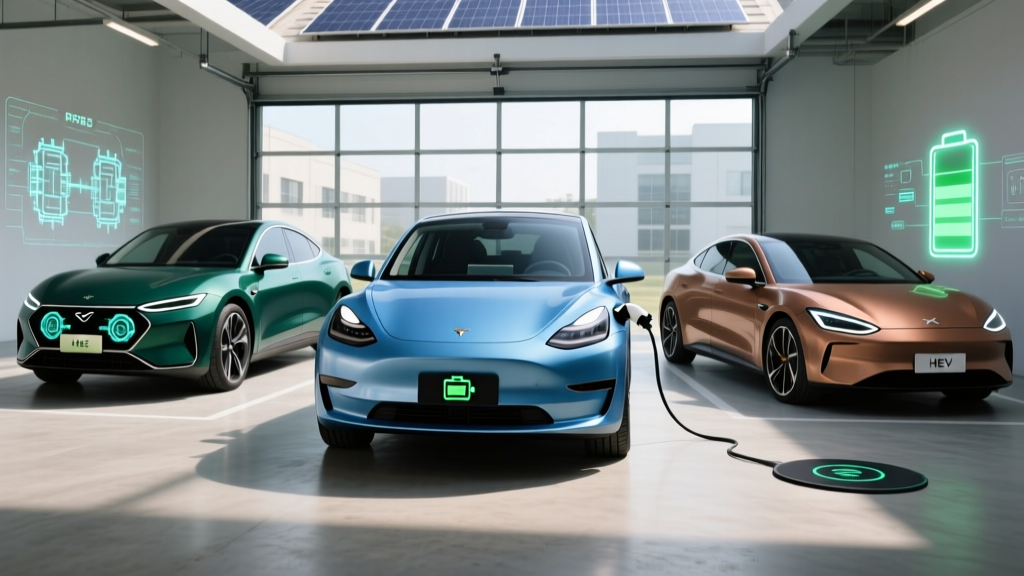
When shoppers ask what plug in hybrid means, the answer sits between a conventional hybrid and a full battery-electric vehicle. A plug-in hybrid electric vehicle (PHEV) pairs a gasoline engine with a larger battery and electric motor than a standard hybrid, giving it the ability to drive 25–45 miles on electricity alone before the engine fires up. Unlike a conventional hybrid (HEV) such as the Toyota Prius, which recharges its small battery exclusively through regenerative braking and the engine, a PHEV can be plugged into a wall outlet or charging station to refill its battery — hence the name.
The practical result: most daily commutes happen on cheap, quiet electric power, while the gas engine eliminates range anxiety on road trips. You never have to plug in a PHEV — it will operate as a conventional hybrid if you skip charging — but you lose the core benefit if you never do.
HEV vs PHEV: The Mechanical Differences
| Feature | Conventional Hybrid (HEV) | Plug-In Hybrid (PHEV) |
|---|---|---|
| Battery size | 0.5–1.5 kWh | 13–25 kWh usable |
| Electric-only range | 0.5–2 miles at low speed | 25–45 miles at full speed |
| Plug-in charging | No — self-charging only | Yes — Level 1 (120V) or Level 2 (240V) |
| DC fast charging | Not applicable | Rare — only select models (e.g., Mitsubishi Outlander PHEV) |
| Federal tax credit (§30D) | Not eligible | Up to $7,500 if battery ≥7 kWh and sourcing rules met |
| Typical combined MPG (gas mode) | 45–57 MPG | 25–40 MPG (engine alone) |
| MPGe (electric + gas combined) | Not rated in MPGe | 70–105 MPGe |
| Price premium over gas model | $1,000–$3,000 | $4,000–$10,000 |
The HEV's small battery acts as a buffer to let the engine run at optimal efficiency. The PHEV's much larger battery is a genuine traction pack — it powers highway speeds on electrons alone until depleted, then the vehicle seamlessly transitions to hybrid operation. According to fueleconomy.gov, the EPA rates PHEVs with both an MPGe figure (electricity + gas blended) and a standard MPG figure (gas-only after battery depletion).
2026 PHEV Lineup: Range, MPG, and Pricing at a Glance
| Model (2025–2026) | EV Range | Battery (kWh) | Combined HP | Gas MPG | MPGe | Base MSRP |
|---|---|---|---|---|---|---|
| Toyota RAV4 Prime | 42 mi | 18.1 | 302 | 38 | 94 | $44,735 |
| Toyota Prius Prime | 39–44 mi | 13.6 | 220 | 48–52 | 114–127 | $33,445 |
| Jeep Wrangler 4xe | 22 mi | 17.3 | 375 | 20 | 49 | $51,795 |
| Ford Escape PHEV | 37 mi | 14.4 | 210 | 40 | 105 | $39,500 |
| Hyundai Tucson PHEV | 33 mi | 13.8 | 261 | 35 | 80 | $39,750 |
| Mitsubishi Outlander PHEV | 38 mi | 20.0 | 248 | 26 | 64 | $41,490 |
| BMW X5 xDrive50e | 38 mi | 25.7 | 483 | 24 | 58 | $74,900 |
Sources: EPA fueleconomy.gov, manufacturer press sites. EV range varies by trim, wheel size, and temperature.
Real-World MPG vs. the EPA Sticker
The EPA's combined MPG for a PHEV depends heavily on how often you charge. If you plug in nightly and drive 30 miles a day, you may burn almost zero gasoline for months — making the gas-only MPG figure irrelevant. But if you never charge, a PHEV often returns worse fuel economy than a lighter HEV because it hauls a heavy, depleted battery.
Real-world observations from owners and testers:
- City driving, regular charging: Expect to exceed EPA MPGe. The Toyota Prius Prime routinely returns 55+ MPG in gas-only city driving, beating its 48 MPG sticker thanks to aggressive regenerative braking at low speeds.
- Highway driving, battery depleted: Expect 10–20% below gas-mode MPG. Aerodynamic drag dominates, regen recovery is minimal, and the dead battery is dead weight. A RAV4 Prime rated at 38 MPG combined may return 32–34 MPG on a sustained 75-mph cruise.
- Cold weather (below 32°F): Electric-only range drops 20–30% as the battery's internal resistance rises and cabin heating draws power. A 42-mile EV range may shrink to 28–32 miles in January.
The bottom line: a PHEV's efficiency is a function of your charging discipline. Treat it like an EV during the week and a hybrid on weekends, and the math works beautifully. Ignore the plug, and you've bought a heavier, more expensive Prius.
Charging a PHEV: What to Expect
PHEV batteries are small enough that charging is straightforward and fast compared to a full EV:
| Charging Level | Power (kW) | Time to Full (typical 15 kWh pack) | Equipment Needed |
|---|---|---|---|
| Level 1 (120V household) | 1.2–1.4 kW | 10–14 hours | Included portable cordset |
| Level 2 (240V home/public) | 3.3–7.2 kW | 2–4.5 hours | Home wallbox or public station |
| DC Fast Charge | 22–50 kW (rare) | 25–38 min (0–80%) | CHAdeMO or CCS — only on select models |
Most PHEVs max out at 3.3–6.6 kW on Level 2 AC charging, meaning even a modest home wallbox refills the pack overnight or during a workday. The Mitsubishi Outlander PHEV remains one of the few plug-in hybrids offering DC fast charging (CHAdeMO connector, up to 22 kW), while the newer generation supports CCS at slightly higher rates. The vast majority of PHEV owners charge exclusively at home on Level 1 or Level 2 — public DC charging is unnecessary given the small battery.
Federal Tax Credits for PHEVs in 2026
Under IRS §30D, qualifying PHEVs are eligible for up to $7,500 in federal tax credits — the same program that covers full EVs. However, the rules are strict and eligibility changes frequently based on battery sourcing and critical-mineral requirements. Here is the current framework:
- Battery capacity: Must be ≥7 kWh (virtually all current PHEVs qualify)
- MSRP caps: Vans/SUVs/pickups ≤ $80,000; sedans ≤ $55,000
- Buyer income caps: AGI ≤ $150,000 (single), $225,000 (head of household), $300,000 (joint)
- Battery component sourcing: Percentage thresholds for North American assembly and critical-mineral sourcing increase annually — consult IRS.gov §30D guidance for the current year's requirements
- Point-of-sale transfer: As of 2024, buyers can transfer the credit to the dealer for an immediate price reduction rather than waiting for tax filing
As of early 2026, the Toyota RAV4 Prime and Jeep Wrangler 4xe have seen partial or full credit eligibility depending on the production batch and sourcing compliance — always verify the VIN on the IRS clean-vehicle portal before purchasing. The Prius Prime (MSRP under $55,000) has intermittently qualified for the full $7,500, but critical-mineral sourcing rules have caused fluctuations. State incentives (California's CVRP, Colorado's innovative motor vehicle credit, New York's Drive Clean Rebate) may stack on top, but amounts and eligibility vary by jurisdiction — check your state energy office for current programs.
Battery Longevity, Warranty, and Replacement Costs
Hybrid & PHEV Battery Warranty Standard
Federal law mandates that hybrid and PHEV batteries carry a minimum warranty of 8 years / 100,000 miles (10 years / 150,000 miles in California Air Resources Board states including CA, NY, MA, NJ, and others). Most manufacturers meet or exceed this baseline.
PHEV battery degradation is generally modest because the pack is small, thermal management is adequate, and the vehicle's software maintains a generous buffer — you rarely charge to true 100% or discharge to true 0%. Real-world data from Consumer Reports and owner forums shows most PHEV batteries retain 85–92% of original capacity after 8 years of daily cycling.
If replacement is needed out of warranty:
- Toyota Prius Prime: $3,500–$5,000 (battery pack + labor)
- RAV4 Prime: $5,000–$7,500
- BMW X5 xDrive50e: $10,000–$15,000+ (larger pack, premium labor rates)
For context, the conventional hybrid Toyota Prius (HEV) battery replacement runs $2,000–$3,500. The PHEV premium reflects the larger pack. However, catastrophic PHEV battery failure before 150,000 miles is uncommon — most degradation manifests as a gradual reduction in electric-only range rather than sudden failure.
PHEV vs. HEV vs. Full EV: Which Fits You?
Choose a Conventional Hybrid (HEV) if:
- You have no access to home or workplace charging
- You want maximum MPG with zero behavior change
- Your budget is tight — HEVs carry the smallest price premium ($1,000–$3,000 over gas)
- You drive mostly city miles where regen braking shines (expect to beat EPA city MPG)
Choose a Plug-In Hybrid (PHEV) if:
- You can charge at home (even a standard 120V outlet works overnight)
- Your daily round-trip commute is under 40 miles
- You take road trips where charging infrastructure is sparse or unreliable
- You want EV-like daily driving without range anxiety or a second car
- You qualify for the §30D tax credit, narrowing the price gap with a full EV
Choose a Full EV (BEV) if:
- You have reliable home Level 2 charging
- Your daily driving is predictable and under 250 miles
- You want zero tailpipe emissions and minimal maintenance (no oil changes, no engine)
- You can access the full $7,500 federal credit plus state incentives
- You're ready to plan road trips around DC fast-charging stops
Pros and Cons of Owning a PHEV
Pros
- 25–45 miles of electric commuting at ~$0.04–$0.08/mile (vs. $0.12–$0.18/mile for gas)
- No range anxiety — gas engine covers any distance
- Smaller battery means faster, cheaper home charging (no panel upgrade usually needed)
- Federal tax credit up to $7,500 on eligible models
- Strong resale value on popular models (RAV4 Prime has historically sold above MSRP)
- Quieter, smoother daily driving in EV mode
Cons
- Higher upfront cost than an HEV ($4,000–$10,000 premium)
- Gas-mode MPG often worse than an equivalent HEV due to battery weight
- Two powertrains mean two maintenance schedules (engine oil + EV system checks)
- Charging discipline required — without plugging in, you lose the core benefit
- Cargo space sometimes reduced vs. gas/HEV variant due to battery placement
- Fewer PHEV choices in 2026 as some automakers shift R&D to full EVs
Frequently Asked Questions
How many MPG does a plug-in hybrid get?
It depends on charging habits. In gas-only mode after battery depletion, expect 20–52 MPG combined depending on the model — the Prius Prime leads at 48–52 MPG combined, while the Jeep Wrangler 4xe returns around 20 MPG. When regularly charged, the effective MPGe can exceed 100 because most miles are driven electrically.
How far can a PHEV go on electric only?
Current 2025–2026 PHEVs offer 22–44 miles of EPA-rated electric range. The Toyota RAV4 Prime leads SUVs at 42 miles; the Prius Prime reaches 44 miles in SE trim. Cold weather reduces this by 20–30%. Highway driving at 70+ mph also shortens EV range compared to the EPA's blended test cycle.
Do I have to plug in a PHEV?
No. A PHEV will operate as a conventional hybrid if you never plug it in — the engine and regenerative braking maintain the battery. However, you forfeit the electric-only range and the fuel-cost savings that justify the PHEV's higher purchase price. If you won't plug in regularly, buy an HEV instead and save $4,000–$8,000.
Is a PHEV reliable compared to a gas car or full EV?
PHEVs carry both an internal-combustion engine and an electric powertrain, meaning more components that could theoretically fail. However, Toyota's PHEV systems (RAV4 Prime, Prius Prime) have demonstrated excellent reliability in Consumer Reports surveys, with the electric motor actually reducing wear on the engine and brakes (regen braking extends pad life significantly). The 8-year/100,000-mile battery warranty provides additional peace of mind.
Does a plug-in hybrid qualify for the $7,500 tax credit?
Yes, if it meets IRS §30D requirements: battery ≥7 kWh, MSRP under the cap ($55,000 for cars, $80,000 for SUVs/trucks/vans), buyer income under the limit, and battery-component/critical-mineral sourcing thresholds. Eligibility changes as sourcing rules tighten annually. Always check the fueleconomy.gov tax credit database and the IRS portal for your specific VIN before purchase.
What's the battery replacement cost for a PHEV?
Out-of-warranty PHEV battery replacement typically costs $3,500–$7,500 for mainstream brands (Toyota, Hyundai, Ford) and $10,000–$15,000+ for luxury models (BMW, Porsche). Under the federally mandated 8-year/100,000-mile warranty (10/150,000 in CARB states), the manufacturer covers battery defects and capacity loss below a stated threshold — usually 60–70% of original capacity.
Can a PHEV charge at a Tesla Supercharger?
Generally no. Most PHEVs use a J1772 connector for Level 2 AC charging and cannot DC fast charge at all. Tesla Superchargers deliver DC power via the NACS connector. The rare PHEVs with DC capability (Mitsubishi Outlander PHEV with CHAdeMO or CCS) still cannot use Superchargers without an adapter, and Tesla's adapter program currently supports CCS-equipped full EVs only. For PHEV owners, Level 2 public stations (ChargePoint, EVgo, Blink) are the practical public-charging option.