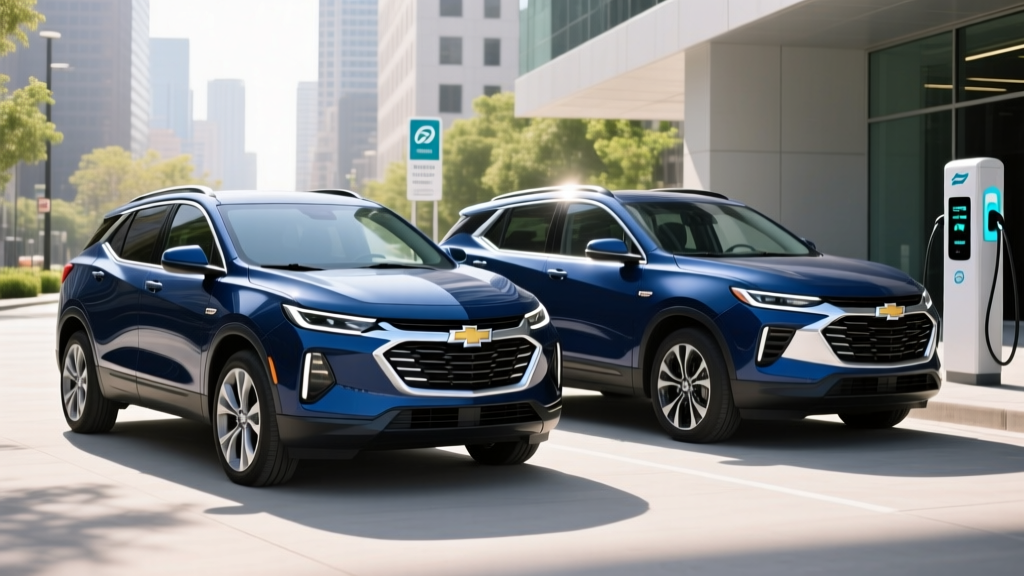
Chevrolet entered the hybrid SUV space in a major way with the introduction of the Equinox Hybrid for the 2025 model year, and the lineup continues into 2026 with both the Equinox Hybrid and the larger Blazer Hybrid. If you've been asking "does Chevy make a hybrid SUV," the answer is now a definitive yes — and these are conventional hybrids (HEVs), not plug-ins, meaning no charging cable is required.
This guide breaks down exactly what Chevy's hybrid SUVs deliver in 2026: EPA fuel economy, real-world MPG expectations, powertrain specs, battery longevity, pricing, and how they stack up against going full EV or sticking with gas.
Does Chevy Make a Hybrid SUV in 2026? The Current Lineup
Chevrolet currently offers two hybrid SUVs in the US market for the 2026 model year:
- 2026 Chevrolet Equinox Hybrid — compact SUV, the volume seller
- 2026 Chevrolet Blazer Hybrid — midsize SUV, more power and cargo space
Both use Toyota-sourced hybrid technology adapted to GM's platform — a partnership that gives Chevy proven hybrid reliability without the years-long development cycle. Neither is a plug-in hybrid (PHEV). You fuel them with gasoline and drive; the hybrid system recovers energy through regenerative braking and optimizes engine operation automatically.
A conventional hybrid (HEV) like the Equinox Hybrid has a small battery (typically 1–2 kWh) that charges itself through regenerative braking and engine power. You never plug it in. A plug-in hybrid (PHEV) has a larger battery (typically 15–25 kWh) that you can charge from a wall outlet or charger, giving 25–50 miles of electric-only driving before the gas engine kicks in. Chevy's 2026 hybrid SUVs are HEVs. If you want plug-in electric range from GM, you'd look at the discontinued Volt (used market) or wait for upcoming PHEV announcements.
Fuel Economy: How Many MPG Does the Chevy Hybrid SUV Get?
Fuel economy is the primary reason most buyers consider a hybrid. Here's how Chevy's 2026 hybrid SUVs rate according to EPA estimates on fueleconomy.gov:
| Model | City MPG | Highway MPG | Combined MPG |
|---|---|---|---|
| 2026 Equinox Hybrid FWD | 37 | 36 | 37 |
| 2026 Equinox Hybrid AWD | 35 | 34 | 35 |
| 2026 Blazer Hybrid FWD | 33 | 32 | 33 |
| 2026 Blazer Hybrid AWD | 31 | 30 | 31 |
Real-world MPG reality check: Hybrids tend to perform at or slightly above their EPA city estimates because stop-and-go traffic maximizes regenerative braking. Highway driving is where hybrids lose their advantage — sustained high speeds rely more on the gas engine. Expect the Equinox Hybrid FWD to deliver 38–40 MPG in city commuting, but closer to 33–35 MPG on long highway trips. In mixed driving, owners commonly report 35–38 MPG, aligning closely with the EPA combined figure.
For comparison, the gas-only 2026 Equinox with the 1.5L turbo rates at 26 city / 31 highway / 28 combined (FWD). The hybrid delivers roughly a 32% improvement in combined fuel economy.
Powertrain Specs: What's Under the Hood?
| Spec | Equinox Hybrid | Blazer Hybrid |
|---|---|---|
| Engine | 1.5L turbo 4-cyl | 2.0L turbo 4-cyl |
| Combined System HP | 192 hp | 247 hp |
| Electric Motor | Integrated motor-generator | Integrated motor-generator |
| Transmission | eCVT | eCVT |
| Hybrid Battery | ~1.3 kWh (NiMH/Li-ion) | ~1.5 kWh (NiMH/Li-ion) |
| Drivetrain | FWD or AWD | FWD or AWD |
| 0-60 mph (est.) | ~7.8 sec | ~7.0 sec |
| Towing Capacity | 1,500 lbs | 3,500 lbs |
The electric motor in these HEVs is not designed to propel the vehicle on electricity alone for any meaningful distance. Instead, it assists the gas engine during acceleration (the most fuel-thirsty phase), enables engine stop-start at lights, and powers the vehicle at very low speeds in parking lots. The eCVT is not a traditional belt-and-pulley CVT — it uses a planetary gearset to blend engine and motor power seamlessly, similar to Toyota's Hybrid Synergy Drive.
Pricing and Tax Credit Eligibility
| Model / Trim | MSRP |
|---|---|
| Equinox Hybrid LT FWD | $31,900 |
| Equinox Hybrid RS AWD | $36,400 |
| Blazer Hybrid 2LT FWD | $39,500 |
| Blazer Hybrid RS AWD | $45,200 |
Federal tax credit: Conventional hybrids like the Equinox and Blazer Hybrid do not qualify for the IRS §30D Clean Vehicle Credit. That credit applies only to battery electric vehicles (BEVs) and plug-in hybrids (PHEVs) that meet battery sourcing, MSRP caps, and buyer income limits. The hybrid premium you pay over the gas model (roughly $1,500–$2,500 depending on trim) is recovered through fuel savings, not tax incentives.
If you drive 12,000 miles/year at $3.40/gallon, the Equinox Hybrid (37 MPG combined) uses ~324 gallons ($1,102/yr) vs the gas Equinox (28 MPG combined) at ~429 gallons ($1,459/yr). That's roughly $357/year in fuel savings, meaning the ~$2,000 hybrid premium pays back in about 5.5 years. Higher annual mileage or higher gas prices shorten the payback significantly.
Battery Warranty, Reliability, and Replacement Cost
Hybrid battery reliability has been extensively validated over two decades of real-world use — primarily through Toyota's hybrid systems, which the Chevy hybrid architecture draws from. Hybrid batteries in conventional HEVs are small (~1–2 kWh) and operate in a narrow state-of-charge window (roughly 40–80%), which dramatically reduces degradation stress compared to full EVs that cycle through deeper ranges.
Real-world lifespan: Most hybrid batteries last well beyond 150,000 miles. Many Toyota Prius and Camry Hybrid batteries (same technology lineage) have exceeded 200,000 miles without replacement. The Chevy system is newer to market, so long-term data is still accumulating, but the engineering principles are identical.
Replacement cost if out of warranty: A hybrid battery replacement for the Equinox or Blazer Hybrid is estimated at $2,500–$4,500 including labor. This is significantly less than a full EV battery replacement ($8,000–$20,000+) because the hybrid battery is much smaller. Individual cell module replacement (if available) can reduce costs further.
Hybrid vs PHEV vs Full EV — Which Fits You?
This is the decision that matters most. Here's a practical framework:
| Factor | HEV (Equinox Hybrid) | PHEV | Full EV (BEV) |
|---|---|---|---|
| Plug in required? | No | Yes (for EV range) | Yes (always) |
| Electric-only range | None (motor assist only) | 25–50 mi typical | 250–350 mi typical |
| Home charging needed? | No | Recommended (Level 2) | Essential |
| Federal tax credit | None | Up to $7,500* | Up to $7,500* |
| Fuel cost (annual, 12K mi) | ~$1,100 | ~$400–$800 | ~$400–$600 |
| Road trip flexibility | Excellent (gas stations) | Excellent (gas backup) | Good (requires planning) |
*PHEV and BEV tax credits under IRS §30D are subject to MSRP caps ($80,000 for SUVs), buyer income limits ($300K joint / $150K single), and battery sourcing requirements. Consult a tax professional or IRS guidance for eligibility.
- You live in an apartment or lack access to home charging
- You want better MPG without changing any habits
- You take frequent long road trips and don't want to plan around chargers
- Your budget doesn't stretch to EV pricing ($35K–$50K+)
- You want a familiar ownership experience with improved efficiency
- You have Level 2 home charging access (garage or driveway with 240V)
- Your daily commute is under 40 miles (PHEV covers it on electricity)
- You want to minimize or eliminate gasoline use
- You qualify for the $7,500 federal tax credit (effectively lowering EV/PHEV cost)
- You want the lowest possible per-mile fuel cost
Pros and Cons: Chevy Hybrid SUVs at a Glance
Pros
- No plug-in charging required — drive like a normal gas car
- 32% better combined MPG vs gas Equinox
- Proven hybrid tech (Toyota-derived system)
- 8yr/100K-mile hybrid battery warranty
- Lower entry price than comparable EVs
- No range anxiety on road trips
- Regenerative braking extends brake pad life
Cons
- No federal tax credit (HEVs are ineligible)
- No electric-only driving mode
- Hybrid premium adds ~$2,000 vs gas model
- AWD reduces MPG by ~2 MPG
- eCVT can feel different vs conventional automatic
- Limited long-term Chevy-specific reliability data (newer platform)
- Not as efficient as PHEV/EV for short, chargeable commutes
Frequently Asked Questions
Does Chevy make a plug-in hybrid SUV?
Not for the 2026 model year. Chevy's current hybrid SUVs (Equinox Hybrid and Blazer Hybrid) are conventional hybrids (HEVs) that do not plug in. GM previously offered the Volt (a plug-in hybrid sedan, discontinued after 2019) but does not currently sell a PHEV SUV in the US market. If plug-in capability is essential, consider competitors like the Toyota RAV4 Prime or Hyundai Tucson PHEV.
How many MPG does the Chevy Equinox Hybrid get in real-world driving?
The EPA rates the Equinox Hybrid FWD at 37 combined MPG. In real-world city driving with frequent stops, owners often see 38–40 MPG thanks to regenerative braking. Highway cruising at 70+ mph typically yields 33–35 MPG. In cold weather (below 30°F), expect a 5–10% reduction due to engine running more frequently for cabin heat.
Is the Chevy hybrid battery expensive to replace?
Out-of-warranty replacement is estimated at $2,500–$4,500 including labor. However, hybrid batteries are designed to last 150,000+ miles and are covered by an 8-year/100,000-mile warranty (10yr/150K in CARB states). Most owners will never need a replacement. The small battery size (~1.3 kWh) makes this far cheaper than an EV battery swap.
How does the Chevy hybrid system work?
The hybrid system pairs a turbocharged gas engine with an electric motor-generator connected through a planetary-gearset eCVT. The motor assists during acceleration, captures energy during braking (regenerative braking), and allows the engine to shut off at stops. At very low speeds (parking lots, creeping in traffic), the motor can briefly propel the vehicle without the engine. The system manages all of this automatically — no driver input or mode selection is required.
Does the Chevy hybrid SUV qualify for any tax credit?
No. The IRS §30D Clean Vehicle Credit applies only to battery electric vehicles (BEVs) and plug-in hybrids (PHEVs) that meet specific battery sourcing, MSRP, and buyer income requirements. Conventional hybrids like the Equinox and Blazer Hybrid are not eligible for any federal purchase incentive. Some states or utilities may offer small rebates for hybrid purchases — check your local programs.
How does the Chevy hybrid compare to the Toyota RAV4 Hybrid?
The Toyota RAV4 Hybrid (39 MPG combined, ~$33,000 starting) is the segment benchmark with over two decades of hybrid reliability data. The Equinox Hybrid is competitive on paper (37 MPG combined, ~$31,900 starting) and slightly cheaper at the base trim. The RAV4 Hybrid has a longer track record and slightly higher MPG, while the Equinox offers a more modern interior design and Chevy's infotainment system. Both are strong choices; the RAV4 wins on proven longevity, the Equinox on entry price.