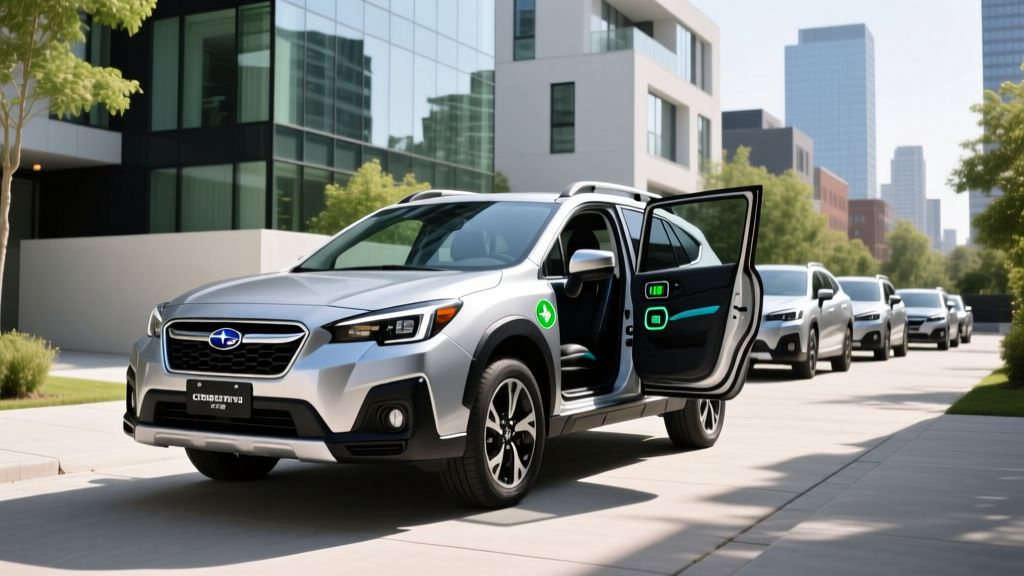
If you've searched "does Subaru make hybrids" you're not alone — the brand has a complicated history with electrification. Subaru discontinued its original Crosstrek Plug-In Hybrid after the 2023 model year, and for 2025–2026 the company has leaned heavily into its next-generation e-Boxer mild-hybrid system and the all-electric Solterra. But the hybrid question hasn't gone away. Let's map out exactly what Subaru offers today, what's coming, and whether a Subaru hybrid (or a competitor) makes sense for your driveway.
Subaru's Hybrid Lineup: What's Available in 2026
As of the 2026 model year, Subaru's U.S. lineup includes one primary electrified offering that qualifies as a hybrid: the Crosstrek Hybrid (reintroduced for 2025 as a conventional hybrid using Subaru's updated e-Boxer system). This is a self-charging hybrid (HEV) — not a plug-in. It pairs Subaru's 2.0-liter flat-four engine with a small electric motor integrated into the Lineartronic CVT, recovering energy during braking and assisting during acceleration. No plug, no charging cable, no behavior change required.
Subaru has also confirmed that a next-generation Crosstrek Plug-In Hybrid (PHEV) is in development, expected to arrive for the 2027 model year with an updated Toyota-sourced plug-in powertrain (building on the RAV4 Prime platform partnership). Until then, the PHEV slot in Subaru's lineup remains empty.
HEV vs. PHEV — What's the Difference?
Conventional Hybrid (HEV): Charges itself via regenerative braking and the gas engine. No plug needed. Small battery (~1–2 kWh). Boosts MPG, especially in city driving. The 2026 Crosstrek Hybrid is an HEV.
Plug-In Hybrid (PHEV): Larger battery (~13–20 kWh) that you plug in to charge. Gives 20–40 miles of electric-only driving before the gas engine kicks in. Requires home or public charging access to maximize value. Subaru's previous Crosstrek PHEV (discontinued after 2023) was this type.
2026 Subaru Crosstrek Hybrid: Full Specs
| Specification | 2026 Crosstrek Hybrid |
|---|---|
| Powertrain | 2.0L flat-4 + e-Boxer electric motor, CVT, AWD |
| Combined Horsepower | ~154 hp (engine + motor assist) |
| Hybrid Battery | ~1.1 kWh lithium-ion (not plug-in) |
| EPA MPG (City / Hwy / Combined) | 36 / 34 / 35 MPG |
| Electric-Only Range | N/A (HEV — no EV-only mode beyond low-speed creep) |
| Total Range | ~490 miles (13.9-gal tank) |
| 0–60 mph | ~9.2 seconds |
| Drivetrain | Symmetrical AWD (standard) |
| Ground Clearance | 8.7 inches |
| Base MSRP | ~$30,995 (Hybrid Premium) |
| Federal Tax Credit (§30D) | Not eligible (HEVs do not qualify) |
Sources: fueleconomy.gov (EPA), Subaru USA official specs. Verify exact figures for your trim at purchase.
Fuel Economy: EPA vs. Real-World MPG
| Driving Scenario | EPA Estimate | Real-World Expectation |
|---|---|---|
| City | 36 MPG | 37–40 MPG (hybrids excel in stop-and-go) |
| Highway | 34 MPG | 31–33 MPG (AWD drag, boxy shape) |
| Combined | 35 MPG | 34–37 MPG (mix-dependent) |
| Cold Weather (below 30°F) | N/A | 29–32 MPG (engine runs more for cabin heat) |
The e-Boxer system shines in city driving, where regenerative braking frequently recaptures energy and the electric motor handles low-speed propulsion. On the highway, the 2.0L flat-four does most of the work, and the Crosstrek's tall ride height and standard AWD create aerodynamic and mechanical drag that limits gains. Expect a 3–5 MPG penalty in sustained sub-freezing temperatures as the engine runs more often to provide cabin heat — a common trait across all hybrids without dedicated heat-pump HVAC systems.
How the Crosstrek Hybrid Compares to Competitors
The Crosstrek Hybrid doesn't exist in a vacuum. Here's how it stacks up against the hybrid crossovers most buyers cross-shop:
| Model | Type | Combined MPG | EV Range | AWD | Base MSRP |
|---|---|---|---|---|---|
| Subaru Crosstrek Hybrid | HEV | 35 | — | Std | ~$30,995 |
| Toyota RAV4 Hybrid | HEV | 39 | — | Std | ~$33,425 |
| Toyota RAV4 Prime | PHEV | 38 (gas) / 94 MPGe | 42 mi | Std | ~$44,935 |
| Honda CR-V Hybrid | HEV | 37 | — | Opt | ~$36,395 |
| Ford Escape PHEV | PHEV | 39 (gas) / 105 MPGe | 37 mi | No | ~$40,500 |
The Crosstrek Hybrid's advantage is standard AWD at the lowest entry price in this segment. The RAV4 Hybrid beats it on MPG and cargo space. If you want plug-in capability with AWD, the RAV4 Prime is the clear class leader — but commands a ~$14,000 premium over the Crosstrek Hybrid and remains supply-constrained.
Tax Credits and Incentives: What Qualifies?
§30D Federal Tax Credit — Hybrid Eligibility
The 2026 Crosstrek Hybrid (HEV) does not qualify for the federal §30D Clean Vehicle Credit. Under current IRS rules, only plug-in electric vehicles (BEVs and PHEVs with ≥7 kWh battery capacity) are eligible. Conventional hybrids like the Crosstrek Hybrid, RAV4 Hybrid, and CR-V Hybrid are excluded regardless of price or income.
If Subaru's next-gen Crosstrek PHEV (expected 2027) arrives with a battery ≥7 kWh, it could qualify — subject to MSRP caps ($80,000 for SUVs), buyer income limits ($150K single / $300K joint), and critical-mineral/battery-component sourcing requirements. Always verify eligibility on irs.gov before purchasing.
Some states offer separate hybrid or high-efficiency vehicle rebates, but these vary widely and change frequently. Check your state's energy office or the Alternative Fuels Data Center for current local incentives.
Reliability and Battery Warranty
Subaru Hybrid Battery Warranty
Hybrid Battery: 8 years / 100,000 miles (whichever comes first). In states adopting California emissions standards (CARB states), coverage extends to 10 years / 150,000 miles.
Powertrain: 5 years / 60,000 miles.
Estimated Battery Replacement Cost: $2,500–$4,000 out of warranty (based on current e-Boxer pack pricing and labor). Because the HEV battery is small (~1.1 kWh) and operates within a narrow state-of-charge window, degradation is minimal — most hybrid batteries outlast the vehicle itself.
Subaru's e-Boxer hybrid system has proven durable since its global introduction. The battery never fully charges or fully depletes — it operates in a 40–80% state-of-charge window managed by the vehicle's computer — which dramatically reduces wear. In real-world ownership data, hybrid battery failures before 150,000 miles are rare across Subaru, Toyota, and Honda platforms.
Hybrid vs. PHEV vs. EV — Which Is Right for You?
Choose the Crosstrek Hybrid (HEV) If:
- You can't install a home charger (apartment, street parking, landlord restrictions)
- You want AWD capability for snow/light off-road without a fuel-economy penalty
- Your budget tops out around $32,000–$35,000
- You drive a mix of city and highway and want zero behavior change from a gas car
Choose a PHEV (RAV4 Prime, Escape PHEV) If:
- You have home Level 2 charging (240V) and a commute under 40 miles round-trip
- You want electric-only daily driving but need gas flexibility for road trips
- You want to access the §30D federal tax credit (up to $7,500, eligibility-dependent)
- Budget allows $40,000–$47,000
Choose a Full EV (Solterra, Ioniq 5, bZ4X) If:
- You have reliable home charging and your daily driving is under 250 miles
- You want the lowest per-mile fuel cost and zero tailpipe emissions
- You qualify for the full §30D credit, bringing effective price closer to a hybrid
- You're willing to plan around DC fast charging on road trips
Pros and Cons at a Glance
✓ Pros
- Standard symmetrical AWD — best-in-class traction for the price
- Low entry price: ~$30,995 vs. $33K–$45K for competitors
- No plug required — behaves exactly like a gas car
- 8.7 inches of ground clearance for light trails and snow
- 35 MPG combined is solid for a compact AWD crossover
- Subaru EyeSight safety suite standard
✗ Cons
- Lower MPG than RAV4 Hybrid (39) and CR-V Hybrid (37)
- No EV-only driving mode — always burns some fuel
- No federal tax credit eligibility
- Modest 154 hp — not a quick vehicle (9.2s to 60)
- Small cargo area vs. RAV4 and CR-V (54.7 cu ft max)
- No PHEV option until expected 2027 model year
Frequently Asked Questions
Does Subaru make a plug-in hybrid in 2026?
Not currently. Subaru discontinued the Crosstrek Plug-In Hybrid after the 2023 model year. A next-generation PHEV is expected for the 2027 model year, likely using an updated Toyota-sourced plug-in powertrain. For 2026, the only Subaru hybrid is the conventional Crosstrek Hybrid (HEV).
How many MPG does the Subaru Crosstrek Hybrid get?
The EPA rates the 2026 Crosstrek Hybrid at 36 city / 34 highway / 35 combined MPG. In real-world city driving, owners commonly report 37–40 MPG thanks to regenerative braking. Highway-heavy commutes tend to yield 31–33 MPG due to the boxy shape and AWD drivetrain losses.
Does the Crosstrek Hybrid need to be plugged in?
No. The Crosstrek Hybrid is a conventional (self-charging) hybrid. Its small 1.1 kWh battery charges through regenerative braking and the gas engine. You refuel at any gas station — no plug, no charger, no behavior change.
Is the Subaru hybrid system reliable?
Yes. Subaru's e-Boxer system has been in global production since 2019 with strong reliability data. The hybrid battery is covered for 8 years/100,000 miles (10 years/150,000 miles in CARB states). Because the battery operates in a narrow charge window, degradation is minimal and most units outlast the vehicle. Out-of-pocket replacement, if needed, runs $2,500–$4,000.
Does the Subaru Crosstrek Hybrid qualify for a tax credit?
No. The federal §30D Clean Vehicle Credit only applies to plug-in vehicles (BEVs and PHEVs). Conventional hybrids like the Crosstrek Hybrid are not eligible. Some states may offer small efficiency rebates — check your local programs.
Should I wait for the 2027 Subaru PHEV?
If you need a plug-in hybrid with AWD and can wait 12–18 months, the next-gen Crosstrek PHEV may be worth holding for — especially if it qualifies for the $7,500 federal credit. If you need a car now, the RAV4 Prime is the proven AWD PHEV benchmark, or the Crosstrek Hybrid offers solid value without plug-in capability.