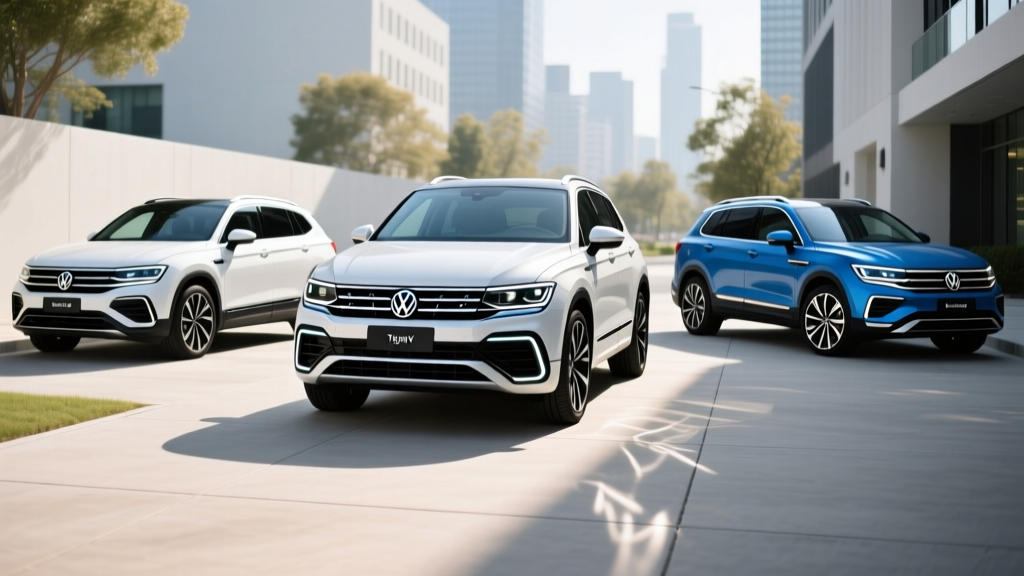
For buyers searching for a VW SUV hybrid, the 2026 Volkswagen Tiguan eHybrid is the centerpiece of Volkswagen's electrified utility lineup in the United States. It arrives at a moment when plug-in hybrid (PHEV) technology has matured past early-generation compromises: larger batteries, faster Level 2 charging, and more seamless transitions between electric and gasoline power. But with competing PHEVs from Toyota, Hyundai, and Ford, and with full battery-electric SUVs pushing past 300 miles of range, where does VW's plug-in hybrid SUV actually fit?
This guide breaks down the 2026 Tiguan eHybrid's powertrain, real-world MPG, electric-only range, charging logistics, pricing, and tax credit eligibility — and helps you decide whether this VW SUV hybrid, a conventional HEV, or a full EV is the right call for your driving routine.
HEV vs PHEV: What VW Actually Offers in 2026
Before diving into specs, it's essential to separate two fundamentally different powertrain types that buyers often conflate:
Conventional Hybrid (HEV)
A standard hybrid pairs a gasoline engine with a small electric motor and a compact battery (typically 1–2 kWh). It never plugs in — the battery recharges through regenerative braking and engine operation. The electric motor assists the engine to reduce fuel consumption, particularly in stop-and-go city driving. Think Toyota RAV4 Hybrid.
Plug-In Hybrid (PHEV)
A plug-in hybrid carries a much larger battery (13–25 kWh) and a more powerful electric motor. It plugs in to charge and can drive 25–45 miles on electricity alone before the gasoline engine activates. Once the battery depletes, it operates like a conventional hybrid. The 2026 Tiguan eHybrid falls squarely in this category.
As of the 2026 model year, Volkswagen does not sell a conventional (non-plug-in) HEV SUV in the U.S. market. The Tiguan eHybrid is the brand's sole hybrid SUV offering stateside. If you want a VW hybrid, you're looking at a PHEV — which means access to a charging outlet is a practical requirement to capture its full value.
2026 Tiguan eHybrid: Powertrain and Performance Specs
The 2026 Tiguan eHybrid pairs a 1.5-liter turbocharged four-cylinder engine with an electric motor integrated into the transmission housing. Combined output significantly exceeds the gas-only Tiguan, giving the PHEV variant a noticeably more responsive character in daily driving.
| Specification | Value |
|---|---|
| Engine | 1.5L turbocharged inline-4 |
| Electric Motor | Permanent-magnet synchronous, integrated |
| Combined System Horsepower | 241 hp |
| Combined System Torque | 295 lb-ft |
| Transmission | 6-speed DSG automatic |
| Drivetrain | Front-wheel drive (4Motion AWD available on select trims) |
| Battery Capacity (Gross / Usable) | 19.7 kWh / ~17.5 kWh (NMC lithium-ion) |
| EPA Electric-Only Range | 33 miles |
| Total Combined Range (Electric + Gas) | ~440 miles |
| 0–60 mph | 7.3 seconds (estimated) |
| Fuel Tank Capacity | 12.7 gallons |
| Max Level 2 Charge Rate | 7.2 kW |
| DC Fast Charging | Not available |
| 10–100% Level 2 Charge Time | ~2 hours 45 minutes |
| Cargo Volume (behind 2nd row) | 33.5 cu ft |
The 241 combined horsepower figure is noteworthy — it positions the Tiguan eHybrid closer to performance-oriented compact SUVs than to efficiency-focused hybrids. The electric motor delivers instant torque at low speeds, making city acceleration feel punchy even before the turbo-four spools up.
Fuel Economy: EPA MPG and Real-World Expectations
PHEV fuel economy is inherently variable. Your actual MPG depends entirely on how often you charge and how far you drive between charges. The EPA reports two figures for plug-in hybrids: a combined MPGe (miles-per-gallon-equivalent) rating when operating on electricity, and a gasoline-only MPG figure once the battery is depleted.
| Mode | City | Highway | Combined |
|---|---|---|---|
| Charge-Sustaining (gas only, battery depleted) | 33 MPG | 30 MPG | 32 MPG |
| Charge-Depleting (electric + gas blended) | 92 MPGe combined | ||
| Electric-Only Range | 33 miles (EPA) | ||
| Electric Efficiency | 2.9 kWh/mile (34 kWh/100 mi) | ||
Real-World MPG vs. EPA Sticker
EPA combined (gas-only): 32 MPG. In real-world driving, PHEVs in charge-sustaining mode often slightly exceed EPA city estimates because regenerative braking is highly effective in urban traffic. Expect 33–36 MPG in city driving on a depleted battery, and 28–31 MPG on the highway at sustained 70+ mph speeds.
EPA electric range: 33 miles. In mild weather (55–75°F) with moderate speeds, owners report 30–35 miles of real-world electric range. In cold weather (below 35°F), cabin heating and reduced battery efficiency cut this to 22–27 miles. Highway driving at 75 mph also reduces electric range to roughly 25–28 miles.
The practical takeaway: if your daily commute is under 30 miles round-trip and you charge at home every night, you may go weeks without visiting a gas station. The Tiguan eHybrid's 33-mile electric envelope covers the majority of American daily driving, according to fueleconomy.gov data on average commute distances.
Charging the Tiguan eHybrid: Level 1, Level 2, and What You Need at Home
Unlike full battery-electric vehicles, the Tiguan eHybrid does not support DC fast charging. This is standard across nearly all compact PHEVs — the battery is small enough that Level 2 AC charging fills it quickly, and the added cost and weight of DC hardware isn't justified.
| Charging Level | Power (kW) | Voltage | 0–100% Time | Practical Notes |
|---|---|---|---|---|
| Level 1 (standard outlet) | ~1.4 kW | 120V | ~12–14 hours | Overnight top-up; sufficient if you drive under 20 miles/day |
| Level 2 (home wallbox or public AC) | 7.2 kW | 240V | ~2 hours 45 min | Recommended for daily full charges; requires 240V outlet or hardwired unit |
| DC Fast Charge | N/A | N/A | N/A | Not supported on Tiguan eHybrid |
For most PHEV owners, a Level 2 home charger is the sweet spot. Plugging in when you get home means a full 33-mile electric range every morning. A basic Level 2 wallbox (such as a ChargePoint Home Flex or Emporia Level 2) costs $400–$700 for the equipment, with professional installation typically adding $500–$1,500 depending on whether your electrical panel needs an upgrade. For a detailed breakdown of home charging installation costs, see our Level 2 home charger installation guide.
If you lack home charging access — say you live in an apartment or park on the street — a PHEV still works. You'll simply operate in charge-sustaining (hybrid) mode more often, achieving 32 MPG combined rather than the 92 MPGe blended figure. The fuel savings over a gas-only Tiguan (approximately 25 MPG combined) still amount to roughly $300–$400 per year at 12,000 miles driven, but you lose the PHEV's primary advantage.
Pricing, Trims, and Federal Tax Credit Eligibility
The 2026 Tiguan eHybrid is available in two trims in the U.S. market:
- SE R-Line Black eHybrid: Starting at $40,490 MSRP (including destination)
- SEL R-Line eHybrid: Starting at $44,290 MSRP (including destination)
Both trims are well-equipped, with the SEL adding features like a panoramic sunroof, ventilated front seats, a head-up display, and Volkswagen's IQ.DRIVE suite with Travel Assist (a Level 2 driver-assistance system — not autonomous driving).
Federal §30D Tax Credit: Does the Tiguan eHybrid Qualify?
Under the IRS §30D Clean Vehicle Credit rules effective for 2026, the Tiguan eHybrid's eligibility is partial and conditional. Here's what determines whether you can claim up to $7,500:
- Battery sourcing (critical minerals): The 19.7 kWh battery must meet escalating critical-mineral and battery-component sourcing thresholds. As of early 2026, VW has not publicly confirmed full compliance with the latest domestic-content requirements for all Tiguan eHybrid battery cells. Buyers should verify the current sourcing status on fueleconomy.gov before purchasing.
- MSRP cap: SUVs must have an MSRP at or below $80,000. Both Tiguan eHybrid trims clear this threshold easily.
- Buyer income limits: Modified adjusted gross income must not exceed $150,000 (single), $225,000 (head of household), or $300,000 (married filing jointly).
- Point-of-sale transfer: If eligible, you can transfer the credit to the dealer at purchase, reducing your out-of-pocket cost immediately rather than waiting to claim it on your tax return.
- Final assembly: The vehicle must undergo final assembly in North America. The U.S.-market Tiguan is assembled in Puebla, Mexico — which currently qualifies under USMCA rules, but buyers should confirm VIN eligibility via the NHTSA VIN lookup tool.
Tax Credit Reality Check
Do not assume a flat $7,500 credit. Depending on battery sourcing compliance in the 2026 model year, the Tiguan eHybrid may qualify for $3,750 (half credit) or the full $7,500 — or potentially neither if sourcing rules tighten further. Always confirm your specific vehicle's eligibility with your dealer and a tax professional before finalizing a purchase. IRS rules change, and manufacturer compliance status updates periodically throughout the year.
Battery Longevity, Warranty, and Replacement Cost
Hybrid Battery Warranty
Volkswagen covers the Tiguan eHybrid's high-voltage battery with an 8-year / 100,000-mile warranty (whichever comes first), with a capacity retention threshold of 70%. This means VW will repair or replace the battery if its usable capacity drops below 70% of the original 17.5 kWh usable figure within the warranty period. This aligns with the federal mandate for PHEV battery coverage and is consistent with what Toyota, Hyundai, and Ford offer on their competing PHEVs.
Battery degradation in PHEVs is generally less aggressive than in full EVs, for a practical reason: PHEV batteries are cycled less deeply. You're typically using 15–17 kWh per full charge rather than the 75–100 kWh cycles common in battery-electric vehicles. Real-world data from earlier-generation VW PHEVs (such as the previous-generation Tiguan eHybrid sold in Europe) suggests 5–8% capacity loss over 5 years with daily charging — well within the warranty threshold.
Should the battery need replacement out of warranty (rare but possible in high-mileage scenarios), current estimates for PHEV battery pack replacement run $6,000–$9,000 including labor, depending on the pack configuration and dealership pricing. This is significantly less than full EV battery replacements, which can exceed $15,000–$20,000 for larger packs.
The conventional 12V auxiliary battery is separate and carries its own standard automotive warranty. Note that the high-voltage hybrid battery discussed here is the traction battery that powers electric driving — not the 12V system.
Tiguan eHybrid vs. the Competition: How It Stacks Up
The compact PHEV SUV segment in 2026 is competitive. Here's how the Tiguan eHybrid compares to its closest rivals on the metrics that matter most:
| Spec | 2026 VW Tiguan eHybrid | 2026 Toyota RAV4 PHEV (Prime) | 2026 Hyundai Tucson PHEV |
|---|---|---|---|
| Combined HP | 241 hp | 302 hp | 261 hp |
| EPA Electric Range | 33 mi | 42 mi | 33 mi |
| Battery (Usable kWh) | ~17.5 kWh | ~18.1 kWh | ~13.8 kWh |
| Gas-Only MPG (Combined) | 32 MPG | 38 MPG | 35 MPG |
| Max Level 2 Charge Rate | 7.2 kW | 6.6 kW | 7.2 kW |
| DC Fast Charge | No | No | No |
| AWD Standard? | Available (not standard) | Yes (standard) | Yes (standard) |
| Starting MSRP | $40,490 | $44,990 | $38,725 |
| Battery Warranty | 8 yr / 100k mi | 10 yr / 150k mi | 10 yr / 100k mi |
Best Electric Range
Toyota RAV4 Prime — 42 EPA miles on electric leads the segment and makes the most sense for longer commutes.
Best Value Entry
Hyundai Tucson PHEV — Starts nearly $2,000 below the Tiguan with standard AWD and competitive electric range.
Best Charge Speed
Tie: VW Tiguan & Hyundai Tucson — Both accept 7.2 kW Level 2, topping up faster than the RAV4 Prime's 6.6 kW.
Best Battery Warranty
Toyota RAV4 Prime — 10 years / 150,000 miles is the longest coverage in this comparison.
Who Should Buy the Tiguan eHybrid — And Who Shouldn't
Choose the Tiguan eHybrid If:
- Your daily round-trip commute is under 30 miles and you can charge at home nightly
- You want VW's interior quality, IQ.DRIVE tech, and European driving dynamics in a compact SUV
- You take occasional road trips and want zero range anxiety — the gas engine covers you for 440+ total miles
- You're not ready for a full EV due to apartment living, unreliable public charging, or frequent long rural drives
Choose a Full EV Instead If:
- You have reliable home Level 2 charging and your daily driving rarely exceeds 100 miles
- You want to eliminate oil changes, spark plugs, and exhaust system maintenance entirely
- You qualify for the full $7,500 federal credit on a qualifying BEV (like the Hyundai Ioniq 5 or Tesla Model Y)
Choose the RAV4 Prime or Tucson PHEV Instead If:
- Standard AWD is non-negotiable (RAV4 Prime and Tucson include it; Tiguan charges extra or limits availability)
- Maximum electric range is your top priority (RAV4 Prime's 42 miles leads the class)
- Longest battery warranty matters most (Toyota's 10yr/150k mi is best-in-class)
Pros
- 241 hp provides genuinely quick acceleration for a PHEV SUV
- 7.2 kW Level 2 charging is fast for the segment
- Premium interior materials and quiet cabin at highway speeds
- 33-mile electric range covers most daily commutes
- IQ.DRIVE with Travel Assist is a polished Level 2 system
Cons
- AWD not standard; costs extra or limits trim availability
- No DC fast charging (common for PHEVs but a limitation for road-trip charging)
- Battery warranty (8yr/100k mi) trails Toyota and Hyundai
- Tax credit eligibility uncertain due to battery sourcing rules
- Starting price above $40K is steep before incentives
Frequently Asked Questions
How many MPG does the 2026 Tiguan eHybrid get?
Once the battery is depleted, the Tiguan eHybrid achieves an EPA-rated 32 MPG combined (33 city / 30 highway) in charge-sustaining mode. When you factor in regular charging and electric-only driving, the blended MPGe rating is 92 MPGe. Real-world city MPG on gas alone often exceeds the EPA figure by 1–4 MPG thanks to regenerative braking in stop-and-go traffic.
How far can the Tiguan eHybrid go on electric power only?
The EPA rates the Tiguan eHybrid at 33 miles of electric-only range. In practice, expect 30–35 miles in mild weather at moderate speeds, dropping to 22–27 miles in freezing temperatures or 25–28 miles at sustained highway speeds above 70 mph.
Hybrid vs. PHEV vs. EV — which is right for me?
If you have home charging and a commute under 30 miles, a PHEV like the Tiguan eHybrid gives you electric daily driving with gas-engine backup for road trips — the best of both worlds. If your commute is longer or you lack home charging, a conventional HEV (like the RAV4 Hybrid) delivers strong MPG without plugging in. If you have reliable charging, rarely drive over 200 miles in a day, and want minimal maintenance, a full EV eliminates gasoline entirely.
Is the Tiguan eHybrid reliable? What does a battery replacement cost?
VW's hybrid powertrain components have been proven in European-market PHEVs since 2020, and major reliability concerns have been minimal. The high-voltage battery is warrantied for 8 years / 100,000 miles at 70% capacity retention. Out-of-warranty replacement, if needed, is estimated at $6,000–$9,000. For most owners, the battery will outlast the vehicle's typical ownership cycle without significant degradation.
Does the 2026 Tiguan eHybrid qualify for a federal tax credit?
It may qualify for up to $7,500 under IRS §30D, but eligibility depends on battery critical-mineral sourcing, your income, and the vehicle's MSRP (which clears the $80K SUV cap). As of early 2026, VW's compliance with the latest sourcing thresholds is partial — meaning the credit could be $3,750 or $7,500 depending on the specific vehicle's battery supply chain. Always verify on fueleconomy.gov and consult a tax professional before purchasing.
Can I charge the Tiguan eHybrid at a public DC fast charger?
No. The Tiguan eHybrid does not have a DC fast charging port. It charges exclusively via AC — Level 1 (120V household outlet) or Level 2 (240V home or public AC charger). This is standard for compact PHEVs. The 19.7 kWh battery fills completely in under 3 hours on Level 2, so DC fast charging is unnecessary for this use case.
What happens if I never plug in the Tiguan eHybrid?
The vehicle operates as a conventional hybrid, achieving approximately 32 MPG combined. You won't damage anything — the system manages battery state-of-charge automatically. However, you'll forfeit the PHEV's primary advantage (electric-only commuting) and pay a price premium over a gas-only Tiguan without capturing the fuel savings that justify it.