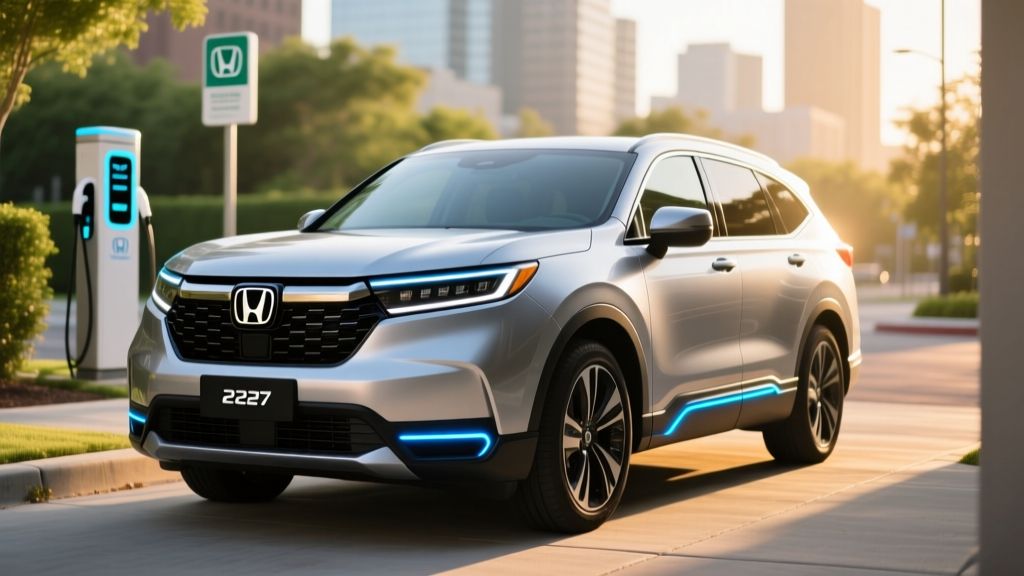
Honda's three-row SUV lineup has never offered a hybrid powertrain in the United States — a gap that grows more conspicuous as the Toyota Highlander Hybrid, Kia Sorento Hybrid, and Mazda CX-90 PHEV rack up strong sales. That could change with the 2027 Honda Pilot Hybrid, a model Honda has not yet officially confirmed but that industry signals and Honda's own electrification roadmap suggest is under development.
Because this vehicle is announced/expected but not yet on sale, every spec in this guide is based on Honda's existing hybrid architecture, supply-chain reporting, and competitive positioning. We'll update this page the moment Honda releases official figures. Until then, here's the most data-informed projection available.
HEV vs PHEV: Which Pilot Hybrid Is Coming?
The first question buyers ask is whether the Pilot Hybrid will be a conventional hybrid (HEV) you never plug in, or a plug-in hybrid (PHEV) with meaningful electric-only range. Honda's current US strategy points to both being plausible, but the conventional HEV is the more likely launch variant.
| Feature | Conventional Hybrid (HEV) | Plug-In Hybrid (PHEV) |
|---|---|---|
| Plug-in charging required? | No — regenerative braking recharges | Yes — for electric-only range |
| Battery size (typical) | 1.0–2.0 kWh | 15–20 kWh |
| Electric-only range | < 1 mile (motor assist only) | 30–45 miles (projected) |
| Federal tax credit (§30D) | Not eligible | Up to $7,500 if sourcing rules met |
| Price premium over gas model | ~$1,500–$2,500 | ~$5,000–$8,000 |
| Best for | Drivers without home charging | Drivers with home L2 + short commutes |
Honda's two-motor hybrid system — currently deployed in the CR-V Hybrid and Accord Hybrid — is a proven, cost-effective architecture that slots easily into the Pilot's platform. A PHEV variant would require a larger battery pack and onboard charger, adding weight and cost that Honda may reserve for a later model year or a different nameplate.
Projected Powertrain & Performance Specs
Honda's most capable two-motor hybrid system pairs a 2.0-liter Atkinson-cycle inline-four with dual electric motors. In the Accord Hybrid, this setup produces 204 hp. For a 4,500-pound three-row SUV, Honda would likely deploy a tuned variant — potentially the same system used in the Chinese-market Honda Elysion, or an evolution of it.
| Specification | 2027 Pilot Hybrid (Projected HEV) | 2026 Pilot Gas (Actual) |
|---|---|---|
| Engine | 2.0L Atkinson I-4 + dual motors | 3.5L V6 |
| Combined horsepower | ~204–240 hp (est.) | 285 hp |
| Transmission | e-CVT (direct-drive) | 10-speed automatic |
| Drivetrain | AWD (torque-vectoring rear motor) | FWD or AWD |
| 0–60 mph | ~7.5–8.0 sec (est.) | 6.5 sec |
| Towing capacity | ~3,500 lb (est.) | 5,000 lb |
| Battery (traction) | ~1.5–2.0 kWh lithium-ion | N/A |
The trade-off is clear: the hybrid sacrifices some peak horsepower and towing capacity in exchange for dramatically better fuel economy, particularly in city and stop-and-go driving where electric motors do the heavy lifting.
Fuel Economy: Projected MPG & Real-World Expectations
This is the headline number. The current gas-only 2026 Honda Pilot AWD achieves an EPA-rated 21 MPG combined (19 city / 25 highway), per fueleconomy.gov. A hybrid powertrain should deliver a substantial improvement.
| Model | City MPG | Highway MPG | Combined MPG |
|---|---|---|---|
| 2026 Pilot AWD (gas, actual EPA) | 19 | 25 | 21 |
| 2027 Pilot Hybrid AWD (projected) | ~28–30 | ~27–29 | ~28–29 |
| Toyota Highlander Hybrid AWD (actual EPA) | 35 | 35 | 35 |
| Kia Sorento Hybrid AWD (actual EPA) | 34 | 31 | 32 |
Real-world MPG reality check: Honda's two-motor hybrids tend to meet or slightly exceed their EPA city estimates in real-world driving, because regenerative braking recovers more energy in stop-and-go traffic than the test cycle captures. Highway MPG, however, can drop 2–4 MPG below the sticker at sustained 75+ mph speeds, where aerodynamic drag dominates and the engine carries more load. Expect roughly 30–32 MPG in mixed suburban driving and 25–27 MPG on long highway trips if Honda's projections hold.
Total range projection: With the Pilot's current 18.5-gallon fuel tank and a projected 28–29 MPG combined, a Pilot Hybrid could deliver 515–535 miles per tank — roughly 120–150 miles farther than the gas model. That's the difference between three and four fuel stops on a cross-country road trip.
If a PHEV Variant Arrives: Electric-Only Range & Charging
Should Honda follow the PHEV route — either at launch or as a subsequent model year addition — here's what the architecture would likely support, based on Honda's global PHEV systems and competitors in the segment:
- Battery capacity: ~17–18 kWh (lithium-ion, likely NMC chemistry for energy density)
- Electric-only range: 30–40 miles EPA (sufficient for most daily commutes)
- Combined total range: ~450–500 miles (electric + gasoline)
- Level 2 charging (240V): ~2.5–3 hours from 0–100% using a ~6.6 kW onboard charger
- DC fast charging: Unlikely — most PHEVs in this class omit DC capability to control cost and weight
- Level 1 charging (120V): ~8–10 hours (overnight from a standard outlet)
The absence of DC fast charging is standard for PHEVs. The Toyota RAV4 Prime, Kia Sorento PHEV, and Mazda CX-90 PHEV all charge exclusively on Level 1 or Level 2 AC power. For a vehicle with a sub-20 kWh battery, this is adequate — you'll charge overnight at home and rarely need public infrastructure.
Pricing, Trims & Tax Credit Eligibility
The 2026 Honda Pilot starts at $39,095 (LX FWD) and climbs to $55,095 (Elite AWD), per Honda's official pricing. A hybrid powertrain typically adds $1,500–$2,500 to a model's MSRP in Honda's current lineup (the CR-V Hybrid commands roughly $1,400 more than its gas counterpart).
| Trim (Projected) | Pilot Gas MSRP (2026) | Pilot Hybrid MSRP (Est.) |
|---|---|---|
| Sport | $42,895 | $44,500–$45,500 |
| EX-L | $46,395 | $48,000–$49,000 |
| Touring | $50,495 | $52,500–$53,500 |
| Elite | $55,095 | $57,000–$58,000 |
Federal tax credit for a Pilot PHEV (if offered): Under current IRS §30D rules (irs.gov), a plug-in hybrid Pilot could qualify for up to $7,500 — but only if all of the following are met:
- MSRP cap: SUVs must be priced at or below $80,000 (likely met by all Pilot trims)
- Buyer income cap: AGI ≤ $150K single / $300K joint filers
- Battery sourcing: Critical minerals and battery components must meet phased-in domestic-content thresholds (increasing annually through 2029)
- Point-of-sale transfer: Eligible buyers can apply the credit as a down-payment reduction at the dealer
Conventional HEV: Does not qualify for the §30D federal credit. Some states offer modest hybrid rebates — check your state energy office for current programs.
Reliability, Battery Warranty & Replacement Costs
Honda's hybrid systems have demonstrated strong reliability in the Accord Hybrid and CR-V Hybrid, both of which use variants of the same two-motor architecture the Pilot Hybrid would adopt. Honda's hybrid battery warranty is competitive with the segment:
| Coverage | Term |
|---|---|
| Hybrid battery warranty | 8 years / 100,000 miles (10 yr / 150,000 mi in CARB states) |
| Hybrid system components | 8 years / 100,000 miles |
| Powertrain warranty | 5 years / 60,000 miles |
| Projected battery replacement cost (out of warranty) | $2,500–$4,000 (HEV); $8,000–$12,000 (PHEV) |
Honda hybrid batteries in the Accord and Insight have demonstrated 10–15% degradation over 100,000 miles in owner-reported data — well within usable thresholds. Most hybrid batteries outlast the vehicle itself. The smaller battery in a conventional HEV is under less stress than a full EV pack, contributing to longevity.
Pilot Hybrid vs. Full EV vs. Gas: Which Fits You?
Choose the Pilot Hybrid (HEV) if:
- You want better fuel economy without changing your driving or charging habits
- You lack access to home or workplace charging
- You regularly take long road trips and don't want to plan around charging stops
- You tow occasionally (hybrid towing is reduced but not eliminated)
Choose a Pilot PHEV (if offered) if:
- You have Level 2 home charging and a commute under 35 miles
- You want to drive mostly on electricity weekdays but need gas flexibility for weekends
- You qualify for the §30D federal tax credit (income + sourcing rules)
Choose a full EV (e.g., Kia EV9, Tesla Model X) if:
- You have reliable home charging and want the lowest per-mile fuel cost
- Your daily driving is under 250 miles and you're comfortable with DC fast charging on road trips
- You want maximum federal and state incentives and zero tailpipe emissions
Stick with the gas Pilot if:
- You need maximum towing capacity (5,000 lb) and lowest upfront price
- You drive primarily highway miles where hybrid advantages shrink
- You plan to keep the vehicle under 5 years and want to minimize initial cost
Projected Pros
- ~30% fuel economy improvement over gas Pilot
- Smooth, quiet electric motor assist at low speeds
- No charging infrastructure required (HEV)
- Honda's proven hybrid reliability record
- Three-row seating and cargo versatility retained
Projected Cons
- Reduced towing capacity vs gas V6 (~3,500 vs 5,000 lb)
- Higher upfront cost ($1,500–$2,500 premium)
- No federal tax credit for conventional HEV
- Slower 0–60 time than the current V6
- Not yet officially confirmed by Honda
Frequently Asked Questions
How many MPG does the 2027 Honda Pilot Hybrid get?
Official EPA numbers are not yet available. Based on Honda's hybrid architecture and the Pilot's size and weight, we project approximately 28–29 MPG combined (roughly 28–30 city / 27–29 highway) for an AWD HEV variant. Real-world city driving may exceed the EPA estimate thanks to regenerative braking; highway driving at 75+ mph may return 2–4 MPG less.
Will the 2027 Pilot Hybrid be a plug-in (PHEV) or a regular hybrid (HEV)?
Honda has not confirmed either variant. Industry analysis suggests a conventional HEV is more likely for the initial launch, given Honda's current US hybrid strategy and the cost/complexity of a PHEV powertrain. A PHEV variant could follow in a subsequent model year if demand and regulatory pressure warrant it.
Does the Honda Pilot Hybrid qualify for a federal tax credit?
A conventional hybrid (HEV) does not qualify for the IRS §30D clean vehicle credit. Only a plug-in hybrid (PHEV) with sufficient battery capacity could qualify — and only if it meets current battery-sourcing, MSRP ($80,000 SUV cap), and buyer income requirements. Consult irs.gov or a tax professional for your specific eligibility.
Is the Honda hybrid system reliable? What does battery replacement cost?
Honda's two-motor hybrid system has a strong reliability record in the Accord Hybrid and CR-V Hybrid. The hybrid battery is warrantied for 8 years/100,000 miles (10 years/150,000 miles in CARB states). Out-of-warranty replacement for a conventional hybrid battery is projected at $2,500–$4,000. Most hybrid batteries show minimal degradation (10–15%) over 100,000+ miles and rarely need replacement within the vehicle's lifespan.
How does the Pilot Hybrid compare to the Toyota Highlander Hybrid?
The Highlander Hybrid is the segment benchmark at 35 MPG combined EPA — likely 6–7 MPG higher than our Pilot Hybrid projection. However, the Pilot offers a more spacious third row, greater cargo volume behind the third row, and Honda's driving dynamics. The trade-off is fuel economy versus interior space and ride quality. If maximum MPG is your priority, the Highlander Hybrid wins. If three-row usability matters more, the Pilot Hybrid has the edge.
When will the 2027 Honda Pilot Hybrid be available?
Honda has not announced an official release date. Based on typical model-year cadence and supply-chain lead times, a reveal could come in late 2026 with deliveries beginning in early-to-mid 2027. We'll update this article as soon as Honda provides confirmed details.