The 2026 Toyota Hybrid SUV Lineup at a Glance
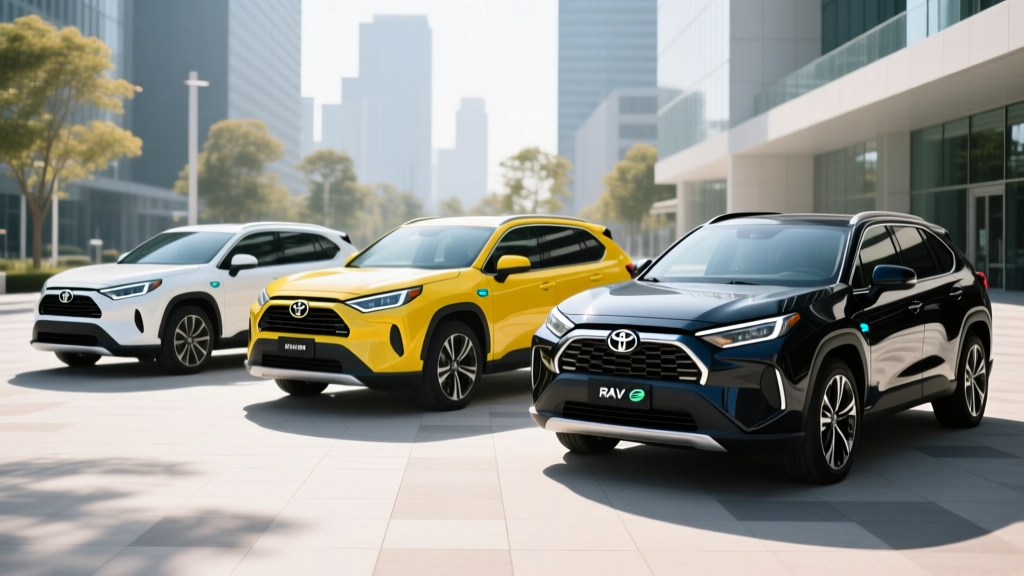
Toyota sells more hybrid SUVs in the United States than any other automaker, and the 2026 model year brings incremental but meaningful updates across the range. If you are researching a Toyota hybrid SUV 2026 model year, you are looking at a lineup that spans the compact RAV4 Hybrid, the midsize Highlander Hybrid, the wagon-style Crown Signia, and the RAV4 Prime plug-in hybrid. Each occupies a distinct niche in terms of size, efficiency, and powertrain architecture.
Before we get into the numbers, one clarification matters: Toyota offers both conventional hybrids (HEVs) and plug-in hybrids (PHEVs). They are not the same thing, and confusing them is the single most common mistake shoppers make. Here is the core difference.
HEV vs. PHEV: What Toyota Buyers Need to Know
| Feature | Conventional Hybrid (HEV) | Plug-in Hybrid (PHEV) |
|---|---|---|
| Plugs in to charge? | No — regenerative braking and engine charge the battery | Yes — has a charge port for Level 1/Level 2 |
| Electric-only driving | Very limited (low-speed, short distance) | Substantial EV range before engine engages |
| Battery size | ~1.0–1.6 kWh (small buffer) | ~18–19 kWh usable |
| Federal tax credit | No — not eligible under §30D | May qualify for up to $7,500 (subject to sourcing/income rules) |
| Ideal for | Drivers who want better MPG without changing habits | Drivers with home/workplace charging who want daily electric commuting |
In the 2026 Toyota SUV lineup, the RAV4 Hybrid, Highlander Hybrid, and Crown Signia are conventional HEVs. The RAV4 Prime is the sole PHEV. Let's look at the numbers.
EPA Fuel Economy: Every 2026 Toyota Hybrid SUV
Toyota publishes EPA-estimated fuel economy for every trim, and because hybrid powertrains recapture energy during braking and low-speed driving, city MPG often exceeds highway MPG — the opposite of a gas-only vehicle. Here is the full breakdown.
| Model | Powertrain | City MPG | Highway MPG | Combined MPG | Combined MPGe (PHEV) |
|---|---|---|---|---|---|
| RAV4 Hybrid (AWD) | 2.5L 4-cyl + 2 motors | 41 | 38 | 39 | — |
| RAV4 Prime (PHEV, AWD) | 2.5L 4-cyl + 2 motors | 40 (hybrid mode) | 36 (hybrid mode) | 38 (hybrid mode) | 94 MPGe |
| Highlander Hybrid (AWD) | 2.5L 4-cyl + 2 motors | 35 | 35 | 35 | — |
| Crown Signia (AWD) | 2.5L 4-cyl + 2 motors | 39 | 37 | 38 | — |
Source: fueleconomy.gov — EPA estimates. Your actual results will vary with driving style, terrain, temperature, and tire condition.
Real-World MPG vs. EPA Sticker
Toyota's hybrid system is one of the most proven on the market, and real-world results tend to track closely with EPA estimates — sometimes exceeding them in stop-and-go city traffic where regenerative braking does the most work. On the highway, where the engine runs more continuously and aero drag dominates, expect highway numbers to land within 1–3 MPG of the EPA sticker.
In colder climates (below 30°F), hybrid fuel economy drops roughly 10–15% due to engine warm-up cycles running longer and battery efficiency decreasing. This is true for every hybrid on the market, not just Toyota. If your commute is mostly short trips in winter, plan for the lower end of the range.
RAV4 Prime: The Plug-in Hybrid Option
For buyers specifically interested in electric-only commuting without fully committing to a BEV, the RAV4 Prime is the standout in Toyota's SUV lineup. It pairs a larger traction battery with more powerful electric motors than the standard RAV4 Hybrid.
| Spec | 2026 RAV4 Prime |
|---|---|
| EPA electric-only range | 42 miles |
| Total combined range (EV + gas) | ~600 miles |
| Battery capacity (usable) | ~18.1 kWh (lithium-ion) |
| Combined horsepower | 302 hp |
| 0–60 mph | 5.7 seconds |
| Level 1 charging (120V) | ~12 hours (0–100%) |
| Level 2 charging (240V, 3.3 kW) | ~4.5 hours (0–100%) |
| DC fast charging | Not available |
| Drivetrain | AWD (electronic rear motor) |
A critical note on charging: the RAV4 Prime does not support DC fast charging. This is typical for PHEVs in this class. You will charge at home on Level 1 or Level 2, or at workplace chargers. If you need rapid top-ups on road trips, a full BEV with DC fast-charge capability is a better fit. The RAV4 Prime is designed around the premise that you charge overnight and drive electric for your daily commute, then rely on the hybrid powertrain for longer trips.
With 42 miles of electric-only range, the RAV4 Prime covers the average American commute (roughly 16 miles each way per the U.S. Census Bureau) entirely on electricity, with substantial buffer remaining. Once the battery depletes, it operates as a conventional hybrid at 38 MPG combined — no range anxiety, no behavioral change required.
Powertrain and Performance Specs
All 2026 Toyota hybrid SUVs use variants of Toyota's fourth-generation hybrid system built around a 2.5-liter Dynamic Force inline-four engine. The system pairs the engine with one or two electric motor-generators and an electronically controlled continuously variable transmission (eCVT). AWD models add a separate rear electric motor — there is no mechanical driveshaft to the rear wheels.
| Model | Engine | Combined HP | 0–60 mph | Towing Capacity |
|---|---|---|---|---|
| RAV4 Hybrid | 2.5L I4 + e-motors | 219 hp | 7.4 sec | 1,750 lbs |
| RAV4 Prime | 2.5L I4 + e-motors | 302 hp | 5.7 sec | 1,500 lbs |
| Highlander Hybrid | 2.5L I4 + e-motors | 243 hp | 7.9 sec | 3,500 lbs |
| Crown Signia | 2.5L I4 + e-motors | 240 hp | 7.1 sec | 1,200 lbs |
The RAV4 Prime's 302 hp makes it the quickest RAV4 Toyota has ever sold, and its 5.7-second 0–60 time rivals many sport compacts. The standard RAV4 Hybrid at 219 hp is adequate for daily driving and highway merging, though it is not a performance vehicle. The Highlander Hybrid moves its larger, heavier body competently, and its 3,500-lb tow rating is best-in-class for a hybrid three-row SUV.
Pricing and Federal Tax Credit Eligibility
Toyota's hybrid SUVs carry a price premium over their gas-only counterparts, typically $1,500–$2,500 at the trim level. That premium is usually recovered through fuel savings within 3–5 years for most drivers, depending on annual mileage and local gas prices.
| Model | Base MSRP (approx.) | Federal Tax Credit (§30D) |
|---|---|---|
| RAV4 Hybrid LE | $34,425 | Not eligible (HEV) |
| RAV4 Prime SE | $46,000 | Up to $7,500 (see rules below) |
| Highlander Hybrid LE | $43,970 | Not eligible (HEV) |
| Crown Signia XLE | $45,990 | Not eligible (HEV) |
MSRP figures are approximate for 2026 model year base trims including destination. Verify with your dealer and Toyota's official configurator.
Does the RAV4 Prime Qualify for the Federal Tax Credit?
The RAV4 Prime is a PHEV and may qualify for the federal clean vehicle credit under IRS §30D, which offers up to $7,500. However, eligibility depends on several conditions that change periodically:
- MSRP cap: SUVs must have an MSRP at or below $80,000. The RAV4 Prime clears this easily.
- Buyer income cap: Modified adjusted gross income must not exceed $150,000 (single), $225,000 (head of household), or $300,000 (joint).
- Battery sourcing: A percentage of critical minerals and battery components must be sourced from the U.S. or free-trade-agreement countries. These thresholds increase annually and can disqualify otherwise eligible vehicles mid-year.
- Point-of-sale transfer: As of 2024, buyers can transfer the credit to the dealer for an immediate price reduction at purchase, rather than waiting to claim it on their tax return.
Because battery-sourcing rules tighten each year, a vehicle that qualifies in January may not qualify in July. Always verify current eligibility on fueleconomy.gov or with a tax professional before purchasing.
The conventional hybrids (RAV4 Hybrid, Highlander Hybrid, Crown Signia) are not eligible for the §30D federal credit. Some states offer their own hybrid incentives, but these vary widely — check your state's energy office or DMV for specifics.
Reliability, Battery Warranty, and Replacement Costs
Toyota's hybrid system is arguably the most battle-tested in the automotive industry, with over 25 years of continuous production since the original Prius. The eCVT has no traditional gears or clutch packs to wear out, and the hybrid battery operates within a narrow state-of-charge window that minimizes degradation.
Toyota Hybrid Battery Warranty
All 2026 Toyota hybrid and PHEV models carry a hybrid battery warranty of 10 years or 150,000 miles, whichever comes first. This covers the high-voltage traction battery against defects and excessive capacity loss. The hybrid system components (inverter, eCVT, motor-generators) are covered for 8 years or 100,000 miles.
How Long Do Toyota Hybrid Batteries Actually Last?
Real-world data from fleet operators and long-term owners suggests Toyota hybrid batteries routinely exceed 150,000 miles before significant degradation. Many first-generation Prius taxis ran past 300,000 miles on the original battery. The PHEV battery in the RAV4 Prime is larger and operates under similar conservative management, though long-term data is younger (the Prime launched for the 2021 model year).
Battery Replacement Cost
If a hybrid battery does need replacement outside warranty, expect to pay between $2,000 and $4,500 for a conventional Toyota hybrid battery (RAV4 Hybrid, Highlander Hybrid) including labor at a dealership. The RAV4 Prime's larger PHEV battery is more expensive — roughly $6,000 to $8,500 — reflecting its higher capacity. Third-party rebuilt or refurbished batteries can reduce these costs by 30–40%.
For context, the average driver puts 14,000 miles on a vehicle per year. The hybrid battery warranty covers you for over 10 years of typical use, and the likelihood of needing an out-of-pocket replacement during that period is low based on Toyota's historical failure rates.
Hybrid vs. PHEV vs. Full EV: Which Fits You?
Choosing between a Toyota hybrid, the RAV4 Prime PHEV, and a full battery-electric vehicle depends on your driving patterns, charging access, and comfort with behavioral change. Here is a practical framework.
Decision Framework
Choose a Toyota HEV (RAV4 Hybrid, Highlander Hybrid, Crown Signia) if:
- You cannot charge at home or work (apartment, street parking, no garage)
- You want maximum fuel efficiency with zero change to your routine
- You regularly take long road trips and don't want to plan around charging
- You want the lowest upfront cost among electrified options
Choose the RAV4 Prime PHEV if:
- You have Level 1 or Level 2 charging at home or work
- Your daily round-trip commute is under ~40 miles
- You want electric driving most days but gas flexibility for road trips
- You want to claim the federal tax credit (if eligible)
Choose a full BEV (e.g., Tesla Model Y, Hyundai Ioniq 5, Toyota bZ4X) if:
- You have reliable home Level 2 charging
- You want zero tailpipe emissions and the lowest per-mile energy cost
- You are comfortable planning longer road trips around DC fast charging
- You want the maximum federal tax credit and lowest operating cost
For many buyers, the Toyota HEV is the pragmatic sweet spot: no infrastructure investment, proven reliability, and a meaningful MPG improvement over gas-only SUVs. The RAV4 Prime is ideal for households that can charge nightly and want to eliminate gas use on most daily driving while keeping the option to drive 600+ miles without stopping. Full EVs make the most financial sense for high-mileage drivers with home charging, where the per-mile electricity cost (often $0.04–$0.06/mile) dramatically undercuts gasoline ($0.12–$0.18/mile at current prices).
Pros and Cons of the 2026 Toyota Hybrid SUV Lineup
Pros
- Best-in-class reliability track record for hybrid powertrains
- 41 MPG city (RAV4 Hybrid) — class-leading for a compact SUV
- RAV4 Prime offers 42 mi EV range + 302 hp — best of both worlds
- 10-year/150,000-mi hybrid battery warranty
- No charging infrastructure needed for HEV models
- Strong resale value — Toyota hybrids depreciate slower than most competitors
- Highlander Hybrid is the only 3-row hybrid SUV with 3,500-lb tow rating
Cons
- RAV4 Prime is expensive ($46K+ base) and often has dealer markups
- No DC fast charging on the RAV4 Prime
- eCVT drone under hard acceleration — not a sporty driving feel
- HEV models don't qualify for federal tax credit
- Highlander Hybrid's 35 MPG is good but not exceptional for its size
- Crown Signia's 1,200-lb tow rating limits utility
- Infotainment system lags behind competitors in responsiveness
Frequently Asked Questions
How many MPG does a 2026 Toyota RAV4 Hybrid get?
The 2026 RAV4 Hybrid with AWD is EPA-rated at 41 city / 38 highway / 39 combined MPG. Real-world results typically land within 1–3 MPG of these figures, with city driving sometimes exceeding the EPA estimate due to regenerative braking. Expect a slight drop (10–15%) in sustained cold weather below 30°F.
How far can the RAV4 Prime go on electric only?
The RAV4 Prime is EPA-rated for 42 miles of electric-only range on a full charge. This covers most daily commutes entirely on electricity. After the battery depletes, it switches seamlessly to hybrid mode at 38 MPG combined, giving a total range of approximately 600 miles.
Is the Toyota hybrid system reliable? What does a battery replacement cost?
Toyota's hybrid system has over 25 years of production history and is widely regarded as the most reliable hybrid powertrain on the market. The hybrid battery is warranted for 10 years/150,000 miles. Out-of-warranty replacement costs range from $2,000–$4,500 for conventional hybrids and $6,000–$8,500 for the RAV4 Prime's larger PHEV battery. Most batteries exceed the warranty period without issue.
Does any 2026 Toyota hybrid SUV qualify for the federal tax credit?
Only the RAV4 Prime (PHEV) may qualify for the federal §30D clean vehicle credit of up to $7,500. Conventional hybrids do not qualify. Eligibility depends on buyer income, MSRP, and battery-sourcing requirements that change annually. Verify current status on fueleconomy.gov before purchasing.
Do I need to plug in a Toyota hybrid?
No. The RAV4 Hybrid, Highlander Hybrid, and Crown Signia are conventional hybrids — they charge their own small battery through regenerative braking and the engine. You never plug them in. Only the RAV4 Prime (PHEV) has a charge port and benefits from plugging in, though it will still operate as a hybrid if you never plug it in.
Which 2026 Toyota hybrid SUV is best for towing?
The Highlander Hybrid offers the highest tow rating at 3,500 lbs, suitable for a small boat trailer or lightweight camper. The RAV4 Hybrid tows up to 1,750 lbs, and the Crown Signia is rated for 1,200 lbs. If you need to tow more than 3,500 lbs, you will need to look outside the hybrid SUV segment.
How does the RAV4 Prime charge without DC fast charging?
The RAV4 Prime charges via Level 1 (standard 120V outlet, ~12 hours for a full charge) or Level 2 (240V, ~4.5 hours at 3.3 kW). It does not have a DC fast-charge port. This is standard for PHEVs in this class — the battery is small enough that overnight Level 1 or Level 2 charging is sufficient for daily use.