Quick Verdict: The 2026 CR-V Hybrid at a Glance
The 2026 Honda CR-V Hybrid remains one of the most practical compact SUVs for buyers who want electrified efficiency without plugging in. Honda's two-motor hybrid system delivers an EPA-estimated 40 MPG combined, 204 combined horsepower, and a starting MSRP around $36,000. For 2026, Honda refreshes the color palette and adds minor tech updates, but the core value proposition is unchanged: real-world fuel savings, Honda reliability, and no range anxiety.
2026 Honda CR-V Hybrid Color Options by Trim
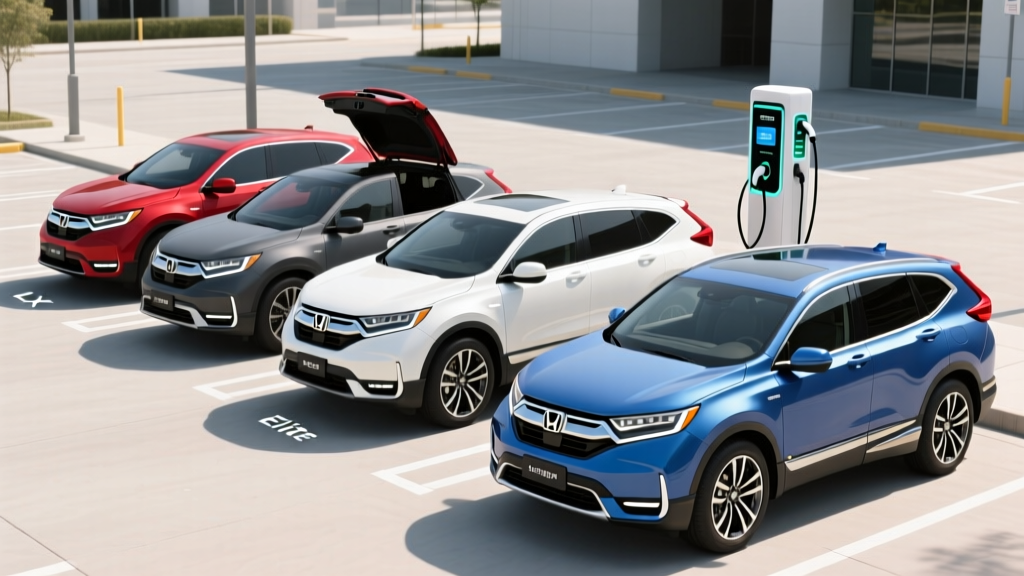
For 2026, Honda offers the CR-V Hybrid across Sport, Sport-L, and Sport Touring trims, each with a distinct color lineup. Here's the full exterior color breakdown:
| Color Name | Sport | Sport-L | Sport Touring |
|---|---|---|---|
| Crystal Black Pearl | ✓ | ✓ | ✓ |
| Platinum White Pearl | ✓ | ✓ | ✓ |
| Meteorite Gray Metallic | ✓ | ✓ | ✓ |
| Canyon River Blue Metallic | ✓ | ✓ | ✓ |
| Urban Gray Pearl | ✓ | ✓ | — |
| Radiant Red Metallic | — | ✓ | ✓ |
| Still Night Pearl (new for 2026) | — | — | ✓ |
Color notes: Platinum White Pearl and Radiant Red Metallic typically carry a $395 premium as pearl/metallic finishes. Still Night Pearl is a dark blue-black exclusive to the Sport Touring trim for 2026, replacing the outgoing Deep Scarlet Pearl. All trims come with a black or gray interior depending on exterior color choice.
Fuel Economy: EPA Ratings vs. Real-World MPG
| Drivetrain | City MPG | Highway MPG | Combined MPG |
|---|---|---|---|
| FWD (Sport) | 43 | 36 | 40 |
| AWD (Sport, Sport-L, Sport Touring) | 40 | 34 | 37 |
Source: EPA Fuel Economy
Powertrain: How the CR-V Hybrid System Works
The 2026 CR-V Hybrid uses Honda's fourth-generation two-motor hybrid system, which is a conventional hybrid (HEV) — not a plug-in hybrid. This is an important distinction: you never plug it in. The system captures energy through regenerative braking and the gasoline engine to charge a small lithium-ion battery pack.
| Component | Specification |
|---|---|
| Engine | 2.0L DOHC Atkinson-cycle 4-cylinder |
| Engine Output | 145 hp @ 6,100 rpm / 138 lb-ft torque |
| Electric Motors | Two-motor system (drive + generator) |
| Drive Motor Output | 181 hp / 247 lb-ft torque |
| Combined System Output | 204 hp / 247 lb-ft torque |
| Transmission | e-CVT (no traditional gears) |
| Hybrid Battery | ~1.06 kWh lithium-ion (not plug-in capable) |
| Drivetrain | FWD standard; Real Time AWD available |
| 0-60 MPH | ~7.6 seconds (AWD) |
| Towing Capacity | 1,000 lbs |
How it drives: The CR-V Hybrid operates primarily on electric power at low speeds and during gentle acceleration, with the gasoline engine acting as a generator. At highway speeds or under heavy load, the engine directly drives the wheels through a lock-up clutch. The transition between modes is seamless — most drivers won't notice when the engine engages. The 247 lb-ft of electric torque provides responsive off-the-line acceleration that makes the hybrid feel quicker than its 0-60 time suggests.
HEV vs. PHEV vs. EV: Which Powertrain Fits You?
Conventional Hybrid (HEV) — The CR-V Hybrid
No plug required. You fuel it like a normal gas car and the hybrid system reduces fuel consumption by 30-40% compared to a non-hybrid equivalent. Best for: drivers without home charging access, those who take frequent long road trips, and buyers who want simplicity. The CR-V Hybrid is this type.
Plug-In Hybrid (PHEV) — Not Available for CR-V
Plugs in for 25-40 miles of electric-only range, then operates as a conventional hybrid once the battery depletes. Requires home Level 2 charging to maximize value. Honda does not currently offer a CR-V PHEV in the US market. If you want a Honda PHEV, the Clarity was discontinued; look to competitors like the Toyota RAV4 Prime (42 mi electric range) or Hyundai Tucson PHEV (33 mi).
Battery Electric Vehicle (BEV) — Fully Electric
No gasoline at all. 250-350+ miles of range, requires regular charging at home or public stations. Best for: drivers with reliable home charging, shorter daily commutes, and those wanting minimal maintenance and zero tailpipe emissions. Examples: Tesla Model Y, Hyundai Ioniq 5, Ford Mustang Mach-E.
→ Choose the CR-V Hybrid (HEV) if you lack home charging, drive 200+ miles in a single trip regularly, or want the lowest purchase price among electrified SUVs.
→ Choose a PHEV if you have home charging, commute under 35 miles daily, and still want gas-engine flexibility for road trips.
→ Choose a BEV if you have home charging, want the lowest per-mile fuel cost, and your daily driving stays within ~250 miles.
Pricing, Trims & Tax Credit Eligibility
| Trim | Drivetrain | MSRP (est.) |
|---|---|---|
| Sport | FWD | $36,050 |
| Sport | AWD | $37,550 |
| Sport-L | AWD | $39,850 |
| Sport Touring | AWD | $43,350 |
Reliability, Battery Warranty & Replacement Costs
Hybrid Battery Warranty
Honda covers the CR-V Hybrid's lithium-ion battery pack with an 8-year/100,000-mile warranty (10 years/150,000 miles in California and states that follow CARB emissions standards). This warranty covers defects and capacity loss below a defined threshold — typically 60-70% of original capacity.
Battery Lifespan & Replacement Cost
Honda's hybrid battery systems have proven highly durable. Based on long-term data from previous-generation CR-V Hybrids and Accord Hybrids, the lithium-ion pack is designed to last the vehicle's lifetime under normal use. Most hybrid batteries retain 85-90% capacity after 150,000 miles. Should replacement be needed out of warranty, expect a cost of $2,000-$4,000 for the battery pack plus labor — significantly less than a full EV battery replacement. Individual module replacement may be possible at lower cost.
Overall Reliability
Honda's hybrid powertrain carries an excellent reliability record. The e-CVT transmission has no traditional gears, belts, or clutches to wear out, reducing long-term maintenance. The 2.0L Atkinson-cycle engine runs under less stress than a turbocharged engine, contributing to longevity. The CR-V consistently earns top marks from IIHS and NHTSA.
Pros, Cons & Ownership Costs
✓ Pros
- 40 MPG combined (FWD) — class-leading for the segment
- 204 hp provides confident merging and passing power
- No plug-in charging needed — refuel at any gas station
- Strong reliability history and 8-yr/100k battery warranty
- Spacious cargo area: 36.3 cu ft behind rear seats
- Standard Honda Sensing ADAS suite (adaptive cruise, lane-keep, AEB)
- Smooth, quiet hybrid operation in city driving
✗ Cons
- No federal tax credit eligibility (HEV, not PHEV/BEV)
- AWD fuel economy drops to 37 MPG combined
- 1,000-lb towing capacity — less than some turbo competitors
- No plug-in hybrid option in Honda's US lineup
- Engine noise becomes noticeable under hard acceleration
- Base Sport trim lacks leather and premium audio
- Slightly higher MSRP than gas-only CR-V trims
Frequently Asked Questions
How many MPG does the 2026 Honda CR-V Hybrid get?
The EPA rates the FWD CR-V Hybrid at 43 city / 36 highway / 40 combined MPG. AWD models get 40 city / 34 highway / 37 combined. Real-world city driving often exceeds EPA estimates by 2-5 MPG thanks to regenerative braking efficiency.
Does the CR-V Hybrid need to be plugged in?
No. The CR-V Hybrid is a conventional hybrid (HEV). It charges its small battery through regenerative braking and the gasoline engine. You simply fill it with regular unleaded gasoline like any other car.
Is there a plug-in hybrid (PHEV) version of the CR-V?
Not in the United States. Honda has offered a CR-V e:PHEV in China and Japan, but it is not available in the US market as of 2026. If you need a compact PHEV SUV, the Toyota RAV4 Prime, Hyundai Tucson PHEV, and Kia Sportage PHEV are the closest alternatives.
What is the hybrid battery replacement cost?
Out-of-warranty replacement runs approximately $2,000-$4,000 including labor. However, Honda hybrid batteries rarely need replacement before 200,000+ miles based on historical data, and the 8-year/100,000-mile warranty provides strong coverage.
Does the 2026 CR-V Hybrid qualify for any tax credit?
It does not qualify for the federal §30D clean vehicle credit, which requires plug-in capability and a battery of at least 7 kWh. Some states and local utilities offer small rebates for hybrid purchases — check your state's energy office for current programs.
What colors are new for 2026?
Still Night Pearl is the notable new color for 2026, exclusive to the Sport Touring trim. It replaces Deep Scarlet Pearl. All other carryover colors remain available across their respective trims.
How does the CR-V Hybrid compare to the Toyota RAV4 Hybrid?
The RAV4 Hybrid is rated at 41 MPG combined (AWD standard) vs. the CR-V's 37 MPG combined with AWD. However, the CR-V offers slightly more cargo space, a more refined interior, and 204 hp vs. the RAV4's 219 hp. Both are excellent choices — the Toyota edges on efficiency, the Honda on refinement and interior quality.