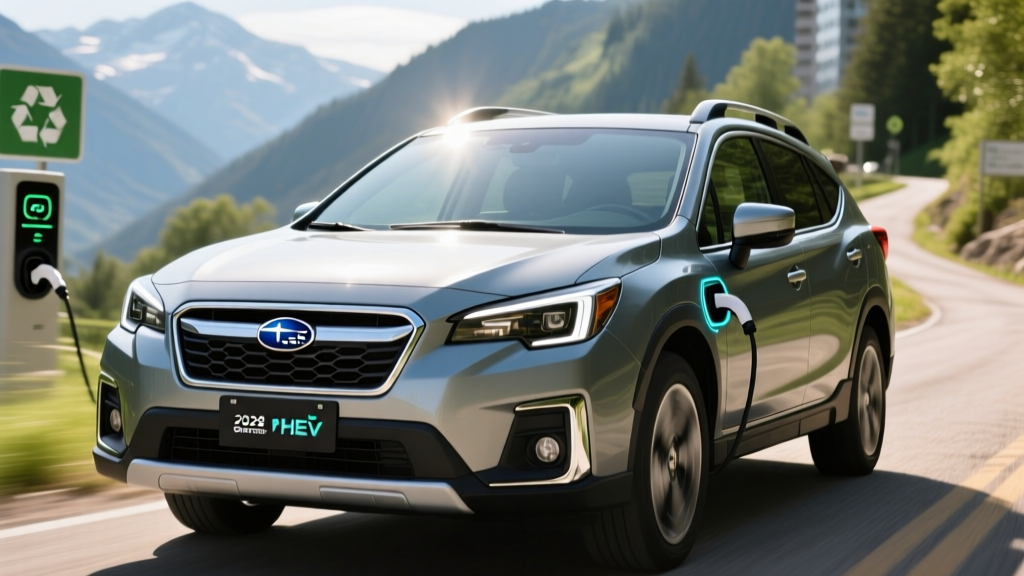
If you've been searching for a Subaru with electrified powertrain credentials, the answer requires some nuance. Subaru's hybrid strategy in 2026 centers on one key model: the Crosstrek Hybrid, which is specifically a plug-in hybrid electric vehicle (PHEV). The brand previously offered a mild-hybrid version of the Forester and Crosstrek, but those conventional hybrid (HEV) variants were discontinued after the 2023 model year. Today, if you want a Subaru hybrid, you're looking at the Crosstrek PHEV — and it's a very specific type of electrified vehicle with distinct advantages and limitations.
Subaru's Hybrid Lineup: HEV vs PHEV Explained
Before diving into specs, it's critical to understand the difference between the two hybrid types Subaru has offered, because they serve very different use cases.
Conventional Hybrid (HEV) — Discontinued
- How it works: A small battery (typically under 1 kWh) recharges through regenerative braking and the gas engine. You never plug it in.
- Electric-only driving: Minimal — only brief low-speed assist, not sustained EV mode.
- Fuel economy benefit: Modest, typically 2-5 MPG improvement over the gas model.
- Subaru's HEV history: The Crosstrek Hybrid (HEV) and Forester Hybrid were sold through 2023, using Toyota-sourced hybrid systems. Neither is available new for 2026.
Plug-in Hybrid (PHEV) — Currently Available
- How it works: A larger battery (8.8 kWh usable in the Crosstrek) can be charged from a wall outlet or public charger. You can drive on electricity alone for a meaningful distance before the gas engine kicks in.
- Electric-only driving: Yes — EPA-rated 17 miles on battery alone.
- Fuel economy benefit: Major, if you charge regularly. Gas engine operates as a highly efficient hybrid once the battery is depleted.
- Current model: 2026 Subaru Crosstrek Hybrid (PHEV), built on the same Toyota-derived plug-in system.
The distinction matters enormously for buyers. A conventional hybrid requires zero behavior change — you just drive and it saves fuel. A PHEV rewards you heavily if you charge it regularly, but if you never plug in, you're just carrying around dead battery weight and getting marginally worse fuel economy than a standard HEV would deliver.
2026 Subaru Crosstrek Hybrid: Full Specifications
| Specification | 2026 Subaru Crosstrek Hybrid (PHEV) |
|---|---|
| Powertrain | 2.0L flat-4 engine + 2 electric motors (Toyota-derived THS II) |
| Combined Horsepower | 148 hp (net system output) |
| Engine Output | 137 hp @ 5,200 rpm / 134 lb-ft torque |
| Electric Motor Output | MG1: 31 kW (generator) / MG2: 88 kW (drive motor) |
| Battery Capacity | 8.8 kWh usable (lithium-ion, NMC chemistry) |
| EPA Electric-Only Range | 17 miles |
| EPA Total Range (EV + Gas) | 440 miles |
| EPA MPGe (EV Mode) | 90 MPGe combined |
| EPA MPG (Hybrid Mode, Battery Depleted) | 35 combined / 34 city / 36 highway |
| Drivetrain | Symmetrical AWD (standard) |
| Level 1 Charging (120V) | ~5 hours (0–100%) |
| Level 2 Charging (240V) | ~2 hours (0–100%) |
| DC Fast Charging | Not supported |
| Charge Port | J1772 (Level 2) |
| 0–60 mph | ~8.5 seconds (estimated) |
| Cargo Volume | 19.9 cu ft (rear seats up) |
| Ground Clearance | 8.7 inches |
| Towing Capacity | 1,000 lbs |
| Base MSRP | $37,495 (before destination) |
| Battery Warranty | 8 years / 100,000 miles |
| Powertrain Warranty | 5 years / 60,000 miles |
Fuel Economy Breakdown: Real-World MPG vs EPA Sticker
| Driving Condition | EPA Rating | Real-World Expectation |
|---|---|---|
| City (Hybrid Mode) | 34 MPG | 35–38 MPG (hybrids often beat EPA in stop-and-go) |
| Highway (Hybrid Mode) | 36 MPG | 32–35 MPG (highway driving favors larger engines, less regen benefit) |
| Combined (Hybrid Mode) | 35 MPG | 33–36 MPG depending on driving mix |
| Electric-Only Mode | 90 MPGe / 17 mi range | 14–17 miles (cold weather reduces to ~11–13 miles) |
The Crosstrek Hybrid's hybrid-mode fuel economy is respectable but not class-leading. The EPA's fueleconomy.gov lists the combined 35 MPG figure, which lands a few MPG behind the Toyota RAV4 Prime (38 MPG combined in hybrid mode) and the Hyundai Tucson PHEV (35 MPG combined, but with a larger 33-mile EV range).
Where Subaru owners consistently report exceeding expectations is in city driving. Regenerative braking in stop-and-go traffic recaptures energy that would otherwise be lost, and the electric motor handles low-speed launches where gas engines are least efficient. If your commute is predominantly urban, expect to see 36–38 MPG once the battery is depleted.
The electric-only range deserves honest framing. The EPA's 17-mile rating assumes moderate temperatures and mixed driving. In winter conditions below 32°F, battery chemistry limits and cabin heating demands can reduce that to 11–13 miles. In warm weather with gentle acceleration, some owners report squeezing out 19–20 miles. For a daily commute under 15 miles round-trip, this PHEV can genuinely operate as a pure EV most days.
Charging: What You Need to Know
The Crosstrek Hybrid uses a standard J1772 connector for Level 1 (120V household outlet) and Level 2 (240V) charging. Here's the critical limitation: it does not support DC fast charging. This is common for PHEVs with smaller batteries, but it means you cannot top up quickly on a road trip.
At Level 1 (a standard 120V outlet), a full charge takes approximately 5 hours — practical for overnight charging if your daily electric-only needs are modest. At Level 2 (240V, like a home wall charger or public Level 2 station), a full charge takes about 2 hours. Given the small 8.8 kWh battery, most owners find Level 1 sufficient for overnight replenishment.
Battery Warranty & Replacement Cost
Subaru covers the Crosstrek Hybrid's high-voltage battery for 8 years or 100,000 miles (whichever comes first), with a capacity retention threshold of 70%. This is consistent with industry-standard PHEV battery warranties and is mandated in California Air Resources Board (CARB) states for 10 years/150,000 miles.
If replacement is needed out of warranty, expect a cost between $4,000 and $6,500 including labor, based on parts pricing for the Toyota-derived battery pack. However, PHEV battery failures before 150,000 miles are statistically rare — the smaller depth-of-discharge cycles in a PHEV are less stressful on cells than full BEV cycling.
Pricing, Trims & Federal Tax Credit Eligibility
The 2026 Subaru Crosstrek Hybrid starts at $37,495 before the $1,420 destination charge, bringing the effective base price to $38,915. Subaru typically offers the Hybrid in a single well-equipped trim, bundling features like EyeSight driver-assistance, heated seats, and an 8-inch infotainment screen as standard.
Regarding the federal tax credit under IRS §30D: the Crosstrek Hybrid's eligibility is complicated and depends on several factors that shift frequently. Here's the current framework:
- MSRP cap: PHEVs classified as SUVs must be under $80,000 MSRP — the Crosstrek Hybrid qualifies at ~$38,915.
- Buyer income cap: Modified adjusted gross income must not exceed $150,000 (single) or $300,000 (joint filing).
- Battery sourcing requirements: The critical minerals and battery component sourcing rules under §30D have tightened annually. As of 2026, vehicles must meet escalating domestic-content thresholds. The Crosstrek Hybrid's Toyota-sourced powertrain components face scrutiny under these rules.
- Credit amount for PHEVs: Unlike full BEVs eligible for up to $7,500, PHEVs qualify for a prorated credit based on battery capacity. The Crosstrek's 8.8 kWh battery typically qualifies for $3,750 to $4,500, not the full $7,500.
- Point-of-sale transfer: If eligible, the credit can be transferred to the dealer at purchase, reducing your out-of-pocket cost directly.
Always verify current eligibility on IRS.gov's clean vehicle credit page before purchasing, as battery-sourcing determinations change throughout the year.
Hybrid vs PHEV vs Full EV: Which Fits Your Situation?
Choose the Subaru Crosstrek Hybrid (PHEV) if:
- You can charge at home every night (Level 1 is sufficient for the small battery)
- Your daily commute is under 20 miles round-trip — you'll drive mostly on electricity
- You need AWD and 8.7 inches of ground clearance for snow, dirt roads, or outdoor recreation
- You take road trips where charging infrastructure is sparse and can't risk range anxiety
- You want to reduce fuel consumption without fully committing to a BEV
Choose a Full BEV (like the Subaru Solterra or Hyundai Ioniq 5) if:
- You have reliable home Level 2 charging and your daily driving is under 200 miles
- You want the lowest per-mile fuel cost (electricity is typically 40–60% cheaper per mile than gas)
- You want zero tailpipe emissions and minimal maintenance (no oil changes, fewer moving parts)
- You qualify for the full $7,500 federal tax credit, narrowing the price gap
Choose a Gas-Only Vehicle if:
- You cannot charge at home or at work
- Your budget is under $30,000 and you need the lowest upfront cost
- You drive over 30,000 miles per year and the hybrid premium won't pay back in fuel savings
The Crosstrek Hybrid occupies a specific niche: it's the best option for Subaru-loyal buyers who want some electrification but aren't ready to abandon the gas station entirely. The 17-mile EV range is short compared to the RAV4 Prime's 42 miles, but the Crosstrek's standard AWD, higher ground clearance, and lower starting price make it compelling for buyers in rural or snowy regions where public charging is scarce.
Reliability & Long-Term Ownership
Subaru's hybrid system benefits from its Toyota engineering roots. The THS II (Toyota Hybrid System) powertrain is one of the most proven hybrid architectures on the road, with millions of units in service globally across Prius, RAV4 Hybrid, and Camry Hybrid models. The Crosstrek Hybrid inherits this reliability pedigree.
Common long-term ownership considerations:
- Hybrid battery longevity: PHEV batteries experience shallower charge cycles than full BEVs, which typically translates to slower degradation. Expect 85–90% capacity retention at the 8-year/100,000-mile mark under normal use.
- Brake wear: Regenerative braking significantly reduces mechanical brake wear. Many hybrid owners report original brake pads lasting 80,000–100,000 miles.
- AWD system: Subaru's Symmetrical AWD is mechanically robust, but the rear motor in the hybrid system adds complexity compared to the mechanical AWD in gas Crosstreks. Subaru's AWD-related warranty claims remain low historically.
- Resale value: Subaru vehicles hold value well, and the Hybrid trim typically commands a $2,000–$3,000 premium over equivalent gas trims in the used market.
According to IIHS safety ratings, the Crosstrek platform earns top marks in crashworthiness, and the EyeSight driver-assistance suite (standard on the Hybrid) provides automatic emergency braking, lane-keep assist, and adaptive cruise control. Note that EyeSight is an SAE Level 2 system — it assists but does not replace driver attention.
Pros and Cons at a Glance
Pros
- Standard AWD with 8.7" ground clearance — best-in-class for a PHEV in this price range
- Proven Toyota-derived hybrid system with strong reliability track record
- 17-mile EV range covers most daily commutes when charged nightly
- Level 1 charging is practical — no mandatory $500–$1,200 Level 2 install
- 35 MPG combined in hybrid mode beats the gas Crosstrek's 29 MPG by 20%
- Partial federal tax credit ($3,750–$4,500) reduces effective price
- 8-year/100,000-mile battery warranty
Cons
- 17-mile EV range is the shortest among current PHEV competitors
- No DC fast charging — road trip top-ups are not possible
- 148 hp combined is adequate but not quick; 0–60 in ~8.5 seconds
- Single trim limits customization; you get one equipment package
- Cargo space (19.9 cu ft) is reduced vs gas Crosstrek due to battery placement
- Towing limited to 1,000 lbs (gas Crosstrek tows 1,500 lbs)
- Premium over gas Crosstrek (~$7,000 more) takes 5–7 years to recoup in fuel savings at average mileage
Frequently Asked Questions
Does Subaru offer a conventional hybrid (non-plug-in) in 2026?
No. Subaru discontinued its conventional hybrid (HEV) models — the Crosstrek Hybrid HEV and Forester Hybrid — after the 2023 model year. The only electrified Subaru available new in 2026 is the Crosstrek Hybrid PHEV, which requires plug-in charging to access its electric-only range. The all-electric Subaru Solterra is also available as a full BEV.
How many MPG does the Subaru Crosstrek Hybrid get?
Once the battery is depleted and the vehicle operates as a conventional hybrid, the EPA rates it at 35 MPG combined (34 city / 36 highway). In real-world city driving, many owners report 36–38 MPG thanks to regenerative braking. Highway driving typically yields 32–35 MPG. When operating on battery alone, it achieves 90 MPGe for up to 17 miles.
How far can the Crosstrek Hybrid go on electric only?
The EPA rates the Crosstrek Hybrid at 17 miles of electric-only range. In warm weather with gentle driving, expect 17–20 miles. In cold weather (below 32°F), expect 11–13 miles due to battery chemistry limitations and cabin heating demands. Total combined range (EV + gas) is 440 miles.
Does the Subaru Crosstrek Hybrid qualify for a federal tax credit?
It may qualify for a partial federal tax credit under IRS §30D, typically between $3,750 and $4,500 — not the full $7,500 available to some full BEVs. Eligibility depends on your income (under $150K single / $300K joint), the vehicle's battery component sourcing compliance, and current-year rules. Always verify on IRS.gov before purchasing.
Is the Subaru hybrid battery reliable and what does replacement cost?
The Crosstrek Hybrid's 8.8 kWh battery uses proven Toyota-derived lithium-ion cells and is warranted for 8 years / 100,000 miles (10 years / 150,000 miles in CARB states). PHEV batteries experience less stress than full BEV batteries due to shallower charge cycles. Out-of-warranty replacement costs between $4,000 and $6,500, but premature failures are uncommon based on historical Toyota hybrid system data.
Do I need to install a Level 2 home charger for the Crosstrek Hybrid?
No. The 8.8 kWh battery charges fully in about 5 hours on a standard 120V household outlet (Level 1), which is sufficient for overnight charging. A Level 2 charger (240V) reduces charge time to about 2 hours, but the added $500–$1,200 installation cost is optional for this PHEV — unlike full BEVs where Level 2 is essentially mandatory.
Hybrid vs PHEV vs EV — which Subaru should I buy?
Subaru only offers two electrified options in 2026: the Crosstrek Hybrid (PHEV) and the Solterra (full BEV). Choose the Crosstrek Hybrid if you need AWD, ground clearance, road-trip flexibility, and have home charging. Choose the Solterra if your daily driving is under 200 miles, you want the lowest per-mile cost, and you have reliable home Level 2 charging. If you can't charge at home, a gas-only Subaru remains the practical choice.