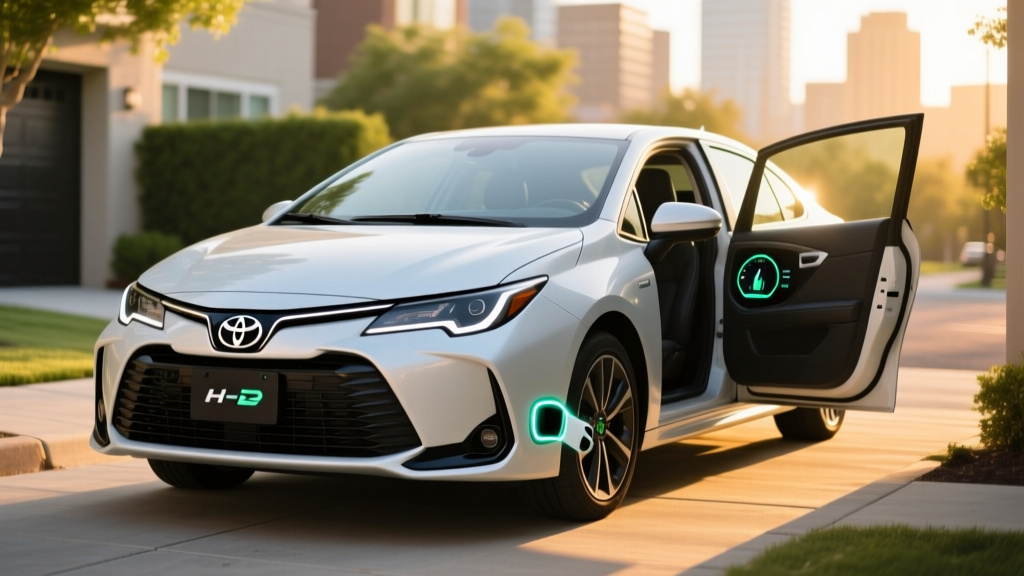
The 2019 Toyota Corolla Hybrid remains one of the most fuel-efficient sedans ever sold in the United States, and in 2026 it has become a compelling used-car option for buyers who want maximum MPG without plugging in. Built on the same platform as the Prius but wearing Corolla styling, this conventional hybrid (HEV) delivers an EPA-estimated 52 MPG combined — a number many owners actually exceed in city driving. With no plug required, no range anxiety, and Toyota's legendary hybrid reliability, the 2019 Corolla Hybrid is a pragmatic choice for commuters, rideshare drivers, and budget-conscious buyers navigating today's fuel prices.
This guide covers everything you need to know before buying one used: real-world fuel economy, powertrain specs, battery longevity, replacement costs, warranty coverage, and how it stacks up against plug-in hybrids and full EVs in 2026.
HEV vs PHEV: Where the 2019 Corolla Hybrid Fits
Before diving into specs, it is essential to distinguish between the two main hybrid types, because the 2019 Corolla Hybrid is a conventional hybrid (HEV), not a plug-in hybrid (PHEV).
Conventional Hybrid (HEV)
- No plug-in charging required. The battery recharges through regenerative braking and the gasoline engine.
- Small battery (typically 1–2 kWh) used to assist the engine and enable brief electric-only operation at low speeds.
- Fuel economy gains come from engine optimization, regen braking, and electric motor assist — not from grid electricity.
- Example: 2019 Toyota Corolla Hybrid.
Plug-in Hybrid (PHEV)
- Must be plugged in to access its full electric-only range (typically 20–50 miles).
- Larger battery (8–20 kWh) that can be charged via Level 1 (120V) or Level 2 (240V) outlets.
- Once the electric range is depleted, the vehicle operates as a conventional hybrid.
- May qualify for federal tax credits under IRS §30D if new; used PHEVs may qualify for the up-to-$4,000 used-EV credit.
- Example: Toyota Prius Prime.
The 2019 Corolla Hybrid never needs to be plugged in. You fuel it with gasoline like any other car, and the hybrid system handles the rest. This is a key advantage for apartment dwellers, street parkers, and anyone without access to home or workplace charging.
Fuel Economy: EPA Ratings and Real-World MPG
The 2019 Corolla Hybrid's headline number is its EPA-estimated fuel economy, which remains class-leading years after its release.
| Driving Cycle | EPA Estimate | Real-World Expectation |
|---|---|---|
| City | 53 MPG | 54–58 MPG (hybrids often exceed EPA in stop-and-go) |
| Highway | 52 MPG | 46–50 MPG (sustained high speed reduces hybrid advantage) |
| Combined | 52 MPG | 50–54 MPG (mixed driving) |
According to fueleconomy.gov, the 2019 Corolla Hybrid achieves 53 city / 52 highway / 52 combined MPG. In practice, Toyota's hybrid system excels in urban environments where regenerative braking recaptures energy at every stoplight. Many owners report 55+ MPG in city driving during warm months — a rare case where the EPA sticker underestimates real-world results.
Highway driving tells a different story. At sustained 70–80 mph speeds, the electric motor contributes less and aerodynamic drag dominates. Expect highway MPG to dip into the mid-to-high 40s, particularly in cold weather or with a full passenger load. This is normal hybrid behavior, not a deficiency.
Cold-weather impact: In sub-freezing temperatures, expect a 5–10% fuel economy reduction. The engine runs more frequently to maintain cabin heat and battery temperature, reducing electric-only operation. This is far less severe than the 20–30% range loss that full EVs experience in winter.
Powertrain Specs: Engine, Motor, and Combined Output
| Specification | 2019 Toyota Corolla Hybrid |
|---|---|
| Engine | 1.8L 4-cylinder Atkinson-cycle |
| Engine Power | 97 hp @ 5,200 rpm / 105 lb-ft torque |
| Electric Motor | Permanent-magnet synchronous (integrated in transaxle) |
| Motor Power | 71 hp / 120 lb-ft torque |
| Combined Net Horsepower | 121 hp |
| Transmission | Continuously Variable (eCVT — planetary gearset, not belt-driven) |
| Drivetrain | Front-wheel drive (FWD) |
| Hybrid Battery | 1.31 kWh (nickel-metal hydride, NiMH) |
| 0–60 mph | ~9.0 seconds (est.) |
| Fuel Tank | 11.4 gallons |
| Total Range | ~590 miles (at combined EPA) |
The Corolla Hybrid shares its powertrain architecture with the fourth-generation Prius. The 1.8L Atkinson-cycle engine prioritizes thermal efficiency over peak power, while the electric motor fills in torque at low RPMs for responsive off-the-line acceleration. Toyota's eCVT uses a planetary gearset — not a traditional belt-and-pulley CVT — which is one of the most durable transmissions in the industry.
With 121 combined horsepower, this is not a fast car. The 0–60 mph time hovers around 9 seconds, which is adequate for merging and city driving but noticeably sedate on highway on-ramps. The trade-off for 52 MPG is acceptable to most buyers in this segment, but performance-oriented shoppers should look elsewhere.
Battery Longevity, Warranty, and Replacement Cost
Hybrid battery lifespan is the single most common concern among used-hybrid buyers. Here is what the data shows for the 2019 Corolla Hybrid's NiMH pack:
Battery Warranty & Lifespan
- Original Warranty: 8 years / 100,000 miles (10 years / 150,000 miles in California and states adopting CARB emissions standards).
- Chemistry: Nickel-Metal Hydride (NiMH) — proven, thermally stable, and less prone to degradation than early lithium-ion packs.
- Expected Lifespan: 150,000–200,000+ miles with normal use. Many Prius-family taxis exceed 300,000 miles on the original battery.
- Replacement Cost (2026): $2,000–$3,500 for a refurbished or new OEM battery, including labor. Aftermarket refurbished units are available from $1,500–$2,200 installed.
Toyota's NiMH hybrid batteries have an exceptional track record. Unlike the lithium-ion packs in full EVs, the Corolla Hybrid's 1.31 kWh battery operates within a narrow state-of-charge window (roughly 40–80%), which dramatically reduces stress on the cells. Toyota's battery management system never allows full charges or full discharges, preserving long-term health.
For a 2019 model in 2026, the original 8-year / 100,000-mile warranty may still have remaining coverage depending on the vehicle's mileage. If you are buying from a dealership, ask for the hybrid battery health check — Toyota's diagnostic tool can report battery internal resistance and capacity. Independent shops with hybrid expertise can also perform this test.
If the battery does fail outside warranty, replacement is straightforward. Toyota dealerships charge $3,000–$3,500 for a new OEM pack installed. Independent hybrid specialists offer refurbished batteries for $1,500–$2,500 with 1–3 year warranties. This is a known, predictable cost — unlike EV battery replacements, which can exceed $10,000.
Used Pricing and Tax Credit Eligibility in 2026
The 2019 Corolla Hybrid was sold exclusively in the LE trim at an original MSRP of approximately $23,100 (including destination). In the 2026 used market, expect the following pricing based on mileage and condition:
- 60,000–80,000 miles: $16,000–$19,000
- 80,000–120,000 miles: $13,000–$16,000
- 120,000+ miles: $10,000–$13,000
Federal tax credit: The 2019 Corolla Hybrid is a conventional HEV and does not qualify for the IRS §30D new-vehicle clean vehicle credit, nor does it qualify for the used clean vehicle credit (up to $4,000 under IRC §25E), because that credit applies only to plug-in vehicles (PHEVs and BEVs). There is no federal incentive for purchasing a used conventional hybrid.
Some states offer their own incentives for efficient vehicles, but these vary by jurisdiction and change frequently. Check your state's energy office or department of revenue for current programs. Consult a tax professional for eligibility specifics.
Reliability, Safety, and Ownership Costs
The 2019 Corolla Hybrid benefits from Toyota's reputation for long-term reliability, and the data supports it. The Prius-family powertrain has been in continuous production since 1997, and the 1.8L hybrid system is among the most thoroughly proven in automotive history. Consumer surveys and long-term fleet data consistently rank the Corolla Hybrid and Prius near the top for dependability.
Safety: The 2019 Corolla Hatchback (the platform donor) earned strong crash-test ratings. The Corolla Hybrid sedan, built on the same TNGA-C platform, includes Toyota Safety Sense P (TSS-P) as standard equipment: pre-collision system with pedestrian detection, lane departure alert with steering assist, automatic high beams, and full-speed dynamic radar cruise control. Check NHTSA.gov for specific crash-test ratings by body style.
Maintenance costs are low. The hybrid system has fewer wear items than a conventional gas car: regenerative braking extends pad life (60,000–100,000 miles is common), there is no traditional starter motor or alternator to replace, and the eCVT planetary gearset has no belts or clutches to wear out. Routine maintenance is limited to oil changes (0W-20 synthetic, every 10,000 miles), cabin air filter, brake fluid, and coolant.
Insurance: Hybrid sedans in this class typically carry average to slightly-below-average insurance premiums. The Corolla Hybrid is not a high-theft or high-repair-cost vehicle, which keeps rates modest.
Corolla Hybrid vs PHEV vs Full EV: Which Should You Choose?
The decision between a conventional hybrid, a plug-in hybrid, and a battery electric vehicle depends on your driving pattern, charging access, and budget.
Choose the 2019 Corolla Hybrid (HEV) if:
- You lack access to home or workplace charging (apartment, street parking, no 240V outlet).
- Your budget is under $20,000 and you want maximum MPG with zero plug-in hassle.
- You drive a mix of city and highway and want consistent 50+ MPG without behavioral changes.
- You want a proven, low-risk used vehicle with predictable maintenance costs.
- You frequently take long road trips and don't want to plan around charging stops.
Consider a PHEV (e.g., Prius Prime) if:
- You have home Level 2 charging and a commute under 25 miles each way.
- You want electric-only daily driving but gas-engine flexibility for road trips.
- You're buying used and can find a PHEV eligible for the up-to-$4,000 federal used clean vehicle credit (IRC §25E).
- You're willing to pay a $3,000–$5,000 premium over the Corolla Hybrid for plug-in capability.
Consider a full EV (e.g., used Chevrolet Bolt, Nissan LEAF, or Tesla Model 3) if you have reliable home charging, want zero tailpipe emissions, and your daily driving stays within 150–250 miles. Full EVs have lower per-mile fuel costs (electricity vs gasoline) and fewer maintenance requirements, but they require charging infrastructure and careful trip planning for long drives.
For buyers who simply want to fill up at any gas station, never think about charging, and still achieve over 50 MPG, the 2019 Corolla Hybrid is the optimal choice.
What to Check When Buying a Used 2019 Corolla Hybrid
If you are evaluating a used 2019 Corolla Hybrid in 2026, prioritize these inspection items:
- Hybrid battery health report. Request a Toyota hybrid battery diagnostic from the seller or have one performed at a Toyota dealer or hybrid-specialist shop. Key metrics: internal resistance variance between modules and overall capacity percentage.
- Service records. Verify regular oil changes (every 10,000 miles with 0W-20 synthetic) and inverter coolant maintenance.
- Brake pad thickness. Regen braking extends pad life, but at 80,000+ miles, inspect for wear. Replacement is standard and inexpensive.
- Inverter coolant. Toyota recommends replacement at 100,000 miles. Confirm this was done or budget for it.
- 12V auxiliary battery. Like all modern vehicles, the Corolla Hybrid has a 12V battery for electronics. These typically last 4–5 years and cost $150–$250 to replace. A weak 12V battery can prevent the hybrid system from starting — a common roadside issue that is not a hybrid battery problem.
- Recall status. Check the VIN on NHTSA.gov for any open recalls and confirm they were addressed.
Frequently Asked Questions
How many MPG does the 2019 Toyota Corolla Hybrid get?
The EPA rates the 2019 Corolla Hybrid at 53 city / 52 highway / 52 combined MPG. In real-world city driving, many owners achieve 55–58 MPG. Highway driving at sustained high speeds typically yields 46–50 MPG.
Does the 2019 Corolla Hybrid need to be plugged in?
No. The 2019 Corolla Hybrid is a conventional hybrid (HEV). Its small battery recharges through regenerative braking and the gasoline engine. You never plug it in — just fill it with gas like any other car.
How long does the hybrid battery last, and what does replacement cost?
Toyota's NiMH hybrid batteries regularly last 150,000–200,000+ miles. The original warranty covers 8 years / 100,000 miles (10 years / 150,000 miles in CARB states). If replacement is needed, expect $2,000–$3,500 at a dealer, or $1,500–$2,500 for an aftermarket refurbished unit.
Does the 2019 Corolla Hybrid qualify for any federal tax credit?
No. Federal clean vehicle credits (IRS §30D for new, IRC §25E for used) apply only to plug-in vehicles — battery electric vehicles (BEVs) and plug-in hybrids (PHEVs). Conventional hybrids like the Corolla Hybrid do not qualify for any federal tax credit.
Is the 2019 Corolla Hybrid reliable?
Yes. The Corolla Hybrid uses Toyota's fourth-generation hybrid system, which shares its architecture with the Prius — one of the most reliable vehicles ever produced. The eCVT planetary gearset, NiMH battery, and 1.8L engine are all thoroughly proven with decades of fleet and consumer data.
How does the Corolla Hybrid compare to the Prius?
The 2019 Corolla Hybrid and 2019 Prius share the same 1.8L hybrid powertrain and achieve nearly identical fuel economy (52 vs 54 MPG combined). The Corolla Hybrid offers a conventional sedan trunk and more traditional styling, while the Prius provides a hatchback with greater cargo versatility. Both are equally reliable.
Can the 2019 Corolla Hybrid run on electric power alone?
Only at very low speeds (under ~25 mph) for short distances (a few hundred yards). The 1.31 kWh battery is not designed for sustained electric-only driving. This is normal for conventional hybrids — the electric motor assists the engine rather than replacing it.