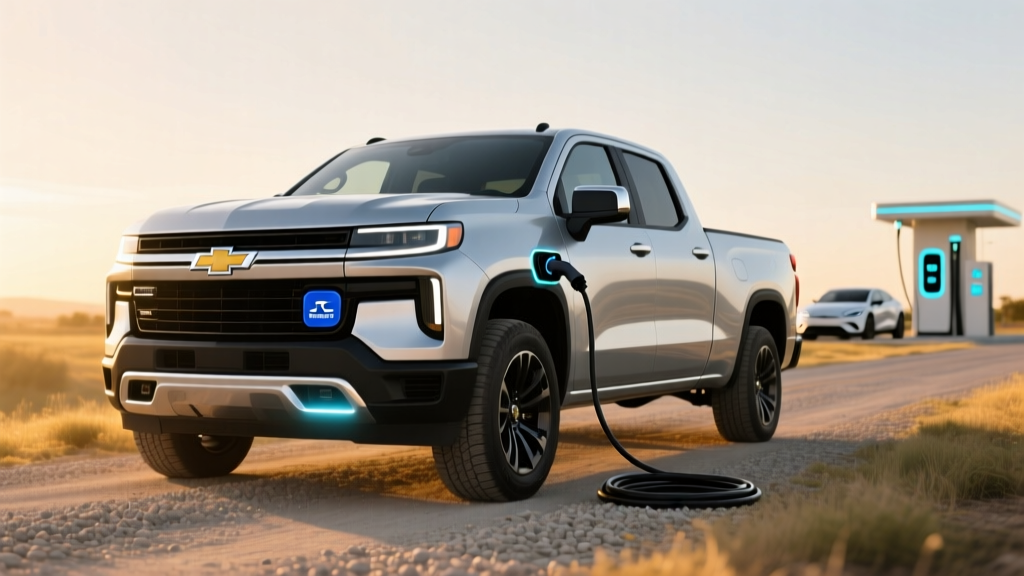
If you've been searching for a Silverado 1500 hybrid, you've likely noticed something frustrating: Chevrolet doesn't currently sell a new hybrid version of its best-selling half-ton pickup. The Silverado 1500 lineup for the 2025–2026 model years is powered exclusively by gasoline engines — the 2.7L TurboMax I4, 5.3L V8, 6.2L V8, and the 3.0L Duramax turbodiesel. There is no factory HEV (conventional hybrid) and no PHEV (plug-in hybrid) option available at your Chevy dealer.
That doesn't mean your search ends here. The electrified-truck landscape has shifted dramatically, and buyers cross-shopping a Silverado 1500 hybrid have legitimate alternatives — from the Ford F-150 PowerBoost hybrid to the Silverado EV, which is a fully electric truck wearing the same badge. This guide breaks down exactly where the Silverado 1500 stands today, what GM has signaled for the future, and which electrified truck actually fits your needs.
The Current Silverado 1500 Powertrain Lineup (No Hybrid Option)
Before we compare alternatives, let's establish what you can buy in a 2026 Silverado 1500. Every engine pairs with a 10-speed automatic transmission and is available across multiple trims (WT, Custom, LT, RST, ZR2, LTZ, High Country).
| Engine | Horsepower | Torque (lb-ft) | EPA Combined MPG (2WD) | Max Towing (lbs) |
|---|---|---|---|---|
| 2.7L TurboMax I4 | 310 hp | 430 | 21 MPG | 9,500 |
| 5.3L EcoTec3 V8 | 355 hp | 383 | 19 MPG | 11,300 |
| 6.2L EcoTec3 V8 | 420 hp | 460 | 17 MPG | 11,100 |
| 3.0L Duramax I6 Turbo-Diesel | 305 hp | 495 | 26 MPG | 13,300 |
The Duramax diesel is the efficiency champion of the lineup at 26 MPG combined, but it adds roughly $2,500–$3,000 to the sticker price depending on trim and requires diesel exhaust fluid (DEF). None of these powertrains use an electric motor for propulsion or regenerative braking — they are conventional internal-combustion engines through and through.
A conventional hybrid (HEV) like the Ford F-150 PowerBoost uses a small battery (typically 1–2 kWh) and an electric motor to assist the gas engine. You never plug it in — the battery recharges through regenerative braking and the engine. A plug-in hybrid (PHEV) has a larger battery (typically 12–20+ kWh), can be plugged in to charge, and offers 20–40 miles of electric-only driving before the gas engine kicks in. Neither exists in the current Silverado 1500.
The Ford F-150 PowerBoost: The Hybrid Truck Benchmark
The closest analog to what a "Silverado 1500 hybrid" buyer actually wants is the Ford F-150 PowerBoost. It's the only full-size conventional hybrid pickup on the market, and it sets the bar that Chevy would need to clear.
| Spec | Value |
|---|---|
| Powertrain | 3.5L EcoBoost V6 + 35 kW electric motor |
| Combined Output | 430 hp / 570 lb-ft torque |
| Battery | 1.5 kWh lithium-ion (HEV — not plug-in) |
| EPA City MPG (2WD) | 25 MPG |
| EPA Highway MPG (2WD) | 26 MPG |
| EPA Combined MPG (2WD) | 25 MPG |
| EPA Combined MPG (4WD) | 23 MPG |
| Max Towing | 12,700 lbs |
| Pro Power Onboard | Up to 7.2 kW (bed outlets) |
| Hybrid Premium | ~$3,000–$4,000 over comparable gas V6 |
The PowerBoost's 25 MPG combined is a meaningful improvement over the Silverado 1500's 5.3L V8 (19 MPG combined). On 15,000 miles of annual driving at $3.40/gallon, that's roughly $520/year in fuel savings — enough to recoup the hybrid premium in 6–8 years, not counting the added resale value hybrids typically command in the truck segment.
Real-world note: F-150 PowerBoost owners frequently report exceeding the EPA city estimate. Hybrid trucks benefit most from stop-and-go driving where regenerative braking recaptures energy. Highway-heavy commuters may see 22–23 MPG in 4WD models, closer to the EPA sticker but not dramatically above it. Source: fueleconomy.gov.
Silverado EV vs. a Hypothetical Silverado 1500 Hybrid
Chevrolet's answer to electrified truck buyers isn't a hybrid — it's the Silverado EV, a ground-up electric truck built on GM's Ultium platform. It's a fundamentally different vehicle from the ICE Silverado 1500 (different platform, different dimensions, no shared body panels), but it carries the Silverado name. Here's how it stacks up against what a hypothetical Silverado hybrid might offer.
| Attribute | Silverado EV (4WT) | Hypothetical Silverado HEV | F-150 PowerBoost |
|---|---|---|---|
| Powertrain Type | BEV (full electric) | HEV (conventional hybrid) | HEV (conventional hybrid) |
| Combined Output | 510 hp / 615 lb-ft | Est. 400 hp | 430 hp / 570 lb-ft |
| EPA Combined Efficiency | 63 MPGe (2.0 kWh/mi) | Est. 22–24 MPG | 25 MPG (2WD) |
| Range | 390 miles (EPA) | ~550+ miles (est.) | ~600+ miles |
| Refueling Time | ~35 min (10–80% DC) | ~5 min (gas pump) | ~5 min (gas pump) |
| Plug-In Required? | Yes | No | No |
| Base MSRP | ~$55,000 | Does not exist | ~$57,000 |
| Federal Tax Credit | Up to $7,500 (§30D) | N/A | Not eligible |
| Vehicle-to-Load | Yes (V2L capable) | Unlikely | Yes (7.2 kW) |
The Silverado EV trades the unlimited range and 5-minute refueling of a hybrid for dramatically lower operating costs, instant torque, and zero tailpipe emissions. Whether that trade makes sense depends entirely on your use case — which we'll break down below.
Fuel Economy Deep Dive: What Hybrid Truck Buyers Actually Get
If GM were to introduce a Silverado 1500 hybrid, the F-150 PowerBoost's EPA data gives us a reliable template. Here's the MPG breakdown that matters:
| Driving Scenario | EPA Estimate | Real-World Expectation |
|---|---|---|
| City (2WD) | 25 MPG | 25–27 MPG (hybrids excel here) |
| Highway (2WD) | 26 MPG | 23–25 MPG (less hybrid benefit at steady speed) |
| Combined (2WD) | 25 MPG | 23–26 MPG |
| Combined (4WD) | 23 MPG | 21–24 MPG |
| Towing (5,000 lb trailer) | N/A (EPA doesn't test towing) | 13–16 MPG (hybrid benefit nearly vanishes) |
| Cold Weather (below 30°F) | N/A | 20–22 MPG (engine runs more for cabin heat) |
The critical insight: hybrid fuel-economy advantages are largest in city driving and smallest when towing heavy loads. If your truck life is 80% highway commuting with occasional heavy towing, a diesel (like the Silverado's 3.0L Duramax at 26 MPG combined) may actually deliver comparable or better real-world economy without a hybrid system's complexity.
Pricing, Tax Credits, and Total Cost of Ownership
Because there is no Silverado 1500 hybrid to price, let's examine the economics of the alternatives.
2026 Silverado 1500 gas models start at approximately $38,700 (WT regular cab 2WD) and climb to $68,000+ for a High Country crew cab 4WD with the 6.2L V8. The 3.0L Duramax diesel adds roughly $2,500–$3,000 to comparable trims.
The Silverado EV starts around $55,000 for the 4WT trim and qualifies for the federal §30D clean vehicle tax credit, which can provide up to $7,500 depending on battery sourcing, critical mineral content, buyer income, and MSRP caps. Under current 2026 IRS rules, the credit can be transferred to the dealer at point of sale, reducing your purchase price directly. However, eligibility is not guaranteed — battery component and critical mineral sourcing requirements phase in progressively. Always verify current eligibility on irs.gov and consult a tax professional.
The Ford F-150 PowerBoost does not qualify for the §30D credit because it is a conventional hybrid (HEV), not a plug-in electric vehicle. The credit requires a minimum battery capacity of 7 kWh and plug-in capability — criteria the PowerBoost's 1.5 kWh non-plug-in battery does not meet.
- Vehicle must be a plug-in EV or fuel cell vehicle (conventional hybrids do NOT qualify)
- Battery capacity ≥ 7 kWh
- MSRP cap: $80,000 for vans/SUVs/pickups; $55,000 for sedans
- Buyer income cap: $300,000 (joint), $225,000 (head of household), $150,000 (individual) AGI
- Battery components and critical minerals must meet phased sourcing thresholds
- Credit can be transferred to dealer at point of sale for immediate price reduction
Battery Warranty, Reliability, and Replacement Costs
Hybrid battery longevity is the top concern for truck buyers considering an HEV or PHEV. Here's what the data shows:
Ford F-150 PowerBoost: Hybrid battery covered for 8 years / 100,000 miles (whichever comes first), consistent with federal emissions warranty requirements for hybrid components. Ford specifies the battery is designed to last the life of the vehicle under normal use.
Silverado EV (Ultium battery): 8 years / 100,000 miles with a minimum 70% capacity retention threshold, per Chevrolet's published warranty.
Replacement cost: Full hybrid battery pack replacement for a full-size truck HEV typically runs $4,000–$7,000 (parts and labor) based on current market data. However, wholesale replacements are rare — individual cell or module repairs are increasingly common and significantly cheaper. Most hybrid batteries outlast 150,000+ miles with minimal degradation (typically 5–10% capacity loss over 10 years).
GM's hybrid systems have a strong reliability track record. The two-mode hybrid system used in the 2008–2013 Silverado Hybrid (a now-discontinued model) had isolated inverter and battery issues, but the vast majority of units exceeded 150,000 miles without major hybrid-component failure. Modern systems benefit from improved thermal management and cell chemistry. If GM introduces a future Silverado hybrid, it would likely use a derivative of the hybrid architecture already proven in the Tahoe/Yukon hybrid SUVs and the Corvette E-Ray.
Hybrid vs. PHEV vs. EV: Which Electrified Truck Fits You?
With no Silverado 1500 hybrid available, here's a practical decision framework for electrified-truck shoppers:
- You want hybrid fuel savings without changing your refueling habits
- You tow regularly and can't afford range loss or charging delays on the road
- You don't have access to home or workplace charging
- You want onboard power (7.2 kW Pro Power) for job sites or camping
- You drive 15,000+ miles/year in mixed city/highway conditions
- You have reliable Level 2 home charging (240V, 40–80A circuit)
- Your daily driving is under 250 miles and you can plan road-trip charging
- You want the lowest per-mile fuel cost (~$0.04–0.06/mile on home electricity vs. $0.17–0.22/mile on gas)
- You want maximum torque (615 lb-ft) and the quietest drivetrain
- You qualify for the §30D tax credit, bringing the effective price down by up to $7,500
- You regularly tow over 10,000 lbs (diesel excels here at 26 MPG without hybrid complexity)
- You live in a region with extreme cold and limited charging infrastructure
- You want the lowest upfront purchase price (WT trim starts ~$38,700)
- You plan to keep the truck 10+ years and prefer proven, simple powertrain technology
Will Chevrolet Release a Silverado 1500 Hybrid?
As of early 2026, GM has not officially announced a conventional hybrid or plug-in hybrid version of the ICE-platform Silverado 1500. The company's electrification strategy has focused on the Ultium-based Silverado EV for zero-emission buyers, while the gas/diesel Silverado 1500 continues without hybrid assistance.
Industry analysts have speculated that GM could introduce a mild-hybrid or full-hybrid system on the next-generation Silverado (expected around 2028–2029), particularly as CAFE fuel-economy standards tighten. The 2.7L TurboMax engine's architecture could theoretically accommodate a 48V mild-hybrid system similar to what Ram offers with its eTorque setup. However, until GM makes an official announcement, any hybrid Silverado 1500 remains speculative.
What is confirmed: GM is expanding its Ultium EV lineup, and the Silverado EV is actively ramping production. If you want an electrified Chevy truck today, the Silverado EV is the only option.
Frequently Asked Questions
Does the 2026 Silverado 1500 have a hybrid option?
No. The 2026 Chevrolet Silverado 1500 is available only with gasoline engines (2.7L turbo I4, 5.3L V8, 6.2L V8) and a 3.0L turbodiesel I6. There is no conventional hybrid (HEV) or plug-in hybrid (PHEV) variant. The closest competitor hybrid truck is the Ford F-150 PowerBoost.
How many MPG does the Ford F-150 PowerBoost hybrid get?
The F-150 PowerBoost achieves an EPA-estimated 25 MPG city / 26 MPG highway / 25 MPG combined in 2WD, and 22 city / 24 highway / 23 combined in 4WD. Real-world results vary: city drivers often exceed EPA estimates, while towing drops economy to 13–16 MPG.
Does the Silverado EV qualify for a federal tax credit?
The Silverado EV may qualify for up to $7,500 under the IRS §30D clean vehicle credit, subject to buyer income limits ($150K–$300K AGI depending on filing status), MSRP caps ($80K for trucks), and battery sourcing requirements. The credit can be transferred to the dealer at point of sale. Always verify eligibility on irs.gov before purchasing.
What is the hybrid battery replacement cost for a full-size truck?
Full hybrid battery replacement for a full-size truck HEV typically costs $4,000–$7,000 including parts and labor. However, complete replacements are uncommon. Most hybrid batteries last 150,000+ miles with only 5–10% degradation, and modular repairs (replacing individual cells or the inverter) cost significantly less.
Is a hybrid truck worth it for towing?
Hybrid fuel-economy benefits nearly disappear when towing heavy loads. Expect 13–16 MPG towing a 5,000-lb trailer with a hybrid truck, comparable to a non-hybrid V6 or V8. If towing is your primary use case, the 3.0L Duramax diesel (26 MPG unloaded, strong towing torque) may be a better choice than a hybrid.
Will Chevy make a Silverado hybrid in the future?
GM has not officially announced a hybrid Silverado 1500. The company's electrified truck strategy currently centers on the Silverado EV (fully electric). A mild-hybrid or full-hybrid ICE Silverado could arrive with the next-generation platform (est. 2028–2029), but nothing is confirmed.