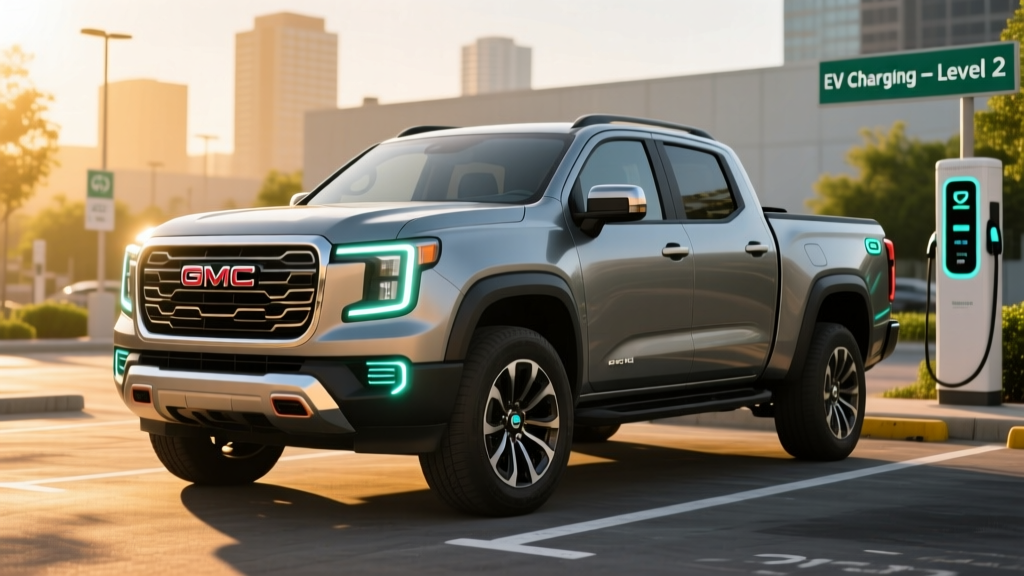
Midsize truck buyers have long faced a binary choice: burn fuel or compromise on capability. The GMC Canyon hybrid — announced by General Motors as part of its next-generation midsize truck electrification strategy — aims to change that equation. But with details still emerging and production timelines shifting, prospective buyers need a clear-eyed look at what's confirmed, what's projected, and where this truck fits in the broader electrified-truck landscape.
As of early 2026, GMC has signaled its intent to offer an electrified Canyon, but the vehicle has not yet entered production or gone on sale. This guide synthesizes everything GM has disclosed, pairs it with data from the current Canyon platform, and frames realistic expectations for range, efficiency, pricing, and ownership.
Is the GMC Canyon Hybrid an HEV or a PHEV?
Based on GM's public statements and industry reporting, the electrified GMC Canyon is expected to arrive as a plug-in hybrid electric vehicle (PHEV), not a conventional hybrid (HEV). The distinction matters enormously for buyers:
| Feature | Conventional Hybrid (HEV) | Plug-In Hybrid (PHEV) |
|---|---|---|
| Plugs in to charge? | No — charges via regenerative braking and engine | Yes — has a larger battery you charge externally |
| Electric-only driving | Minimal (typically under 1 mile at low speed) | 20–50+ miles on battery alone (estimated for Canyon PHEV) |
| Battery size | 1–2 kWh | 15–25 kWh (estimated) |
| Federal tax credit | Not eligible under §30D | Potentially up to $7,500 (income, MSRP, and sourcing rules apply) |
| Home charging needed? | No | Recommended to unlock electric range and savings |
GM's Ultium-derived PHEV architecture — which underpins the upcoming Corvette E-Ray and has been referenced in GM's midsize truck roadmap — supports meaningful electric-only range, making a PHEV the logical choice for a truck that needs to tow, haul, and still deliver daily commuter efficiency.
Projected Powertrain: Engine, Motor, and Combined Output
The current third-generation GMC Canyon (redesigned for 2023) uses a 2.7-liter turbocharged inline-four producing up to 310 hp and 430 lb-ft of torque in High-Output tune. The anticipated PHEV variant would pair an updated version of this engine with one or more electric motors integrated into the drivetrain.
| Specification | Current Canyon (Gas) | Canyon PHEV (Projected) |
|---|---|---|
| Engine | 2.7L Turbo I4 | 2.7L Turbo I4 + electric motor(s) |
| Combined horsepower | 310 hp | 375–425 hp (estimated) |
| Combined torque | 430 lb-ft | 475–525 lb-ft (estimated) |
| Transmission | 8-speed automatic | Hybrid-specific automatic or e-CVT |
| Drivetrain | RWD / 4WD | 4WD expected standard (e-AWD possible) |
| Battery chemistry | N/A | Likely NMC (nickel manganese cobalt) |
| Battery capacity | N/A | 18–25 kWh usable (estimated) |
| Towing capacity | 7,700 lbs (max) | 6,500–7,500 lbs (estimated — battery weight reduces payload) |
The added electric torque should deliver noticeably stronger off-the-line acceleration and low-speed trail crawling. However, buyers should expect a modest towing-capacity reduction compared to the gas-only Canyon due to the PHEV battery adding roughly 300–500 lbs of curb weight. This is a consistent trade-off across every PHEV truck and SUV on the market.
Fuel Economy and Electric-Only Range: What to Expect
This is where the Canyon PHEV's value proposition crystallizes — and where buyers need to manage expectations with real numbers rather than marketing promises.
| Metric | Current Canyon 4WD (EPA) | Canyon PHEV (Projected) |
|---|---|---|
| City MPG | 18 mpg | 28–34 mpg (charge-sustaining) |
| Highway MPG | 22 mpg | 24–28 mpg (charge-sustaining) |
| Combined MPG | 20 mpg | 26–30 mpg (charge-sustaining) |
| MPGe (electric mode) | N/A | 55–70 MPGe (estimated) |
| Electric-only range | N/A | 25–40 miles (estimated) |
| Total combined range | ~420 miles | ~450–520 miles (estimated) |
Real-world context: PHEVs deliver their best efficiency when the battery is charged daily. If your commute is under 30 miles round-trip and you charge at home overnight, you may burn almost no gasoline on weekdays. But once the battery depletes, the truck operates as a conventional hybrid — and a heavy body-on-frame truck with a turbo four won't match the charge-sustaining MPG of a unibody PHEV crossover. Expect real-world highway MPG in charge-sustaining mode to land closer to 22–25 mpg, not the upper estimates.
Cold weather will reduce electric-only range by 15–30%, consistent with all PHEVs. A 35-mile EPA electric range could drop to 25 miles in freezing temperatures — still useful, but plan accordingly.
Charging: Battery Size, Charge Times, and DC Fast Charging
A PHEV is only as practical as your ability to charge it. Here's what the projected battery and charging specs look like:
| Charging Level | Power | Estimated Time (0–100%) | Notes |
|---|---|---|---|
| Level 1 (120V household) | ~1.4 kW | 14–18 hours | Trickle charge; sufficient only for very small daily use |
| Level 2 (240V home/public) | 3.3–7.2 kW | 3–5 hours | Overnight home charging; recommended setup |
| DC Fast Charge | TBD | TBD | Most PHEVs do NOT support DC fast charging; expect Level 2 max |
Critical note: The vast majority of PHEVs on the market — including the Ford Escape PHEV, Toyota RAV4 Prime, and Jeep Wrangler 4xe — do not support DC fast charging. Their batteries are too small to justify the hardware cost, and Level 2 fully replenishes them in a few hours. Expect the Canyon PHEV to follow this pattern. If you need rapid roadside charging, a full BEV is the better architecture.
For home Level 2 charging, budget $500–$1,500 for a quality 240V charger (such as a ChargePoint Home Flex or Emporia Vue) and $500–$2,000 for professional electrician installation, depending on whether your panel needs an upgrade. A 200-amp panel is typically sufficient.
Pricing, Trims, and Federal Tax Credit Eligibility
GM has not published official MSRP figures for the Canyon PHEV. However, we can project based on the current Canyon lineup and the typical PHEV premium seen across the industry:
| Trim | Current Canyon MSRP (2025) | Projected Canyon PHEV MSRP |
|---|---|---|
| Elevation (base) | ~$38,000 | ~$46,000–$48,000 |
| AT4 | ~$45,000 | ~$53,000–$56,000 |
| Denali | ~$52,000 | ~$60,000–$64,000 |
| AT4X / AEV | ~$60,000+ | ~$68,000–$72,000 (if offered) |
The PHEV premium typically adds $7,000–$10,000 over the equivalent gas trim. This is consistent with what we've seen on the Jeep Wrangler 4xe and the Ford F-150 PowerBoost hybrid.
Federal §30D Tax Credit: What You Need to Know
A qualifying PHEV can earn up to $7,500 under the IRS §30D Clean Vehicle Credit, but eligibility is far from guaranteed. Per current IRS rules, the Canyon PHEV would need to satisfy:
- MSRP cap: Trucks/vans/SUVs must have an MSRP under $80,000
- Buyer income cap: AGI must not exceed $150,000 (single), $225,000 (head of household), or $300,000 (joint)
- Battery sourcing: Critical minerals and battery components must meet escalating domestic/free-trade-partner thresholds — these tighten annually
- Final assembly: Must occur in North America (expected — GM builds the Canyon in Missouri)
- Point-of-sale transfer: Eligible buyers can apply the credit as a down-payment reduction at the dealer
The battery-sourcing requirements are the wildcard. As of 2026, the thresholds are stringent enough that several PHEVs have lost partial or full credit eligibility. Always verify the specific VIN on fueleconomy.gov before purchasing.
Battery Warranty, Longevity, and Replacement Cost
Federal law mandates that hybrid and PHEV batteries carry a minimum warranty of 8 years / 100,000 miles (in California Air Resources Board states, this extends to 10 years / 150,000 miles). GM has historically matched or exceeded these minimums on its electrified vehicles.
For the Canyon PHEV, expect:
- Battery warranty: 8 years / 100,000 miles minimum (capacity retention threshold likely 70%)
- Powertrain warranty: 5 years / 60,000 miles (GM standard)
- Projected out-of-warranty replacement cost: $8,000–$14,000 for the PHEV battery pack, based on current PHEV replacement pricing across the industry
Real-world reliability context: PHEV batteries in trucks and SUVs have proven durable. The Toyota RAV4 Prime and Jeep Wrangler 4xe have shown minimal degradation in early fleet data, typically retaining 90%+ capacity after 5 years. The Canyon PHEV's NMC battery (if equipped) should follow a similar trajectory, especially with GM's active thermal management system. However, long-term data specific to this vehicle won't exist until it's been on sale for several years.
Who Should Choose the GMC Canyon Hybrid — and Who Shouldn't?
Choose the Canyon PHEV if:
- You want a midsize truck with real towing and off-road capability but also want to commute on electricity most days
- You have access to home Level 2 charging (a garage or driveway with a 240V outlet)
- Your daily driving is under 30–40 miles, meaning you'll rarely burn gas on weekdays
- You want to reduce fuel costs without committing to a full BEV or worrying about charging-desert road trips
- You qualify for the §30D tax credit, which can offset much of the PHEV premium
Look elsewhere if:
- You can't charge at home — without regular plug-in charging, you're carrying dead battery weight and getting marginal MPG gains over the gas Canyon
- You need maximum towing capacity — the PHEV battery's weight will reduce max towing by 500–1,000 lbs
- You want zero tailpipe emissions — a PHEV still burns gasoline on longer trips; a full BEV like the Rivian R1T or the upcoming Silverado EV eliminates that entirely
- You're buying now — this truck is not yet on sale, and specs remain preliminary
Projected Pros
- 25–40 miles of electric-only commuting range eliminates weekday gas use for most owners
- Combined 375+ hp with instant electric torque improves both performance and trail capability
- Retains body-on-frame truck DNA: real towing, real payload, real off-road chops
- Potential $7,500 federal tax credit reduces effective price significantly
- No range anxiety — gas engine covers long road trips seamlessly
Projected Cons
- $7,000–$10,000 price premium over gas-only Canyon trims
- Reduced towing capacity due to battery weight (~500–1,000 lb penalty)
- Likely no DC fast charging — Level 2 only
- Charge-sustaining highway MPG may only marginally beat the gas model
- Not yet available — buyers must wait for production and real-world validation
How It Compares: Canyon PHEV vs. the Electrified-Truck Field
The midsize PHEV truck segment is thin. Here's how the projected Canyon PHEV stacks up against adjacent options:
| Vehicle | Type | Electric Range | Combined MPG / MPGe | Starting MSRP | Towing |
|---|---|---|---|---|---|
| GMC Canyon PHEV (projected) | PHEV | 25–40 mi | 26–30 mpg / 55–70 MPGe | ~$46,000 | ~7,000 lbs |
| Ford Maverick Hybrid | HEV | N/A | 42 city / 33 hwy / 37 combined | ~$28,000 | 2,000 lbs |
| Jeep Wrangler 4xe | PHEV | 21 mi (EPA) | 20 mpg / 49 MPGe | ~$52,000 | 3,500 lbs |
| Ford F-150 PowerBoost | HEV | N/A | 22 city / 24 hwy / 23 combined | ~$56,000 | 12,700 lbs |
| Rivian R1T | BEV | 270–410 mi (EPA) | 70–73 MPGe | ~$75,000 | 11,000 lbs |
The Canyon PHEV occupies a unique niche: more truck than the Maverick, more electric range than the Wrangler 4xe, and far cheaper than the R1T. If GM prices it competitively and delivers on projected range, it could be the most practical electrified midsize truck on the market — if you can charge at home.
Frequently Asked Questions
How many MPG does the GMC Canyon hybrid get?
The current gas-only GMC Canyon 4WD is EPA-rated at 18 city / 22 highway / 20 combined mpg. The projected Canyon PHEV should deliver roughly 26–30 mpg combined in charge-sustaining mode (after the battery depletes), plus 55–70 MPGe when operating on electricity. Real-world highway MPG in hybrid mode will likely land closer to 22–25 mpg, given the truck's aerodynamics and weight.
How far can the Canyon PHEV go on electric only?
Based on projected battery capacity (18–25 kWh usable) and the truck's weight and aerodynamics, expect an EPA electric-only range of 25–40 miles. This covers the average American's daily commute. In cold weather (below freezing), plan for 15–30% less — roughly 18–34 miles.
Hybrid vs. PHEV vs. full EV — which is right for me?
A conventional hybrid (HEV) like the Ford Maverick Hybrid needs no plug and simply improves MPG — ideal if you can't charge at home. A PHEV like the projected Canyon PHEV gives you 25–40 miles of electric driving plus a gas engine for longer trips — ideal if you can charge at home but take regular road trips. A full BEV like the Rivian R1T eliminates gasoline entirely with 270+ miles of range — ideal if you want zero tailpipe emissions, can charge at home, and are comfortable planning road-trip charging stops.
Is the Canyon PHEV reliable, and what does a battery replacement cost?
GM's hybrid and EV battery systems have shown strong durability in existing products, and the PHEV battery will carry a federally mandated warranty of at least 8 years / 100,000 miles. Out-of-warranty PHEV battery replacement is projected at $8,000–$14,000, consistent with current PHEV packs. However, most PHEV batteries outlast their warranty periods with minimal degradation — early data from comparable vehicles shows 90%+ capacity retention at 5 years.
Does the GMC Canyon hybrid qualify for a tax credit?
As a PHEV, the Canyon would potentially qualify for the federal §30D Clean Vehicle Credit of up to $7,500 — but only if it meets MSRP (under $80,000 for trucks), buyer income, battery-sourcing, and North American assembly requirements. Some higher trims (Denali, AT4X) could approach or exceed the $80,000 MSRP cap depending on options. Always check fueleconomy.gov for the specific VIN's eligibility before purchasing, and consult a tax professional for your personal situation.
When will the GMC Canyon hybrid be available?
GM has announced electrification plans for its midsize truck lineup but has not confirmed an exact on-sale date for the Canyon PHEV as of early 2026. Industry estimates suggest a 2027 or 2028 model-year launch. All specifications in this article are projections based on GM disclosures, current platform data, and segment benchmarks — final production specs may differ.
Sources: fueleconomy.gov (current Canyon EPA data), IRS §30D Clean Vehicle Credit rules, GM corporate electrification announcements. All projected specifications are estimates pending official manufacturer confirmation.