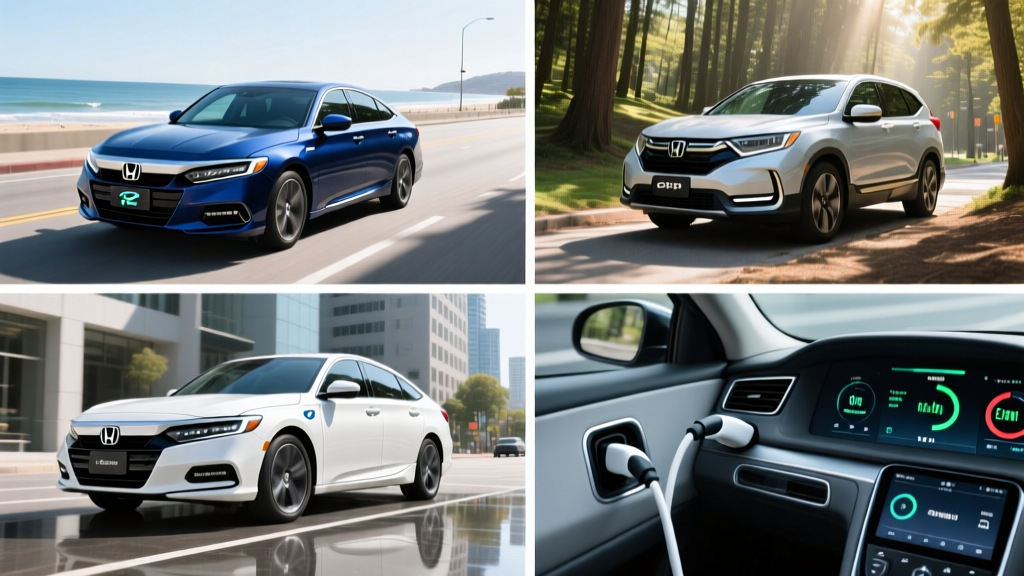
Honda has gone all-in on hybrid powertrains for its most popular models, and the "Sport" and "Sport Touring" trims are where performance meets efficiency. If you've been searching for a Honda hybrid sport model, you're likely weighing the Accord Hybrid Sport, the Civic Hybrid Sport, and the CR-V Hybrid Sport Touring against each other — and against full EVs and conventional gas cars. This guide breaks down exact EPA MPG figures, real-world fuel economy, powertrain output, battery warranties, and whether any of these qualify for federal tax credits in 2026.
Honda's Hybrid Sport Lineup at a Glance
For the 2026 model year, Honda offers hybrid powertrains across three core models in sport-oriented trims. All three use Honda's fourth-generation two-motor hybrid system, which pairs a 2.0-liter Atkinson-cycle four-cylinder engine with two electric motors — one for propulsion, one primarily as a generator. None of these are plug-in hybrids (PHEVs); they are conventional hybrids (HEVs) that recharge their small battery packs through regenerative braking and the gasoline engine. You never plug them in.
| Model / Trim | Combined HP | EPA City / Hwy / Combined MPG | 0–60 mph | Starting MSRP |
|---|---|---|---|---|
| Accord Hybrid Sport | 204 hp | 46 / 41 / 44 MPG | ~6.5 sec | $34,250 |
| Civic Hybrid Sport | 200 hp | 50 / 47 / 49 MPG | ~6.2 sec | $30,650 |
| CR-V Hybrid Sport Touring | 204 hp | 40 / 34 / 37 MPG | ~7.6 sec | $41,350 |
Sources: fueleconomy.gov (EPA estimates), Honda Newsroom 2026 model-year press kits. Real-world results vary with driving style, temperature, and terrain.
HEV vs. PHEV vs. EV: Which Honda Fits You?
Before diving deeper into the sport trims, it's critical to understand the three electrification paths Honda offers — and which one matches your lifestyle.
Conventional Hybrid (HEV) — Accord, Civic, CR-V Hybrid
- No plug required; battery recharges via regen and the gas engine
- Small battery (~1.1 kWh usable) — electric-only driving limited to brief low-speed bursts
- Best for: drivers without home charging access who want maximum MPG with zero behavior change
Plug-In Hybrid (PHEV) — Not Currently Offered by Honda in the U.S.
- Larger battery (typically 15–18 kWh) enabling 25–40 miles of electric-only range
- Requires Level 1 or Level 2 plug-in charging to capture EV-mode benefits
- Honda does not sell a PHEV in the U.S. market for 2026; the Clarity PHEV was discontinued after 2021
Battery Electric (BEV) — Honda Prologue
- Zero gasoline; 85 kWh battery, ~296 miles EPA range
- Requires home Level 2 or public DC fast charging infrastructure
- Best for: drivers with reliable home charging and mostly under-300-mile daily needs
Bottom line: If you want a Honda hybrid sport model today, you're choosing a conventional HEV. That's a smart pick if you lack a garage charger or regularly drive beyond 300 miles between stops.
Fuel Economy Deep Dive: EPA vs. Real-World MPG
Honda's hybrid system excels in city driving, where the electric motor handles low-speed propulsion and the engine operates only in its most efficient RPM range. On the highway, the engine takes over more directly, which is why you'll notice the city MPG is often higher than highway MPG — the opposite of a gas-only car.
| Model | City MPG | Highway MPG | Combined MPG | Estimated Real-World Combined* |
|---|---|---|---|---|
| Accord Hybrid Sport | 46 | 41 | 44 | 40–46 MPG |
| Civic Hybrid Sport | 50 | 47 | 49 | 45–52 MPG |
| CR-V Hybrid Sport Touring (AWD) | 40 | 34 | 37 | 33–39 MPG |
*Real-world estimates based on owner-reported data and independent testing. City-heavy commutes often exceed EPA; sustained 80+ mph highway driving and cold weather (below 35°F) can reduce MPG by 8–15%.
What this means at the pump: At $3.40/gallon and 12,000 miles/year, the Civic Hybrid Sport costs roughly $830/year in fuel. A comparable gas-only Civic 2.0L sedan (combined ~33 MPG) costs about $1,236/year. That's a ~$400 annual fuel savings for the hybrid.
Powertrain Performance: Honda's Two-Motor Hybrid System
Honda's e:HEV (branded simply as "hybrid" in the U.S.) system uses a series-parallel architecture. Under light loads, the gasoline engine generates electricity that powers the drive motor (series mode). Under heavy acceleration or highway cruising, a lock-up clutch connects the engine directly to the wheels (parallel mode). A small lithium-ion battery pack buffers energy between the engine-generator and the drive motor.
| Specification | Accord Hybrid Sport | Civic Hybrid Sport | CR-V Hybrid Sport Touring |
|---|---|---|---|
| Engine | 2.0L DOHC Atkinson I-4 | 2.0L DOHC Atkinson I-4 | 2.0L DOHC Atkinson I-4 |
| Engine HP / Torque | 146 hp / 134 lb-ft | 146 hp / 134 lb-ft | 146 hp / 134 lb-ft |
| Drive Motor Output | 181 hp / 247 lb-ft | 181 hp / 232 lb-ft | 181 hp / 247 lb-ft |
| Combined System HP | 204 hp | 200 hp | 204 hp |
| Drivetrain | FWD | FWD | AWD (real-time) |
| Battery Type / Capacity | Lithium-ion / ~1.1 kWh | Lithium-ion / ~1.1 kWh | Lithium-ion / ~1.1 kWh |
| Transmission | e-CVT (direct-drive) | e-CVT (direct-drive) | e-CVT (direct-drive) |
The Sport trims add paddle shifters that simulate stepped gear ratios through the e-CVT, plus a Sport driving mode that sharpens throttle response and holds the engine at higher RPM for more immediate power delivery. It's not a sports car, but the instant electric torque (232–247 lb-ft available from 0 RPM) makes these feel noticeably quicker off the line than their gas-only counterparts.
Battery Warranty, Lifespan, and Replacement Cost
Battery longevity is the top concern for hybrid buyers, and Honda addresses it with robust warranty coverage.
Honda Hybrid Battery Warranty
- Hybrid Battery: 8 years / 100,000 miles (10 years / 150,000 miles in CARB states including CA, CT, MA, ME, MD, NJ, NY, OR, RI, VT, WA)
- Hybrid System Components: 8 years / 100,000 miles (inverter, converter, control unit)
- Capacity Threshold: Honda warrants the battery against abnormal capacity loss — if the battery degrades below functional thresholds during the warranty period, Honda replaces it at no cost
Real-world lifespan data: Honda's hybrid batteries in the Accord and CR-V have demonstrated strong longevity. Independent fleet data and owner reports suggest these packs typically retain 85–90% of original capacity after 150,000 miles. The small ~1.1 kWh pack undergoes shallow charge-discharge cycles (typically operating between 40–80% state of charge), which significantly reduces degradation compared to a full EV battery that cycles through a wider range.
Out-of-warranty replacement cost: If the hybrid battery does fail beyond the warranty period, expect a replacement cost of $2,000–$4,000 (parts and labor) at a Honda dealership. Third-party hybrid battery refurbishers offer remanufactured packs for $1,200–$2,200. This is far less than EV battery replacements, which can exceed $10,000.
Tax Credits and Incentives for Honda Hybrids
This is where the distinction between HEV and PHEV/BEV becomes financially significant.
- Federal §30D Clean Vehicle Credit ($7,500): NOT available. The IRS §30D credit requires a plug-in vehicle with at least 7 kWh of battery capacity. Honda's conventional hybrids (~1.1 kWh) do not qualify. (Source: IRS §30D guidelines)
- Federal Used EV Credit (up to $4,000): NOT available. Same plug-in requirement applies.
- State Hybrid Incentives: A handful of states offer modest rebates for conventional hybrids. For example, some utility companies offer $250–$500 rebates for purchasing any high-efficiency vehicle. Check your local utility and state energy office.
- Honda Prologue (BEV) Alternative: If the $7,500 federal credit is a priority, the Honda Prologue EV (starting ~$47,400) may qualify depending on your income, the vehicle's MSRP, and battery-sourcing requirements. Consult a tax professional for your specific situation.
The hybrid sport models don't come with federal tax incentives, but their lower purchase price and strong fuel economy still deliver a compelling total cost of ownership compared to gas-only alternatives — and far less upfront cost than a full EV.
Ownership Economics: 5-Year Cost Comparison
| Cost Factor | Civic Hybrid Sport ($30,650) | Civic Sport Touring Gas ($31,450) |
|---|---|---|
| Purchase Price (MSRP) | $30,650 | $31,450 |
| Fuel (60K mi @ $3.40/gal) | $4,163 | $6,182 |
| Estimated Maintenance | $2,400 | $2,800 |
| Insurance (avg.) | $7,800 | $7,500 |
| Federal Tax Credit | $0 | $0 |
| 5-Year Total | $45,013 | $47,932 |
Assumes no financing interest, 12,000 miles/year, $3.40/gal average fuel price. Insurance estimates are approximate and vary by driver, location, and carrier. Source for MPG: fueleconomy.gov.
The Civic Hybrid Sport saves roughly $2,900 over five years despite a similar sticker price. The Accord Hybrid Sport shows similar savings. The CR-V Hybrid Sport Touring carries a higher premium over its gas counterpart, but the fuel savings and resale value typically close the gap within 4–5 years.
Which Honda Hybrid Sport Model Should You Choose?
Accord Hybrid Sport — Pros
- Spacious midsize sedan with 16.7 cu-ft trunk
- 44 MPG combined in a 204-hp package
- Refined ride, excellent highway cruiser
- Google built-in infotainment on Sport and above
Accord Hybrid Sport — Cons
- No AWD option (FWD only)
- Sedan cargo limits vs. SUV
- ~$2,000 more than Civic Hybrid Sport
Civic Hybrid Sport — Pros
- Best fuel economy: 49 MPG combined
- Quickest 0–60: ~6.2 seconds
- Lowest entry price: ~$30,650
- Fun-to-drive chassis, compact footprint
Civic Hybrid Sport — Cons
- Tighter rear seat and trunk vs. Accord
- No AWD option
- Road noise on coarse pavement
Choose the Accord Hybrid Sport if:
You need a spacious daily commuter with a large trunk, regularly carry rear-seat passengers, and prioritize highway comfort alongside strong MPG.
Choose the Civic Hybrid Sport if:
You want maximum fuel savings, a lower purchase price, and a more engaging drive in a compact package — ideal for solo commuters and couples.
Choose the CR-V Hybrid Sport Touring if:
You need AWD, SUV cargo versatility (36.3 cu-ft behind rear seats), and family-hauling practicality, and you're willing to trade ~10 MPG for that capability.
Choose a full EV (Honda Prologue or competitor) if:
You have reliable home Level 2 charging, drive under 250 miles daily, and want the $7,500 federal credit plus near-zero maintenance.
Frequently Asked Questions
How many MPG does the Honda hybrid sport get?
The 2026 Civic Hybrid Sport leads at 49 MPG combined (50 city / 47 highway). The Accord Hybrid Sport achieves 44 MPG combined (46 city / 41 highway). The CR-V Hybrid Sport Touring AWD returns 37 MPG combined (40 city / 34 highway). Real-world results vary: city-heavy driving often exceeds EPA estimates, while sustained highway speeds above 75 mph and cold weather can reduce efficiency by 8–15%.
Do Honda hybrid sport models need to be plugged in?
No. The Accord Hybrid, Civic Hybrid, and CR-V Hybrid are all conventional hybrids (HEVs). They recharge their small battery packs through regenerative braking and the gasoline engine. You simply fill up with gas as you would with any car. Honda does not currently offer a plug-in hybrid (PHEV) in the U.S. market.
Is the Honda hybrid battery reliable, and what does replacement cost?
Honda's hybrid batteries have a strong reliability record. They're warrantied for 8 years/100,000 miles (10 years/150,000 miles in CARB states). Real-world data shows these packs typically retain 85–90% capacity after 150,000 miles. Out-of-warranty replacement costs $2,000–$4,000 at a dealer or $1,200–$2,200 through third-party refurbishers — far less than an EV battery replacement.
Does any Honda hybrid qualify for a federal tax credit?
No. The federal §30D Clean Vehicle Credit requires a plug-in vehicle with at least 7 kWh of battery capacity. Honda's conventional hybrids have ~1.1 kWh batteries and do not plug in, so they are ineligible. If a tax credit is a priority, consider the Honda Prologue (BEV), which may qualify for up to $7,500 depending on your income, the vehicle MSRP, and battery-sourcing requirements per current IRS rules.
How does the Honda hybrid sport compare to a full EV like the Prologue?
The hybrid sport models cost $12,000–$17,000 less upfront, don't require home charging installation, and have unlimited range via gas stations. The Prologue EV offers ~296 miles of range, near-zero maintenance, potential $7,500 tax credit eligibility, and lower per-mile "fuel" costs (electricity vs. gas) — but requires charging infrastructure and isn't ideal for frequent 300+ mile road trips. For buyers without a garage or driveway charger, the hybrid is the more practical electrified choice.
What's the difference between Sport and Sport Touring trims?
Sport trims add cosmetic upgrades (blacked-out trim, sport pedals, paddle shifters) and the hybrid powertrain. Sport Touring (available on the CR-V) adds premium features: leather seats, Bose audio, wireless Apple CarPlay/Android Auto, heated rear seats, a power liftgate, and Honda's full Honda Sensing ADAS suite with low-speed braking control. Both use the same hybrid powertrain with identical MPG and performance.