If you need a full-size pickup that can tow a boat on Saturday and commute efficiently on Monday, the Ford F-150 PowerBoost hybrid occupies a specific niche: it's a conventional hybrid electric vehicle (HEV) that requires no plug, no behavior change, and no range anxiety — just better fuel economy and a built-in generator. For 2026, Ford continues the PowerBoost as the only full-hybrid option in the F-150 lineup, pairing a 3.5-liter twin-turbo V6 with an electric motor integrated into the 10-speed automatic transmission.
This guide covers exactly what the PowerBoost delivers in MPG, towing, and daily usability, how it compares to both gas-only F-150s and full-electric trucks like the F-150 Lightning, and whether the hybrid premium makes financial sense for your driving pattern.
F-150 PowerBoost Hybrid Powertrain: What's Under the Hood
The PowerBoost system combines a 3.5L EcoBoost twin-turbocharged V6 engine with a 35 kW (47 hp) electric motor mounted inside the bell housing of Ford's 10-speed automatic transmission. Combined output is 430 horsepower and 570 lb-ft of torque — making it the most powerful engine option in the F-150 lineup short of the high-output Raptor variants.
| Specification | 2026 F-150 PowerBoost |
|---|---|
| Engine | 3.5L Twin-Turbo V6 + 35 kW electric motor |
| Combined Horsepower | 430 hp |
| Combined Torque | 570 lb-ft |
| Transmission | 10-speed automatic |
| Drivetrain | RWD or 4WD |
| Hybrid Battery | 1.5 kWh lithium-ion (non-plug-in) |
| Max Towing Capacity | 12,700 lbs (properly equipped) |
| Pro Power Onboard | Up to 7.2 kW generator output |
| 0-60 mph | ~5.9 seconds (4WD) |
The 1.5 kWh battery pack is small by EV standards — it's not designed for electric-only driving. Instead, it captures energy from regenerative braking and deceleration, then feeds it back to the electric motor for low-speed assist, engine-off coasting, and seamless stop-start. The system can propel the truck on electric power alone at very low speeds (parking lots, creeping in traffic), but this is measured in hundreds of feet, not miles.
Real-World MPG: EPA Ratings vs. What You'll Actually See
Ford publishes the following EPA fuel economy estimates for the 2026 F-150 PowerBoost, and data from fueleconomy.gov confirms these figures:
| Configuration | City MPG | Highway MPG | Combined MPG |
|---|---|---|---|
| PowerBoost 4x2 (RWD) | 25 | 26 | 25 |
| PowerBoost 4x4 | 23 | 24 | 24 |
For context, the non-hybrid 3.5L EcoBoost V6 with 4WD returns 17 city / 23 highway / 19 combined. That's a meaningful 5 MPG combined improvement with the PowerBoost — roughly a 26% efficiency gain in mixed driving.
Where the PowerBoost Exceeds EPA
Like most hybrids, the PowerBoost tends to outperform its EPA city rating in stop-and-go traffic, where regenerative braking recaptures the most energy and the electric motor handles frequent low-speed launches. Owners who do heavy city and suburban driving frequently report 25-27 MPG in 4WD configuration, exceeding the 23 MPG city sticker.
Where It Falls Short
Sustained highway driving at 75-80 mph, especially with a headwind or payload, yields less hybrid benefit. The electric motor contributes less at highway speeds where aerodynamic drag dominates. Expect 21-23 MPG on the highway at 75+ mph in 4WD models — slightly below the EPA highway estimate. Towing a trailer drops economy sharply: plan for 10-14 MPG depending on trailer weight and terrain.
Real-world fuel economy expectation: 24 MPG combined is realistic for mixed suburban/highway driving in 4WD. City-heavy commuters may see 26+ MPG. Highway-only road trippers at 80 mph should expect ~22 MPG. Towing? Budget for 10-14 MPG.
HEV vs. PHEV vs. EV: Which F-150 Is Right for You?
The F-150 lineup now spans three electrification levels. Here's how to think about them:
| Factor | F-150 PowerBoost (HEV) | F-150 Lightning (BEV) |
|---|---|---|
| Plug-in required? | No — self-charging | Yes — Level 2 home or DC fast |
| Combined efficiency | 24 MPG (4WD) | ~70 MPGe (230-320 mi range) |
| Max towing | 12,700 lbs | 10,000 lbs |
| Payload capacity | ~2,120 lbs | ~2,235 lbs |
| Base MSRP (2026) | ~$56,000 | ~$55,000 |
| Fuel cost per mile | ~$0.14 (at $3.30/gal) | ~$0.05 (at $0.14/kWh home) |
| Federal tax credit | None (not a PHEV/BEV) | Up to $7,500 (§30D, income/sourcing rules apply) |
| Onboard power | Up to 7.2 kW (Pro Power Onboard) | Up to 9.6 kW (Pro Power Onboard) |
| Best for | No home charging access, frequent towing | Home charging available, mostly daily driving |
Choose the PowerBoost HEV if: You don't have access to home Level 2 charging, you tow frequently above 8,000 lbs, you take long road trips into areas with sparse charging infrastructure, or you simply don't want to change any refueling habits.
Choose the Lightning BEV if: You can install a Level 2 home charger, your daily driving is under 250 miles, you want the lowest per-mile operating cost, and you value instant torque and near-silent operation.
Note on PHEVs: As of 2026, Ford does not offer a plug-in hybrid F-150. The PowerBoost is a conventional HEV only. If you want a full-size PHEV truck, you'd need to look at competitors or wait for future Ford product announcements.
Pricing, Trims, and Tax Credit Reality
The 2026 F-150 PowerBoost is available across multiple trims, from XLT through Platinum and Limited. Here's the approximate MSRP breakdown:
- XLT PowerBoost 4x2: ~$56,000
- XLT PowerBoost 4x4: ~$59,500
- Lariat PowerBoost 4x4: ~$66,000
- Platinum PowerBoost 4x4: ~$75,000
- Limited PowerBoost 4x4: ~$87,000
The PowerBoost hybrid system adds roughly $3,000-$4,000 to the price versus the equivalent non-hybrid 3.5L EcoBoost configuration, depending on trim and package bundling.
Federal Tax Credit: Does the PowerBoost Qualify?
Short answer: No. The F-150 PowerBoost is a conventional hybrid (HEV), not a plug-in vehicle. Under IRS §30D Clean Vehicle Credit rules, only battery electric vehicles (BEVs) and plug-in hybrids (PHEVs) with at least 4 kWh of battery capacity qualify. The PowerBoost's 1.5 kWh pack and lack of plug-in capability make it ineligible for the federal $7,500 credit.
This is a key economic consideration: the F-150 Lightning BEV may qualify for up to $7,500 in federal tax credits (subject to MSRP caps, buyer income limits, and battery sourcing requirements), effectively narrowing the price gap between the two trucks. Check current IRS guidance and consult a tax professional before relying on credit eligibility.
Some states offer their own hybrid or high-efficiency vehicle rebates, but these vary widely and change frequently. Check your state's energy or environmental agency for current programs.
Battery Warranty, Reliability, and Replacement Costs
Hybrid battery longevity is consistently the top concern among first-time hybrid buyers. Here's what Ford covers:
| Component | Warranty Coverage |
|---|---|
| Hybrid battery pack | 8 years / 100,000 miles (10 years / 150,000 miles in CARB states) |
| Hybrid system components (motor, inverter) | 8 years / 100,000 miles |
| Powertrain (engine + transmission) | 5 years / 60,000 miles |
| Bumper-to-bumper | 3 years / 36,000 miles |
The 1.5 kWh battery pack is modest in size, which works in its favor for longevity. Unlike large EV batteries that experience significant thermal stress during DC fast charging, the PowerBoost pack undergoes relatively gentle charge/discharge cycles. The battery management system keeps state of charge (SoC) within a narrow, battery-friendly window — typically between 40% and 60% — which dramatically reduces degradation.
Real-World Reliability
Ford's PowerBoost system has been in production since the 2021 model year, giving it a multi-year track record. The hybrid components (electric motor, inverter, battery) have proven durable in fleet and owner reports. The 3.5L EcoBoost engine itself has been in production since 2011 with millions of units on the road, though earlier generations had cam phaser and timing chain issues that Ford addressed in subsequent revisions.
If the hybrid battery does need replacement out of warranty, expect a cost in the $2,500-$4,000 range for the 1.5 kWh pack — significantly less than a full EV battery replacement because the pack is much smaller. Ford dealerships can replace the hybrid battery as a single unit, and aftermarket/remanufactured options are beginning to appear for earlier model years.
Pro Power Onboard: The Hidden Advantage
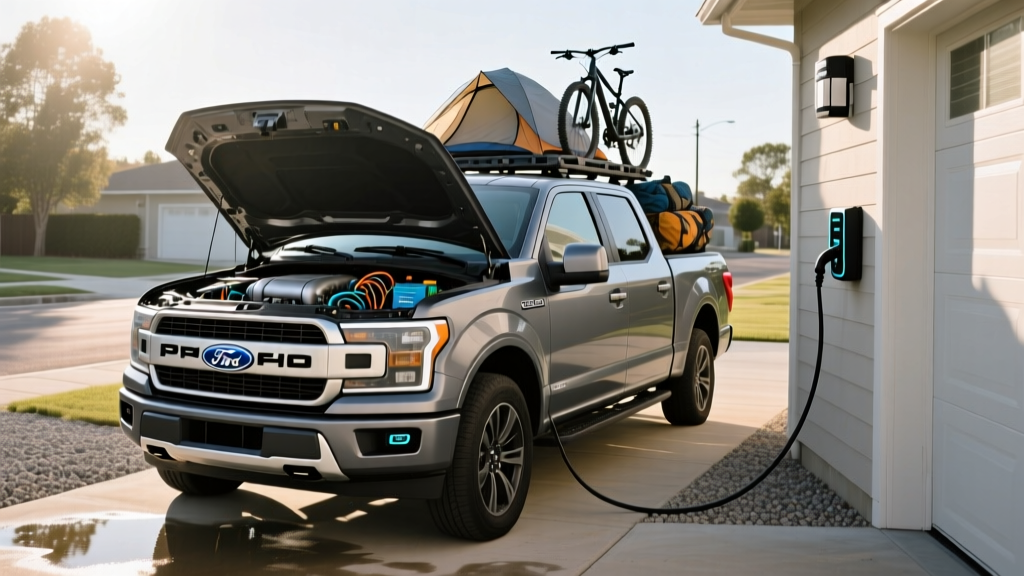
One of the PowerBoost's most compelling features isn't fuel economy — it's the available Pro Power Onboard system, which turns the truck into a mobile generator. The hybrid system's battery and inverter can deliver up to 7.2 kW of continuous AC power through bed-mounted 120V and 240V outlets.
That's enough to run:
- A job site with circular saws, compressors, and lights simultaneously
- A 30-amp RV hookup
- Essential home circuits during a power outage (refrigerator, furnace blower, lights, sump pump)
The engine will automatically start and stop as needed to maintain battery charge, and Ford estimates the system can run for up to 85 hours on a full tank at moderate load. For contractors, campers, and anyone in an area with unreliable grid power, this feature alone can justify the hybrid premium.
Who Should Buy the F-150 PowerBoost Hybrid?
PowerBoost Is a Strong Fit For:
- Contractors and tradespeople who need onboard power (7.2 kW Pro Power) for job sites
- Heavy tow-payload users who need 12,700-lb max towing — more than the Lightning BEV offers
- Rural or apartment dwellers without access to home Level 2 charging
- Frequent long-distance travelers who don't want to plan around charging stops
- City-commuting truck owners who benefit most from hybrid regenerative braking (25+ MPG in stop-and-go)
Consider the Lightning BEV Instead If:
- You have home Level 2 charging and daily drives under 250 miles
- You want the lowest per-mile fuel cost (~$0.05/mi vs ~$0.14/mi)
- You qualify for the $7,500 federal tax credit (effectively reducing Lightning cost)
- You prioritize instant torque, one-pedal driving, and near-silent operation
- You rarely tow above 8,000 lbs
Frequently Asked Questions
How many MPG does the F-150 PowerBoost hybrid get?
The EPA rates the 2026 F-150 PowerBoost 4x4 at 23 city / 24 highway / 24 combined MPG. The 4x2 version achieves 25/26/25 MPG. Real-world results vary: city-heavy drivers often see 25-27 MPG in 4WD, while sustained highway driving at 75+ mph yields 21-23 MPG. Towing drops economy to 10-14 MPG depending on load.
Does the F-150 PowerBoost need to be plugged in?
No. The PowerBoost is a conventional hybrid (HEV). It charges its 1.5 kWh battery through regenerative braking and the gasoline engine. You never plug it in — just fill up at the gas station as you would with any other truck.
How far can the F-150 PowerBoost drive on electric only?
Essentially zero meaningful distance. The PowerBoost can creep at very low speeds (parking lots) on electric power alone for a few hundred feet, but it is not designed for electric-only driving. This is not a plug-in hybrid (PHEV) — it has no electric-only range rating.
Is the F-150 PowerBoost hybrid reliable?
The PowerBoost system has been in production since 2021, and Ford's hybrid components have proven durable in fleet and owner use. The 3.5L EcoBoost engine is a well-established design. Ford backs the hybrid battery and system with an 8-year / 100,000-mile warranty (10 years / 150,000 miles in CARB states). As with any turbocharged engine, following oil change intervals is important for long-term reliability.
What does a PowerBoost hybrid battery replacement cost?
If the 1.5 kWh hybrid battery needs replacement out of warranty, expect to pay approximately $2,500-$4,000 at a Ford dealership. This is far less than an EV battery replacement because the pack is small. Remanufactured and aftermarket options may become available as earlier PowerBoost trucks age.
Does the F-150 PowerBoost qualify for a federal tax credit?
No. Under IRS §30D rules, only plug-in vehicles (BEVs and PHEVs) qualify for the federal Clean Vehicle Credit. The PowerBoost is a conventional hybrid with no plug-in capability and a battery below the 4 kWh threshold. The F-150 Lightning BEV may qualify for up to $7,500, subject to buyer income limits, MSRP caps, and battery sourcing requirements.
How does the PowerBoost compare to the 3.5L EcoBoost non-hybrid?
The PowerBoost adds 30 hp and 70 lb-ft of torque versus the standard 3.5L EcoBoost (400 hp / 500 lb-ft), improves combined fuel economy by roughly 5 MPG, and adds Pro Power Onboard capability. The trade-off is a $3,000-$4,000 price premium and slightly more mechanical complexity. For most buyers who can afford the premium, the PowerBoost is the better version of the 3.5L V6.
Can the F-150 PowerBoost tow as much as the gas-only F-150?
Yes. The PowerBoost 4x2 achieves a maximum towing rating of 12,700 lbs when properly equipped — matching or exceeding most gas-only F-150 configurations. The hybrid system's additional torque actually benefits low-speed trailer launch and hill climbing. The F-150 Lightning BEV, by contrast, is rated for 10,000 lbs maximum.