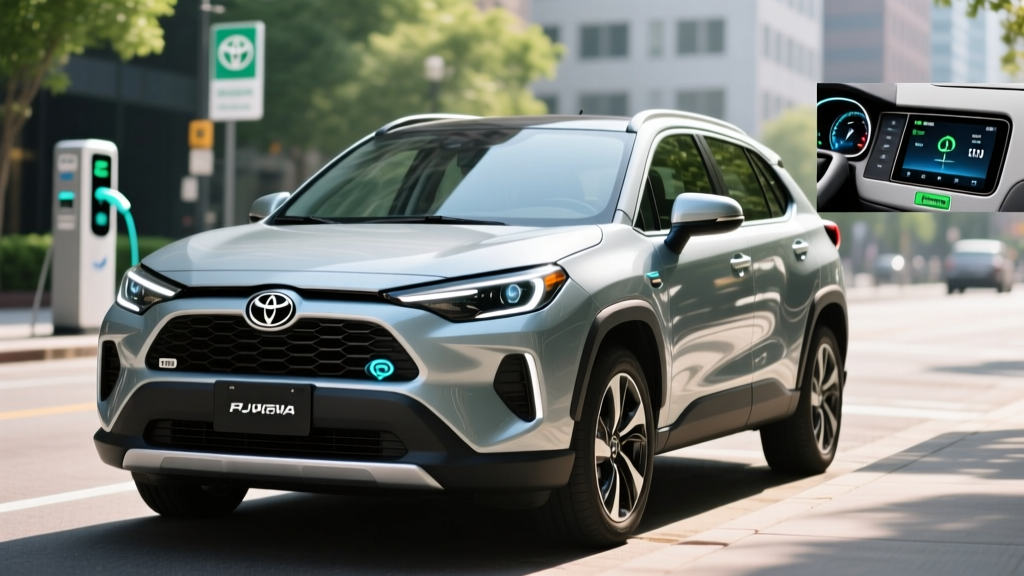
The 2026 Toyota Corolla Cross Hybrid occupies a specific niche: a compact crossover that delivers Prius-grade fuel economy without requiring a single change to your daily routine. No plugs, no range math, no charging apps. You fill it with gas and drive. For the 720 people searching for this model every month, the core question is whether Toyota's fifth-generation hybrid system in a taller, more practical package justifies its price premium over the gas-only Corolla Cross — or whether a full EV like the Hyundai Kona Electric makes more sense.
This guide breaks down the 2026 Corolla Cross Hybrid's real-world MPG, powertrain specs, ownership costs, battery longevity, and where it fits in the broader hybrid-versus-EV decision.
HEV vs PHEV: What the Corolla Cross Hybrid Actually Is
Before we get into the numbers, a critical distinction that trips up many shoppers:
Conventional Hybrid (HEV)
The 2026 Corolla Cross Hybrid is a self-charging hybrid (HEV). It has a small 1.3 kWh nickel-metal hydride (NiMH) traction battery that charges exclusively through regenerative braking and the gasoline engine. You never plug it in. There is no electric-only driving range to speak of — the electric motor assists the gas engine and enables brief low-speed electric creep, but the engine is always the primary power source.
Plug-In Hybrid (PHEV)
A PHEV like the Toyota RAV4 Prime carries a much larger battery (18.1 kWh) that you plug in to charge, delivering 42 miles of electric-only range before the gas engine engages. The Corolla Cross Hybrid is not a PHEV — Toyota does not offer a plug-in version of the Corolla Cross for 2026.
This matters because it sets expectations: you will not commute on electricity alone. What you get instead is seamless fuel reduction across every drive cycle, with the biggest gains in stop-and-go city traffic where regenerative braking works hardest.
Fuel Economy: EPA Ratings and Real-World MPG
The 2026 Corolla Cross Hybrid carries over the powertrain introduced with the 2023 refresh. All trims come with electronic all-wheel drive (AWD) as standard — there is no front-wheel-drive hybrid variant.
| Metric | EPA Rating |
|---|---|
| City MPG | 45 MPG |
| Highway MPG | 38 MPG |
| Combined MPG | 42 MPG |
| Fuel Tank Capacity | 10.6 gallons |
| Total Range (est.) | ~445 miles |
Source: EPA Fuel Economy
Real-World MPG vs. EPA Sticker
Toyota's hybrid system historically over-delivers in city driving. Owners routinely report 46–48 MPG in urban and suburban cycles where regen braking is frequent and engine load stays low. Highway driving at 75+ MPH, however, tends to drop efficiency to 35–37 MPG as aerodynamic drag overwhelms the hybrid system's advantages. In cold weather (below 30°F), expect a 3–5 MPG reduction due to increased engine runtime for cabin heat and battery conditioning. For mixed commuting, 42–44 MPG is a realistic year-round average.
Powertrain: 196 HP with Electronic AWD
The Corolla Cross Hybrid pairs a 2.0-liter four-cylinder Atkinson-cycle engine with two motor-generators through Toyota's fifth-generation Hybrid Synergy Drive. A third motor-generator powers the rear axle, providing electronic AWD without a mechanical driveshaft.
| Specification | Value |
|---|---|
| Engine | 2.0L 4-cylinder Atkinson-cycle |
| Net Combined Horsepower | 196 HP |
| Front Motor Output | 83 kW (111 HP) |
| Rear Motor Output | 30 kW (40 HP) |
| Traction Battery | 1.3 kWh NiMH (sealed) |
| Transmission | eCVT (planetary gearset) |
| Drivetrain | Electronic AWD (standard) |
| 0–60 MPH | ~7.5 seconds |
| Towing Capacity | Not rated for towing |
The 196 HP figure is a meaningful step up from the 169 HP gas-only Corolla Cross. In practice, the electric motor's instant torque fill eliminates the CVT drone typical of non-hybrid Toyota models during acceleration. The 0–60 time of approximately 7.5 seconds makes it genuinely quick for the segment — roughly 2.5 seconds faster than the gas model.
Trims, Pricing, and Tax Credit Eligibility
The 2026 Corolla Cross Hybrid is offered in three trims, all with standard AWD:
| Trim | MSRP (incl. destination) | Key Features |
|---|---|---|
| S | $29,990 | 8" touchscreen, TSS 3.0, 17" alloy wheels, LED headlights |
| SE | $31,490 | Sport-tuned suspension, SofTex seats, 18" wheels, roof rails |
| XSE | $33,990 | JBL 9-speaker audio, wireless CarPlay/Android Auto, heated front seats, power liftgate |
Federal Tax Credit: What You Need to Know
The Corolla Cross Hybrid does not qualify for the federal §30D Clean Vehicle Credit. Under current IRS rules, the §30D credit applies only to plug-in electric vehicles (BEVs and PHEVs) with a battery capacity of at least 7 kWh. The Corolla Cross Hybrid's 1.3 kWh NiMH battery falls far short of that threshold.
This is a deliberate trade-off: you sacrifice up to $7,500 in potential tax credits in exchange for a lower purchase price, no charging infrastructure requirement, and zero behavioral change. For buyers who cannot install a home charger or who drive in regions with sparse public charging, the math often favors the HEV.
Some states and utilities offer their own rebates for conventional hybrids, though these are typically $250–$500 and vary widely. Check your state energy office or utility provider for current programs.
Hybrid Battery Longevity, Warranty, and Replacement Cost
Battery anxiety is the single most common concern among first-time hybrid buyers. Here's what the data shows:
Battery Warranty Coverage
- Hybrid Battery: 10 years / 150,000 miles (whichever comes first) — covers capacity loss and defects
- Hybrid System Components: 8 years / 100,000 miles — includes inverter, motor-generators, eCVT
- Limited Powertrain: 5 years / 60,000 miles
California-emissions states (CA, CT, ME, MA, NJ, NY, OR, RI, VT, WA) may carry extended coverage — confirm with your dealer.
Toyota's NiMH hybrid batteries have an exceptional longevity record. Data from Prius fleets and consumer reports consistently show these batteries lasting 150,000–200,000+ miles with minimal degradation. Unlike the larger lithium-ion packs in EVs, the Corolla Cross Hybrid's small NiMH battery is never deeply cycled — the hybrid system keeps it between roughly 40% and 80% state of charge at all times, which dramatically extends cycle life.
If replacement is needed outside warranty, a new OEM hybrid battery runs approximately $2,500–$3,500 including labor. Refurbished/reconditioned units are available from $1,200–$2,000. Compare that to $8,000–$18,000 for an EV traction battery replacement — the risk profile is fundamentally different.
Corolla Cross Hybrid vs. Rivals: How It Stacks Up
| Model | Combined MPG | HP | AWD | Starting MSRP |
|---|---|---|---|---|
| Toyota Corolla Cross Hybrid | 42 MPG | 196 | Standard | $29,990 |
| Honda HR-V (gas only) | 28 MPG | 158 | Optional | $26,400 |
| Subaru Crosstrek Hybrid (PHEV) | 35 MPG + 17 mi EV | 148 | Standard | $36,995 |
| Kia Seltos (gas only) | 29 MPG | 146 | Optional | $25,190 |
The Corolla Cross Hybrid's closest competitor on fuel economy doesn't exist in the compact crossover segment — no rival HEV crossover matches its 42 MPG combined. The Subaru Crosstrek Hybrid is a PHEV with electric-only range but costs $7,000 more and delivers lower hybrid-mode MPG. Gas-only rivals like the HR-V and Seltos are cheaper upfront but cost roughly $800–$1,000 more per year in fuel at 12,000 miles annually (assuming $3.40/gal regular).
Pros
- 42 MPG combined with standard AWD — best-in-segment efficiency
- 196 HP provides confident acceleration; 2.5 sec quicker than gas model
- No plug-in requirement; zero lifestyle adjustment needed
- Proven 5th-gen Toyota hybrid system with strong reliability record
- 10-year/150,000-mile hybrid battery warranty
- Toyota Safety Sense 3.0 standard on all trims
Cons
- No federal tax credit eligibility (§30D requires 7+ kWh battery)
- Cargo space slightly reduced vs. gas model (battery placement): ~25 cu ft rear seats up
- Highway MPG drops to 35–37 at sustained 75+ MPH speeds
- Not rated for towing (even light utility trailers)
- XSE trim pushes past $34,000, approaching RAV4 Hybrid territory
- Infotainment interface lags behind Hyundai/Kia competitors
Who Should Buy the Corolla Cross Hybrid — and Who Shouldn't
Choose the Corolla Cross Hybrid If:
- You rent or live somewhere you cannot install a Level 2 home charger
- Your daily commute is 15–40 miles of mixed city/highway driving
- You want AWD for snow/rain without the fuel penalty of a gas AWD crossover
- You plan to own the vehicle 8–12 years and want proven hybrid reliability
- You drive 12,000–18,000 miles per year (high mileage maximizes fuel savings)
Choose a Full EV (e.g., Hyundai Kona Electric, Chevrolet Equinox EV) If:
- You can install a Level 2 charger at home and want $0 gas spend
- Your daily driving stays under 200 miles round-trip
- You want the $7,500 federal tax credit (on qualifying models) and lower per-mile energy cost
- You prioritize instant torque, one-pedal driving, and zero tailpipe emissions
Choose the Gas-Only Corolla Cross If:
- Your annual mileage is under 8,000 miles (hybrid premium won't pay back)
- You need maximum cargo space and the lowest possible purchase price
- You plan to sell or trade within 3 years
The Payback Math
The Corolla Cross Hybrid S starts at $29,990 versus the gas-only Corolla Cross LE at $25,060 — a $4,930 premium. At 12,000 miles/year, the hybrid saves roughly $750/year in fuel (42 MPG vs. 28 MPG combined, $3.40/gal). That's a payback period of approximately 6.5 years on fuel savings alone. Factor in potentially higher resale value for the hybrid and the gap narrows further. If you drive 15,000+ miles annually, payback drops to roughly 5 years.
Frequently Asked Questions
How many MPG does the 2026 Corolla Cross Hybrid get?
The EPA rates it at 45 city / 38 highway / 42 combined MPG. In real-world driving, expect 46–48 MPG in city conditions and 35–37 MPG at sustained highway speeds above 75 MPH. Cold weather reduces efficiency by roughly 3–5 MPG.
Can I plug in the Corolla Cross Hybrid to charge it?
No. The Corolla Cross Hybrid is a conventional (self-charging) hybrid, not a plug-in hybrid. Its 1.3 kWh battery charges through regenerative braking and the gasoline engine. There is no charge port and no electric-only driving range.
Does the Corolla Cross Hybrid qualify for any tax credit?
It does not qualify for the federal §30D Clean Vehicle Credit, which requires a plug-in vehicle with at least 7 kWh of battery capacity. Some states or utilities may offer small rebates for hybrids — check your local programs. The IRS Clean Vehicle Credit page has the full eligibility rules.
Is the Corolla Cross Hybrid reliable, and what does a battery replacement cost?
Toyota's hybrid system is among the most proven in the industry, with decades of Prius data showing 150,000–200,000+ mile battery life under normal use. The hybrid battery is warrantied for 10 years/150,000 miles. Out-of-warranty replacement costs $2,500–$3,500 for a new OEM unit, or $1,200–$2,000 for a refurbished pack. Toyota's warranty documentation provides full coverage details.
How does the Corolla Cross Hybrid compare to the RAV4 Hybrid?
The RAV4 Hybrid offers more interior space (37.5 cu ft cargo vs. ~25 cu ft), a higher tow rating (1,750 lbs), and similar MPG (39 combined). However, the RAV4 Hybrid starts around $34,500 — roughly $4,500 more than the Corolla Cross Hybrid S. If you don't need the extra room or tow capacity, the Corolla Cross Hybrid is the more efficient and affordable choice.
Does the Corolla Cross Hybrid have AWD?
Yes. All 2026 Corolla Cross Hybrid trims come with electronic AWD as standard equipment. A dedicated rear motor-generator provides torque to the rear axle during acceleration and low-traction conditions. There is no FWD-only hybrid variant.
What is the total driving range on a full tank?
With a 10.6-gallon fuel tank and 42 MPG combined, expect approximately 445 miles of total range. In predominantly city driving at 46 MPG, range can stretch to nearly 490 miles. Highway-heavy trips at 36 MPG reduce range to roughly 380 miles.
Specifications and pricing reflect 2026 model-year data as published by Toyota Motor North America. EPA estimates from fueleconomy.gov. Tax credit rules per IRS §30D. Always verify current pricing, incentives, and eligibility with your dealer and tax professional before purchasing.