Quick Verdict: The Accord Hybrid Sport in 2026
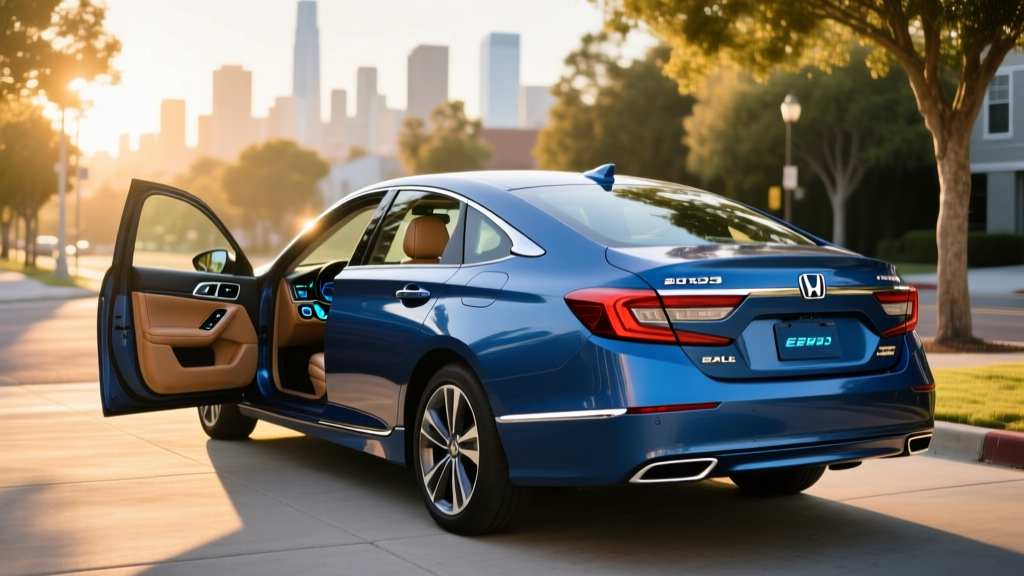
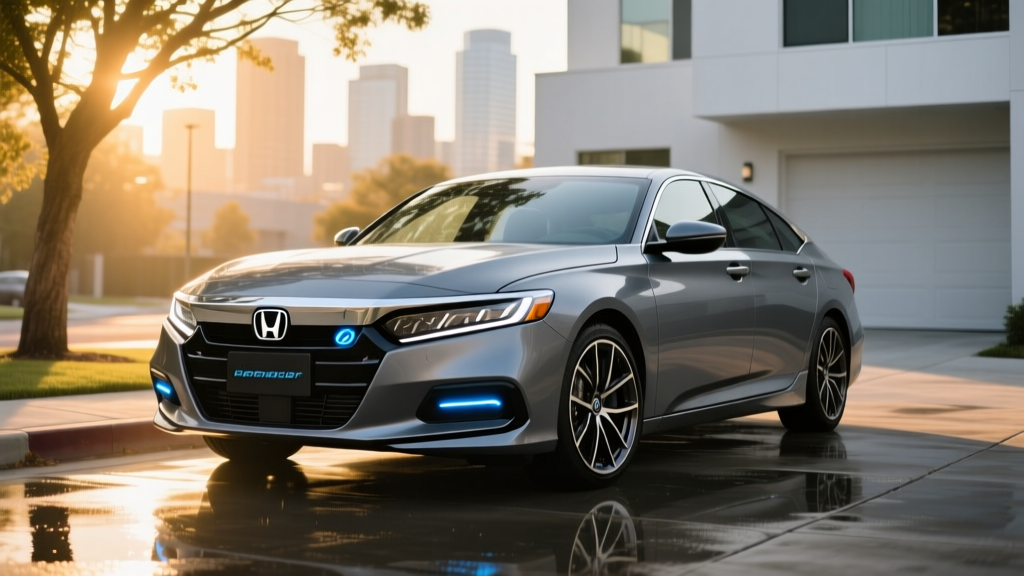
The 2026 Honda Accord Hybrid Sport occupies a precise niche: a midsize sedan that delivers genuine fuel savings without requiring you to change a single habit. You never plug it in. You never plan around charging stations. You just fill up at the same gas station you always have — but roughly half as often. Honda's two-motor hybrid system, now in its fourth generation on the Accord platform, pairs a 2.0-liter Atkinson-cycle engine with dual electric motors for a combined 204 horsepower and an EPA-estimated 48 MPG combined. The Sport trim adds blacked-out styling, 19-inch wheels, and paddle-mounted regen selectors without the price premium of the top-tier Touring.
This is a conventional hybrid electric vehicle (HEV), not a plug-in hybrid (PHEV). That distinction matters enormously for buyers cross-shopping against models like the Toyota Prius Prime or Hyundai Tucson PHEV. The Accord Hybrid does not offer electric-only driving beyond brief low-speed assist, and it does not qualify for the federal §30D clean vehicle credit. What it does offer is exceptional efficiency, Honda's proven hybrid reliability record, and a starting MSRP around $34,395 that undercuts most PHEV competitors by thousands.
HEV vs PHEV: What the Accord Hybrid Actually Is
| Feature | 2026 Accord Hybrid (HEV) | Typical PHEV (e.g., Prius Prime) | Battery Electric (BEV) |
|---|---|---|---|
| Plug-in required? | No — regenerative braking charges battery | Yes — Level 1 or Level 2 | Yes — Level 2 or DC fast |
| Electric-only range | None (motor assists engine) | 25–44 miles | 250–400+ miles |
| Total range | ~580 miles (12.8-gal tank) | ~400–600 miles combined | 250–400+ miles |
| Battery size | ~1.3 kWh (small buffer) | 13–18 kWh usable | 60–100+ kWh |
| Federal tax credit | Not eligible | Up to $7,500 (if eligible) | Up to $7,500 (if eligible) |
| Best for | No home charging access; long commutes | Short commutes + home charger | Home charging + mostly electric |
Honda's hybrid system in the Accord uses a small lithium-ion battery pack (approximately 1.3 kWh total capacity) that you never think about. The system captures energy during braking and deceleration, stores it briefly, then deploys it to assist acceleration or power low-speed crawling. The engine shuts off at stops and can disconnect entirely at highway cruise under light loads. The result is a car that behaves exactly like a normal Accord sedan — smooth, quiet, composed — while sipping fuel at a rate that would make a subcompact jealous.
Fuel Economy: EPA Ratings and Real-World MPG
| Metric | EPA Estimate | Real-World Expectation |
|---|---|---|
| City | 51 MPG | 48–55 MPG (hybrids often beat EPA in city) |
| Highway | 44 MPG | 39–44 MPG (less regen benefit at steady speed) |
| Combined | 48 MPG | 44–50 MPG depending on driving mix |
| Annual fuel cost* | ~$1,200 | Varies by local gas price and mileage |
| Cost per mile | ~$0.08 | Based on $3.50/gal national average |
*Based on 15,000 miles/year, 55% city driving, and $3.50/gallon regular unleaded. Source: fueleconomy.gov.
The Accord Hybrid Sport's 12.8-gallon fuel tank yields a practical range of approximately 550–620 miles between fill-ups depending on your driving pattern. For a 40-mile daily round-trip commute, that means visiting the gas station roughly once every two weeks.
Powertrain and Performance Specifications
| Specification | 2026 Accord Hybrid Sport |
|---|---|
| Engine | 2.0L DOHC Atkinson-cycle 4-cylinder |
| Engine output | 146 hp / 134 lb-ft torque |
| Drive motors | Dual electric motors (propulsion + generation) |
| Motor output | 184 hp / 247 lb-ft torque |
| Combined system output | 204 hp / 247 lb-ft torque |
| Transmission | Direct-drive (no traditional CVT or gears) |
| 0–60 mph | ~7.2 seconds |
| Drivetrain | Front-wheel drive |
| Curb weight | ~3,477 lbs |
| Battery type | Lithium-ion, ~1.3 kWh |
| Regen control | Steering wheel paddle selectors (4 levels) |
Honda's e:HEV-style two-motor system operates differently from the planetary-gear setups found in older Toyota hybrids. In most driving conditions, the propulsion motor drives the wheels directly while the engine spins a separate generator motor to produce electricity. At higher highway speeds, a lock-up clutch connects the engine directly to the wheels for efficiency. The transition between modes is seamless — most drivers never notice which motor or combination is active.
The Sport trim's paddle selectors behind the steering wheel let you choose from four levels of regenerative braking intensity. Level 1 feels like mild engine braking; Level 4 provides strong deceleration that approaches one-pedal driving in stop-and-go traffic, though the car will not come to a complete stop without touching the brake pedal. This is a meaningful feature for hybrid newcomers who want to maximize energy recapture without the learning curve of full one-pedal operation.
Pricing, Trims, and Tax Credit Eligibility
The 2026 Honda Accord Hybrid is available in four trims. The Sport sits in the middle of the lineup:
- Sport: ~$34,395 MSRP — 19-inch black alloy wheels, black exterior accents, heated front seats, leather-wrapped steering wheel, wireless Apple CarPlay/Android Auto, Honda Sensing suite
- Sport-L: ~$36,045 MSRP — Adds leather-trimmed seats, heated rear seats, wireless phone charger
- EX-L: ~$36,695 MSRP — Chrome exterior accents, power moonroof, upgraded audio
- Touring: ~$40,695 MSRP — Bose 12-speaker audio, heated/ventilated front seats, heated steering wheel, low-speed braking control
The 2026 Honda Accord Hybrid is a conventional HEV, not a plug-in vehicle. Under current IRS §30D rules, the federal clean vehicle credit (up to $7,500) applies only to battery electric vehicles (BEVs) and plug-in hybrids (PHEVs) that meet battery capacity, critical mineral sourcing, MSRP caps, and buyer income limits. Conventional hybrids like the Accord do not qualify for §30D or the §25E used-vehicle credit.
However, some states and local utilities offer rebates or HOV lane access for hybrid vehicles. Check your state energy office and local utility for current programs. These vary significantly by jurisdiction and change frequently.
Without a federal credit, the Accord Hybrid Sport's value proposition rests on its low operating cost. Compared to a similarly equipped gas-only midsize sedan achieving 30 MPG combined, the Accord Hybrid saves approximately $450–$600 per year in fuel at 15,000 miles driven. Over a typical 5-year ownership period, that's $2,250–$3,000 in fuel savings — effectively offsetting much of the hybrid premium over a base gas-only Accord (if one were available, though Honda now offers the Accord exclusively as a hybrid in most trims for 2026).
Battery Warranty, Reliability, and Long-Term Costs
- Hybrid battery: 8 years / 100,000 miles (10 years / 150,000 miles in CARB states including CA, NY, MA, and others)
- Hybrid system components: 8 years / 100,000 miles
- Powertrain warranty: 5 years / 60,000 miles
- Limited vehicle warranty: 3 years / 36,000 miles
Honda covers the hybrid battery against capacity loss below a specified threshold (typically 60–70% of original capacity) for the full warranty period. Source: Honda's official warranty documentation.
The Accord Hybrid's small lithium-ion battery is far less stressed than the large packs in BEVs or PHEVs. It operates within a narrow state-of-charge window (roughly 40–80% SoC), never fully depletes, and never charges to 100%. This conservative management strategy is why Honda's hybrid batteries routinely last 150,000–200,000+ miles with minimal degradation. Third-generation Accord Hybrid owners (2018–2022 models) report excellent battery longevity, with very few replacements needed within the warranty period.
If a hybrid battery replacement is needed out of warranty, expect a cost of approximately $2,000–$4,000 for the battery pack plus labor at a Honda dealer. Independent hybrid specialists can often perform the same service for $1,500–$2,500. Refurbished or remanufactured packs are available for older models at lower cost. This is significantly less expensive than BEV battery replacements ($8,000–$20,000+) because the Accord's hybrid battery is small and simple.
Honda's reliability record for the Accord Hybrid is strong. The two-motor system has fewer moving parts than a conventional automatic transmission (no gear sets, torque converter, or clutch packs to wear). The engine operates under lighter loads than in a gas-only vehicle. IIHS has consistently rated the Accord highly for safety, and the hybrid variant carries identical crash-test performance.
Accord Hybrid Sport vs. the Alternatives
Where does the Accord Hybrid Sport fit among its direct competitors and adjacent electrified options?
- You lack home charging access (apartment, street parking) and cannot plug in
- Your commute involves heavy stop-and-go traffic where hybrids shine
- You want a spacious midsize sedan with 16.7 cu-ft trunk and 40.8" rear legroom
- You prefer proven reliability with a strong dealer network
- You want 48 MPG without changing any driving or fueling habits
- Budget matters — the Sport undercuts PHEVs by $4,000–$8,000
- You have home Level 2 charging and a short commute (PHEV eliminates most gas use)
- You want electric-only driving for silent, zero-tailpipe-emission neighborhood travel
- You qualify for the $7,500 federal credit (effectively making a PHEV cheaper than the Accord Hybrid)
- You drive fewer than 30 miles daily and want to rarely visit a gas station
- You want the lowest possible per-mile energy cost ($0.03–$0.05/mi on home electricity vs. $0.08/mi on gas)
| Vehicle | Type | EPA MPG/MPGe | EV Range | Starting MSRP | Federal Credit |
|---|---|---|---|---|---|
| 2026 Honda Accord Hybrid Sport | HEV | 48 combined | N/A | ~$34,395 | None |
| 2026 Toyota Camry Hybrid SE | HEV | 47 combined | N/A | ~$33,500 | None |
| 2026 Hyundai Sonata Hybrid SEL | HEV | 47 combined | N/A | ~$32,250 | None |
| 2026 Toyota Prius Prime SE | PHEV | 52 combined / 127 MPGe | 44 mi | ~$34,675 | Up to $7,500* |
| 2026 Hyundai Tucson PHEV SEL | PHEV | 35 combined / 80 MPGe | 33 mi | ~$38,725 | Up to $7,500* |
*Federal credit eligibility depends on buyer income, vehicle MSRP, battery sourcing requirements, and point-of-sale transfer rules under current IRS §30D guidelines. Verify at irs.gov before purchasing.
Interior, Technology, and Daily Usability
The Sport trim comes well-equipped for its price point. Standard features include a 10.2-inch digital instrument cluster with hybrid-specific energy flow displays, a 12.3-inch touchscreen infotainment system with wireless Apple CarPlay and Android Auto, a 6-speaker audio system, dual-zone automatic climate control, and the full Honda Sensing ADAS suite (adaptive cruise control, lane-keeping assist, collision mitigation braking, road departure mitigation, and traffic sign recognition).
Honda Sensing is an SAE Level 2 driver-assistance system — it provides steering and speed support but requires the driver to remain fully attentive with hands on the wheel and eyes on the road at all times. It is not autonomous driving and does not replace driver engagement.
Cargo space remains unaffected by the hybrid system: the battery is packaged beneath the rear seats, preserving the full 16.7 cubic feet of trunk volume. Rear-seat passengers get 40.8 inches of legroom. The Sport trim includes 60/40 split-folding rear seats for longer cargo. There is no frunk (front trunk), as the engine bay is fully occupied by the hybrid powertrain.
Frequently Asked Questions
How many MPG does the 2026 Honda Accord Hybrid Sport get?
The EPA rates the 2026 Accord Hybrid Sport at 51 MPG city, 44 MPG highway, and 48 MPG combined. In real-world driving, city-heavy commuters often achieve 50+ MPG thanks to regenerative braking, while highway-dominant drivers should expect 39–44 MPG. Cold weather and aggressive acceleration reduce these figures by 5–10%.
Does the Accord Hybrid need to be plugged in?
No. The Accord Hybrid is a conventional HEV that charges its small battery entirely through regenerative braking and engine-driven generation. You never plug it in. If you want plug-in capability with electric-only driving range, you would need a PHEV like the Toyota Prius Prime or a full BEV.
How far can the Accord Hybrid drive on electric power alone?
The Accord Hybrid cannot drive on electric power alone for any meaningful distance. The electric motor assists the gasoline engine during acceleration and can power the car at very low speeds (parking lots, brief coasting) for a few hundred yards, but the engine is the primary propulsion source at all times. This is by design — the 1.3 kWh battery is too small to sustain electric-only driving.
Is the Honda Accord Hybrid reliable, and what does a battery replacement cost?
Honda's hybrid system has demonstrated strong reliability over multiple generations. The hybrid battery is covered for 8 years/100,000 miles (10 years/150,000 miles in CARB states). Out-of-warranty battery replacements run $2,000–$4,000 at a dealer, or $1,500–$2,500 at independent hybrid specialists. Most Accord Hybrid batteries last 150,000+ miles without issue due to conservative charge management.
Does the 2026 Accord Hybrid qualify for any tax credits?
The Accord Hybrid does not qualify for the federal §30D clean vehicle credit, which is limited to plug-in vehicles (PHEVs and BEVs). Some state programs and local utilities offer modest hybrid incentives, but these vary widely. Check your state energy office for current programs. The lack of a federal credit is offset by the Accord Hybrid's lower MSRP compared to PHEV competitors and its strong fuel savings over time.
How does the Accord Hybrid compare to a full EV for total cost of ownership?
Over 5 years and 75,000 miles, the Accord Hybrid Sport costs approximately $6,000 in fuel (at $3.50/gal). A comparable BEV charged primarily at home ($0.14/kWh) would cost $2,500–$3,500 in electricity — a savings of $2,500–$3,500. However, the BEV's higher purchase price (often $5,000–$10,000 more before credits), potentially higher insurance premiums, and charging infrastructure needs may offset those savings. The Accord Hybrid is the lower-hassle, lower-upfront-cost choice; the BEV offers lower per-mile energy cost if you have home charging.
What maintenance does the Accord Hybrid require?
Standard maintenance: oil changes every 7,500–10,000 miles, tire rotations, brake fluid, cabin air filter, and transmission fluid (Honda's e-CV fluid) at recommended intervals. Brake pads typically last 80,000–100,000+ miles because regenerative braking handles most deceleration. There is no hybrid-specific maintenance beyond periodic system health checks included in standard service visits.