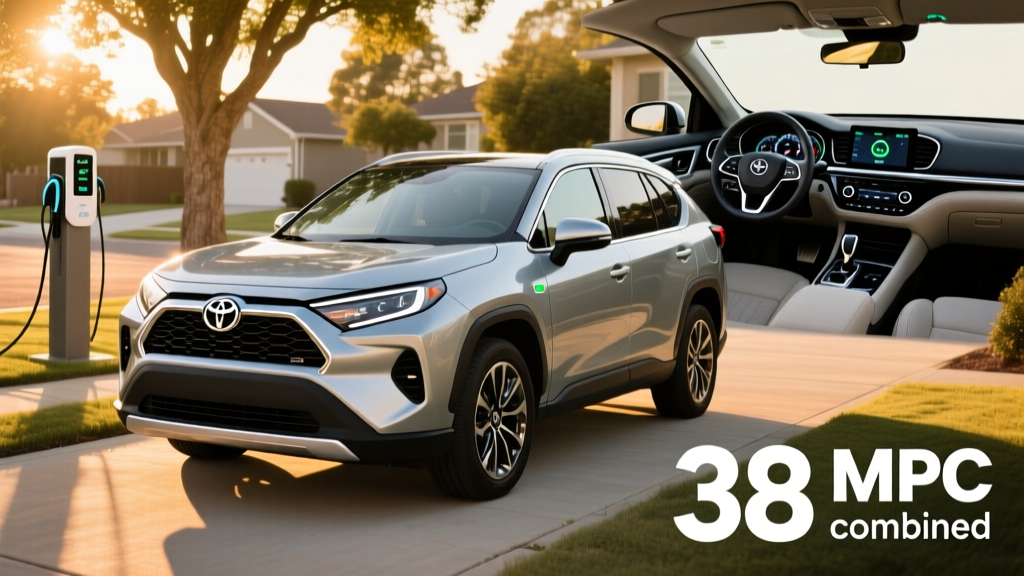
Quick Verdict: The 2023 RAV4 Hybrid Still Sets the Compact SUV Benchmark
Toyota sold over 100,000 RAV4 Hybrids in the U.S. for the 2023 model year, and the formula hasn't changed much since: a 2.5-liter four-cylinder paired with front and rear electric motors, standard all-wheel drive, and EPA fuel economy that routinely beats its sticker numbers in city driving. For buyers researching the 2023 RAV4 Hybrid — whether on the used market or comparing it to newer model years — the powertrain remains one of the most proven hybrid systems on the road.
This guide breaks down every efficiency figure, powertrain spec, battery-warranty detail, and ownership cost you need to evaluate the 2023 RAV4 Hybrid against a plug-in hybrid (PHEV) or a full battery-electric vehicle (BEV).
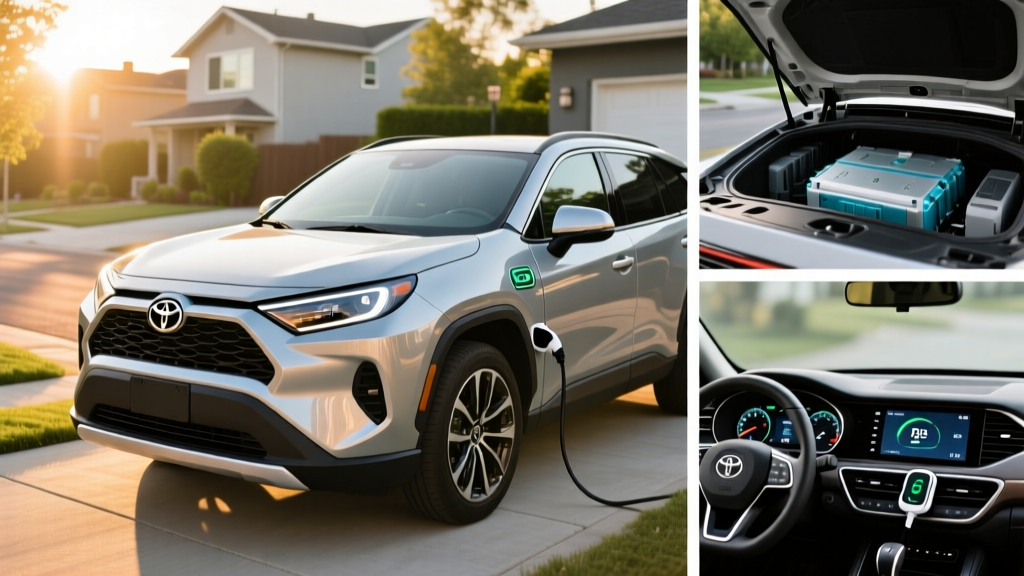
The 2023 RAV4 Hybrid is a conventional hybrid (HEV). It charges its small battery through regenerative braking and the gas engine — you never plug it in. The RAV4 Prime, by contrast, is a plug-in hybrid (PHEV) with a larger 18.1 kWh battery, 42 miles of electric-only range, and a charging port. We compare both below.
Fuel Economy: EPA MPG and Real-World Results
The EPA rates the 2023 RAV4 Hybrid across three trim configurations, and the numbers hold up well even years after release:
| Trim | City MPG | Highway MPG | Combined MPG | Annual Fuel Cost* |
|---|---|---|---|---|
| LE | 41 | 38 | 40 | $1,350 |
| XLE / XLE Premium | 41 | 38 | 40 | $1,350 |
| SE / XSE / Limited / Woodland | 41 | 38 | 40 | $1,350 |
*Based on 15,000 miles/year, 55% city driving, and $3.50/gallon regular unleaded. Source: fueleconomy.gov
Real-World MPG: Why City Drivers Often Beat the Sticker
Toyota's Hybrid Synergy Drive system recovers kinetic energy during braking and low-speed driving, which means the electric motor handles a disproportionate share of city mileage. In real-world ownership data aggregated by Fuelly, 2023 RAV4 Hybrid owners report an average of 38–43 MPG combined, with city-heavy commuters regularly seeing 43–45 MPG. Highway-only road trips at 75+ mph tend to drop to 34–36 MPG, since the electric motors contribute less at sustained high speed and the 2.5L engine carries the load.
Expect a 5–12% fuel-economy drop in freezing temperatures. The engine runs longer to heat the cabin and bring the catalytic converter to operating temperature, and battery efficiency dips in cold. Northern-climate owners commonly report 35–37 MPG combined in winter versus 41–43 MPG in summer.
Powertrain Specs: What Moves the RAV4 Hybrid
| Specification | Detail |
|---|---|
| Engine | 2.5L Dynamic Force 4-cylinder (176 hp, 163 lb-ft) |
| Front Electric Motor | Permanent-magnet synchronous (118 hp, 149 lb-ft) |
| Rear Electric Motor | Permanent-magnet synchronous (54 hp, 89 lb-ft) |
| Net Combined Horsepower | 219 hp |
| Transmission | eCVT (planetary gearset, no fixed gears) |
| Drivetrain | Electronic On-Demand AWD (standard all trims) |
| Hybrid Battery | 1.6 kWh nickel-metal hydride (NiMH) |
| 0–60 mph | 7.4 seconds |
| Towing Capacity | 1,750 lbs |
| Fuel Tank | 14.5 gallons (regular 87 octane) |
| Total Driving Range | ~580 miles (EPA combined) |
The eCVT is not a belt-driven continuously variable transmission like you'd find in a Subaru or Nissan. Toyota uses a planetary gearset that blends engine and motor power seamlessly — there are no rubber bands, no slipping belts, and far fewer wear components. This design is a major reason Toyota's hybrid powertrains consistently rank at the top of long-term reliability surveys.
RAV4 Hybrid vs. RAV4 Prime (PHEV): Which Powertrain Fits?
Toyota also offered the 2023 RAV4 Prime as a plug-in hybrid. Here's how the two stack up side by side:
| Attribute | RAV4 Hybrid (HEV) | RAV4 Prime (PHEV) |
|---|---|---|
| Powertrain Type | Conventional hybrid — no plug | Plug-in hybrid — charges via outlet |
| Combined Horsepower | 219 hp | 302 hp |
| Electric-Only Range | N/A (EV mode ~1 mile at low speed) | 42 miles (EPA) |
| Battery Capacity | 1.6 kWh (NiMH) | 18.1 kWh (lithium-ion) |
| Plug-In Charging | No | Yes — Level 1 (120V) or Level 2 (240V) |
| Level 2 Charge Time | N/A | ~2.5 hours (6.6 kW onboard charger) |
| DC Fast Charging | N/A | No — not supported |
| MPG (gas, after battery depleted) | 40 combined | 38 combined |
| MPGe (electric + gas) | N/A | 94 MPGe |
| 0–60 mph | 7.4 sec | 5.7 sec |
| Total Range (full tank + full battery) | ~580 miles | ~600 miles |
| Base MSRP (2023) | $30,600 (LE) | $43,090 (SE) |
| Federal Tax Credit (§30D) | Not eligible | Up to $7,500 (subject to eligibility) |
Who Should Choose Which?
Choose the RAV4 Hybrid (HEV) if: You want maximum simplicity — no charging cables, no home electrical upgrades, just fill up with gas and drive. Ideal for apartment dwellers without charging access, or drivers whose daily mileage far exceeds 42 miles.
Choose the RAV4 Prime (PHEV) if: You can install a Level 2 charger at home, your daily commute is under 42 miles round-trip, and you want to drive mostly on electricity while keeping gas for road trips. The $12,000+ price premium is partly offset by the federal tax credit and dramatically lower per-mile fuel cost on electric.
Consider a full BEV (like the Toyota bZ4X or Tesla Model Y) if: You have reliable home charging, your daily driving is under 250 miles, and you want zero tailpipe emissions and the lowest per-mile energy cost. Trade-offs include higher upfront pricing, cold-weather range loss, and dependence on public charging for road trips.
Battery Longevity, Warranty, and Replacement Costs
Hybrid battery lifespan is the single most common concern among first-time hybrid buyers. Here's what the data shows:
- Hybrid Battery: 10 years / 150,000 miles (whichever comes first) — transferable to subsequent owners
- Hybrid System Components: 8 years / 100,000 miles (inverter, transaxle, control module)
- Standard Powertrain: 5 years / 60,000 miles
Toyota extended its hybrid battery warranty from 8 years/100,000 miles to 10 years/150,000 miles starting with the 2020 model year. The 2023 RAV4 Hybrid is fully covered under the longer warranty. Source: Toyota Owner's Warranty Guide
How Long Do RAV4 Hybrid Batteries Actually Last?
Toyota's NiMH hybrid battery packs are among the most durable in the industry. Fleet data and owner reports show the majority of RAV4 Hybrid batteries last 150,000–200,000+ miles before significant degradation. The 1.6 kWh pack is small, and Toyota's battery management system keeps the state of charge in a conservative 40–80% window — the pack never fully charges or fully depletes, which dramatically extends cycle life.
If replacement is needed out of warranty, a new OEM NiMH hybrid battery for the RAV4 Hybrid costs approximately $2,000–$3,500 installed at a Toyota dealer. Independent hybrid specialists often offer refurbished packs for $1,000–$1,800 with a 1–3 year warranty. For context, this is far less than a full EV battery replacement, which can exceed $10,000–$20,000.
General Reliability
The 2023 RAV4 Hybrid carries a strong reliability record. Toyota's hybrid system has been in continuous production since the 1997 Prius, and the eCVT planetary gearset has no clutch packs, belts, or torque converters to fail. Consumer Reports consistently gives the RAV4 Hybrid above-average predicted reliability ratings, and the model earned an IIHS Top Safety Pick+ designation for 2023.
Pricing, Trims, and Tax Credit Eligibility
Because the 2023 model year is now available primarily on the used and certified pre-owned (CPO) market, pricing has shifted from original MSRP. Here's the landscape:
| Trim | Original MSRP | Typical CPO/Used Price (2026) |
|---|---|---|
| LE | $30,600 | $24,000–$27,500 |
| XLE | $32,100 | $25,500–$29,000 |
| XLE Premium | $34,600 | $27,500–$31,000 |
| SE | $34,400 | $27,000–$30,500 |
| XSE | $35,800 | $28,000–$32,000 |
| Limited | $38,900 | $30,000–$35,000 |
| Woodland Edition | $35,500 | $28,500–$33,000 |
Does the 2023 RAV4 Hybrid Qualify for Any Tax Credit?
No. The conventional RAV4 Hybrid (HEV) does not qualify for the federal §30D Clean Vehicle Credit. Under current IRS rules, only plug-in electric vehicles (BEVs and PHEVs) with sufficient battery capacity are eligible. Conventional hybrids that cannot be plugged in have never qualified for §30D.
If you're looking at the RAV4 Prime (PHEV) instead, it may qualify for up to $7,500 under §30D — but eligibility depends on several conditions:
- Buyer income caps: Modified AGI must not exceed $150,000 (single), $225,000 (head of household), or $300,000 (joint filing)
- MSRP cap: SUVs/vans must not exceed $80,000 (the RAV4 Prime clears this easily)
- Battery sourcing: Critical minerals and battery components must meet phased percentage thresholds from U.S. or FTA-partner countries — these thresholds tighten each year
- Point-of-sale transfer: Eligible buyers can transfer the credit to the dealer at purchase, reducing the purchase price directly
On the used market, a pre-owned RAV4 Prime may qualify for the Used Clean Vehicle Credit (up to $4,000 or 30% of sale price, whichever is less) if the vehicle is at least two model years old, priced under $25,000, and purchased from a licensed dealer. Check the latest IRS guidance before relying on this credit, as vehicle eligibility lists update frequently.
Some states offer additional incentives for PHEVs (California's CVRP, for example), but conventional hybrids generally do not qualify for state rebates either. Check your state's energy or DMV website for current programs.
5-Year Ownership Cost: RAV4 Hybrid vs. Gas-Only RAV4
The hybrid premium pays for itself through fuel savings. Here's a side-by-side comparison over 5 years and 75,000 miles:
| Cost Category | 2023 RAV4 Hybrid (AWD) | 2023 RAV4 Gas (AWD) |
|---|---|---|
| Purchase Price (LE, MSRP) | $30,600 | $29,600 |
| EPA Combined MPG | 40 | 28 |
| Fuel Cost (75K mi, $3.50/gal) | $6,563 | $9,375 |
| Fuel Savings vs. Gas | $2,812 saved with hybrid | |
| Estimated Maintenance (5 yr) | $2,200 | $2,400 |
| Insurance (avg. 5 yr) | $7,500 | $7,200 |
| Estimated 5-Yr Total (purchase + fuel + maint + insurance) | $46,863 | $48,575 |
The hybrid breaks even on its ~$1,000 price premium within roughly 18 months of average driving. Over 5 years, the hybrid saves approximately $1,700 in total ownership costs, and the gap widens further if gas prices rise. Note that the hybrid also benefits from regenerative braking, which extends brake pad life — many owners report original brake pads lasting 80,000+ miles.
Pros and Cons at a Glance
Pros
- 40 MPG combined — often exceeded in real city driving
- Standard AWD on every trim
- No plug-in charging required — zero lifestyle change
- 10-year/150,000-mile hybrid battery warranty
- Proven eCVT with no belt or clutch wear items
- Strong resale value and CPO demand
- Runs on regular 87-octane fuel
Cons
- No federal tax credit eligibility (HEV)
- Highway MPG drops to 34–36 at sustained 75+ mph
- Engine noise under hard acceleration (eCVT drone)
- 1,750-lb towing limit (lower than some turbo competitors)
- Infotainment system (Toyota Audio Multimedia) is functional but dated vs. rivals
- Cold-weather MPG penalty of 5–12%
Frequently Asked Questions
How many MPG does the 2023 RAV4 Hybrid actually get?
The EPA rates it at 41 city / 38 highway / 40 combined across all trims. In real-world driving, city-heavy commuters often see 43–45 MPG, while highway-only driving at 75+ mph drops to 34–36 MPG. Cold weather reduces these figures by 5–12%.
Does the RAV4 Hybrid need to be plugged in?
No. The 2023 RAV4 Hybrid is a conventional hybrid (HEV). Its 1.6 kWh battery charges through regenerative braking and the gas engine. You never plug it in. If you want plug-in capability, look at the RAV4 Prime (PHEV).
How far can the RAV4 Prime go on electric only?
The 2023 RAV4 Prime has an EPA-rated 42 miles of electric-only range on a full charge. After the battery depletes, it operates as a conventional hybrid at 38 MPG combined. Total range (full tank + full battery) is approximately 600 miles.
Is the 2023 RAV4 Hybrid reliable, and what does battery replacement cost?
Yes — Toyota's hybrid system is among the most reliable powertrains on the market, with the eCVT planetary gearset eliminating common failure points found in traditional automatics. The hybrid battery is warranted for 10 years/150,000 miles, and most packs last 150,000–200,000+ miles. If replacement is needed out of warranty, expect $2,000–$3,500 for a new OEM pack or $1,000–$1,800 for a refurbished unit.
Does the RAV4 Hybrid qualify for any federal tax credit?
No. The conventional RAV4 Hybrid (HEV) does not qualify for the §30D Clean Vehicle Credit — only plug-in vehicles (BEVs and PHEVs) are eligible. The RAV4 Prime PHEV may qualify for up to $7,500, subject to buyer income limits, battery sourcing requirements, and MSRP caps. A used RAV4 Prime purchased from a dealer for under $25,000 may qualify for the Used Clean Vehicle Credit of up to $4,000.
Hybrid vs. PHEV vs. full EV — which should I choose?
Choose the RAV4 Hybrid (HEV) if you want zero charging hassle, live in an apartment or lack home charging, or drive long distances regularly. Choose the RAV4 Prime (PHEV) if you can charge at home and your daily commute is under 42 miles — you'll drive mostly on electricity and save significantly on fuel. Choose a full BEV (like the Tesla Model Y or Hyundai Ioniq 5) if you want the lowest per-mile cost, zero tailpipe emissions, and have reliable home charging — but accept the trade-offs of cold-weather range loss and public charging dependence on road trips.