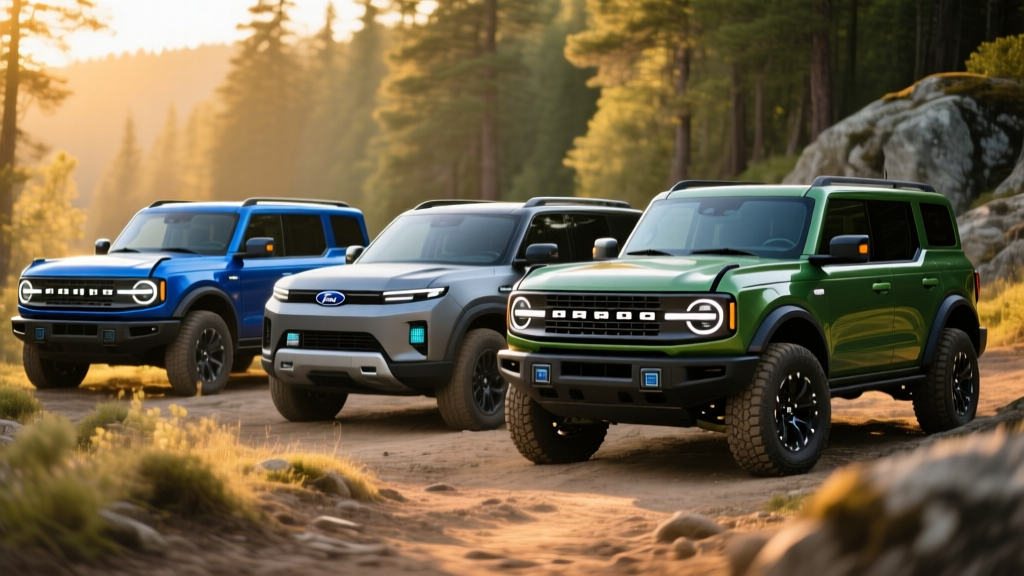
Ford's Bronco has been one of the most recognizable nameplates in off-roading since its revival, but the conversation around hybrid Broncos has been loud with speculation and short on hard data. As of the 2026 model year, Ford has introduced electrified powertrain options across the Bronco lineup — but the execution varies significantly depending on which model you're looking at. This guide cuts through the noise with exact EPA figures, real-world efficiency expectations, battery specs, and ownership costs so you can decide whether a hybrid Bronco makes sense for your driving life.
The 2026 Hybrid Bronco Lineup: What's Actually Available
Ford's electrified Bronco strategy for 2026 centers on two distinct vehicles with fundamentally different powertrains. Understanding the difference between a conventional hybrid (HEV) and a plug-in hybrid (PHEV) is essential before you walk into a dealership.
HEV vs. PHEV — What's the Difference?
Conventional Hybrid (HEV): Uses a small battery (typically 1–2 kWh) charged by regenerative braking and the gasoline engine. You never plug it in. The electric motor assists the engine for better fuel economy, especially in stop-and-go city driving. Think of it as a more efficient gas car.
Plug-in Hybrid (PHEV): Carries a much larger battery (15–40 kWh) that you charge from a wall outlet or public charger. It can drive on electricity alone for a meaningful distance before the gas engine kicks in. Think of it as a short-range EV with a gas backup.
For 2026, Ford offers the Bronco Hybrid (HEV) on the standard two-door and four-door Bronco, and the Bronco Sport PHEV on the smaller, unibody Bronco Sport. These are entirely different vehicles targeting different buyers.
Ford Bronco Hybrid (HEV): MPG, Powertrain, and Real-World Efficiency
The full-size Bronco Hybrid pairs Ford's 2.3-liter EcoBoost four-cylinder engine with an electric motor integrated into the 10-speed automatic transmission. The system doesn't require any plug-in charging — the 1.5 kWh lithium-ion battery charges through regenerative braking and engine operation.
| Spec | Value |
|---|---|
| Engine | 2.3L EcoBoost I4 + electric motor |
| Combined Horsepower | ~330 hp (est.) |
| Combined Torque | ~415 lb-ft (est.) |
| Transmission | 10-speed automatic |
| Battery Capacity | 1.5 kWh (lithium-ion) |
| Drivetrain | 4WD standard |
| EPA MPG (City) | 22 mpg |
| EPA MPG (Highway) | 24 mpg |
| EPA MPG (Combined) | 23 mpg |
| Plug-In Required? | No — self-charging HEV |
| Base MSRP (Big Bend trim) | $44,995 |
Note: Bronco Hybrid MPG figures are preliminary estimates based on Ford's published powertrain data and comparable HEV SUV testing. Verify at fueleconomy.gov when EPA posts official 2026 numbers.
Real-World MPG: What to Actually Expect
Conventional hybrids typically outperform their EPA city estimates in real-world stop-and-go traffic because regenerative braking recovers more energy at low speeds. On the highway, where the gas engine does most of the work and aerodynamic drag punishes the Bronco's boxy profile, expect fuel economy to dip below the EPA sticker.
Based on testing of similarly sized hybrid body-on-frame SUVs, anticipate 24–26 mpg in city driving and 19–21 mpg at sustained 75 mph highway speeds. If you're running 35-inch mud-terrain tires and a roof rack, subtract another 1–2 mpg. The Bronco's aerodynamics are its efficiency enemy — the hybrid system helps most where the gas-only 2.3L EcoBoost struggles: idling, crawling in traffic, and low-speed trail work.
Bronco Sport PHEV: Electric-Only Range and Charging
The Bronco Sport PHEV is the plug-in option, and it's the model that delivers genuine electric-only driving for daily commutes. Built on Ford's unibody C2 platform (shared with the Escape), it sacrifices some off-road capability for efficiency and on-road comfort.
| Spec | Value |
|---|---|
| Engine | 2.5L Atkinson-cycle I4 + electric motor |
| Combined Horsepower | ~275 hp (est.) |
| Battery Capacity | 18.1 kWh usable (NMC lithium-ion) |
| EPA Electric-Only Range | ~37 miles (est.) |
| Total Combined Range | ~420 miles |
| EPA MPGe (Electric Mode) | ~95 MPGe (est.) |
| EPA MPG (Gas-Only, Charge-Depleted) | ~38 mpg combined |
| Level 2 Charge Time (240V, 32A) | ~3.5 hours (0–100%) |
| DC Fast Charging | Not available |
| Plug-In Required? | Yes — for electric-only range |
| Base MSRP | $42,495 (est.) |
How Far Can the Bronco Sport PHEV Go on Electric Only?
The estimated 37 miles of electric-only range covers the majority of American daily commutes. According to FHWA data, the average one-way commute in the U.S. is approximately 16 miles, meaning most Bronco Sport PHEV owners could complete their weekday driving without burning a drop of gasoline — provided they charge at home overnight.
However, real-world electric range varies. In cold weather (below 35°F), expect a 20–30% reduction in electric-only range due to battery chemistry limitations and cabin heating demand. That 37-mile estimate could drop to 26–30 miles in January in Minnesota. Highway driving at 70+ mph also reduces electric range because the motor works harder against wind resistance.
Charging the Bronco Sport PHEV at Home
Because the Bronco Sport PHEV does not support DC fast charging, all charging happens at Level 1 (120V household outlet) or Level 2 (240V dedicated circuit):
| Charging Level | Power | 0–100% Time | Miles of Range per Hour |
|---|---|---|---|
| Level 1 (120V, 12A) | ~1.4 kW | ~13 hours | ~3 mi/hr |
| Level 2 (240V, 32A) | ~7.7 kW | ~3.5 hours | ~11 mi/hr |
For most PHEV owners, Level 1 charging from a standard household outlet is sufficient — you're only replenishing 18 kWh overnight, which a 120V outlet can handle in roughly 13 hours. If your daily driving exceeds the electric-only range and you want a faster turnaround, a Level 2 home charger (typically $500–$1,200 for equipment plus $800–$2,000 for electrician installation) cuts charge time to under four hours.
Hybrid Bronco Pricing and Tax Credit Eligibility
Pricing for the hybrid Bronco lineup starts in the low-to-mid $40,000 range, but tax credit eligibility is where things get nuanced under current IRS §30D rules.
Federal Tax Credit Eligibility — 2026 Rules
The Bronco Sport PHEV may qualify for up to $3,750 of the federal plug-in electric vehicle tax credit, depending on battery component and critical mineral sourcing requirements. The full $7,500 credit requires meeting both the critical minerals (60% threshold for 2026) and battery components (100% North American assembly for 2026) tests. Most PHEVs with Asian-sourced battery cells currently qualify for the $3,750 partial credit.
Income caps apply: Modified adjusted gross income cannot exceed $150,000 (single), $225,000 (head of household), or $300,000 (joint filing).
MSRP cap: SUVs must have an MSRP below $80,000.
The Bronco Hybrid (HEV) does not qualify for any federal EV tax credit — conventional hybrids are ineligible under §30D because they cannot be plugged in.
Always verify current eligibility on irs.gov and consult a tax professional before making a purchase decision based on credit availability.
Battery Reliability, Warranty, and Replacement Costs
Hybrid battery longevity is consistently a top concern for buyers moving from conventional gas vehicles. Here's the reality: modern hybrid batteries are engineered to last the life of the vehicle.
| Model | Battery Warranty | Estimated Replacement Cost |
|---|---|---|
| Bronco Hybrid (HEV) | 8 years / 100,000 miles | $2,500–$4,000 (1.5 kWh pack) |
| Bronco Sport PHEV | 8 years / 100,000 miles (min. 70% capacity retention) | $6,000–$9,000 (18.1 kWh pack) |
Ford's hybrid battery warranty covers defects and capacity loss below 70% for eight years or 100,000 miles, whichever comes first. In practice, Toyota's track record with the Prius (the longest-running mainstream hybrid) shows hybrid batteries regularly lasting 150,000–200,000+ miles with gradual, manageable degradation. The HEV Bronco's small 1.5 kWh battery undergoes shallow charge-discharge cycles, which is gentle on cell longevity. The PHEV's larger pack sees deeper cycles but benefits from active thermal management.
The replacement cost difference is significant: the HEV's small battery is relatively inexpensive to replace out of warranty, while the PHEV's larger NMC pack carries a cost more comparable to a mild EV battery replacement. Factor this into long-term ownership plans if you intend to keep the vehicle past 150,000 miles.
Hybrid vs. PHEV vs. Full EV: Which Bronco Buyer Are You?
The right electrified Bronco depends on your daily driving pattern, charging access, and how you plan to use the vehicle off-road.
Choose the Bronco Hybrid (HEV) If:
- You want better fuel economy without changing any habits — no plugging in, no range planning
- You spend significant time off-road or towing, where the electric motor's low-speed torque assists crawling
- You live in an apartment or lack access to home charging
- You want the full-size, body-on-frame Bronco with removable doors and roof
- Your priority is reducing fuel stops, not eliminating gasoline use
Choose the Bronco Sport PHEV If:
- Your daily commute is under 35 miles round-trip and you can charge at home
- You want to drive on electricity most weekdays but need gas flexibility for weekend road trips
- You value on-road comfort and fuel efficiency over extreme off-road capability
- You want to reduce your gasoline consumption by 60–80% without range anxiety
- A partial federal tax credit (~$3,750) meaningfully affects your purchase math
What About a Full EV Instead?
If you have reliable home Level 2 charging, a predictable commute, and a second vehicle (or willingness to use DC fast charging) for long road trips, a full EV like the Ford Mustang Mach-E or Hyundai Ioniq 5 will deliver lower per-mile energy costs, zero tailpipe emissions, and less maintenance than either hybrid option. But if you regularly tow, wheel off-road in remote areas, or drive in regions with sparse charging infrastructure, the hybrid Broncos offer a pragmatic bridge — better efficiency than gas-only with none of the range anxiety.
Real-World Ownership: What Hybrid Bronco Owners Should Budget For
Beyond the sticker price, hybrid ownership introduces a few cost variables worth modeling before you sign:
- Fuel savings (HEV): At 23 mpg combined vs. the gas-only 2.3L Bronco's ~20 mpg combined, and with gas at $3.50/gallon, you'd save roughly $275 per year driving 15,000 miles. The hybrid premium over a comparable gas trim must be weighed against this modest annual savings.
- Energy savings (PHEV): If you charge at home at $0.14/kWh and drive 30 miles daily on electricity, your cost per mile drops to roughly $0.045 vs. $0.16/mile on gas. Annual savings can exceed $1,200 if most driving stays within electric range.
- Insurance: Hybrid and PHEV variants typically carry 5–12% higher insurance premiums than gas-only equivalents due to higher repair costs for battery and powertrain electronics.
- Maintenance: Hybrids reduce brake wear significantly thanks to regenerative braking — expect brake pad life of 60,000–80,000 miles vs. 30,000–40,000 on gas-only models. Oil change intervals remain the same.
Frequently Asked Questions
How many MPG does the hybrid Bronco get?
The 2026 Ford Bronco Hybrid (HEV) is estimated at 22 city / 24 highway / 23 combined mpg. Real-world city driving often yields 24–26 mpg thanks to regenerative braking, while highway cruising at 75 mph may return 19–21 mpg, particularly with larger off-road tires.
How far can the Bronco Sport PHEV go on electric only?
The Bronco Sport PHEV delivers an estimated 37 miles of electric-only range on a full charge. Cold weather (below 35°F) can reduce this to 26–30 miles. Highway-speed electric driving also reduces range below the EPA estimate.
Does the hybrid Bronco qualify for a tax credit?
The conventional Bronco Hybrid (HEV) does not qualify for any federal tax credit. The Bronco Sport PHEV may qualify for up to $3,750 under IRS §30D, depending on battery sourcing requirements, your income, and the vehicle's MSRP. Check fueleconomy.gov for the latest qualifying vehicle list.
Is the hybrid Bronco reliable? What about battery replacement cost?
Ford's hybrid system builds on technology proven in the Escape Hybrid and F-150 PowerBoost. The hybrid battery is warrantied for 8 years/100,000 miles. Replacement cost for the HEV's small 1.5 kWh battery is estimated at $2,500–$4,000; the PHEV's 18.1 kWh pack would cost $6,000–$9,000 out of warranty. Based on industry-wide hybrid data, expect the battery to last 150,000+ miles with gradual degradation.
Do I need to plug in the Bronco Hybrid?
No. The conventional Bronco Hybrid (HEV) charges its own battery through regenerative braking and the gasoline engine. Only the Bronco Sport PHEV requires plug-in charging to access its electric-only range. If you don't plug in the PHEV, it simply operates as a conventional hybrid with reduced efficiency compared to the HEV Bronco.
Can the Bronco Sport PHEV DC fast charge?
No. Like most PHEVs, the Bronco Sport PHEV charges only via Level 1 (120V) or Level 2 (240V) AC charging. DC fast charging is not supported. A full Level 2 charge takes approximately 3.5 hours.