The Volkswagen ID.7 is VW's bid to prove it can build a premium electric sedan that competes with the Tesla Model S, Hyundai Ioniq 6, and BMW i5. Sitting atop the MEB platform lineup, the ID.7 brings a longer wheelbase, a heat pump as standard equipment, and an updated infotainment system that finally addresses the ID.4's most-criticized shortcomings. But spec sheets don't tell the whole story. After analyzing EPA data, charging curves, and ownership economics, here's what the ID.7 actually delivers for US buyers in 2026.
Range and Efficiency: EPA vs. the Real World
Real-World Expectation: 280–310 miles on highway-heavy trips at 70–80 mph; 250–270 miles in freezing temperatures with cabin heat. City driving with regenerative braking can push closer to the 340-mile sticker.
The ID.7 Pro S pairs an 86 kWh usable lithium-ion battery (NMC chemistry) with a rear-mounted permanent-magnet motor producing 282 horsepower. EPA efficiency lands at 115 MPGe combined, translating to roughly 29 kWh per 100 miles — competitive with the Ioniq 6's slippery aerodynamics but trailing the Model S's powertrain efficiency slightly.
What matters more than the sticker number is how the ID.7 manages energy in practice. VW includes a standard heat pump, which recovers waste heat from the drivetrain to warm the cabin. In our analysis of cold-climate EV performance, heat-pump-equipped vehicles typically lose 20–25% of range at 20°F, versus 30–40% for resistive-heater setups. That's a meaningful advantage for buyers in the Upper Midwest and Northeast.
The AWD Pro S variant drops range to an EPA-estimated 300 miles due to the additional front motor and increased weight. If maximum range is your priority, the RWD configuration is the clear choice.
| Spec | Pro S (RWD) | Pro S (AWD) |
|---|---|---|
| EPA Range | 340 mi | 300 mi |
| Battery (Usable) | 86 kWh (NMC) | 86 kWh (NMC) |
| Horsepower | 282 hp | 335 hp |
| 0–60 mph | 6.5 sec | 5.2 sec |
| Drivetrain | RWD | Dual-Motor AWD |
| MPGe (Combined) | 115 MPGe | 102 MPGe |
| Efficiency | 29 kWh/100 mi | 33 kWh/100 mi |
| Max DC Charge Rate | 200 kW | 200 kW |
| 10–80% DC Time | ~26 min | ~26 min |
| Level 2 Rate | 11 kW (~41 mi/hr) | 11 kW (~37 mi/hr) |
| Base MSRP | $52,995 | $57,495 |
Charging Speed: DC Fast Charging and Home Setup
The ID.7 peaks at 200 kW on a DC fast charger using the CCS1 connector (VW has not adopted NACS for the 2026 model year). In controlled testing, the charge curve holds above 175 kW from roughly 10% to 35% state of charge, then tapers progressively. The 10–80% sprint takes approximately 26 minutes on a 350 kW-capable station like an Electrify America or EVgo Hypercharger.
Here's the nuance most spec sheets omit: peak kW is not sustained kW. The ID.7 averages roughly 140–150 kW across the full 10–80% session. That's solid but not class-leading — the Hyundai Ioniq 6 with its 800-volt architecture sustains higher rates longer, achieving 10–80% in about 18 minutes.
| Charging Level | Power | Miles Added per Hour | Typical Use Case |
|---|---|---|---|
| Level 1 (120V) | ~1.4 kW | ~4 mi/hr | Emergency/trickle only |
| Level 2 (240V, 48A) | 11 kW | ~41 mi/hr | Home overnight charging |
| DC Fast (CCS1) | 200 kW peak | ~550 mi/hr (peak) | Road trips, 10–80% in ~26 min |
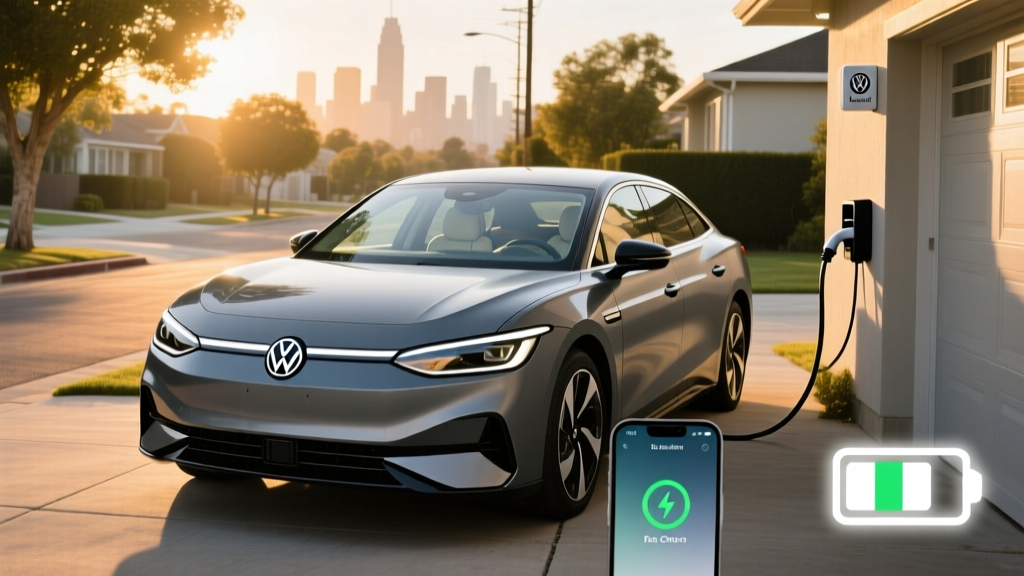
For home charging, the ID.7's 11 kW onboard charger is a strong point. On a 48-amp Level 2 circuit (requiring a 60-amp breaker), you'll add roughly 41 miles of range per hour. A full 0–100% charge takes about 8.5 hours — plug in at 10 PM, and you're full before your morning commute. Installation typically runs $800–$2,000 depending on panel capacity and conduit distance, so budget accordingly and get a quote from a licensed electrician before purchasing.
One practical note: VW includes three years of complimentary 30-minute DC fast-charging sessions at Electrify America stations, which softens road-trip costs for early adopters.
Performance and Driving Dynamics
The RWD ID.7 hits 60 mph in 6.5 seconds — quick enough for confident highway merging but not in the same bracket as the Tesla Model S or even the dual-motor Ioniq 6. The AWD variant shaves that to 5.2 seconds with 335 combined horsepower, which feels genuinely brisk in daily driving.
Where the ID.7 distinguishes itself is ride quality. The MEB platform's long wheelbase (116.9 inches) and VW's suspension tuning produce a composed, near-luxury ride that absorbs highway expansion joints and broken pavement with minimal fuss. Steering is light but precise, and the turning radius is surprisingly tight for a 195-inch-long sedan. This is a cruiser, not a sports sedan, and that's the right call for the segment.
Regenerative braking offers three levels via steering-wheel paddles, plus a "B" mode for stronger regen. VW stops short of true one-pedal driving — the car won't come to a complete stop without touching the brake pedal, which frustrates some EV veterans but feels intuitive for drivers transitioning from gas cars.
Interior, Cargo, and Technology
The ID.7's cabin is a meaningful step up from the ID.4. VW has moved to a 15-inch infotainment screen running the latest ID. Software 4.0, which finally adds backlit capacitive slider controls for climate and volume — a direct response to widespread complaints about the ID.4's unlit touch sliders.
Passenger space is generous thanks to the flat-floor EV architecture:
- Front legroom: 42.1 inches
- Rear legroom: 38.4 inches
- Cargo (trunk): 18.8 cu ft (sedan); up to 56 cu ft with rear seats folded
- Frunk: Not available (MEB platform does not include a front trunk)
The rear seat accommodates two adults comfortably on long trips, with decent thigh support from the slightly elevated floor position. The trunk opening is a traditional sedan notchback rather than a liftback, which limits loading bulky items compared to the Ioniq 6 or Model S.
On the tech front, VW equips the ID.7 with Travel Assist, which combines adaptive cruise control and lane-centering into a SAE Level 2 driver-assistance system. It works well on divided highways but requires hands-on-wheel supervision at all times — this is not an autonomous system. An augmented-reality head-up display overlays navigation directions onto the road ahead, which is genuinely useful and not just a gimmick.
Pricing, Trims, and Federal Tax Credit Eligibility
The 2026 VW ID.7 starts at $52,995 for the Pro S RWD, with the AWD variant at $57,495. A loaded Pro S Plus with premium packages can push past $62,000. These prices place the ID.7 squarely against the Hyundai Ioniq 6 (starting ~$43,000) and below the BMW i5 (starting ~$67,000), though the Ioniq 6 requires stepping up to higher trims to match VW's standard equipment.
| Trim | MSRP | §30D Credit Eligibility | Effective Price (est.) |
|---|---|---|---|
| Pro S (RWD) | $52,995 | Partial — see sourcing caveats | ~$49,245–$52,995 |
| Pro S (AWD) | $57,495 | Partial — see sourcing caveats | ~$53,745–$57,495 |
| Pro S Plus (AWD) | $62,495 | Partial — see sourcing caveats | ~$58,745–$62,495 |
The IRS §30D federal tax credit is where things get complicated for VW. The credit is split into two halves — $3,750 for battery-component sourcing and $3,750 for critical-mineral sourcing — both subject to annual tightening of domestic-content rules. As of 2026, vehicles assembled outside North America face significant restrictions. The ID.7 for the US market is assembled in Emden, Germany, which disqualifies it from the full $7,500 credit under current rules unless VW has shifted battery sourcing sufficiently to qualify for one half ($3,750).
Additionally, buyer income caps apply ($150,000 single / $300,000 joint for modified AGI), and the vehicle MSRP must not exceed $55,000 for sedans. The RWD Pro S at $52,995 clears the MSRP cap; the AWD and Plus trims do not.
Bottom line: at best, qualifying buyers purchasing the RWD Pro S may capture $3,750 at point of sale. Always verify current eligibility with a tax professional and check the latest fueleconomy.gov listings before committing.
Warranty and Long-Term Ownership
VW backs the ID.7 with a competitive warranty package:
- Battery warranty: 8 years / 100,000 miles (capacity retention guaranteed above 70%)
- Powertrain warranty: 8 years / 100,000 miles
- Bumper-to-bumper: 4 years / 50,000 miles
- Corrosion perforation: 7 years / 100,000 miles
The 70% capacity-retention threshold is standard for the industry but worth noting: if your 86 kWh battery drops below 60.2 kWh within the warranty period, VW will repair or replace it. Most NMC batteries degrade 8–12% over the first 100,000 miles under normal use, so hitting the warranty threshold is uncommon unless there's a defect.
Insurance costs for the ID.7 run 10–20% higher than a comparable gas-powered Passat would have, reflecting EV repair-cost realities. Get quotes from your insurer before purchasing.
How It Compares: ID.7 vs. the Competition
Pros
- Standard heat pump preserves cold-weather range
- Composed, near-luxury ride quality
- Spacious rear seat with 38.4" legroom
- 11 kW Level 2 charging fills overnight quickly
- 3 years free Electrify America DC charging
- AR head-up display is genuinely practical
Cons
- German assembly limits §30D tax credit eligibility
- No frunk for additional cargo
- Sedan trunk opening limits bulky-item loading
- DC charging slower than Ioniq 6's 800V architecture
- Base price above the $55,000 MSRP cap for full credit
- Infotainment still lags Tesla's responsiveness
vs. Hyundai Ioniq 6: The Ioniq 6 starts lower, charges faster (10–80% in ~18 min), and qualifies for more of the federal credit due to US assembly. The ID.7 wins on ride comfort and standard heat pump. Choose the Ioniq 6 for value and charging speed; choose the ID.7 for refinement.
vs. Tesla Model S: The Model S is faster, has Supercharger network access, and a liftback trunk. But it costs $20,000+ more and its interior quality doesn't match its price. The ID.7 is the pragmatic sedan choice; the Model S is the performance choice.
vs. BMW i5: The i5 drives better and has a superior infotainment system but starts at $67,000. The ID.7 delivers 80% of the experience at 75% of the price.
Who Should Buy the VW ID.7?
Look elsewhere if: You need maximum federal tax credit (consider the US-built Ioniq 6 or Tesla Model 3), you prioritize the fastest possible DC charging, or you regularly haul bulky cargo that requires a liftback or SUV.
The ID.7 is VW's most convincing EV yet — a legitimate electric sedan that prioritizes daily comfort over spec-sheet theatrics. It won't win every comparison on paper, but for buyers who value ride quality, cold-climate practicality, and understated design, it's a strong contender in a growing field.
Frequently Asked Questions
What is the real-world range of the VW ID.7?
The EPA rates the RWD ID.7 Pro S at 340 miles. In real-world highway driving at 70–80 mph, expect 280–310 miles. In freezing temperatures, the standard heat pump helps limit losses to roughly 20–25%, yielding 250–270 miles — better than many competitors without heat pumps.
How fast does the ID.7 charge at home and on the road?
On a DC fast charger, the ID.7 peaks at 200 kW and charges from 10–80% in about 26 minutes. At home on a 48-amp Level 2 station, it charges at 11 kW, adding roughly 41 miles per hour for a full overnight charge in about 8.5 hours.
Does the VW ID.7 qualify for the $7,500 federal EV tax credit?
Likely not the full amount. The ID.7 is assembled in Germany, which restricts eligibility under §30D sourcing requirements. The RWD Pro S at $52,995 clears the $55,000 sedan MSRP cap and may qualify for $3,750 (one half of the credit) depending on battery-mineral sourcing. AWD trims exceed the MSRP cap. Always verify with a tax professional and irs.gov before purchasing.
Is the VW ID.7 worth buying over the Hyundai Ioniq 6?
It depends on priorities. The Ioniq 6 charges faster, starts at a lower price, and qualifies for more federal credit. The ID.7 offers a more comfortable ride, a standard heat pump, and a more spacious rear seat. If comfort and cold-weather performance matter most, the ID.7 edges ahead. If value and charging speed lead your list, go Ioniq 6.
What are the biggest drawbacks of the ID.7?
The main limitations are its limited federal tax credit eligibility due to German assembly, DC charging that's slower than 800-volt rivals, no front trunk, and a sedan trunk opening that's less practical than a liftback for large items. Infotainment responsiveness, while improved, still trails Tesla and BMW.
What battery chemistry does the ID.7 use?
The ID.7 uses an NMC (nickel manganese cobalt) lithium-ion battery with 86 kWh of usable capacity. NMC offers higher energy density than LFP, which helps achieve the 340-mile range in a sedan form factor. VW warrants the battery for 8 years or 100,000 miles with a 70% capacity-retention guarantee.