If you've typed "buy a Tesla" into a search bar lately, you've already noticed something unusual: there are no dealerships, no haggling, and no finance manager trying to sell you paint protection. Tesla sells every vehicle directly through its website, and for the 2026 Model Y, that means a fixed MSRP, a non-refundable order fee, and a delivery timeline that can stretch from two weeks to two months depending on your region and configuration.
This guide walks through exactly what you're getting when you click "Order" on a 2026 Tesla Model Y — real-world range, charging behavior, tax-credit math, and the practical ownership picture that Tesla's configurator won't show you.
2026 Tesla Model Y: Quick Verdict
The 2026 Model Y remains the best-selling EV in the U.S. for good reason: it pairs competitive range, access to the Supercharger network (now the de facto standard via NACS), and a practical crossover footprint. The Juniper refresh brought a quieter cabin, a rear touchscreen for passengers, ventilated front seats, and ambient lighting — addressing the most common complaints about the pre-2025 interior. The trade-offs are still the panel-gap variability, the absence of traditional physical controls, and the reliance on a single-screen interface for everything from mirror adjustment to glovebox release.
For buyers purchasing online without a test drive, the Model Y is one of the safer blind buys in the EV market because the product is well-documented and the return policy (within 7 days or 1,000 miles, whichever comes first, subject to restocking terms) provides a limited safety net.
| Spec | Long Range RWD | Long Range AWD | Performance |
|---|---|---|---|
| EPA Range | 320 mi | 308 mi | 280 mi |
| Battery (usable) | ~78 kWh (NMC) | ~78 kWh (NMC) | ~78 kWh (NMC) |
| MPGe (combined) | 122 MPGe | 116 MPGe | 111 MPGe |
| Efficiency | 28 kWh/100 mi | 29 kWh/100 mi | 30 kWh/100 mi |
| 0–60 mph | 5.8 sec | 4.8 sec | 3.5 sec |
| Peak DC Charge Rate | 250 kW | 250 kW | 250 kW |
| 10–80% DCFC Time | ~27 min | ~27 min | ~27 min |
| Level 2 (11.5 kW AC) | ~44 mi/hr | ~44 mi/hr | ~44 mi/hr |
| Horsepower | 346 hp | 384 hp | 456 hp |
| Drivetrain | RWD | Dual Motor AWD | Dual Motor AWD |
| Base MSRP | $44,990 | $47,990 | $52,490 |
| Battery Warranty | 8 yr / 120,000 mi (70% retention) | ||
Real-World Range: What the EPA Sticker Doesn't Tell You
Real-World Expectation: 270–290 mi mixed driving; 240–260 mi sustained highway at 75 mph; 210–240 mi in freezing weather with cabin heat
The 2026 Model Y Long Range RWD carries an EPA-estimated 320 miles on a full charge. That number is achievable in moderate conditions with mixed city/highway driving and conservative speeds. Tesla's efficiency — roughly 28 kWh per 100 miles in the Long Range RWD — is among the best in the crossover segment, largely thanks to the heat pump (standard on all trims) and the heat-pump-integrated Octovalve thermal management system.
On sustained highway runs at 70–75 mph, expect to use about 30–32 kWh/100 mi, which drops effective range to roughly 250 miles before you'd want to stop. In winter conditions below freezing, cabin heating and battery conditioning can reduce range by 20–30%, putting realistic cold-weather highway range in the 210–240 mile band. Preconditioning the battery while plugged in (using Scheduled Departure in the app) mitigates some of this loss and is essential for preserving DC fast-charge speeds in cold weather.
The battery chemistry is NMC (nickel manganese cobalt), which offers higher energy density than LFP but is more sensitive to sustained 100% states of charge. Tesla recommends daily charging to 80–90% and reserving 100% for road trips. Over hundreds of cycles, this practice keeps degradation modest — typically 8–12% over the first 100,000 miles based on aggregated fleet data.
Charging Speed: DC Fast, Level 2, and the Supercharger Advantage
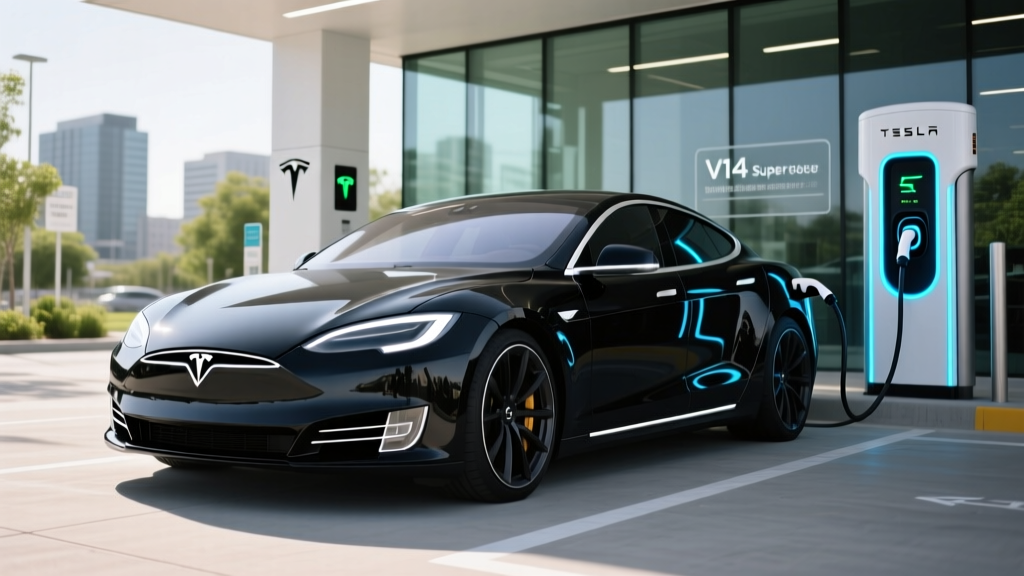
The 2026 Model Y peaks at 250 kW on a V3 or V4 Supercharger (or any CCS-capable station via the native NACS port). That peak is not sustained — the charge curve tapers meaningfully above 50% state of charge. Here's what the curve actually looks like in practice:
| Charging Level | Power | Speed | Notes |
|---|---|---|---|
| Level 1 (120V, 12A) | ~1.4 kW | ~3–4 mi/hr | Emergency/trickle only |
| Level 2 (240V, 48A Wall Connector) | 11.5 kW | ~44 mi/hr | Full charge in ~7–8 hrs |
| Level 2 (240V, 32A mobile connector) | 7.7 kW | ~30 mi/hr | Slower but adequate for most commutes |
| DC Fast (peak) | 250 kW | ~170 mi in 15 min | Requires preconditioned battery |
| DC Fast (10–80%) | Avg ~140 kW | ~27 min | Tapers hard above 80% |
The critical detail for road-trippers: that 10–80% time of roughly 27 minutes assumes the battery is preconditioned — either by navigating to a Supercharger in the car's built-in navigation (which triggers active thermal prep) or by driving for 30+ minutes in warm weather. Arrive at a charger with a cold, un-preconditioned battery and that same 10–80% session can stretch to 40+ minutes.
The native NACS port on the 2026 Model Y means no adapter is needed for Tesla Superchargers. For non-Tesla DC fast networks (Electrify America, EVgo), Tesla provides a CCS-to-NACS adapter in the glovebox or sells one separately. As of 2026, most major networks have begun deploying NACS-native cables, reducing adapter dependency.
Buying a Tesla Online: The Order-to-Delivery Process
Ordering through Tesla.com or the Tesla app is a fixed-price transaction. Here's the sequence:
- Configure: Select trim (Long Range RWD, Long Range AWD, or Performance), paint color, wheel size (19" or 20"), interior color, and optional Enhanced Autopilot or Full Self-Driving (Supervised).
- Order Fee: A non-refundable $250 order fee is charged to your credit card. This is not a deposit — it's a processing fee and will not be applied to your purchase price.
- VIN Assignment: Tesla assigns a VIN typically 1–3 weeks before delivery. This is when your delivery window firms up.
- Financing/Trade: You can arrange financing through Tesla's partner lenders, bring your own lender, or pay cash. Trade-in valuation is done through the app with photos and a questionnaire.
- Delivery: Most deliveries are "touchless" — you inspect the vehicle at a delivery center or via mobile delivery, sign digitally, and drive away. You have a limited window to report transport damage.
The entire process from order to delivery typically takes 2–8 weeks depending on trim, region, and inventory. Popular configurations (Long Range AWD in gray/black with 19" wheels) often have shorter lead times because Tesla produces them in higher volume.
Pricing, Tax Credits, and Total Cost
| Trim | Base MSRP | Destination | As-Configured (typical) | §30D Credit Eligible? |
|---|---|---|---|---|
| Long Range RWD | $44,990 | $1,390 | $46,380 | Yes (if MSRP < $80K cap) |
| Long Range AWD | $47,990 | $1,390 | $49,380 | Yes (if MSRP < $80K cap) |
| Performance | $52,490 | $1,390 | $54,880 | Yes (if MSRP < $80K cap) |
All 2026 Model Y trims fall under the IRS §30D MSRP cap of $80,000 for SUVs. However, the full $7,500 federal tax credit is not automatic. Eligibility depends on three buyer-side and vehicle-side requirements:
- Buyer income cap: Modified AGI must not exceed $150,000 (single), $225,000 (head of household), or $300,000 (joint) in the year of delivery or the prior year (whichever is lower).
- MSRP cap: Vehicle MSRP (before options, excluding destination) must be under $80,000. All Model Y trims qualify.
- Battery sourcing: The vehicle must meet critical mineral and battery component requirements that phase in annually. As of 2026, the sourcing thresholds are stringent, and Tesla's supply chain has adapted, but the exact credit amount ($3,750 or $7,500) depends on the specific VIN's battery provenance. Verify with your tax professional.
As of 2026, the §30D credit can be transferred to the dealer (Tesla) at point of sale, reducing your out-of-pocket cost directly rather than waiting for a tax refund. Tesla's checkout flow includes a credit-transfer election step.
Interior, Cargo, and Daily Practicality
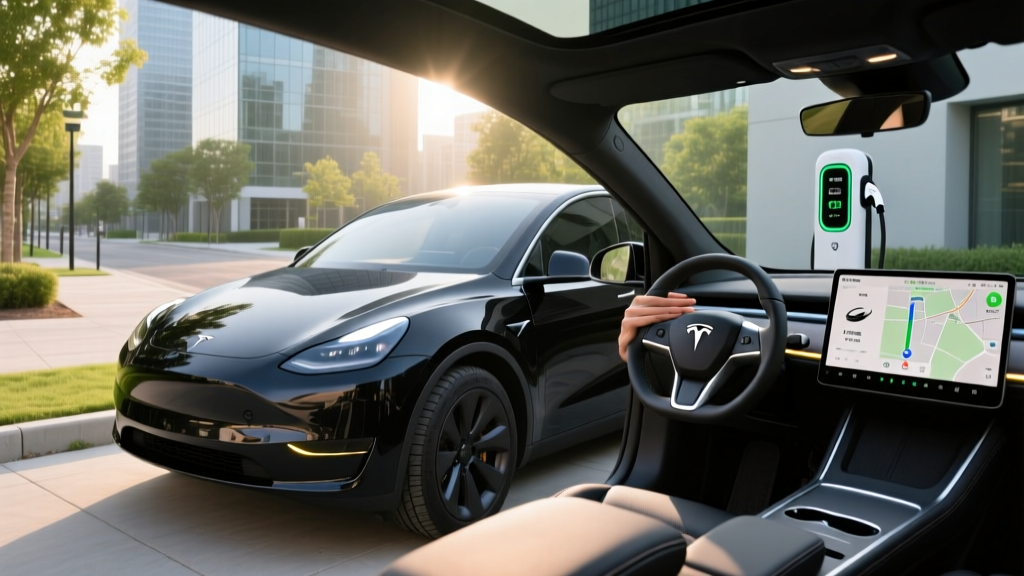
The Juniper-refreshed Model Y interior is noticeably more refined than the 2020–2024 generation. Ventilated front seats, a power-folding second row, ambient lighting, and a rear 8" touchscreen for passengers (climate, media, and gaming) bring it closer to premium-compact crossover expectations.
Cargo volume remains a strong point:
- Behind second row: 30.2 cu ft
- Second row folded: 72.1 cu ft
- Front trunk (frunk): 4.1 cu ft
- Rear legroom: 41.6 inches
- Front legroom: 41.8 inches
The flat load floor and hatchback design make the Model Y practical for bulky items — IKEA runs, camping gear, or a week's worth of groceries for a family of four. The frunk is small but useful for charging cables and emergency supplies.
The minimalist interior means zero physical buttons. Climate, mirrors, glovebox, wiper speed, and even the turn signal (on yoke-equipped models) are screen- or stalk-integrated. This is polarizing: some owners adapt within a week, others never fully warm to it. If you're buying online sight-unseen, plan for a learning curve.
Driver Assistance: Autopilot and FSD (Supervised)
Both Autopilot (standard) and Full Self-Driving Supervised ($8,000 option or $99/mo subscription) require continuous driver supervision. The driver must keep hands on the wheel and eyes on the road. These are not autonomous systems — they are advanced driver-assist features. Tesla's FSD (Supervised) can navigate highway interchanges, stop lights, and some city streets, but it makes errors that require human intervention. Treat it as a co-pilot, not a chauffeur.
Standard Autopilot includes Traffic-Aware Cruise Control and Autosteer (lane centering on marked highways). Enhanced Autopilot ($6,000) adds Navigate on Autopilot, Auto Lane Change, Autopark, and Summon. FSD (Supervised) adds city-street traffic-light and stop-sign recognition with automatic responses.
For most buyers, standard Autopilot is sufficient for highway commuting. The $8,000 FSD upgrade is a personal risk/reward calculation — it improves with each software release, but its current capabilities do not justify the price for every driver. The $99/month subscription is a reasonable way to trial it before committing.
Pros and Cons
- Class-leading Supercharger network access (17,000+ U.S. stalls)
- Excellent efficiency (28–30 kWh/100 mi)
- Over-the-air updates add features post-purchase
- Strong cargo space and flat load floor
- Fixed pricing — no dealer negotiation
- 8 yr / 120,000 mi battery warranty (70% retention threshold)
- Heat pump standard — good cold-weather efficiency
- No physical buttons — everything through the touchscreen
- Panel gap and paint quality variability
- FSD ($8K) remains Level 2, not autonomous
- Ride can be firm on 20" wheels
- No Apple CarPlay or Android Auto
- Insurance premiums often 20–40% above segment average
- Turn signal on yoke (if equipped) requires adaptation
Who Should Buy the 2026 Model Y?
Choose the Model Y if: You want a practical electric crossover with the most reliable DC fast-charging network, you value OTA software improvements, you need strong cargo capacity, and you're comfortable with a touchscreen-centric interface.
Consider competitors if: You prefer physical buttons and a more traditional cockpit (Hyundai Ioniq 5, Kia EV6), you need a more plush ride and quieter cabin at highway speeds (BMW iX), or you want a longer EPA range in a similarly priced package (Chevrolet Equus/Blazer EV, depending on trim).
The Model Y is best for: suburban commuters with home Level 2 charging, families of 3–4 who road-trip 2–4 times per year, and tech-forward buyers who want a vehicle that improves with software updates. It's less ideal for buyers who prioritize ride comfort over sportiness, those who want Apple CarPlay integration, or anyone who prefers the dealership experience for service and support.
Frequently Asked Questions
What is the real-world range of the 2026 Tesla Model Y?
The EPA rates the Long Range RWD at 320 miles, the Long Range AWD at 308 miles, and the Performance at 280 miles. In real-world mixed driving, expect 270–290 miles. Sustained highway driving at 75 mph drops that to 240–260 miles, and freezing-weather conditions can reduce range to 210–240 miles due to cabin heating and battery thermal demands.
How fast does the Model Y charge at home and on the road?
At home on a Tesla Wall Connector (240V, 48A), the Model Y charges at 11.5 kW, adding about 44 miles of range per hour — a full 10–80% session takes roughly 5 hours. On a DC fast charger, it peaks at 250 kW and charges from 10–80% in approximately 27 minutes with a preconditioned battery. Without preconditioning, expect 35–45 minutes for the same session.
Does the 2026 Model Y qualify for the $7,500 federal EV tax credit?
All Model Y trims are under the $80,000 MSRP cap for SUVs. However, the full $7,500 credit requires meeting buyer income limits ($150K single / $300K joint), battery critical-mineral and component sourcing thresholds, and VIN-specific eligibility. The credit can be transferred at point of sale to reduce your purchase price directly. Verify your eligibility with a tax professional and check the IRS's official guidance before ordering.
Is buying a Tesla online safe without a test drive?
Tesla offers a limited return window (typically 7 days or 1,000 miles) if the vehicle doesn't meet expectations, subject to mileage and condition terms. The fixed pricing eliminates negotiation risk, and the product is well-documented in reviews and owner forums. That said, you cannot test-drive before ordering — only after delivery. If the all-screen interface or firm ride concerns you, consider scheduling a ride-along with a current owner through Tesla's referral community or a local EV club before committing.
How does the Model Y compare to the Hyundai Ioniq 5 and Kia EV6?
The Ioniq 5 and EV6 offer 800V architecture (faster peak charging at 350 kW-capable chargers), physical buttons, Apple CarPlay/Android Auto, and a more comfortable ride. The Model Y counters with Supercharger network access, superior OTA updates, a more mature software ecosystem, and slightly better cargo volume. If DC fast-charging infrastructure reliability is your top priority, the Supercharger network still leads. If you want a more traditional driving experience and faster peak charging, the Korean platforms are strong alternatives.
What does the battery warranty cover?
Tesla covers the Model Y battery and drive unit for 8 years or 120,000 miles (whichever comes first) with a minimum 70% capacity retention threshold. If the battery degrades below 70% of its original capacity within that window, Tesla will repair or replace it. This is competitive with the segment standard (most rivals offer 8 yr / 100,000 mi). Real-world degradation data from fleet aggregators suggests most Model Y batteries retain 88–92% capacity at 100,000 miles when charged responsibly (daily limit of 80–90%).